



21 Christmas Bedroom Decor Ideas to Create a Cozy, Festive Holiday Retreat
Think about where the season really lands on you. It is rarely the hallway or the dining table. It is the last lamp you switch off at night and the first scene you blink at on a dark December morning, and that scene is almost always your bedroom. Yet most of us pour the tinsel into the living room and leave the bedroom looking as if it never got the memo.
Reader threads on r/ChristmasDecorating show the same hesitation again and again. Is it overboard? Will it feel cramped? What about the cat? One reader weighed up the effort rather neatly: roughly an hour to dress and fluff a pencil tree, set against a soft glow every single night, felt like money in the bank. That, in a nutshell, is the case for decorating the room where you sleep. The outlay is small and the payback turns up nightly.
Below you will find 21 ideas, from a five-minute pillow-cover swap to a full guest-room welcome, and none of them demand a bigger budget or a bigger room. They draw on fire-service statistics, veterinary guidance on festive plants, published sleep research and the questions people keep asking in the wild. Where an idea carries a catch, such as fairy lights, candles or a plant that disagrees with cats, the catch is spelled out right beside it. Prices quoted are recommended retail prices seen in November 2026 and may move.
Quick answer: how do you decorate a bedroom for Christmas?
Start with the bed, because it is the largest surface in the room. Add warm, low lighting on a timer, then one focal piece such as a slim tree, a garland over the headboard or a wreath. Keep to about three colours, favour fabrics and greenery over anything that plugs in, and switch lights off or put them on a timer before you sleep.
- Biggest impact for the least effort: a layered bed with a festive throw and pillow covers.
- Best lighting: warm white (around 2700K or lower) on a dimmer or timer.
- Best tree for tight spaces: a pencil tree for a corner, or a tabletop tree of 1.5 to 2 feet (about 45 to 60cm) for a surface.
- Safest scent: a linen or room spray rather than a lit candle.
- Easiest to store: pillow covers, ribbon, paper decorations and fresh greenery.
How this guide was put together, and how to use it

This guide began with a close reading of eight published Christmas bedroom roundups, to see what they gave readers and what they left out. The same gaps kept surfacing: very little about sleep, thin safety advice, almost nothing for cat owners, renters or small rooms, and few sums on what any of it costs. Those gaps shaped the pages that follow.
The practical advice leans on five sources:
- US fire-protection statistics from NFPA on trees, lights and candles.
- A peer-reviewed 2011 sleep study on evening light.
- Veterinary and poison-information guidance on festive plants.
- Named interior designers and lighting specialists, credited wherever they are quoted.
- Reader threads on r/ChristmasDecorating, used to find real-world worries and never as proof of anything.
Prices are retail prices seen in November 2026. Treat the safety notes as sound habits rather than guarantees: they do not replace a manufacturer’s instructions, your tenancy agreement or a qualified electrician’s advice. And you do not need all 21 ideas. Pick one from the bed, one from the lighting and one tree or garland, and you already have a complete scheme.
Why a little Christmas in the bedroom pays off
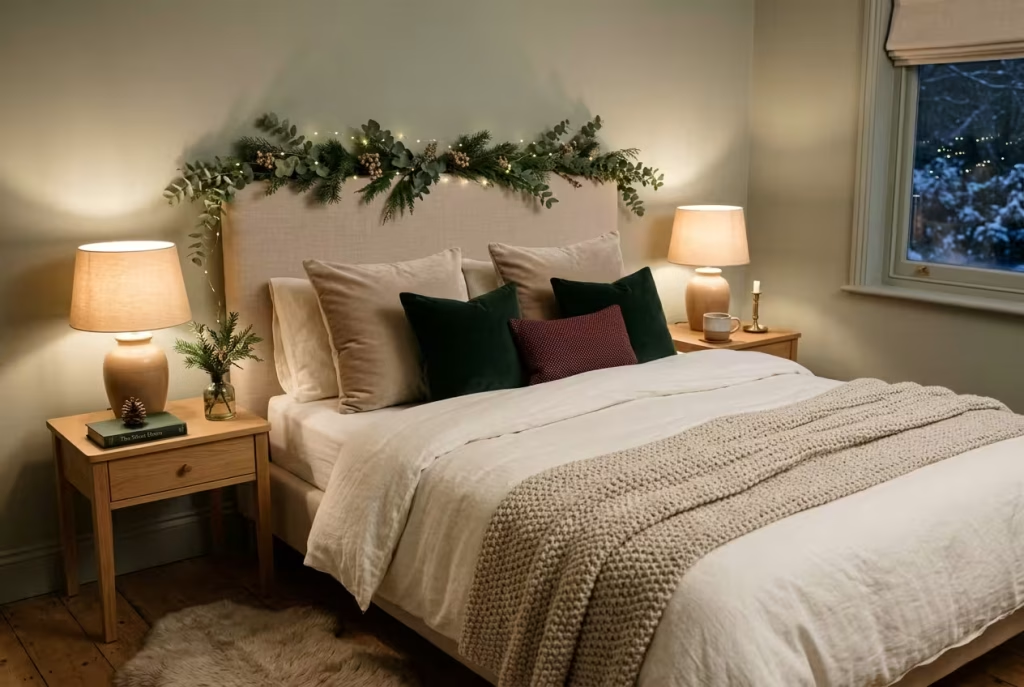
The bedroom is the one room with no audience. Nobody inspects it over the mince pies, so every choice can be made for you alone: the scent you like, the glow that suits your eyes, the stocking you longed for as a child. That freedom is rare at a season otherwise bent on pleasing everyone else.
Interior designer Anita Yokota describes holiday decorating as “emotional regulation through sensory design”, a tidy way of saying that colour, texture and light can calm us as well as cheer us. That is a designer’s view rather than a clinical finding, but it rings true in a bedroom, where every sense is already tuned to winding down.
There is a practical side too, and it deserves a straight look. In a widely cited 2011 study in the Journal of Clinical Endocrinology & Metabolism, researchers led by Joshua Gooley of Brigham and Women’s Hospital and Harvard Medical School followed 116 healthy volunteers aged 18 to 30 for five days. Those exposed to ordinary room light in the eight hours before bed had their melatonin production shortened by about 90 minutes compared with people kept in dim light, and light left on during sleep cut melatonin by more than half. The study tested standard room lighting rather than fairy lights, so nobody can promise that a string of bulbs will fix your sleep. The sensible takeaway is gentler: let the bedroom be the dimmest, warmest and calmest room in the house, and let the festive touches whisper rather than shout.
Mood matters as much as mechanics. One reader found that vintage multicoloured bulbs made the whole room feel heavy instead of fun, and fellow readers rescued the scheme by threading small white lights through the colour and adding cream bows and pearl garlands. Keep that lesson in your back pocket as you read on. A festive bedroom is a balancing act between sparkle and rest, and the best schemes lean towards rest.
Choose your palette before you buy a single bauble

Colour sets the mood long before the first ornament goes up, so settle it first. The table below pairs six popular schemes with the rooms they suit and the pitfall to dodge.
| Palette | Mood it creates | Works best with | Watch out for |
| Red, forest green and cream | Storybook and traditional | Dark wood, white bedding, brass | Looks busy if all three colours carry equal weight |
| Sage, ivory and champagne gold | Soft and hotel-calm | Painted walls, linen, pale rugs | Needs texture or it reads flat |
| Blue, white and silver | Frosty and airy | Pale blue or grey walls | Feels chilly under cool white bulbs, so choose warm ones |
| Charcoal, white and natural wood | Moody and modern | Dark walls, iron bedsteads | Add one pale note or the room swallows the light |
| Blush, cream and berry | Gentle and romantic | Neutral or pink rooms, velvet | Keep the berry deep, or it turns sugary |
| All white with one dark accent | Quiet and snowy | Small rooms, Scandi schemes | Without the dark accent it can look washed out |
A three-colour limit is the rule most designers fall back on. Repeat each shade at least twice, once on the bed and once higher up on a wreath, a garland or the curtains, so the eye travels around the room. If in doubt, let the bed lead and the rest follow.
Test the palette before you commit. Lay the duvet cover, curtains and rug together at dusk with the lamps switched on, then hold a bauble or a length of ribbon against them. Colour shifts under warm bulbs, and the red that looked perfect in the shop can turn orange or sulky in a room lit at 2700K.
The 21 ideas at a glance

Use this table to pick your starting points. Effort is our own estimate: Quick means roughly a quarter of an hour or less.
| # | Idea | Best for | Wire-free option | Effort |
| 1 | Layered bed | Every bedroom | Yes | Quick |
| 2 | Winter fabrics | Cold rooms, hot sleepers | Yes | Moderate |
| 3 | Tartan and heritage checks | Traditional rooms | Yes | Quick |
| 4 | Fairy lights | Headboards, curtain poles | Battery sets | Quick |
| 5 | Dimming and white lights | Moody or heavy rooms | Battery sets | Quick |
| 6 | Shelf, jar or sill glow | Renters, small rooms | Battery sets | Quick |
| 7 | Pencil tree | Corners | Rarely | Moderate |
| 8 | Tabletop tree | Chests of drawers | Battery models | Quick |
| 9 | Tree trio or story tree | Dressers, shelves | Battery models | Moderate |
| 10 | Bedside still life | Any bedside table | Yes | Quick |
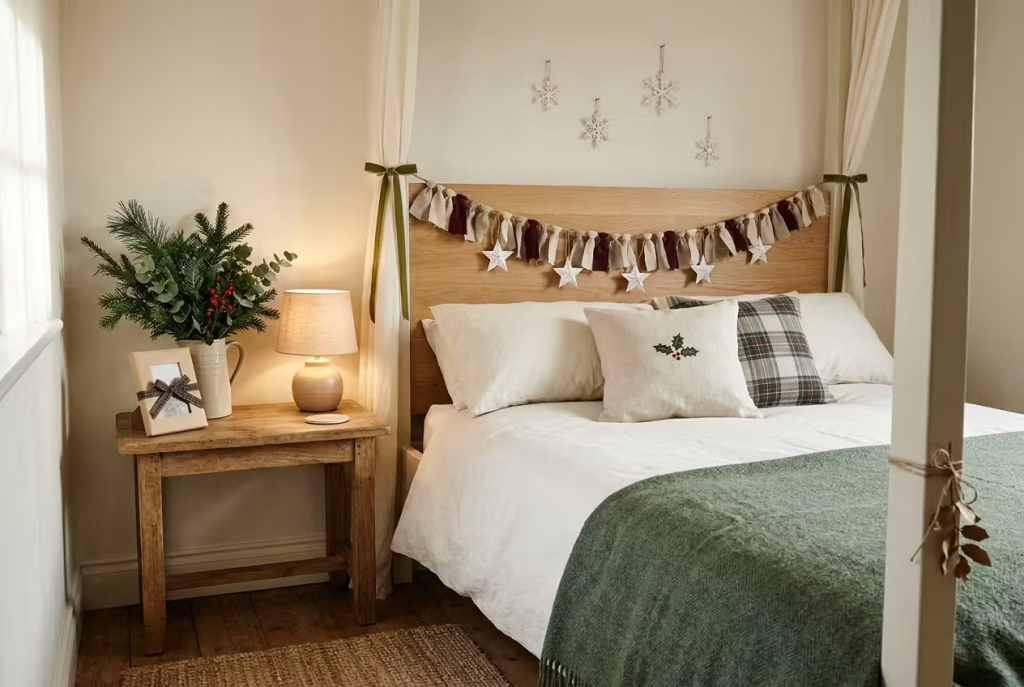
| 11 | Headboard garland | Beds with headboards | Battery models | Moderate |
| 12 | Wreath | Walls, doors, mirrors | Yes | Quick |
| 13 | Window frame | Sash and bay windows | Battery lights | Moderate |
| 14 | Flame-free scent | Everyone | Yes | Quick |
| 15 | Wrapped frames and cards | Renters | Yes | Quick |
| 16 | Bedpost stocking | Bedsteads | Yes | Quick |
| 17 | Calm motifs | Light sleepers, January | Yes | Quick |
| 18 | Guest welcome | Spare rooms | Yes | Moderate |
| 19 | Child’s room | Families | Battery only | Moderate |
| 20 | Thirty-minute scheme | Small rooms, rentals | Yes | Quick |
| 21 | January exit plan | Everyone | Yes | Plan ahead |
The bed: where the room wins or loses its festive spirit
1. Build the bed in layers, base first

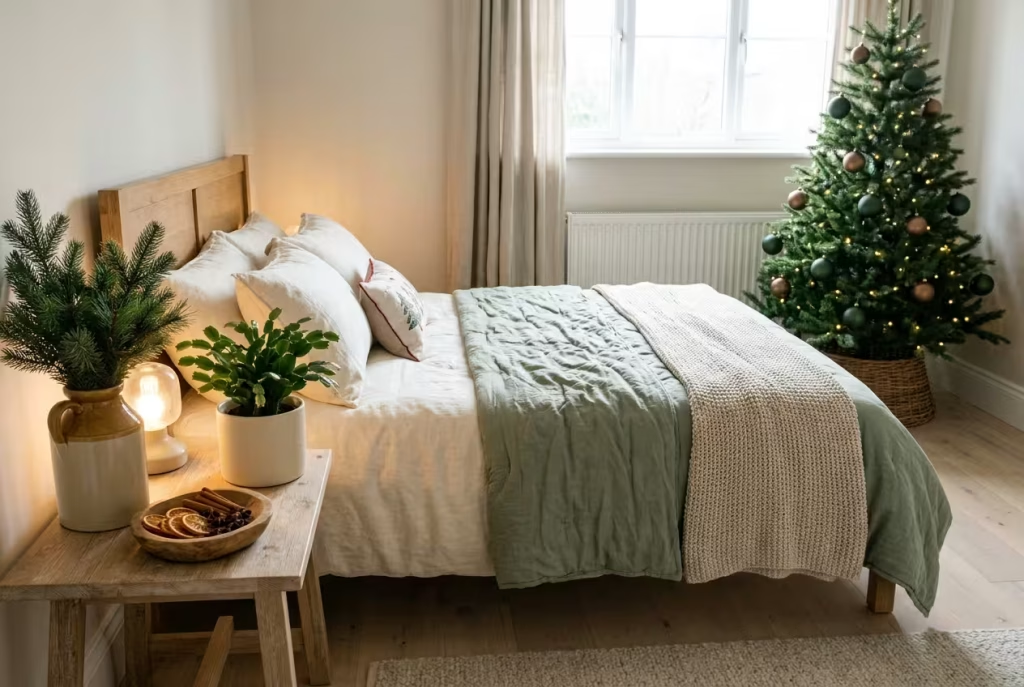
Start with a calm foundation in white, oatmeal or soft sage, so colour has somewhere to land. Add a single colour layer next, such as a quilt or a wool throw, then turn to the pillows. A formula favoured by tree and bedding specialists keeps things looking styled rather than stuffed: two or three plain pillows, two smaller patterned ones and one carrying a Christmas motif. Mix the sizes as well. A standard UK pillow measures 48 x 74cm, a square Euro pillow 65 x 65cm and a typical cushion 45 x 45cm, and that variety is what stops the pile looking like a showroom.
Better still, change the covers rather than the pillows. Festive covers fold flat into a drawer in January, which cures the storage headache readers raise so often, and they cost a fraction of new cushions.
The order below, from the mattress up, saves a lot of fiddling:
- Fresh sheets and a duvet in its plain cover form the base.
- A quilt or blanket, folded in thirds, lies across the lower part of the bed.
- The throw is tossed over one corner or the foot, never pressed flat.
- Sleeping pillows sit against the headboard, two or three decorative pillows in front, then one smaller festive cushion at the centre.
Designer Cassidy Montalvo keeps storage down by buying pillow shams she can swap each year, since they take almost no room and cost far less than seasonal pillows. There is a quiet pleasure in the routine, too. Folding back a quilt at the end of a long day is a ritual in itself, and rituals are half of what Christmas is made of.
You May also Like: 20 Gorgeous White Stucco Townhouse Ideas for Timeless Curb Appeal
2. Reach for fabrics that feel like a hug on a frosty night

Texture does the heavy lifting here. Brushed cotton or flannel sheets, a velvet cushion, a chunky knit at the foot of the bed: each one tells your hands it is winter before your eyes have noticed. Interior designer Birdie Fortescue also recommends a sheepskin or wool rug beside the bed, since bare feet on a cold floorboard are no way to greet a December morning.
Layering earns its keep for another reason. A 3-in-1 duvet, such as the M&S version that splits into 4.5 and 9 tog (13.5 when joined) at an RRP of £85, lets you peel back a layer when the radiator kicks in. Hot sleepers get to sleep like a log, and chilly ones can pile it on.
Pick fabrics by what they do for you, not only by how they look:
| Fabric | How it feels | Best used for | Watch out for |
| Flannel or brushed cotton | Warm from the first touch | Sheets and duvet covers | Can overheat hot sleepers |
| Velvet | Rich, cool for a moment, then soft | Cushions, a bed runner | Shows pressure marks and pet hair |
| Wool or chunky knit | Weighty and enfolding | A throw at the foot of the bed | Itchy against skin for some, so keep a layer between |
| Sheepskin or faux fur | Deep and soft underfoot | A rug beside the bed | Sheds; choose a non-slip backing |
A tog guide helps with the duvet itself. A 10.5 tog suits most centrally heated bedrooms through autumn, while 13.5 tog earns its place once the heating goes off overnight. Few things beat the first night in flannel sheets, when the cold bed you dreaded turns into the warmest place in the house.
3. Let tartan and heritage checks carry the nostalgia

Designers writing up the 2026 season keep returning to the same handful of themes: nostalgia, Ralph Lauren style tartan, generous bows, folk patchwork and heirloom pieces. Fortunately, all of them translate neatly to a bed.
The trick is restraint. Choose one bold pattern and repeat it, then let quiet pieces rest on top. A red and green tartan throw folded across the foot of the bed, a plain linen pillowcase with a thin stripe, a patchwork cover on a single cushion: that is plenty. Scale changes the mood, too. Large checks feel bold and graphic, while small checks and gingham read softer and more traditional. Done well, the pieces look cut from the same cloth, as though they had always lived there.
Three ways to wear a check, depending on how bold you feel:
- Lead: a tartan duvet cover, with plain linen pillows and one striped cushion on top.
- Support: a tartan throw across the foot of a neutral bed, plus a single patchwork cover for a folk note.
- Accent: one plaid cushion or a ribbon bow, for rooms that prefer to whisper.
Heirloom pieces carry the most feeling of all. Designer Kate Marker suggests mixing in items with an heirloom look, such as brass candlesticks with a worn patina or delicate ornaments handed down through generations, because they lift a scheme and start conversations. A faded family quilt over a modern bed is worth more than anything off the shelf, since it brings its own stories along.
Light: how to make the room glow without keeping it awake

Lighting is where a Christmas bedroom is won or lost, and where most of the safety questions live. The guiding principle comes straight from the sleep research above: low and warm beats bright and white. Look for bulbs sold as warm white, around 2700K or lower, and keep the overall level soft.
4. String warm fairy lights where you can enjoy them and not trip over them

A strand along the headboard, a curtain pole or a picture rail gives a bedroom its quiet sparkle. The catch is bedtime. NFPA, the US fire-protection body, advises switching tree lights off before leaving home or going to bed, and electrical or lighting equipment features in around 40 percent of home Christmas tree fires. The figures are American, but a bulb and a bedspread behave the same way on either side of the Atlantic. Some manufacturers describe modern LEDs as low-risk overnight, yet fire-safety bodies still say off, so belt and braces wins. A timer that cuts the lights an hour or two after lights-out is a sensible middle path.
- Choose battery strands with built-in timers to skip trailing flex altogether.
- Mains sets should carry a UKCA or CE mark and should not be daisy-chained beyond the maker’s stated limit.
- Fix strands with adhesive clips or removable hooks, never wound tightly round bedding or curtains.
Before you plug anything in, give each set a ten-second check for frayed flex, cracked bulbs and loose plugs, and retire any set with damage rather than patching it. Where the strand goes matters as well:
- Headboard: zig-zag the strand across for a full, fluffy glow, or run a single line along the top edge for a cleaner look.
- Curtain pole: loop the strand over the pole and let a few drops hang, so the light pools softly against the fabric.
- Picture rail or ceiling edge: clip every 30cm or so to keep the line crisp, using adhesive clips that lift off cleanly.
Interior designer Anastasia Casey of the Interior Collective sums up why we bother: few things transform a room as quickly as a string of fairy lights. Switch them on at dusk, draw the curtains, and you can feel the day let go of its shoulders.
5. Dim the room and let a little white into the colour
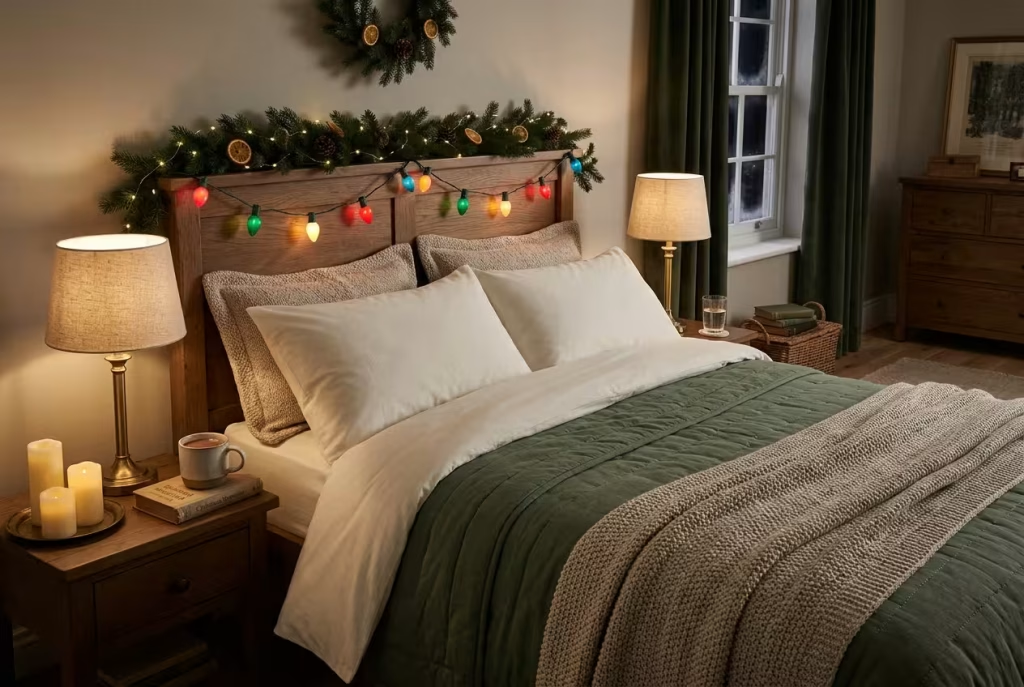
Remember the reader whose multicoloured vintage bulbs made the room feel heavy? The fix that worked was simple: weave small white lights among the colours. They lift the whole display and make the coloured bulbs stand out rather than sink.
Beyond the lights themselves, give the bedside lamps a warm bulb and, if the lamp allows, a dimmer (check the bulb is marked dimmable). Interior designer Bethany Adams puts it plainly: “Rule number one, dim the lights.” For flicker without fire, flameless LED candles with built-in timers do the job. Look for creamy, wax-dipped designs, because the plasticky ones give the game away, and group them on a small tray so they read as a considered cluster.
Different jobs want different light, so think in three moods rather than one:
| Moment | What to use | Why |
| Reading in bed | A bedside lamp with a warm bulb of at least 450 lumens | Lighting designer Jo Plant of Pooky recommends that level to avoid eye strain |
| Winding down | Dimmed lamps plus one fairy-light strand | Keeps the room low and warm, in line with the sleep research |
| Sleeping | As dark as you can comfortably make it | In the 2011 study, light left on during sleep cut melatonin by more than half |
That last row is worth remembering when the fairy lights look too pretty to switch off. The glow belongs to the evening, and the dark belongs to the night.
6. Light a shelf, a jar or a windowsill instead of the whole room
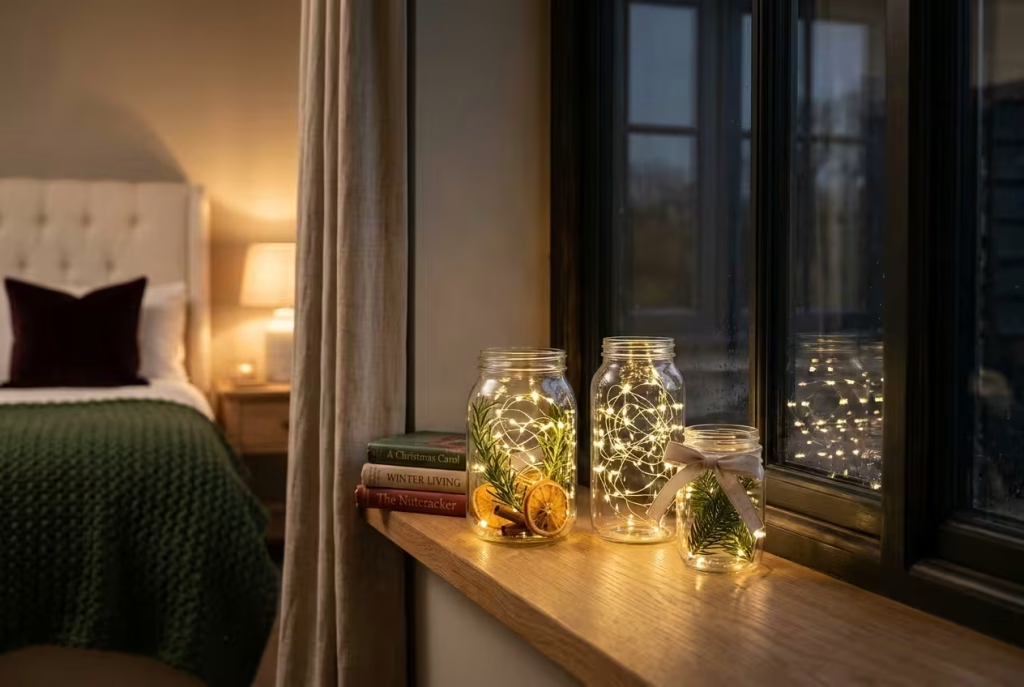
Sometimes a pinpoint of light is worth more than a floodlit room. Battery micro-lights in a glass jar make a lantern in thirty seconds. A strip of warm white LEDs tucked behind a shelf edge turns a row of books and keepsakes into a glowing display, a trick designers have used to backlight built-in shelving at Christmas. A single strand laid along a windowsill finishes the look from outside as well.
All three are wire-light, which suits renters and anyone who dislikes cables snaking across the carpet. Hide the battery pack behind a book, keep strips well away from paper and fabric, and choose warm white over cool white so the glow stays kind to your eyes.
A jar lantern takes less than five minutes to make:
- Choose a clean, dry jam or kilner jar.
- Coil a metre or two of battery micro-lights loosely inside, leaving the battery pack outside.
- Tuck in a sprig of rosemary or a slice of dried orange for texture.
- Set the jar on a shelf, windowsill or bedside table, and stand the battery pack behind a book.
Group three jars of different heights for a tiny skyline. The charm of this idea is how little it asks of you: no sockets, no hooks and no fuss when January arrives. It also keeps the light low, at the height of your eyes as you lie in bed, which is where the quiet magic happens.
You May also Like: 25 Clean & Modern Minimalist Basement Designs That Feel So Spacious, They Don’t Even Feel Like Basements
Trees and tiny surfaces: Christmas in miniature
7. Slip a pencil tree into the corner

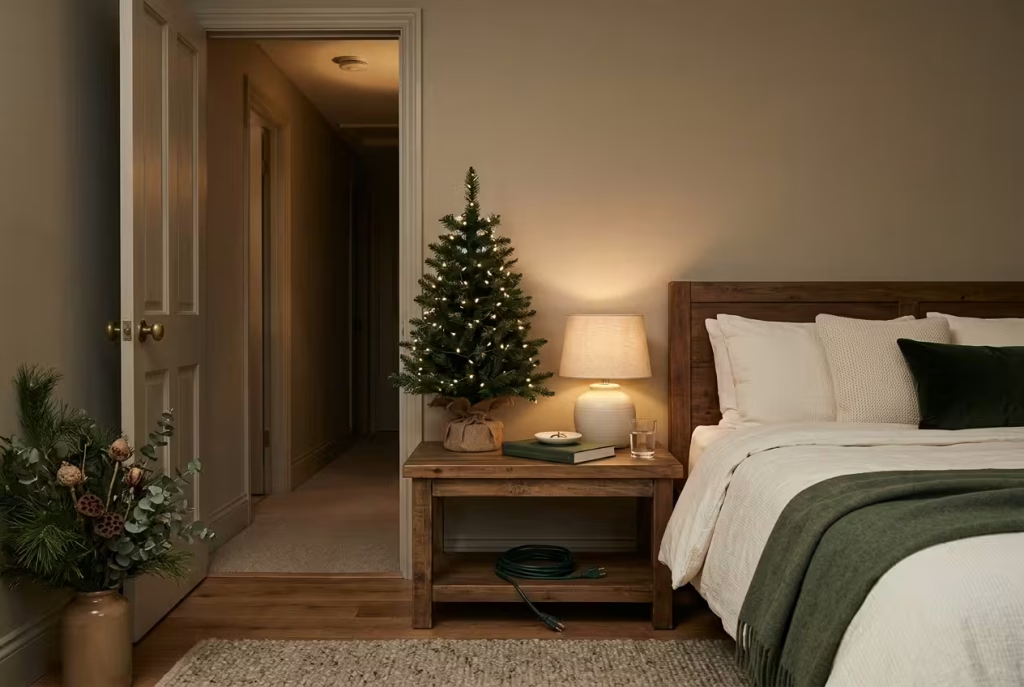
A pencil tree is the slimmest way to give a bedroom a real tree moment, and it earns its keep every evening as a soft glow in the corner. Reader after reader swears by the slim shape because it avoids a crowded, claustrophobic feel. Pre-lit artificial models are the simplest choice for a bedroom, with warm white bulbs and a lead you can tuck neatly out of sight.
Measure before you buy. NFPA guidance puts a tree at least three feet (about 90cm) from any heat source, including radiators, and it should clear the door swing and the wardrobe. If you want the scent of a real one, a small potted tree such as a mini spruce (around £40 at M&S) can be planted out in the garden afterwards, though it needs watering and will dry out faster in a heated room.
A few numbers help you buy the right size. A typical UK ceiling sits at about 2.4m, so a 6ft (1.8m) tree leaves a comfortable gap, while a 7ft (2.1m) tree and its topper leave only around 30cm above. One reader bought a 6ft tree for a bedroom and counts it money well spent.
- Dress it quietly: choose smaller ornaments than you would for a living-room tree and keep to two or three colours from your bedding.
- Think vertically: ribbon cascading in long lines makes a narrow tree look taller.
- Mind the lead: tuck the cable along the skirting board and keep it clear of the door.
Another reader puts the labour at roughly half an hour to fluff the branches and half an hour to dress them. That hour of pottering is handsomely repaid when the tree throws its glow across the ceiling as you read.
8. Give a bedside table or chest of drawers a tabletop tree

When floor space is spoken for, go small and go up. Tabletop trees typically stand 1.5 to 2 feet tall and slot onto a chest of drawers, a dressing table or a bedside table. Options run from a pre-dressed 1.5ft tree with a hidden battery pack (£65 at The White Company) to a moulded-branch model with real depth (about £169 at Balsam Hill). Battery lights avoid the cable question entirely.
Pet owners, take note. One reader with a cat said the big tree gets ignored while smaller ones become playthings. If that sounds familiar, set the tree on the highest surface, weight the base, and hang shatterproof ornaments such as wood or felt rather than glass.
Run through this checklist before you buy:
- Footprint: measure the depth of the surface, because many bedside tables are narrower than they look once a base sits on them.
- Power: battery or mains? Battery models with timers remove the cable and the socket hunt.
- Distance from the lamp: keep the tree a hand’s width or more from any lamp bulb, which can run hot.
- Stability: a weighted or wide base survives a nudged elbow and a curious cat.
One reader keeps a tabletop tinsel tree hung with mini ornaments and a string of coloured incandescent lights she has owned for decades, a pocket-sized echo of childhood Christmases. If you use vintage incandescent sets, keep them clear of fabric, since they run hotter than LEDs, and switch them off at bedtime.
9. Group three trees, or let one tell a story
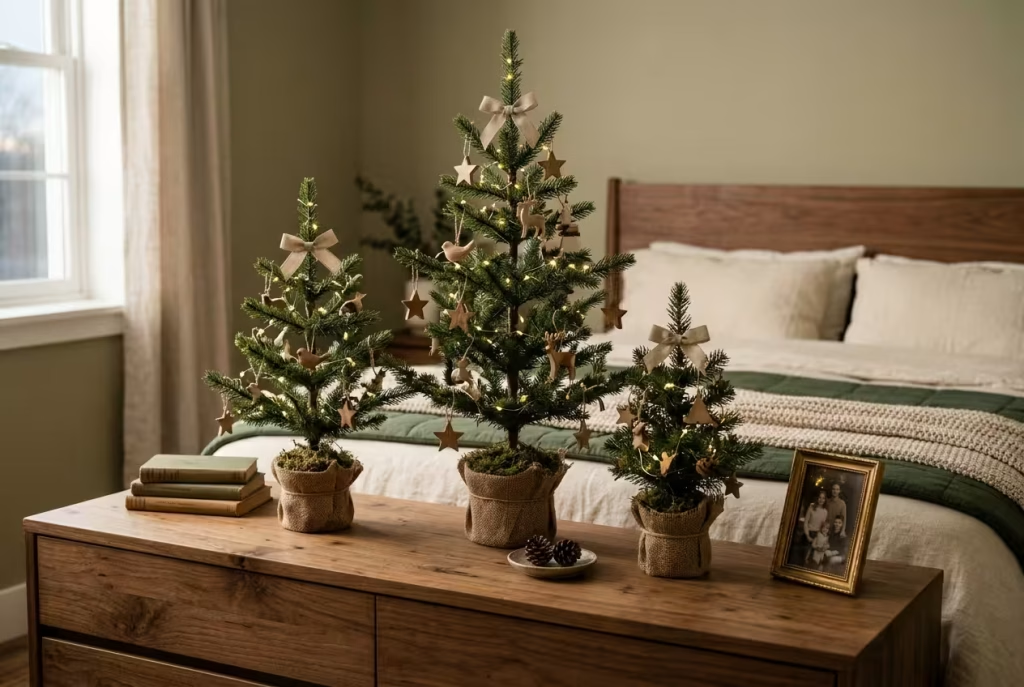
A cluster of three trees at different heights, all in the same style, gives a dresser the look of a tiny forest. Odd numbers sit more naturally to the eye, and matching styles stop the trio looking like a jumble sale.
If one tree is all you have room for, make it a storyteller. Readers suggest themes built around wooden ornaments, travel souvenirs, a child’s handmade decorations or family heirlooms. One imagined a coastal tree hung with treasures from a sea captain’s voyages, there to keep a waiting spouse company. You do not need a sea captain in the family. A handful of keepsakes with a story attached will turn a decoration into a conversation, and a trip down memory lane every time the lights come on. For a wire-free alternative, a few small glass or ceramic trees on a shelf do the same job quietly.
Tiny labels turn ornaments into heirlooms in waiting. Write the year and the name of the giver or maker on a paper tag and tuck it behind each ornament. A few themes to borrow:
- Wooden ornaments collected or carved over the years.
- Travel souvenirs, one from every trip.
- A child’s handmade decorations, glitter and all.
- Small vintage stars. Moravian stars, popular in German households since the mid-1830s, come in small, sturdy papier-mâché versions that suit a dresser.
A small tree rarely needs a crowd of ornaments, so you can be choosy and give each piece room to be seen.
10. Style the bedside table like a tiny still life
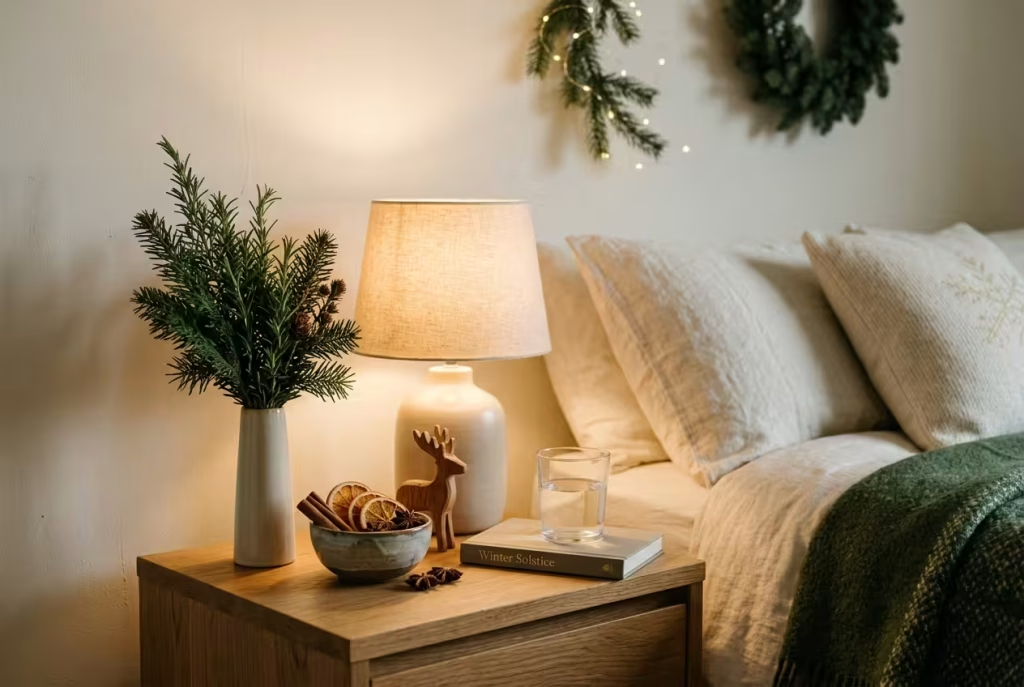
Keep the essentials in place, namely the lamp, a book and a glass of water, then add two or three festive touches and stop. A bud vase of evergreen, a small bowl of dried orange slices with cinnamon sticks, a few pine cones: each takes a minute to arrange and delivers scent as well as colour. A sprig of rosemary tucked into the mix adds a green, herbal note that readers love. Wax-painted candles, kept unlit, make charming sculpture.
Pets deserve a thought here. Amaryllis is a favourite festive bloom but is dangerous for cats in particular, so use faux stems or swap in a Christmas cactus, which is non-toxic (see the plant table later in this guide).
Two tiny projects supply the ingredients:
- Dried orange slices: cut oranges into thin slices of about 5mm, pat them dry and bake in a low oven at around 100°C for two to three hours, turning once, until leathery.
- Pine cones: if you forage them, bake at about 90°C for 30 to 40 minutes to drive out insects and dry the sap before they come indoors.
The rule of three keeps the arrangement calm: one tall element (a bud vase), one low (a bowl of orange slices) and one small surprise (a painted wooden figure or a cinnamon bundle). Leave space around the lamp and the glass of water. A bedside table that can still do its job is the sign of a well-judged festive touch.
Greenery and scent: bring the woods indoors
11. Drape a garland across the headboard

A garland, lush and loosely swagged, gives the bed a focal point without eating a single centimetre of floor space. Size it to the bed. UK standard mattress widths run about 135cm for a double, 150cm for a king and 180cm for a super king, so a 1.3m pre-lit garland suits a double well, while larger beds need two lengths joined or a longer garland. Measure with string first and save yourself a return.
Fix it high and firmly, because nothing should be able to drop onto a sleeper. Damage-free hooks work on most painted walls, and a battery pre-lit garland with a built-in timer (around £30 for a 1.3m length) means no socket hunt. Fresh greenery brings a woodland scent, but it dries quickly in a heated room, and pine needles can lodge in a pet’s gut if swallowed, so go faux where animals roam.
Fresh and faux each have their place, and a pre-lit battery garland is a third way:
| Type | Plus points | Drawbacks | Best for |
| Fresh foraged or bought greenery | Scent, texture, little or no cost | Dries in a heated room; needles and some berries can harm pets | Homes without pets, short displays |
| Faux garland | Reusable for years, no needle drop | No scent; cheaper ones look flat | Pet owners, rentals |
| Pre-lit battery garland | No socket, timer built in | Battery changes | Headboards far from sockets |
Interior designer Anastasia Casey likes to pair natural greenery with richly textured pieces, and reuses spring and summer clippings such as olive and cedar in winter schemes. Holly is one to skip in homes with pets. Fix a garland with a damage-free hook at each end and one in the centre, so the weight is shared and it holds its swag.
12. Hang a wreath where the eye lands first

A wreath above the bed is a classic for good reason. A smaller one even tricks the eye into reading the room as larger, and it takes less than a minute to hang. Other spots work just as well: the wardrobe door, a mirror, the back of the bedroom door, or a loop of red ribbon in the window.
If you go fresh, mist it with water now and then and look for a mossy base that holds moisture. Tie a velvet ribbon in the red or green you used on the bedding, and the wreath and the bed start to look like parts of one plan.
Where you hang it changes the effect:
- Above the bed: centre it over the headboard. A common styling guide is about two thirds of the headboard’s width, so a double headboard of roughly 135cm suits a wreath of around 60 to 90cm.
- On the wardrobe door: use a lightweight wreath on an over-door hook, so nothing marks the paint.
- On a mirror: hang it from a ribbon looped over the top edge, and let the glass bounce the glow back into the room.
- On the bedroom door: the first thing a guest or child sees, which makes it a small act of welcome.
There is an old comfort in a wreath, a circle with no beginning and no end, hung where you will glance up at it last thing at night.
13. Frame the window with greenery and a bow or two
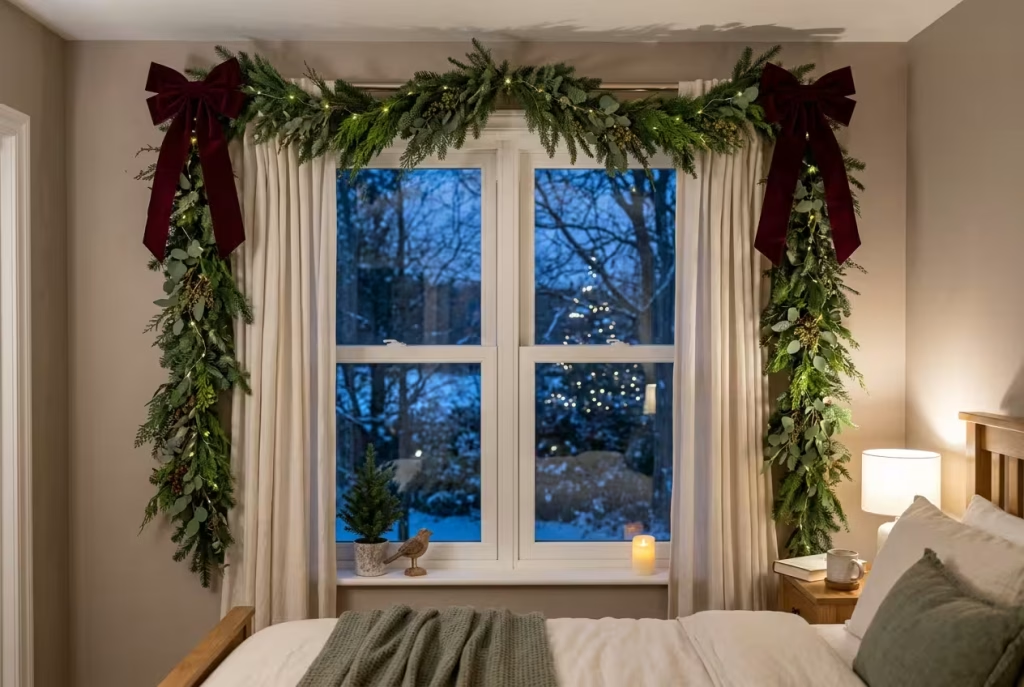
Bows are back in a big way this season, and a window is the perfect stage for them. Run a garland around the frame, tie velvet bows at the corners and, if you like, thread a battery strand through the greenery so the whole thing glows from the street at dusk.
Two cautions. Keep greenery clear of any radiator beneath the sill and away from curtain hems. And if you rent or simply loathe drilling, snowflake window clings are the zero-damage version, a trick one reader uses to good effect.
Three window looks, in rising order of effort:
- Swag at the top: a single garland draped along the pole or pelmet, with a bow at each end.
- Full frame: garland down both sides and across the top, secured with removable hooks.
- Hanging stars: paper or felt stars on lengths of ribbon from the curtain pole, which need no greenery at all.
Choose wired velvet ribbon for the bows, since it holds its shape against gravity, and fix the tails with a tiny stitch or a dab of removable adhesive. A lit window also gives something back to the street, a small, warm signal that somebody inside is looking forward to the season.
14. Scent the room without lighting a thing
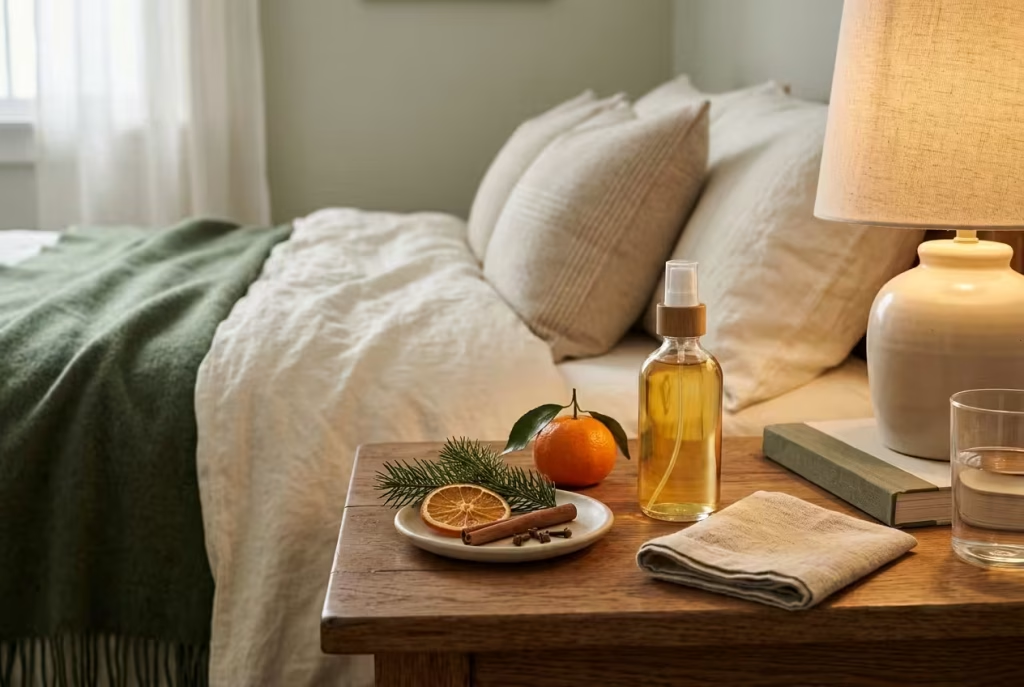
Scent is the fastest route to Christmas morning, and a bedroom can have it without a flame. The case against real candles is stark. US fire data show that around 37 percent of home candle fires start in bedrooms, and falling asleep was a factor in 11 percent of candle fires and 21 percent of the deaths. More than half of home candle fires involve something combustible sitting too close to the flame, and fire services advise keeping candles at least 12 inches (30cm) from anything that can burn.
Try these flame-free routes instead:
- A mandarin, clove and cinnamon room spray misted over curtains and cushions, never directly onto bedding.
- A simmer pot of orange peel, cinnamon and cloves on the hob earlier in the day, then cooled, strained and decanted into a spray bottle. Keep it in the fridge and use it within a few days, since it has no preservatives.
- A sprig of evergreen or a dried orange in a small dish beside the bed.
If you fancy the simmer pot, these proportions work: two apples, quartered, one sliced orange, two cinnamon sticks and a teaspoon of whole cloves, covered with a litre of water and left to burble gently on the lowest heat with the lid off. Never leave it unattended on the hob, and top up the water as it reduces. Do it in the kitchen in the afternoon and let the scent drift upstairs, or turn the cooled liquid into the linen spray described above.
Keep the scent light in the room where you sleep. A faint trace of orange and clove is a pleasure, while a heavy cloud of fragrance can turn a restful room into a busy one. In many homes the smell of Christmas arrives long before the decorations do, and a little of it by the pillow brings a childhood memory in with it.
You May also Like: 25 Ranch Style Bedroom Ideas That Feel Warm, Timeless, and Effortlessly Livable
Walls, stockings and small sentimental touches
15. Wrap a frame, swap a print, or peg the cards on ribbon
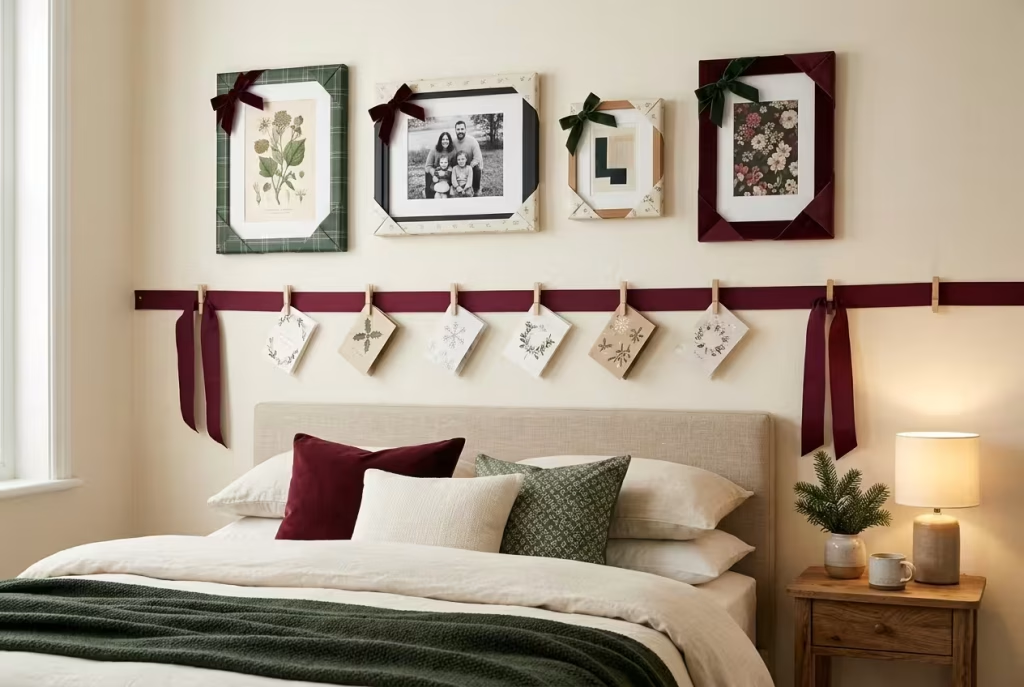
A bedroom wall can be dressed in the time it takes the kettle to boil. Readers wrap a favourite print or photograph in paper that matches the room, finish it with a small bow and watch the whole wall change character. Others swap a print for a winter landscape or a botanical study, or stretch a length of thick ribbon across the wall and peg greetings cards along it, so the cards double as decoration and stop cluttering the surfaces below.
For children’s rooms or anywhere a little whimsy is welcome, paper snowflakes hung at different lengths from the ceiling cost next to nothing and make the room feel as if it is snowing indoors. Use removable adhesive or pegs, and the paintwork stays unscathed.
Make the wall display count:
- Wrapped frames: choose a paper that echoes your palette, wrap the frame only (never the glass), secure it at the back with tape and add a small bow. It comes off in seconds and leaves the print untouched.
- A ribbon card line: fix a length of thick ribbon at the top and peg each greetings card along it. Every card is a person, so the display becomes a gallery of the people you love.
- Keep a few: slip favourite cards into a box in January and you will have a ready-made keepsake by next year.
16. Tie a stocking to the bedpost
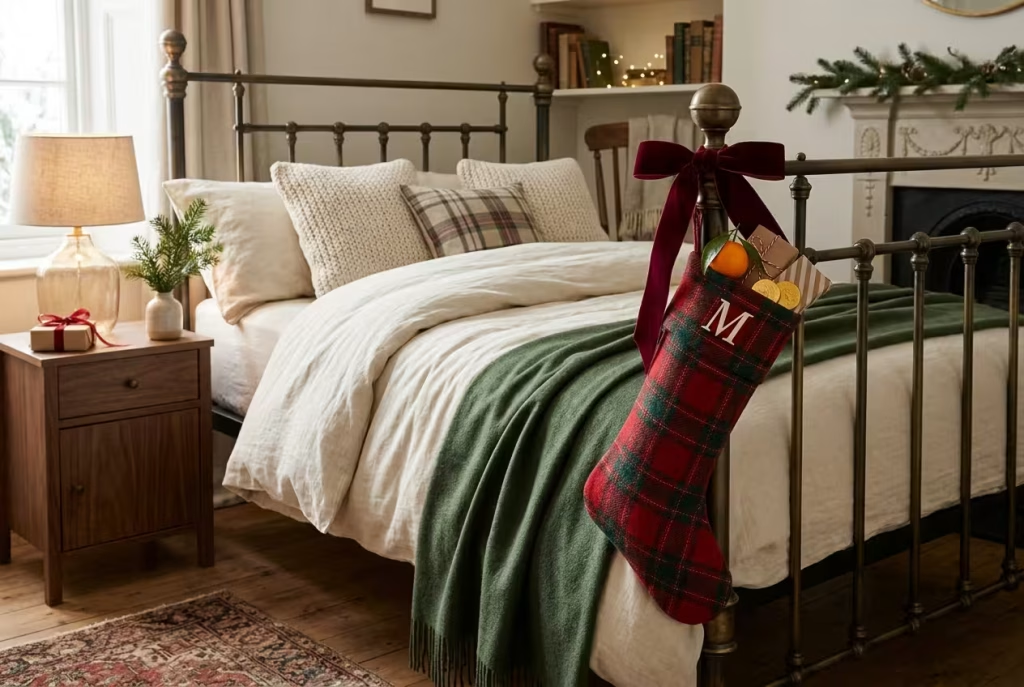
Waking up to a stocking is the oldest bedroom tradition of the lot, and a wrought-iron or brass bedstead is made for it. A tartan stocking tied to the footpost with a velvet ribbon looks nostalgic without trying, and tucking a small treat inside gives sleepy guests or children a lovely surprise at dawn.
Pick stockings that suit the room rather than the shop aisle: charcoal and white Nordic knits in a neutral bedroom, patchwork in a cottage one, chunky wool for a cabin. Keep the contents light so the bed frame is not strained, add a name or initial to make it personal, and if the stocking holds chocolate, keep it well out of a dog’s reach.
In Britain, the traditional stocking has a satsuma or tangerine in the toe, with a few small gifts and a chocolate coin or two above it, a lovely habit to pass on to children or guests. For a modern bed with no post to tie to, hang the stocking from a removable hook on the wall beside the bed or from the end of a bench.
17. Choose calm motifs stars, snowflakes and angels

Here is a thought for a room you go to sleep in. One reader suggested stars and angels, a soothing pairing that nods to “sleep in heavenly peace”. Another dresses a pale blue bedroom with silvery snowflakes, grey stockings, a few snow globes, ribbons and tiny sparkly lights, and happily leaves it up until close to Valentine’s Day because it never shouts Christmas.
That is the quiet beauty of these motifs. Paper stars, felt snowflakes and a small ceramic angel read as winter rather than as a single December date, so the room glides from the festive season into January without a jolt. A wooden snowflake that stays on the wall long after the tree has gone, as one reader keeps hers, is a lovely way to hold on to the glow.
A short menu of calm motifs to choose from:
- Stars: paper or tin stars on ribbon, in white, silver or warm brass.
- Snowflakes: felt or paper, hung at varying heights near a window.
- Angels: one small ceramic or wooden figure on the bedside table, and no more.
Matte finishes keep the glare down. Felt, paper and wood absorb and soften light, whereas glitter and foil bounce it around, which suits a room where the aim is rest. A pared-back palette of silver, white and pale blue also fades gracefully into January, so there is no sudden bare patch on the wall when the festive season ends.
Rooms with rules of their own
18. Welcome overnight guests as if they were checking into a boutique hotel

A guest room asks for a slightly different approach, because the aim is to make someone else feel looked after. A small tree glowing in the corner says “we were expecting you” before a suitcase has been unzipped. Comfort comes next. A feather and down topper (around £75 for an 80/20 fill at Dusk) rescues even a firm spare mattress, and an extra blanket folded at the foot lets guests set their own temperature.
Then add the small kindnesses that people remember for years:
- A carafe and tumbler on the bedside table, with a warm lamp and a box of tissues.
- A handwritten card and a few festive treats, after asking about allergies.
- A folding wooden tray (about £50) or a whitewashed rattan one (about £38) for breakfast in bed.
- A spritz of room spray over the curtains, rather than a candle left to burn.
Copy this checklist for the day before guests arrive:
- Fresh sheets on the bed and the topper smoothed flat
- An extra blanket folded at the foot
- A bedside lamp with a working bulb, and a spare nearby
- A phone charger and a plug socket they can reach
- A carafe and glass, topped up
- Clear hanging space and a few spare hangers
- A towel for each guest, folded on the bed
- The heating on in good time, so the room is warm on arrival
- A handwritten note with the Wi-Fi password and the plan for breakfast
The thought behind every item is the same: a guest should never have to ask for anything. That is what makes a spare room feel like a welcome rather than a favour.
19. Make a child’s room a little bit magic, within sensible limits
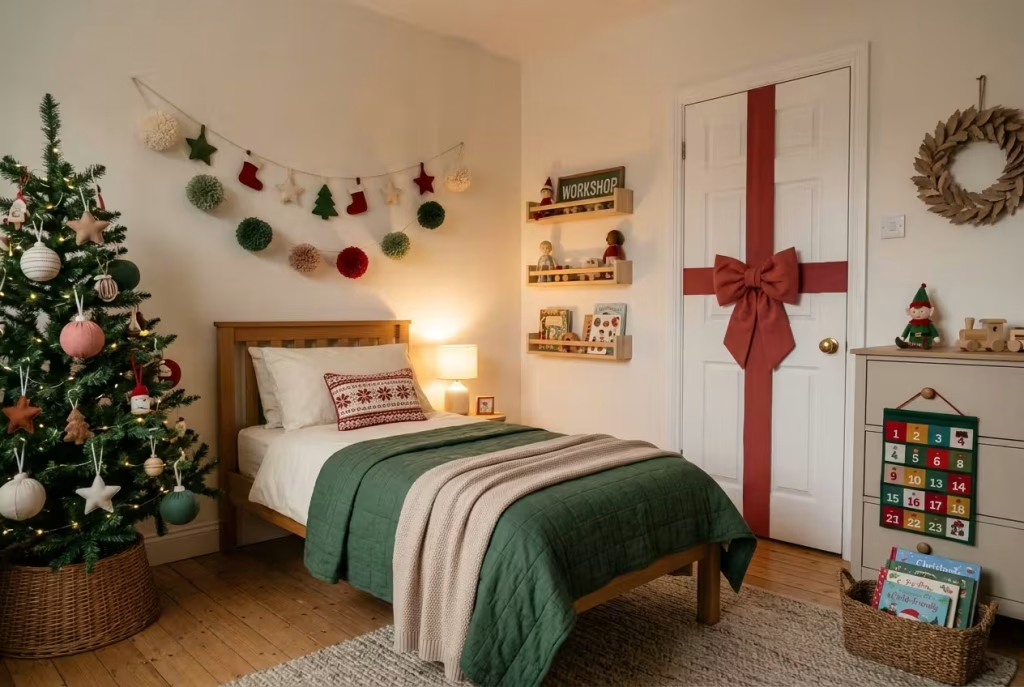
Children are the best audience a Christmas bedroom could ask for, and they love being given the controls. Let them pick a theme, such as Santa’s workshop, then add a garland, a few ornaments and a pom-pom or tassel garland they can help make. Wrapping paper taped across the bedroom door turns it into a giant present, and an advent calendar on the chest of drawers shortens the long wait. One designer hung lightweight paper wreaths from a pair of twin footboards, needing only one damage-free hook for each.
Set the ground rules early. Use battery lights only, skip real candles altogether, keep small ornaments out of reach of under-threes, and anchor any tree so it cannot topple. Lights go off at bedtime, and then the room can do what a child’s room does best, which is to hold a little wonder in the dark.
Safety shapes the plan by age. For under-threes, skip small ornaments and keep every battery pack out of reach, because button batteries are dangerous if swallowed; choose light sets with a screw-fastened battery compartment. Children of about four to eight can take the paper crafts and the choosing of a theme, while you handle the hooks and the lights. Teenagers will want their own taste, so offer a corner and a strand of warm lights and let them run with it. Children rarely remember the decorations themselves. They remember the feeling of falling asleep in a room that looked as though it had been waiting for them.
20. Short on space, renting, or allergic to cables The thirty-minute version

You do not need a big room or a big budget to get the feeling. This quick sequence, tried and tested by readers, transforms a bedroom in about half an hour and packs away in ten minutes.
- Swap the pillow covers and lay a festive throw across the foot of the bed.
- Hang a few ornaments from the curtain rod on lengths of ribbon.
- Clip a battery light strand with a timer along the headboard or window.
- Stand a small tree, or a few glass trees, on the chest of drawers, with a bowl of dried orange slices alongside.
- Hang a wreath from a ribbon on a damage-free hook.
- Finish with a room spray over curtains and cushions.
Fresh greens in a jug need no storing at all, since they go in the bin or the compost in January. If you rent, test any adhesive on a hidden patch first, and check your tenancy agreement for what is allowed.
Keep a small renter’s kit in a shoebox so the whole job lives in one place:
- Damage-free hooks and clear adhesive clips.
- Museum putty for small objects.
- Ribbon in two colours and a few pegs.
- A spare set of batteries for the light strands.
Test any adhesive on a hidden corner and leave it a day before you trust it with a wreath. Renting is no reason to postpone Christmas. A rented room deserves a little festive glow just as much as a house with a mortgage.
You May also Like: 25 Christmas Room Decor Ideas That Bring Comfort, Charm, and Holiday Cheer
21. Plan the January exit before you begin
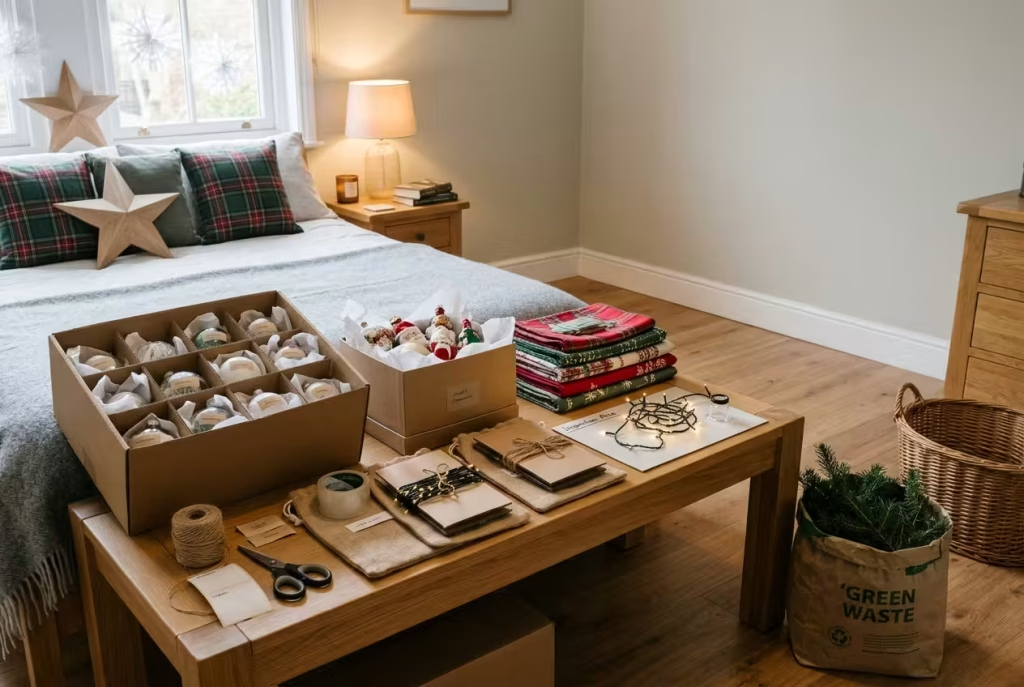
The cleverest decorators choose pieces that can stay. Stars, snowflakes, wool throws and tartan cushions blend into winter without any fuss, so the room never feels abruptly stripped. It pays to think about what must go, too. NFPA data show that 35 percent of home Christmas tree fires happen in January, in large part because a tree dries out the longer it stays indoors, so a real tree should be recycled promptly through your local council scheme.
When the lights come down, unplug them by gripping the plug rather than tugging the cord, wind each strand round a piece of card or seal it in its own bag, and store everything somewhere dry, away from children and pets. Wash the pillow covers before they go into the drawer. A stitch in time saves a tangle next November.
A take-down order that saves time:
- Unplug the lights, grip the plug, and wind each strand round card.
- Strip the fresh greenery and send it for composting or recycling.
- Wrap fragile ornaments and note the year on the box.
- Carry the tree out to your council’s recycling or collection scheme.
- Wash the pillow covers and fold them away.
Check every set of lights as you pack it, and replace any with damage. Your future self, opening the box next November, will be grateful.
Bedroom Christmas safety at a glance

| Item | Main risk | Safer habit |
| Fairy lights and tree lights | Electrical faults and heat; lighting equipment is involved in about 40 percent of home tree fires (NFPA) | Switch off at bedtime or use a timer; choose UKCA or CE marked sets; prefer battery strands |
| Real or artificial tree | Dries out and sits too close to heat | Keep at least 90cm from radiators; water real trees daily; remove promptly in January |
| Candles | About 37 percent of home candle fires start in bedrooms | Choose flameless; if real, never unattended, never when drowsy, 30cm from anything flammable |
| Garlands, ribbons and bows | Slipping onto the bed; touching heat | Fix high and firmly; keep clear of radiators and heaters |
| Small ornaments | Choking and swallowing | Out of reach of babies, toddlers and pets; choose shatterproof |
| Cables and extension leads | Trips and overloaded sockets | Go battery-powered; one plug per socket |
Three myths worth retiring
- “LEDs run so cool they are safe all night.” They run cooler than old incandescent bulbs, but fire-safety guidance still says to switch lights off at bedtime, and a faulty lead or a cheap adaptor can fail whatever bulb is fitted.
- “Poinsettias are deadly to pets.” Poison advice describes them as only mildly irritating. Amaryllis, holly, mistletoe and lilies are the greater worries.
- “Fairy lights will help you sleep.” Nothing in the sleep research says so. The evidence suggests only that dim, warm light before bed is kinder to your body clock than bright light.
While you are checking things, test the smoke alarm outside the bedroom door.
What it costs three budgets, one cosy bedroom
| Budget | What it buys | Where it fits in this guide |
| Free to about £15 | Foraged or fresh greenery, paper snowflakes, ribbon, wrapped frames, a fabric-loop garland (about £10) | Ideas 10, 12, 13 and 15 |
| £15 to £50 | A pre-lit 1.3m garland (about £30), a potted mini spruce (about £40), a tartan bow garland (about £45) | Ideas 8, 11 and 13 |
| £50 to £200 | A dressed 1.5ft tree (£65), a feather and down topper (£75), a 3-in-1 duvet (£85), a moulded tabletop tree (£169) | Ideas 2, 8 and 18 |
Prices are recommended retail prices seen in November 2026 and will shift with sales.
Spend on what touches you every night, such as sheets, a topper and a good bedside lamp, and save on what you only glance at, such as garlands, bows and paper stars. A fabric-loop garland at around £10 and a handful of foraged greenery do as much for the eye as a far dearer set, whereas a topper that rescues a poor mattress changes how every guest sleeps.
Festive plants and pets what to keep and what to skip
| Plant | Risk to pets | Bedroom verdict |
| Amaryllis | Toxic, especially to cats; vomiting, tremors and seizures reported | Use faux stems, or skip |
| Holly and mistletoe | Toxic; veterinary guidance lists both as quite poisonous | Choose artificial versions |
| True lilies | Highly dangerous to cats | Keep out of the house |
| Poinsettia | Only mildly irritating to skin, eyes and stomach | Acceptable, but keep out of reach |
| Christmas cactus | Non-toxic to cats and dogs | The safe, long-lasting choice |
| Pine and fir needles | Sap can upset stomachs; needles can lodge in the gut | Sweep up fallen needles daily; go faux if pets chew |
If a pet eats any festive plant, ring your vet straight away.
Take a photo or a cutting of the plant with you when you ring, so the vet knows exactly what was eaten.
Making the room yours

A Christmas bedroom is not a showpiece. It is a small, private promise to yourself that the season has reached the quietest corner of the house. Start with the bed, keep the light soft and warm, let one tree or one garland take centre stage and leave plenty of breathing space around it. Do that, and the proof of the pudding arrives on a dark December evening, when you switch off the main light, the room glows gently, and the day finally lets go of you.
Your questions, answered
Is it overboard to decorate a bedroom for Christmas?
Not at all. A few considered touches, such as a throw, a small tree and warm lighting, make the room more restful rather than crowded. One reader reckoned an hour of effort bought a soft glow every night. Keep the palette to about three colours and the decorations will feel intentional, not excessive.
Can I leave Christmas lights on overnight in a bedroom?
It is better not to. NFPA advises switching tree lights off before bed, and electrical or lighting equipment features in around 40 percent of home tree fires. A timer that switches battery lights off an hour or two after you settle is a sensible compromise, and sleep research favours dim, warm light before bed anyway.
Is a Christmas tree in the bedroom safe?
Yes, with sensible habits. Keep it at least 90cm from radiators and other heat, make sure it clears the door, switch the lights off at night and, with a real tree, water it daily. Take it down promptly, since 35 percent of tree fires occur in January.
How do I stop coloured lights making the room feel heavy?
Weave small white or warm white lights through the colours, add cream bows or pearl garlands, and keep the bulbs on a dimmer or timer. Readers who tried this found it lifted a gloomy scheme at once without losing the vintage character.
What is the best tree for a small bedroom?
A pencil tree suits a corner, and a tabletop tree of 1.5 to 2 feet suits a bedside table or chest of drawers. Pre-lit battery models avoid trailing cables. If you have a cat, set small trees high, weight the base and choose shatterproof ornaments.
Are candles safe in a bedroom?
Flameless ones are. About 37 percent of home candle fires start in bedrooms, and falling asleep is a factor in 11 percent of them. If you light a real candle, never leave it unattended, never doze beside it and keep it 30cm from anything that can burn. Timed LED candles give the flicker without the risk.
Which Christmas plants are safe for cats and dogs?
Christmas cactus is non-toxic, and poinsettia is only mildly irritating. Amaryllis, holly, mistletoe and true lilies are the ones to avoid, with lilies the gravest danger to cats. Ring your vet at once if a pet nibbles any festive plant.
How do I decorate a rented bedroom without damaging the walls?
Use damage-free hooks, adhesive clips, ribbon, pegs and museum putty, and test each on a hidden patch first. Lean on fabrics, battery lights, window clings and fresh greens, and check your tenancy agreement for any restrictions.
How can I keep bedroom Christmas decor wire-free and easy to store?
Swap pillow covers instead of pillows, hang ornaments from the curtain rod, use fresh greenery that needs no storing, and choose battery lights with timers. Paper decorations and ribbon fold flat and cost very little.
What colours make a Christmas bedroom feel calm?
Sage with ivory and champagne gold, blue with white and silver, or all white with one dark accent all feel restful. Keep to three colours and repeat each one at least twice around the room.
How do I decorate a guest room for Christmas?
Put comfort first with a topper, extra blanket and bedside lamp, then add a small tree, a carafe, tissues, a handwritten card and a few treats. Mist the curtains with a room spray instead of lighting a candle.
How do I move from Christmas to winter decor in January?
Choose motifs such as stars, snowflakes, wool and tartan that can stay on. Remove the real tree promptly, unplug lights by the plug, wind each strand round card and store everything dry. Wash pillow covers before putting them away.
Does warm light help you sleep?
Dim, warm light in the evening is kinder to your body clock than bright white light. The 2011 study found that ordinary room light before bed shortened melatonin duration by about 90 minutes compared with dim light. It tested room lighting rather than fairy lights, so treat warm bulbs as a sensible habit, not a cure.
How much does it cost to decorate a bedroom for Christmas?
A scheme can cost nothing with foraged greenery and paper decorations, around £15 to £50 with a pre-lit garland or a mini tree, and £50 to £200 with a dressed tree, a topper or new bedding. Spend on what you touch nightly and save on what you only glance at.
What if I do not want a tree in the bedroom?
Skip it. A garland over the headboard, a wreath, a stocking on the bedpost, a few small glass trees on a shelf and a warm strand of lights deliver the feeling without taking floor space. Readers who found a full tree too heavy for a bedroom were pointed towards the same swaps.
Sources and notes
- NFPA home Christmas tree and decoration fire statistics (annual averages 2020 to 2024), as reported by Campus Safety Magazine: https://www.campussafetymagazine.com/news/nfpa-december-is-a-leading-month-for-u-s-home-fires/175929
- NFPA Christmas tree placement and lighting guidance: https://ashburnfirerescue.org/?p=16240
- NFPA January tree fire figure: https://www.norwoodrecord.com/article/christmas-tree-fires
- NFPA home candle fire facts (2012 to 2016): https://cbfire.specialdistrict.org/candles
- Gooley et al., 2011, Journal of Clinical Endocrinology & Metabolism, via ScienceDaily: https://sciencedaily.com/releases/2011/01/110113082716.htm
- Texas A&M College of Veterinary Medicine guidance on festive plants: https://www.puppyup.org/?p=11171
- Ideal Home on festive plants poisonous to pets: https://idealhome.co.uk/garden/garden-advice/pet-poisonous-festive-plants
- Almanac list of plants toxic to pets: https://almanac.com/poisonous-plants-dogs-cats-and-other-pets
This guide offers general advice. Always follow manufacturers’ instructions for lights, trees and fire safety, and consult a qualified electrician or your vet where you are unsure. US fire statistics are cited because UK equivalents for these specific categories are less detailed.