



19 Vinyl Record Storage Ideas for a Mid-Century Modern Living Room: Stylish Picks for Collectors
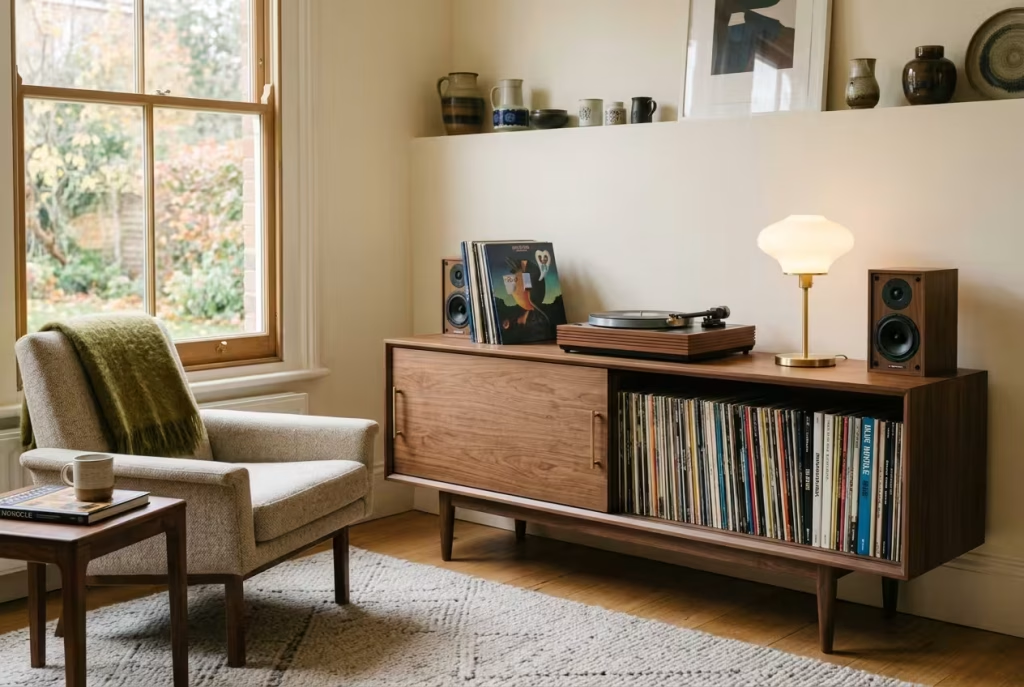
Prices are those listed at the time of writing and move often, so check the retailer before you buy.
Picture a wet Sunday in November. Rain ticks against the sash, the kettle has just clicked off, and a tower of albums leans in the corner like a patient guest who has been kept waiting far too long. You have promised yourself an afternoon of sorting. Then the awkward question lands: where does all of this actually live?
For plenty of collectors the answer is ‘wherever it fits’, which means crates under the stairs, a shelf bowing in the middle, and a cherished first pressing wedged sideways behind the sofa. The price is not only a handful of warped sleeves. It is the slow drift away from the very thing that made you buy the records in the first place. When a favourite is a chore to reach, it stops being played. One r/vinyl collector said as much after hauling his albums up from a basement to the main living floor: with everything within arm’s reach, he found himself playing them daily.
That is the real job of a record cabinet. It should shorten the walk between wanting a song and hearing it. In a mid-century modern room it carries a second brief too, which is to look the part, with a low horizontal line, tapered legs, warm timber and nothing shouting for attention. The 19 ideas below meet both briefs, and they come with the numbers most roundups skip: real depths, shelf loads, capacities and prices, plus a few honest warnings from people who learned the hard way.
What you will take away:
- A simple method for sizing storage to your own collection, with a worked example
- 19 ideas across credenzas, shelving, listening corners, wall displays and small-space fixes
- Straight answers on the IKEA Kallax debate, turntable placement and tip-over safety
- Price ladders from under £100 to bespoke, plus care rules from the Library of Congress
The Quick Answer What Is the Best Vinyl Record Storage for a Mid-Century Living Room?
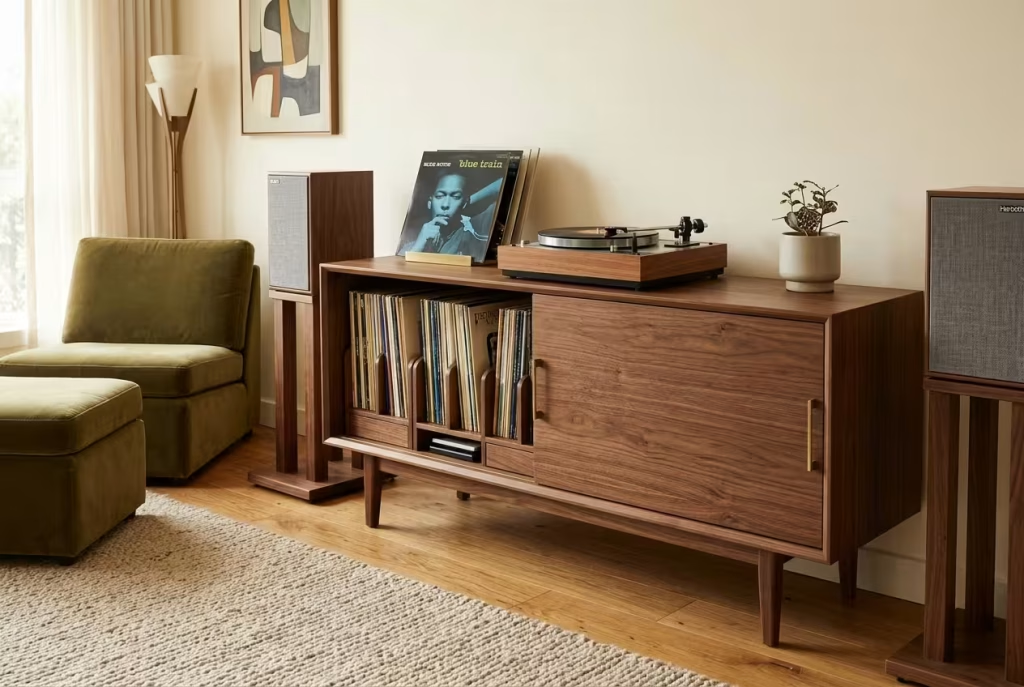
The best storage is a low credenza or shelving unit with at least 33 cm (13 in) of clear depth inside, dividers or short bays that keep records upright, and shelves rated for real weight. A 12-inch sleeve measures about 31.5 cm square, so anything shallower leaves corners hanging out. Raise the piece on tapered legs, keep the turntable off the same surface as the speakers, and allow 30 to 40 per cent spare room for growth.
Five checks save most of the grief:
- Clear depth: 33 cm or more inside, and more again if you use outer sleeves.
- Shelf strength: a published load rating, not a flattering photograph.
- Upright support: dividers, snug bays or heavy bookends so nothing leans.
- Separate surfaces: deck on the furniture, speakers on their own stands.
- Spare capacity: room for the next two or three years of buying.
What Your Records Ask of Furniture
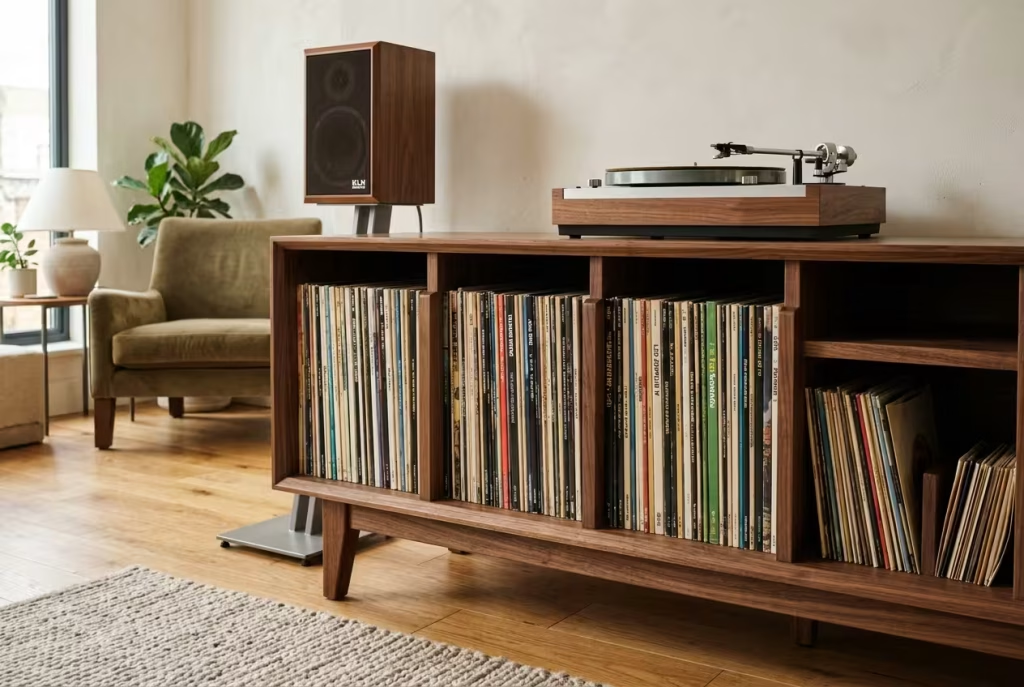
The most useful guidance on grooved discs comes from an unglamorous source: the Library of Congress, which has to keep them playable for a living. It writes for institutions, yet nearly every line translates neatly to a British living room, and together they read like a brief for a cabinet maker.
| Requirement | What the Library of Congress says | What it means at home |
| Position | Store discs upright, on edge | Never stack flat; a pile presses on the grooves beneath |
| Support | Sturdy, immovable dividers every 4 to 6 in (10 to 15 cm), supporting the whole face of the sleeve | Long open runs need dividers or snug bookends |
| Load | Grooved discs average 35+ lb per shelf-foot (about 52 kg per metre) | Check the shelf rating; thin boards bow |
| Sizes | Do not mix discs of different diameters | Give 7-inch singles a compartment of their own |
| Climate | Cool, stable, relatively dry, about 35 to 40% humidity | Keep clear of radiators, vents, damp walls and direct sun |
Read the load line carefully. It describes an average, so a collection rich in gatefolds, box sets and 180 g pressings will sit above it, and the shelf has to cope with the heaviest bay, not the typical one. The weight also concentrates on the centreline of a shelf, which is why a board that looks fine empty can sag into a shallow smile within months.
Translate the rules into shopping questions and the whole market gets easier to read:
- Are the bays divided, or short enough that records stand up by themselves?
- What is the stated load per shelf, and over what span?
- Is the clear depth at least 33 cm once the back panel and any door are fitted?
- Does the piece sit away from the radiator wall where you plan to put it?
A warped record cannot be un-warped. A stitch in time, as the old saying goes, saves nine.
Do the Sums Before You Shop
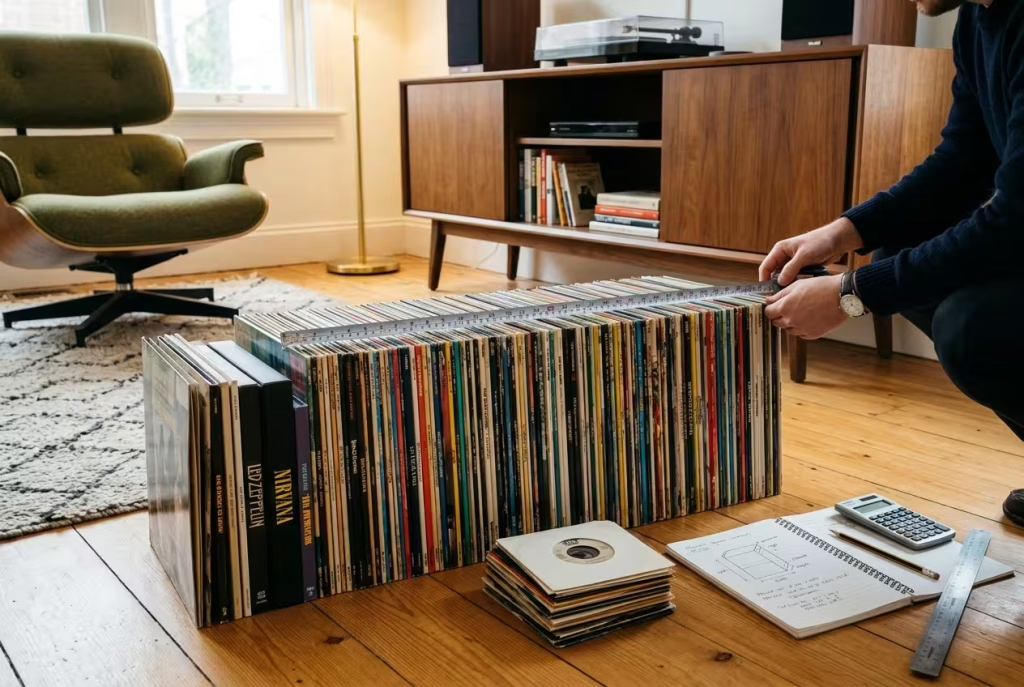
Most buyer’s remorse boils down to arithmetic done a fortnight too late. Published capacities flatter, because albums vary in thickness and nobody photographs a cabinet full of bulky box sets. Work through these steps with your own sleeves and the numbers become your own rather than a seller’s.
- Stand your records together, loosely, and measure the run in centimetres.
- Note the oddballs: gatefolds, box sets, 10-inch records and 7-inch singles.
- Add 30 to 40 per cent for growth, the cushion Plywood Project recommends.
- Measure the wall or alcove, then the doorway the furniture must travel through.
- Check the clear internal depth of any candidate, not its outside measurements.
The ranges below blend owner reports with the Library of Congress figures. They are planning guides, so treat them as a sensible start and test against a real sleeve.
| Collection | Shelf run needed (50 to 80 LPs per 30 cm) | Approx. weight (250 to 400 g per LP) |
| 100 records | 38 to 60 cm | 25 to 40 kg |
| 200 records | 75 to 120 cm | 50 to 80 kg |
| 300 records | 112 to 180 cm | 75 to 120 kg |
| 500 records | 188 to 300 cm | 125 to 200 kg |
A worked example. Say you own 180 albums. At 50 to 80 per 30 cm, that is a run of roughly 68 to 108 cm. Add 35 per cent for the years ahead and you are shopping for about 92 to 146 cm of usable shelf, carrying around 45 to 72 kg. Suddenly a ‘cute’ 60 cm stand looks like a short-term fling rather than a lasting commitment.
The sums have a way of humbling optimistic listings. One r/vinyl owner bought a Wayfair unit advertised for about 500 albums and fits roughly half that, because box sets are bulkier than the brochure assumes. Another found that his cabinet door was a hair too thick to close over a full shelf. Seasoned buyers of second-hand pieces ask the seller for a photograph of a tape measure laid inside the cabinet, which settles the question in seconds and costs nothing.
The 19 Ideas at a Glance
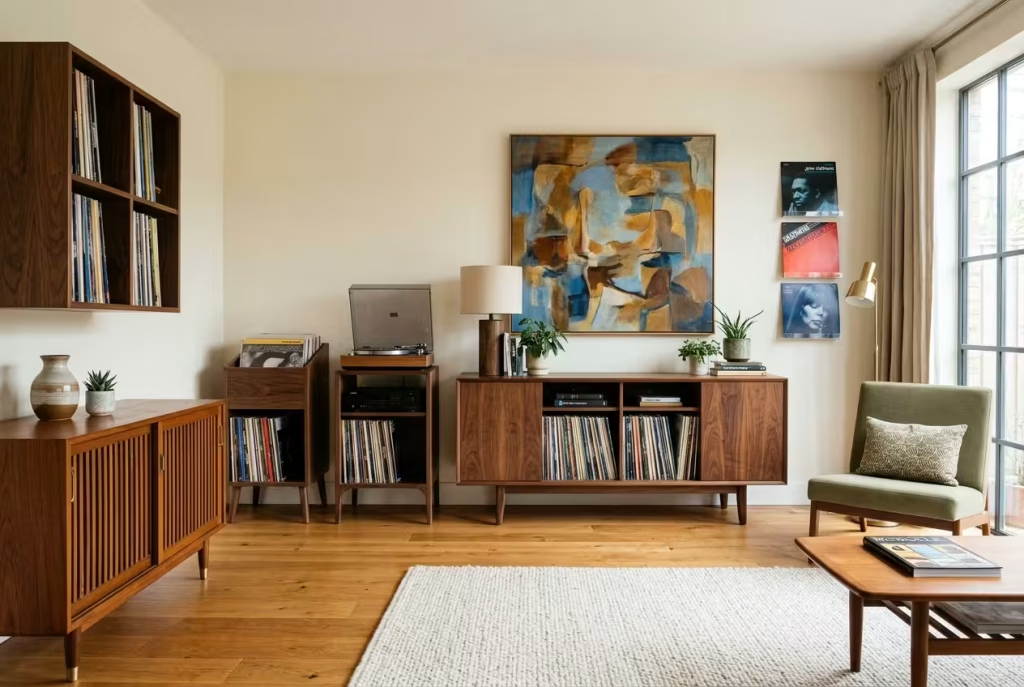
Prices are those listed at the time of writing, mostly in US dollars where the item is sold there, so convert and check before ordering.
| # | Idea | Rough capacity | Price signal |
| 1 | Low walnut credenza, open bays | About 300 across two bays at around 200 cm | Varies by maker |
| 2 | Slatted sliding-door cabinet | About 150 (Modway Render) | $165; closed alternative $599 |
| 3 | Flip-bin browsing credenza | Up to 420 (Symbol Unison, 52 in) | Premium, handcrafted |
| 4 | Angled display credenza | Fewer than a boxy unit | Premium; bespoke walls from $20,000 |
| 5 | Vintage Danish credenza | Varies; depth 40 to 50 cm | Listed $1,118 to $2,388 |
| 6 | Kallax on tapered legs | 50 to 90 per cube | About £49 (UK) plus legs at $20 to $40 |
| 7 | Sideways Kallax with doors | By unit and layout | Kallax plus doors and legs |
| 8 | Built-in beside the fireplace | Made to measure | Joinery quote |
| 9 | Vinyl bookcase | Lower box for records | Varies by maker |
| 10 | Stacked modules, media shelf | 50 to 90 per cube; one unit ~250 in use | Mesh cubes about $57 for three |
| 11 | Record player stand column | Records at the base | Made to order |
| 12 | Three-tier stand | About 100 | $31.99 |
| 13 | Speaker stands beside storage | Not applicable | Varies |
| 14 | Listening-bar corner | One cabinet plus a chair | Varies |
| 15 | Groove shelf, acrylic ledges | 3 per shelf, 1 to 2 per ledge | $29 to $42; 8 ledges about $14 |
| 16 | Wood frame display | One | About $97 |
| 17 | Now-playing holder | 50 to 75 | About $50 |
| 18 | Crate on feet, ottoman | 50 to 75 | $17 to $1,275 |
| 19 | Tiered stand, magazine rack | A handful | $40 to $295 |
You May also Like: 25 Japanese Reading Nook Secrets for a Perfectly Calm Home
Zone One Credenzas and Sideboards
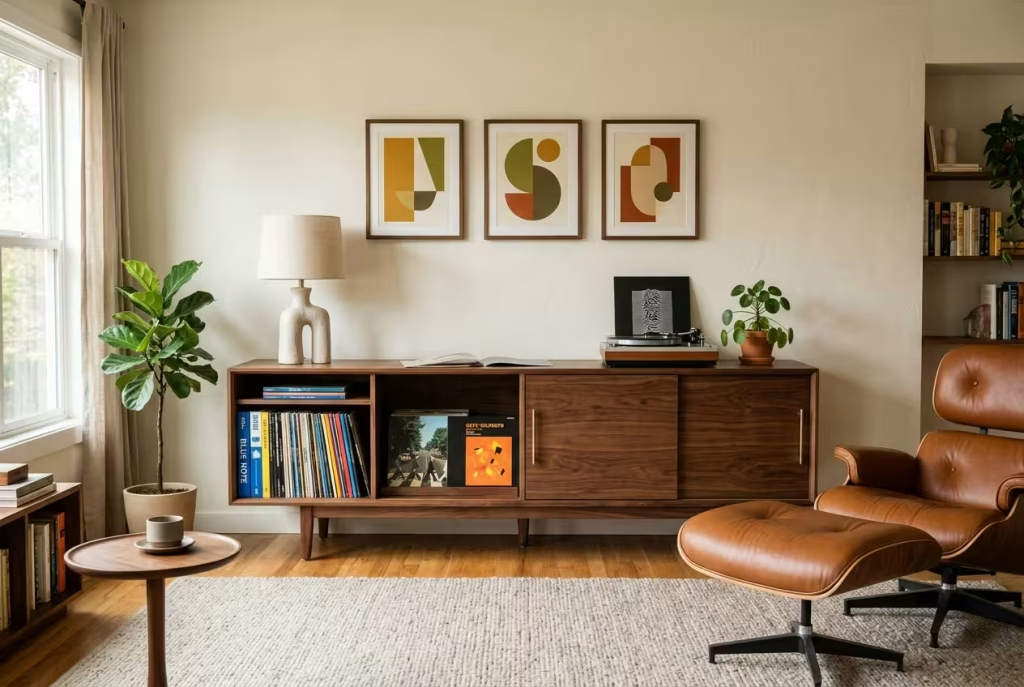
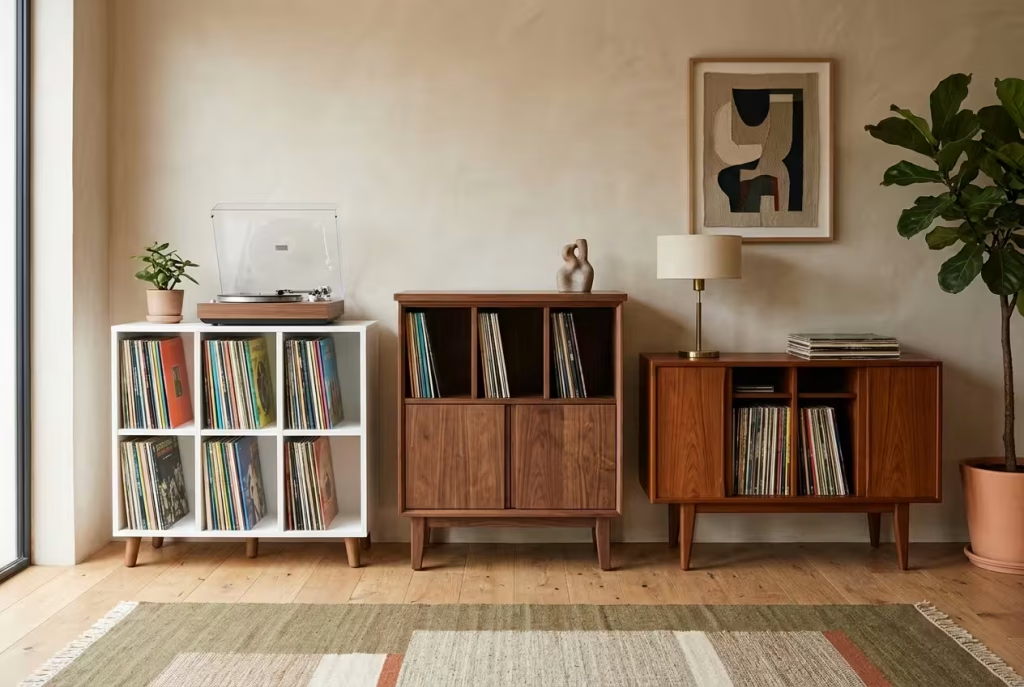
The long, low credenza is the beating heart of mid-century storage. It echoes the radiogram cabinets of the 1950s and 60s, it settles under a window or a run of framed prints without raising its voice, and its top becomes a small gallery for a lamp, a plant and a turntable.
1. The Low Walnut Credenza With Open Bays
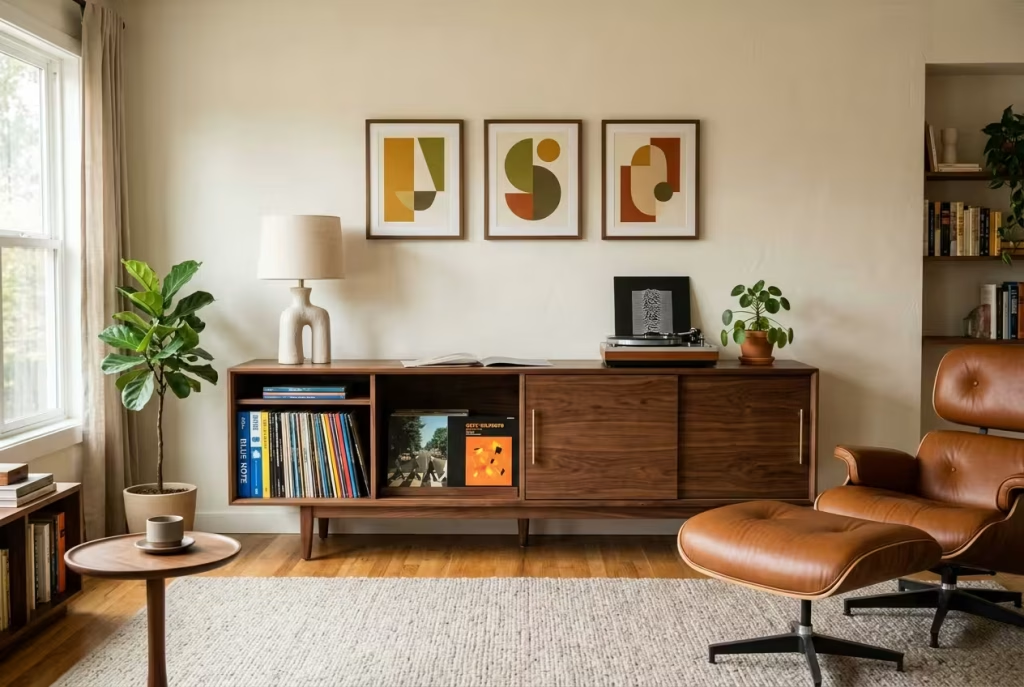
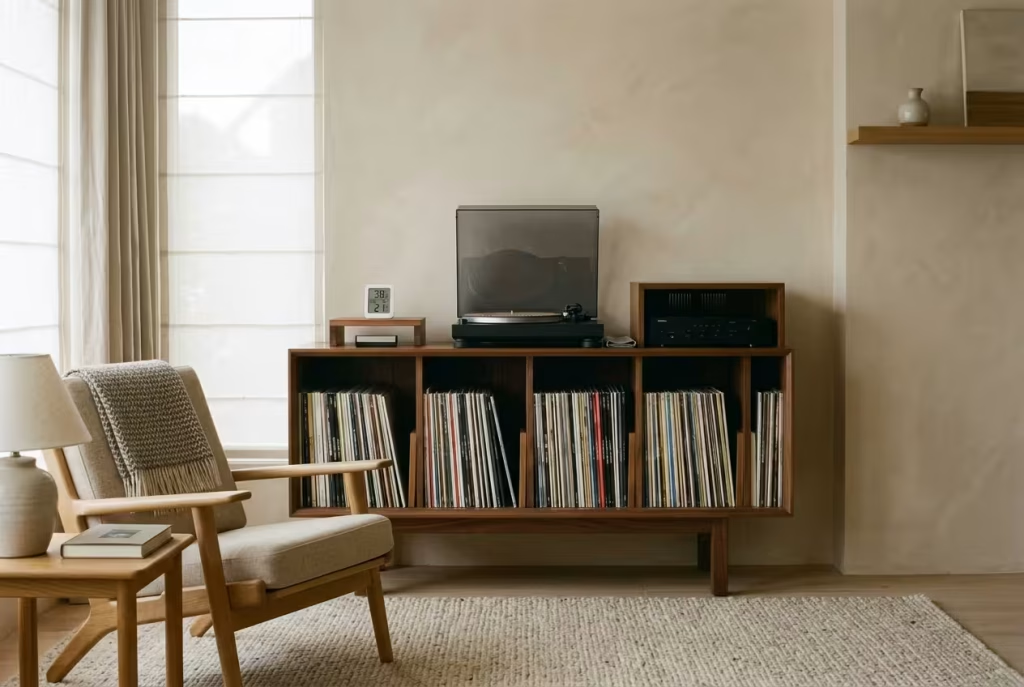
Open bays are the purist’s choice. Spines form a mosaic you can read from the armchair, flicking through takes seconds, and nothing stands between you and the music. Look for a body around 140 to 180 cm wide and 40 to 45 cm deep, standing 70 to 75 cm high on tapered legs, the proportions dealers list for genuine mid-century pieces.
That height has a neat side effect. Comfortable turntable height is generally put at 75 to 90 cm, so a credenza at the top of that range lets you cue a record without stooping, and one at 70 cm asks for a little bend. As a capacity yardstick, one owner reports fitting about 300 records into an 80-inch (roughly 203 cm) West Elm mid-century console across two bays, with the shelving taken out to use the full height.
Mind the divider question. Plywood Project suggests bays of 40 to 60 cm, while the Library of Congress prefers support every 10 to 15 cm. Split the difference sensibly: keep bays short, and wedge a heavy bookend into any bay you leave half full so the run cannot slump.
Who it suits: the listener with 200 to 400 records who browses on impulse and likes the collection to be part of the decor.
2. The Slatted Sliding-Door Cabinet
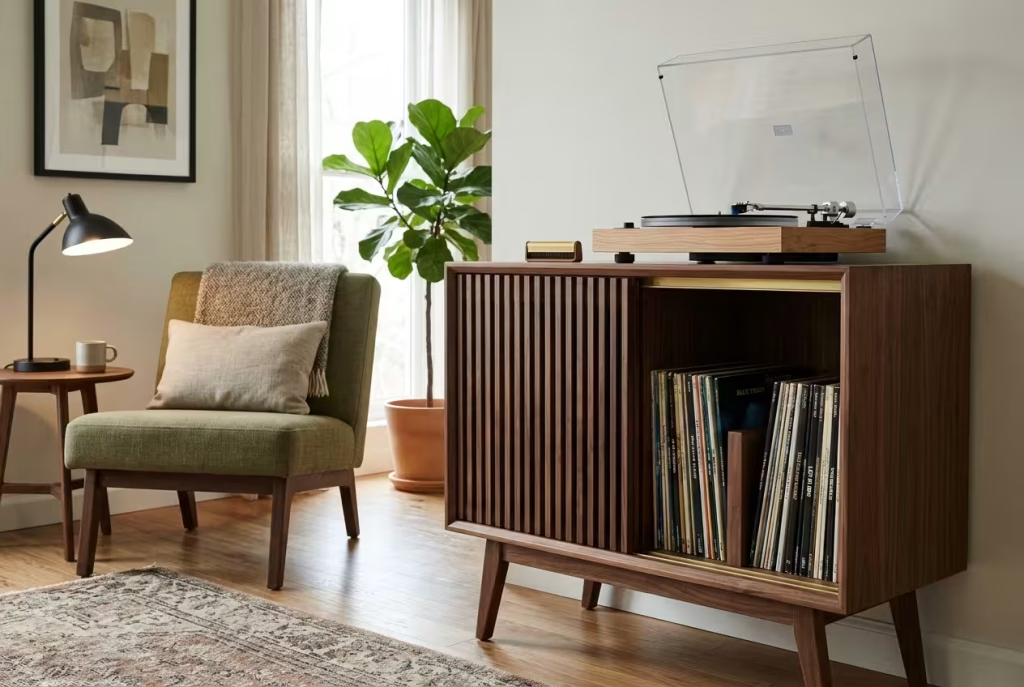
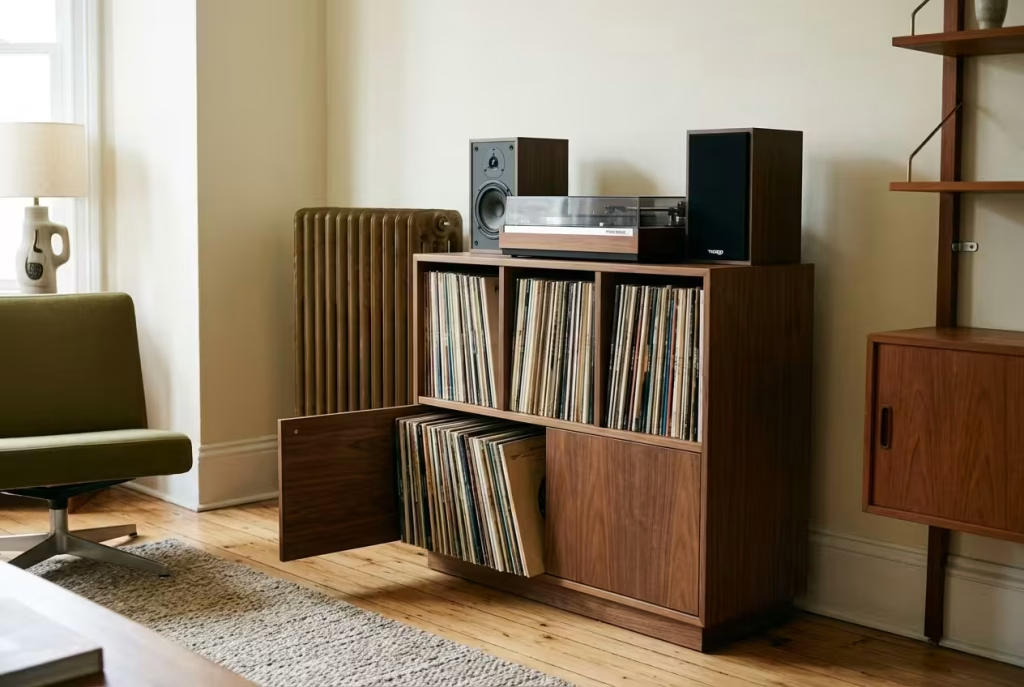
If the sight of spines nags at you, a slatted sliding door offers a gentle compromise. It hides the collection when guests call round, yet it glides aside with no swing arc and no hinge clearance, which sidesteps the commonest complaint about doors. As one r/vinyl regular put it, most people dislike doors on record storage because they limit access, and hinges often cause trouble.
The Modway Render shows the idea in miniature at $165 in the US. It has a solid walnut slatted door on a frame of MDF with walnut veneer, and measures 36.5 x 22 x 17.5 in, which is about 93 x 56 x 44 cm. Reviewers say it holds roughly 150 records and a turntable on top. At only 56 cm tall, though, its top sits well below the 75 to 90 cm playing height, so it suits someone listening from a low lounge chair more than a stand-up cueing enthusiast.
The cost-conscious alternative is Urban Outfitters’ Clara two-door cabinet at $599, a closed design with a top sized for a player. Whichever you choose, run the door test: close it against a real sleeved record before you commit. And if you spot a flip-top console that hides the turntable under a lid and the records behind a sliding panel, the sort of piece one r/vinyl user lamented as out of stock, treat it as a design pattern worth hunting for on the vintage market.
The catch: measure a large turntable’s footprint and dust-cover swing against that compact top before ordering.
3. The Flip-Bin Browsing Credenza
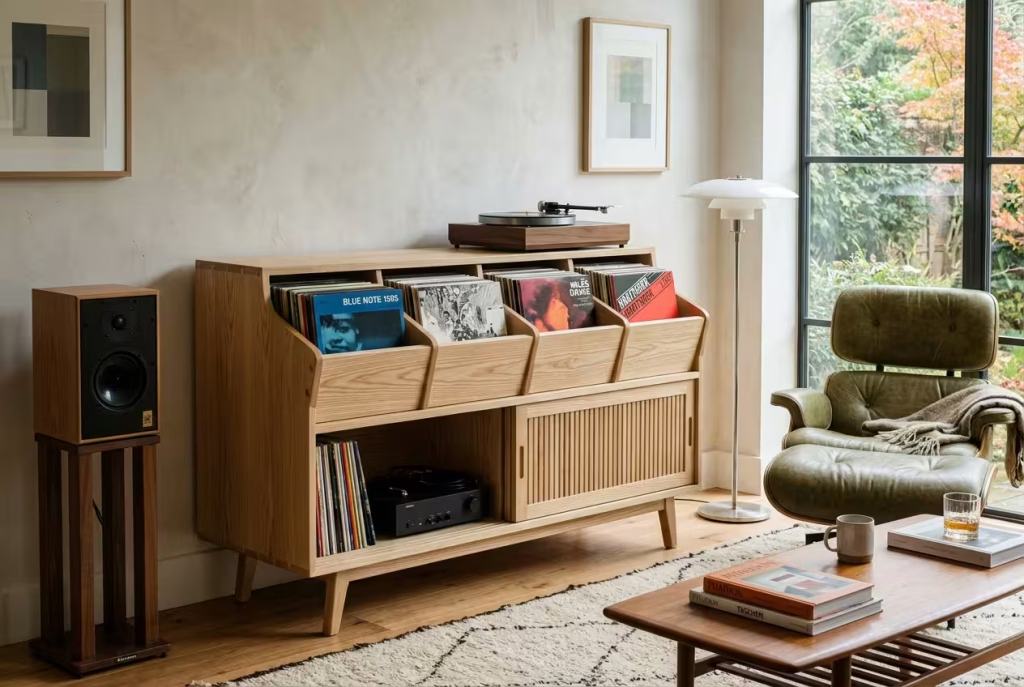
There is a reason record shops use bins. Covers face you, so browsing feels like hunting through a favourite shop on a Saturday afternoon, one sleeve leading to the next. Symbol Audio, a New York firm run by the father-and-son team Blake and Walker Tovin, builds credenzas topped with flip bins in that spirit. Its 52-inch Unison, in natural ash and measuring 34 x 52 x 18 in (about 86 x 132 x 46 cm), is reported to hold up to 420 LPs and tucks a vibration-isolated turntable platform behind a swinging door.
The craft story adds weight to the price. According to the American Craft Council, Symbol partners with a small West Virginia factory and sources about 90 per cent of its American hardwoods within 70 miles of production. An entry-level 24-inch Unison exists for smaller rooms.
Expect trade-offs. Cover-forward browsing eats more floor than a plain run of spines, and handcrafted American-made pieces sit at the premium end of the market. Ask yourself honestly whether the joy of flicking through covers is worth another square metre of living room.
Fit check: the swinging door needs clear space to open, so allow for its arc before settling the layout.
4. The Angled Display Credenza
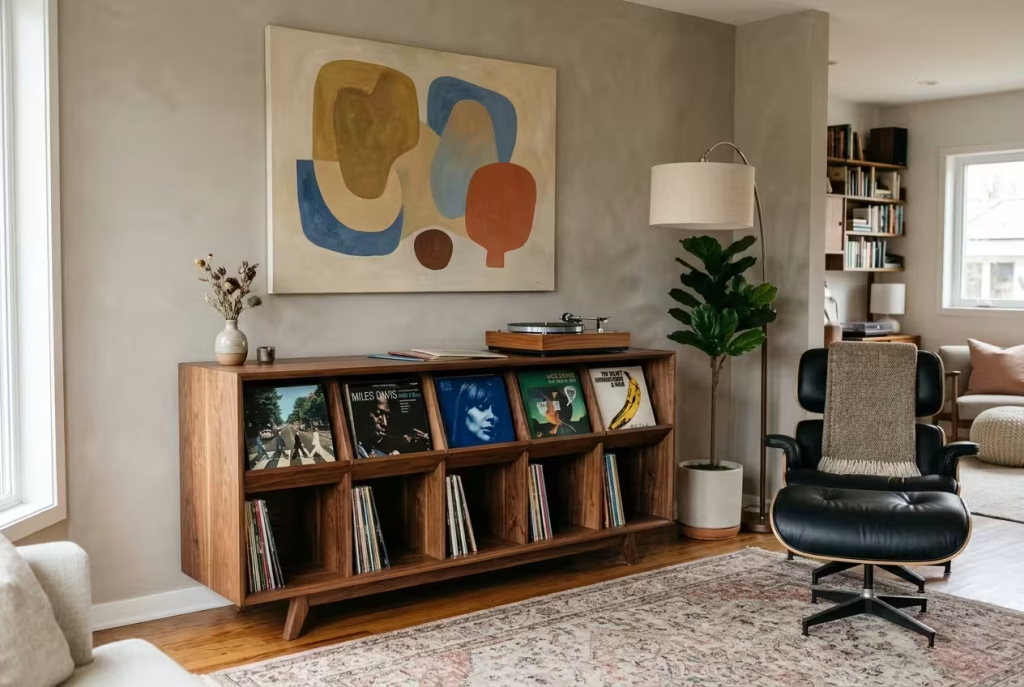
A little theatre goes a long way. Los Angeles studio Geology designed its Open 45 credenza, 21 x 60 x 21 in (about 53 x 152 x 53 cm) in oiled walnut, to hold records on a 45-degree slant, so each cover reads like a small painting. Its dividers slide, the shelves move, and a cord channel runs the whole length so cables vanish. The founder says the piece grew from a simple frustration: he was not using his record player enough, so he built something that made listening easy and appealing.
This is design-led furniture rather than bulk storage, so it will hold fewer records than a plain box of the same width. Treat it as the feature wall beneath a mirror or big canvas, and keep the main body of the collection elsewhere. For a lighter, brighter cousin, Architectural Digest rates the modular Sound-Rack cabinet by Ludovica and Roberto Palomba, around $828 after a 20 per cent discount, whose transparent shelves can be rearranged to separate LPs, 7-inch singles, speakers and a turntable.
Geology also builds the extreme version, a wood-and-steel Wall of Sound that carries up to 30 linear feet of vinyl and anchors to the wall with magnetic cover plates. The American Craft Council puts such installations at upwards of $20,000. Keep that figure in your pocket as the ceiling of the market.
Worth knowing: capacity is the sacrifice, so pair it with plain storage out of sight.
5. The Vintage Danish Credenza
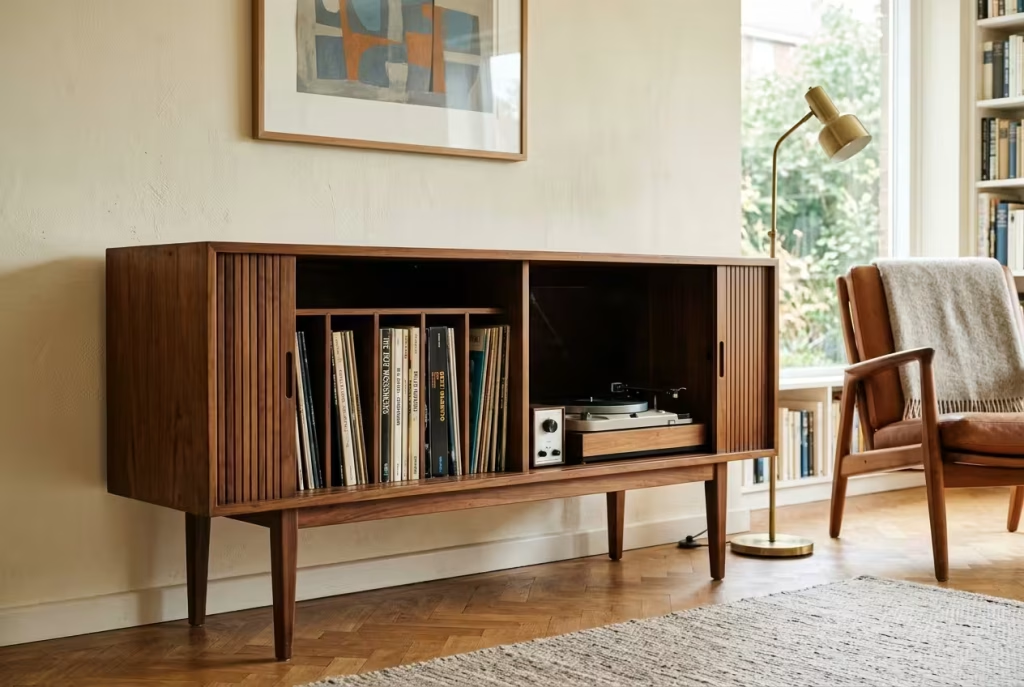
For the real thing, nothing beats a piece with a past. Danish and American makers produced hi-fi and record cabinets through the 1950s and 60s, and dealer listings name Arne Vodder (a tambour-door hi-fi cabinet for Sibast), Poul Cadovius (a record cabinet with dividers on hairpin legs), Edward Wormley for Dunbar and Jens Risom (a walnut tambour stereo console), plus Clairtone’s G2 console from Vancouver. Typical sizes run about 140 cm wide, 40 cm deep and 75 cm high, and 40 to 50 cm of depth swallows a 31.5 cm sleeve with room to spare.
Asking prices in the listings I reviewed ran from about $1,118 for a small three-drawer sideboard to about $2,388 for a 140 cm record cabinet, so treat them as signposts rather than quotes. Buying well takes patience. Ask dealers to ring you when a larger piece arrives, check Marketplace regularly, and request interior measurements in writing every time.
Inspect with a cynical eye. Look for sun-faded tops, veneer lifting at the edges, wobbly legs and sticky tambour doors. And beware optimistic labelling: one r/Mid_Century thread went viral when a buyer was sold a piece as an LP cabinet that plainly was not, a reminder that a ‘record cabinet’ tag is only as good as a tape measure.
The payoff: a cabinet already built for the job, depth and dividers included, with a story you can tell over a cuppa.
Zone Two Shelving, Bookcases and Built-Ins
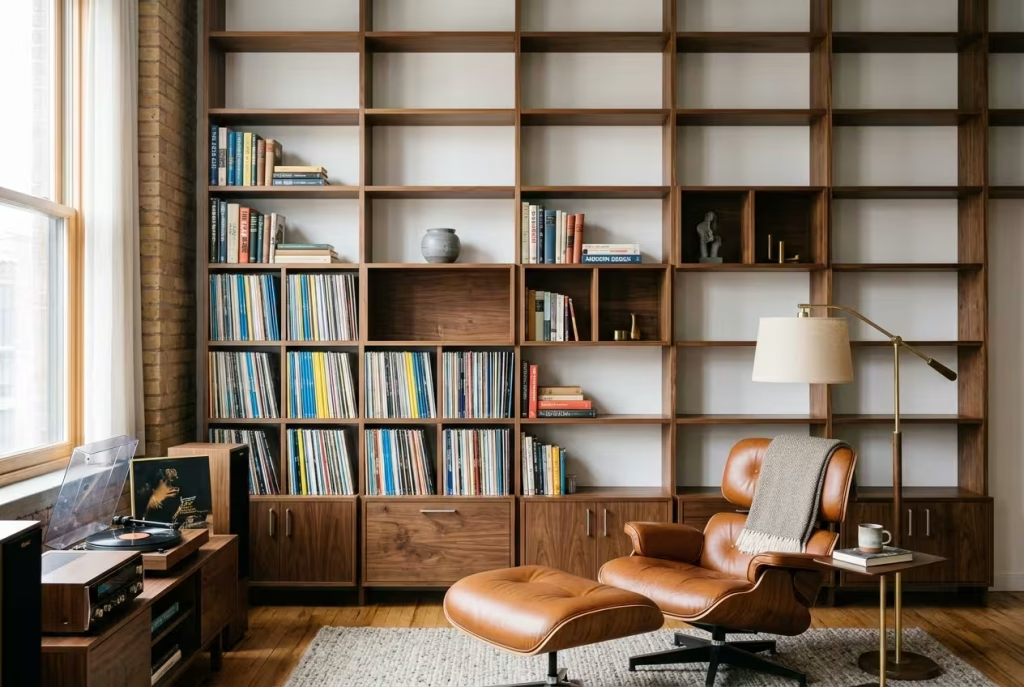
Where a credenza stays low, shelving climbs. Done well, it turns a record collection into architecture, with the colour of the spines doing the decorating. Done badly, it becomes a grey wall of laminate that swallows the room whole.
6. The Kallax on Tapered Legs
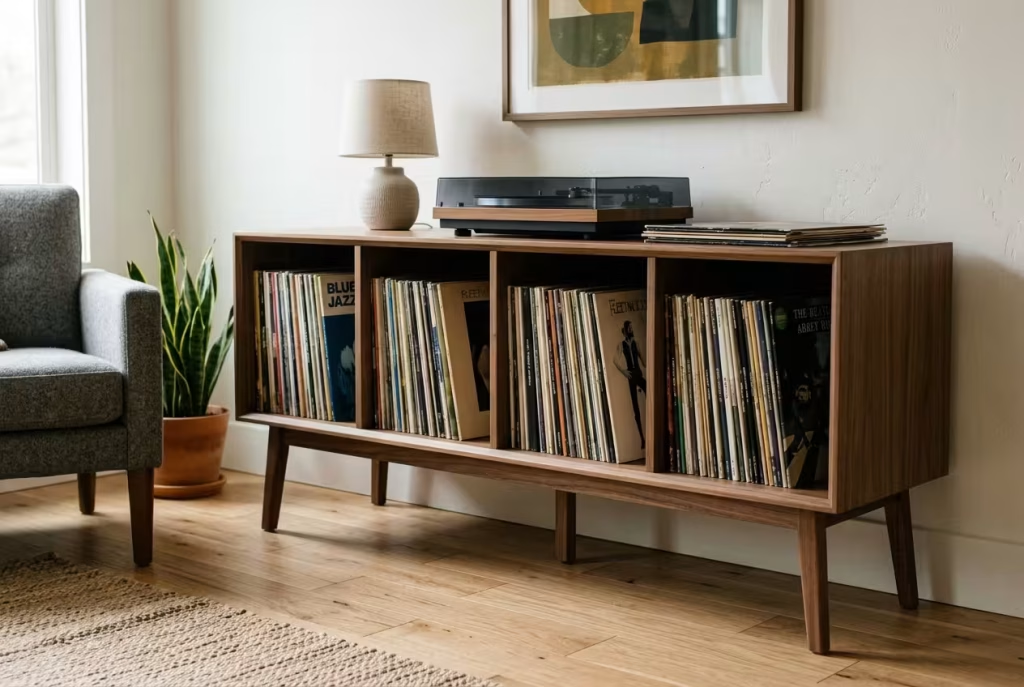
IKEA’s Kallax is the world’s default record shelf, and a set of mid-century legs is the cheapest route to a convincing look. In the UK the Kallax has been trimmed to about £49 from £60, although the source did not name the size, so check on the day. A four-pack of tapered legs costs about $20 to $40 online, against roughly $400 to $600 for a comparable mid-century shelving unit in a shop.
Legs fix the one aesthetic sin everybody names: cubes sitting flat on the floor make a room feel weighed down. A veteran collector on r/vinyl adds two practical grumbles, namely that a floor-hugging unit is a nuisance to vacuum around and can block forced-air or return ducting. Lifting it clear solves both.
Here is how the job goes, according to people who have done it:
- Assemble the unit, then tip it over with a helper so the legs are not bent on the way up.
- Mount the legs slightly inward from the corners, which lets the back sit flush with the wall.
- Add a centre leg beneath any cube that will carry a full load, as one DIY blogger did to cure sagging.
- Level the unit, then fix it to the wall at the top corners, where the brackets stay out of sight.
Now the honest part. IKEA rates each shelf at 13 kg (29 lb), yet a full cube holds roughly 16 to 25 kg of vinyl. Owners split down the middle: some report years of loaded service with no dip, others report bowing. Take the rating as a warning label rather than a ban, support the middle of the span, and keep the heaviest box sets low. If you prefer a plinth, IKEA also sells an underframe of about 146 x 39 x 18 cm that makes vacuuming easy.
Cost check: well under £100 for the basic unit, plus a few pounds for legs.
You May also Like: 25 Beautiful Modern Farmhouse Home Office Ideas for a Stylish Workspace
7. The Sideways Kallax With Doors and a Top
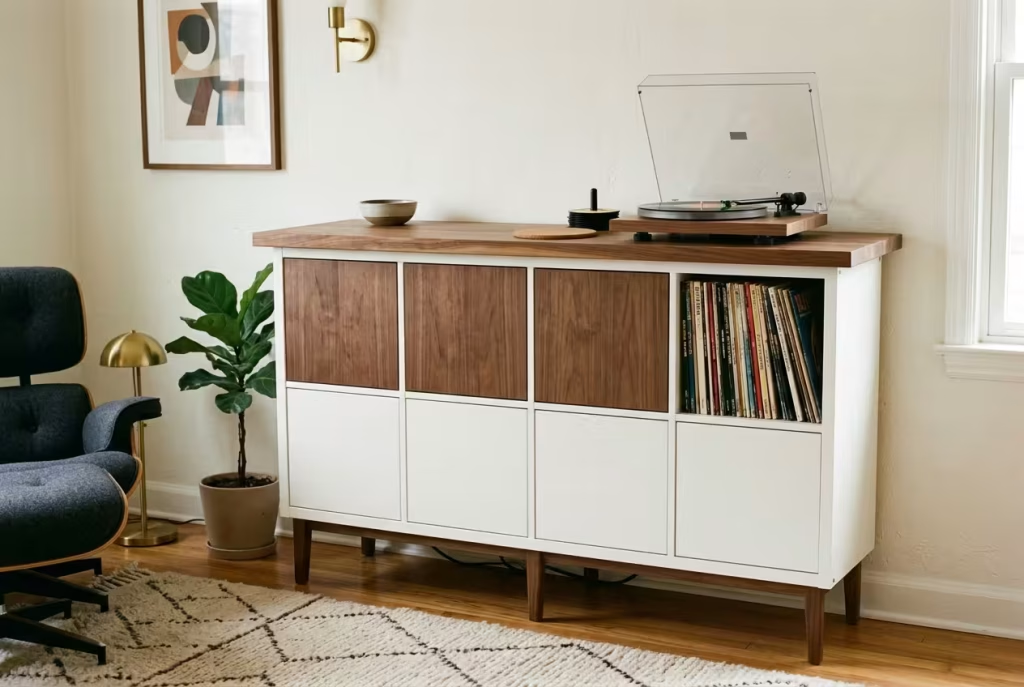
Turn a wide Kallax on its side, add doors and legs, and you have a credenza that has fooled the eye for years. One r/vinyl owner built just that from a two-by-four unit with IKEA doors and legs, and has run two such setups for years without trouble. Designers have documented similar looks, among them a Berlin version with slim cabinet doors and ultra-thin tapered legs on a single-shelf, four-cubby unit.
The proportions happen to flatter a turntable. A 2×4 laid on its side stands about 77 cm high and 147 cm wide, so the top lands inside the 75 to 90 cm playing range before the legs are even added. Eight cubes at 50 to 90 records apiece comfortably cover the 300 that one hopeful poster needed, though a full load could push towards 128 to 200 kg in total. That is a lot to ask of the corner joints, so spread it over four or more legs.
A solid timber or butcher-block top turns the box into proper furniture, and doors tuck leads and clutter out of sight. Livingetc’s roundup credits this pairing, a turntable on top and cables behind doors, with the mid-century mood. For an alternative flat-pack, IKEA’s Eket cabinets can be stacked, wall-mounted and fitted with mid-century-style legs, and once the internal shelves are removed, records slot straight in.
Trade-off: doors add thickness, so test that they close over a loaded shelf before you drill a single hinge hole.
8. The Floor-to-Ceiling Built-In Beside the Fireplace
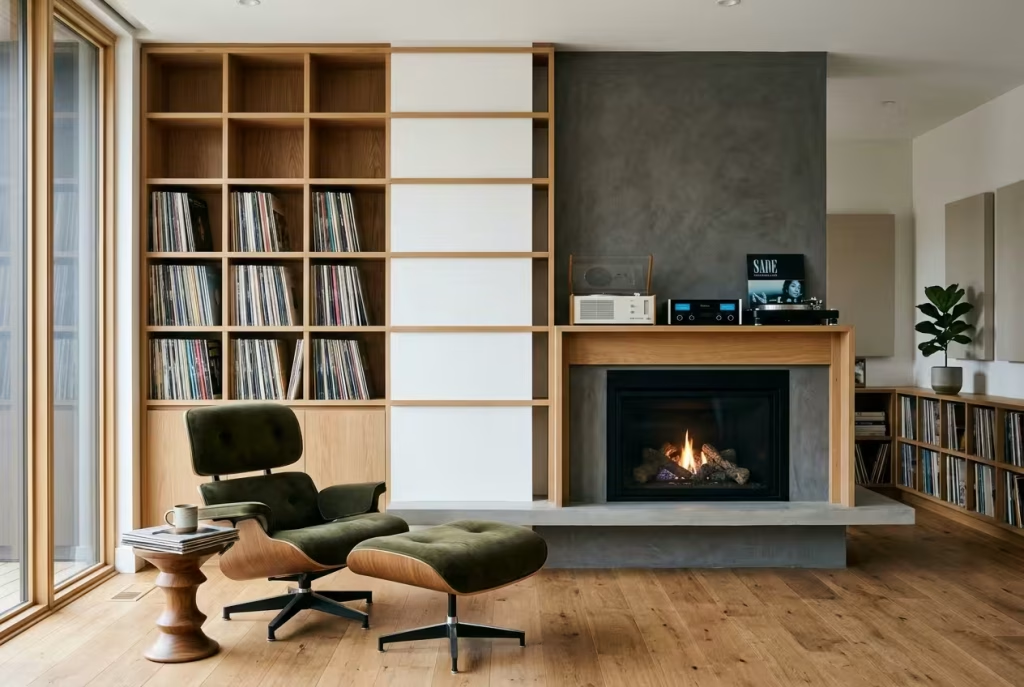
When the wall is fixed, build around it. Architectural Digest featured a 600-square-foot Los Angeles listening room by Lisa Checo of OOAK Design Studio, inspired by Japanese listening bars. White oak runs from the wide-plank floor to a built-in with an integrated fireplace and cubbies sized specifically for vinyl. The idea shrinks happily into a British alcove, where a chimney breast offers a ready-made frame.
Give your joiner a written brief rather than a sketch. These numbers, drawn from the sources above, keep the project honest:
| Detail | Specification to request |
| Cubby clear width | 33 to 35 cm |
| Clear depth | 33 cm or more after the back panel |
| Upright spacing | A fixed divider every 40 to 60 cm at most |
| Shelf load | Comfortably above 52 kg per metre, the Library of Congress average |
| Adjustability | Shelf pegs, so gatefolds and singles can have their own bays |
Heat deserves its own paragraph. The Library of Congress advises keeping discs away from radiators and vents, and a working fire is a stronger source still. Place the cubbies on the far side of the chimney breast, or leave a generous air gap, and never box in a flue or radiator. A built-in is the one idea here you cannot move later, so put the records where the room stays cool and the afternoon sun never reaches.
For homeowners only: this is joinery, with the cost to match, so get a written quote.
9. The Vinyl Bookcase With Records at the Base
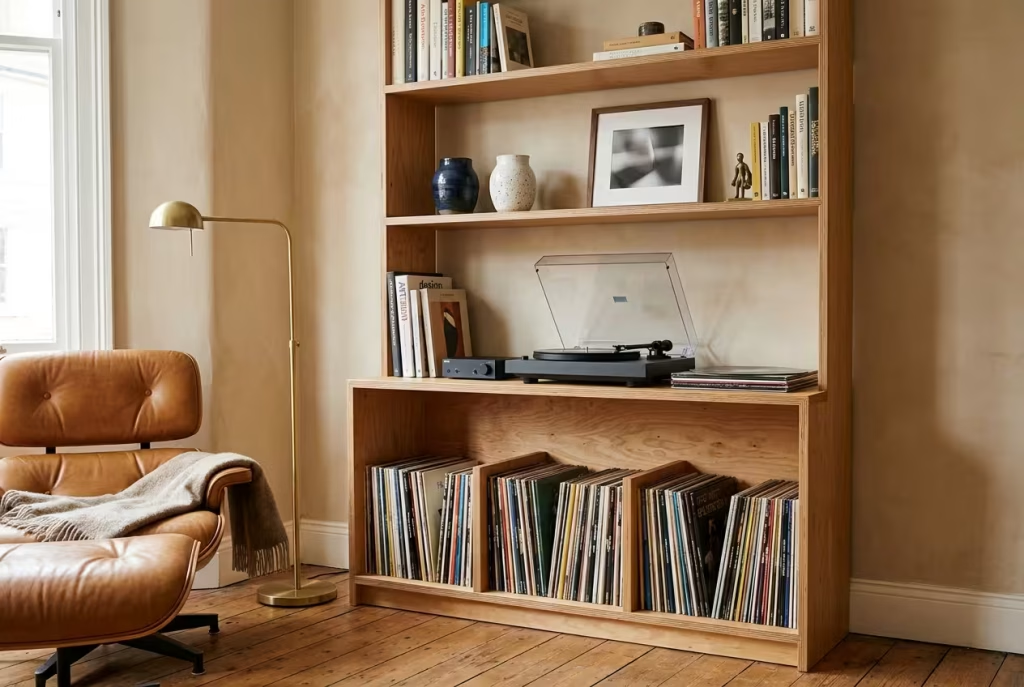
Physics always favours the low shelf. A tall bookcase with a lower box for LPs puts the heaviest load where it belongs, at the bottom, while books, ceramics and framed photographs share the upper tiers. Plywood Project’s 190 cm Maxi bookcase follows that logic, with records below and a turntable at playing height in between, and its 140 cm Midi suits a lower ceiling.
The maker argues for birch plywood on two counts. Cross-banded layers resist sagging over a span, and the exposed laminated edge is a signature mid-century detail. It adds that its pieces are made to order in Poznan from Finnish birch and finished with hard-wax oil. That is the manufacturer’s own account, so weigh it accordingly, but the principle stands for any bookcase: short spans, thick boards and the heavy cargo kept low.
Tall furniture earns a wall fixing. Anchor the bookcase even when the lower box feels reassuringly solid, because the books above change the centre of gravity every time you rearrange them.
Field note: place the turntable at hand height on the middle tier, and you get a listening station that reads as a library rather than a hi-fi rack.
10. Stacked Modules, or a Front-Facing Media Shelf
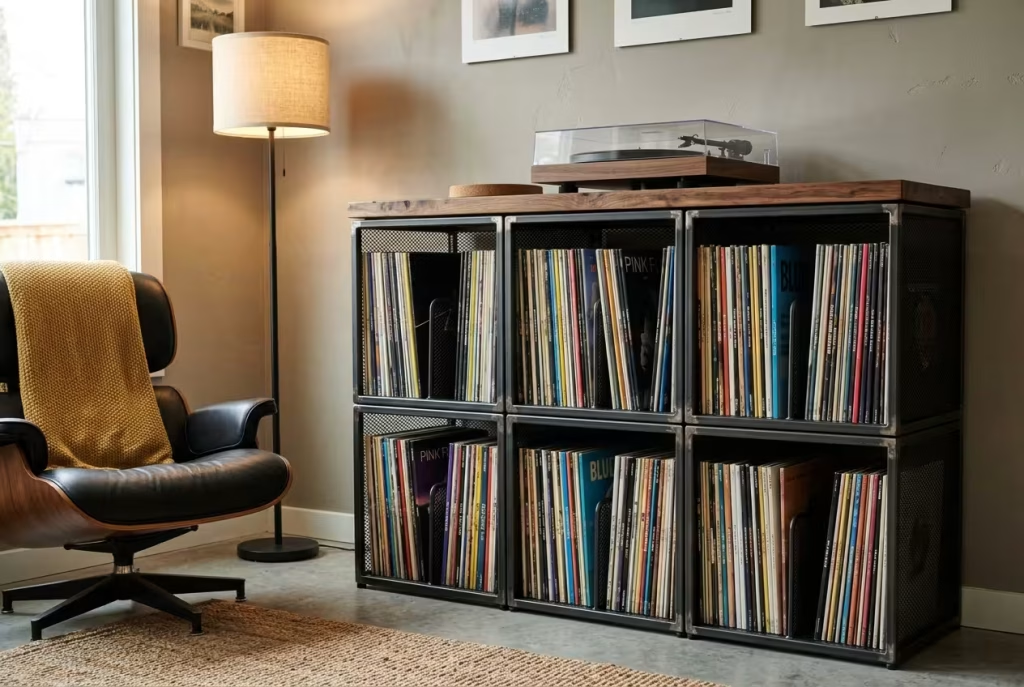
Sometimes two small units beat one large one. An AudioKarma thread, albeit from 2017, makes the case: stacked 2×2 cubes are easier to carry, easier to move house with, and said to be stronger than a single big unit. Another member suggests labelling each cube and wrapping it in cling film for the removal van, which beats boxing up hundreds of records.
For a more finished look, the Dmevkic three-cube set (about $57) has an iron mesh front, so you see the collection from across the room and reach in without opening anything. Real-world capacity is about 80 records a cube, each cube is rated to 100 lb by its maker, and one reviewer is up to 16 cubes. Reports of missing screws are worth a hardware check on arrival, and the wire flanges can snag unsleeved covers, so use outer sleeves. A warm timber board across the top softens the industrial edge.
There is a third route for those who like their covers facing out. A r/vinyl owner bought Wayfair’s Liam media shelves, about 45 in high, for about $500 on sale. They are advertised for roughly 500 albums, though he holds about 250, since box sets bulk things out. He glued every dowel during assembly and checked for locking tabs hidden behind panels. Another commenter warned that albums leaning against the half-height front rows will eventually warp, and suggested metal plates behind the last record in each row. A vinyl-specific alternative, one fan noted, can easily cost $4,000 or more.
Who it suits: growing collections and anyone who expects to move house within a few years.
Zone Three The Listening Corner
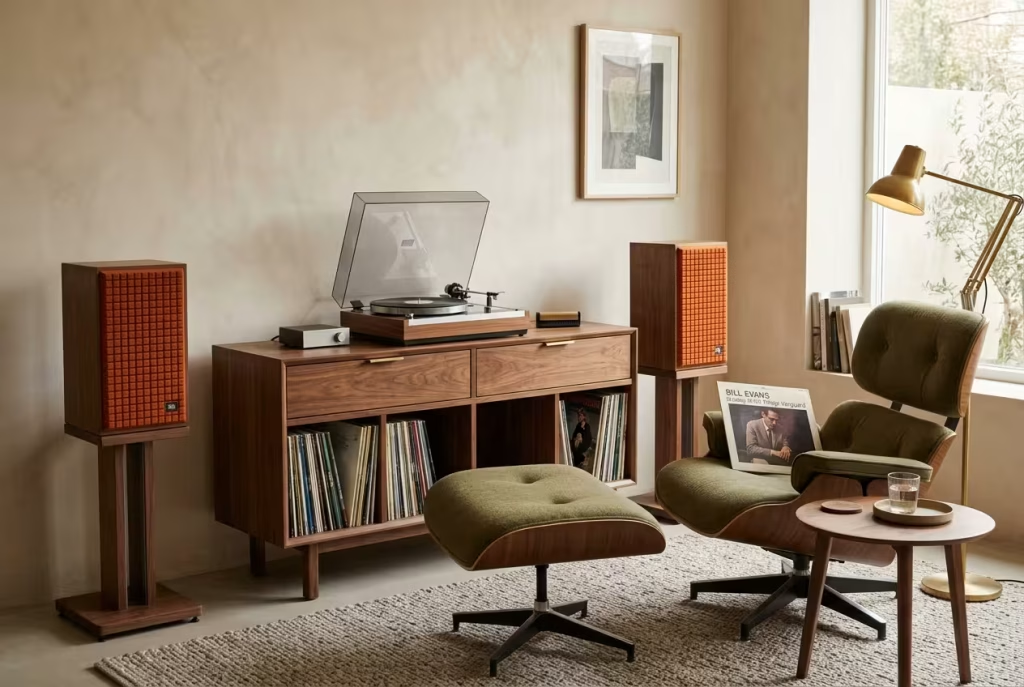
A turntable is a precision instrument that happens to live in a living room. Treat the furniture around it as part of the sound system and the whole corner plays better and lasts longer.
11. The Record Player Stand Column
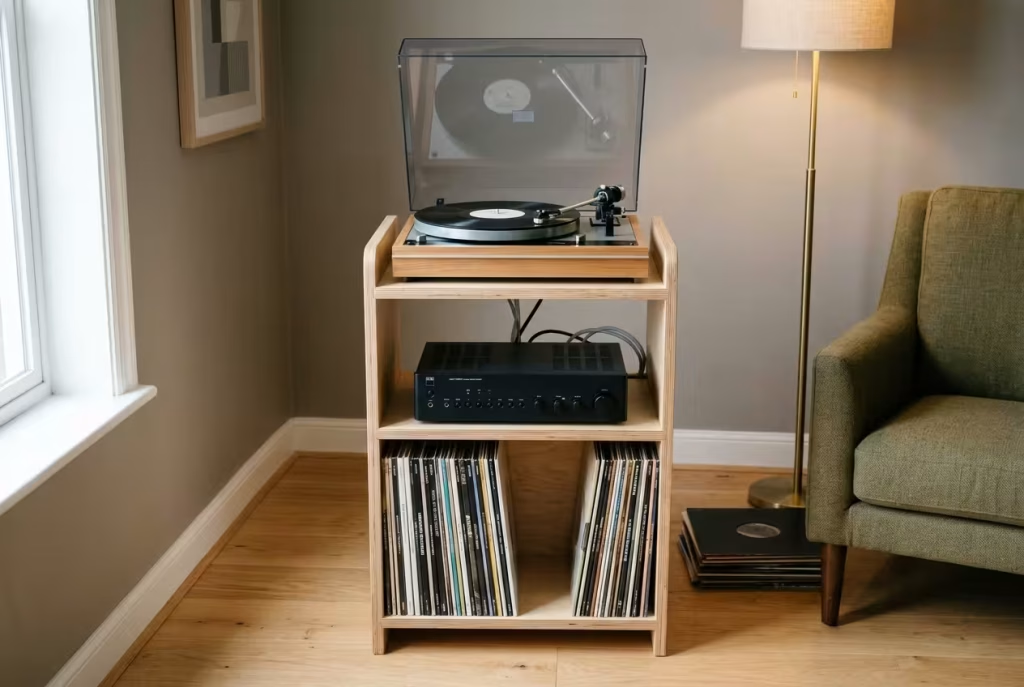
One tidy column, everything stacked in the order you reach for it: turntable on top at about 75 to 90 cm, amplifier on the shelf below, records at the base where the weight sits happily. Plywood Project’s 114 cm Midlite stand works on exactly that plan, with an open back so you can reach the connectors without hauling the piece away from the wall.
Measure the deck with its dust cover raised, and leave room behind for the cables. A shelf directly overhead is a classic blunder, because the lid jams against the wood. Leave air around the amplifier too, since covering vents can send excess heat towards the record player.
If budget allows a more designed piece, Architectural Digest flags Urban Outfitters’ Lola record stand at $329 for mid-century lines, while the KAIU holder, at about $40, takes up to 50 albums for newcomers. Either fits in the corner of a bedroom or a compact flat without demanding a whole wall.
Good to know: a stand like this lets you add records at the bottom without ever disturbing the deck above.
12. The Three-Tier Stand With a Weight Limit
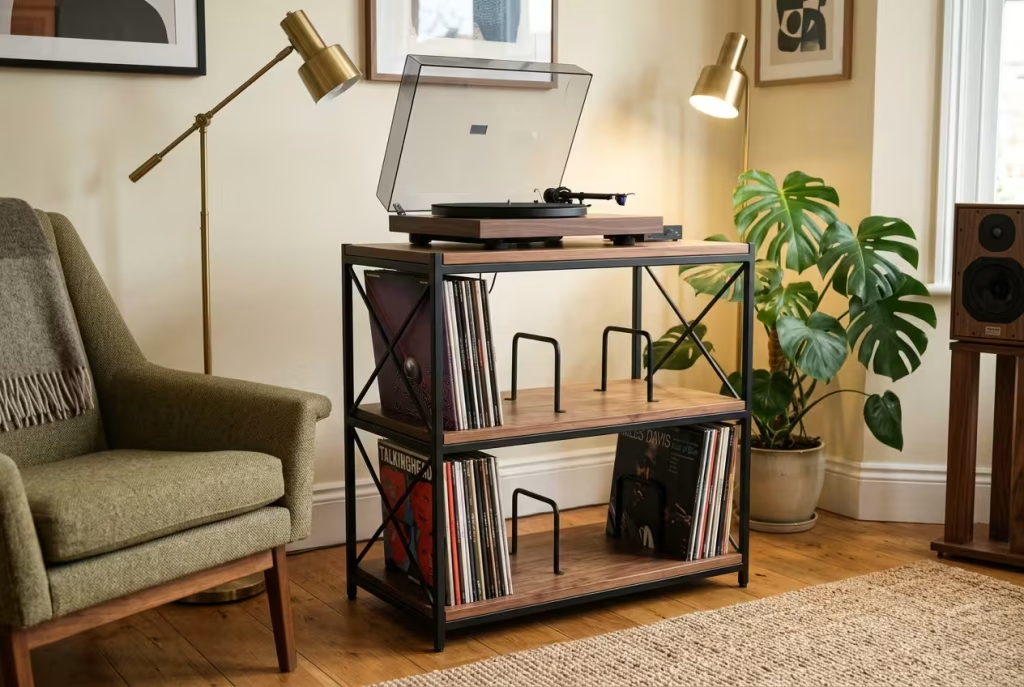
For sheer value, a three-tier stand takes some beating. The VASAGLE model, listed at $31.99 in the US, puts a turntable on top (rated for up to 44 lb) and two lower tiers with removable U-shaped dividers for around 100 albums. It has a metal frame with FSC-certified wood panels in four finishes, and about 83 per cent of its reviews are five stars.
Here the devil is in the detail. The listed depth is 11.8 in, which is shallower than a 12-inch sleeve at about 12.4 in. Check whether that figure is the whole footprint or the clear interior before ordering, because sleeves that overhang the front invite knocks and bent corners. Check your deck falls inside the weight limit too, and be wary of very large players on such a narrow top.
Its look is industrial, a point reviewers concede, so pick the warmest of the four finishes and let a lamp and a plant do the softening.
The reality: a clever, inexpensive start that stops short of heirloom status.
13. Speaker Stands Kept Apart From the Cabinet
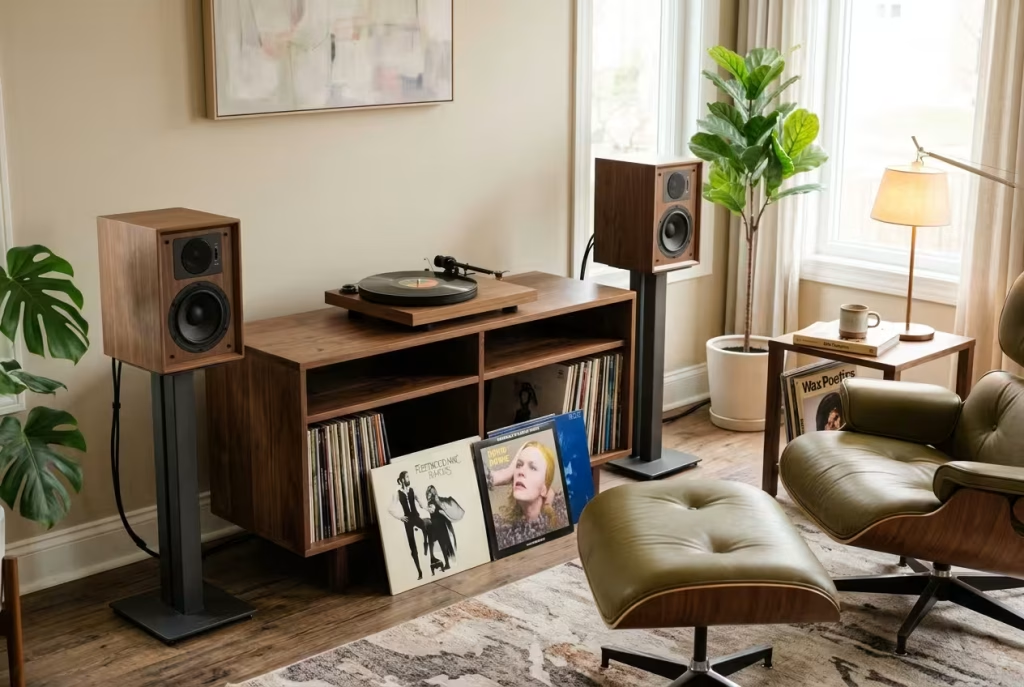
Here is the part most glossy guides skip. Yamaha’s advice is to put the turntable on a solid, heavy piece of furniture that sits firmly on the floor and does not wobble. The Audioholics forum goes further and calls the speakers the greatest source of vibration, so keep them out of the turntable’s cabinet
. Bass energy travels through timber and back into the stylus, where it can cause feedback or skipping. A neat home test from the PS Audio forum: pull the covers from your speakers, play a record, then rap the shelf with your knuckles and watch the woofers.
Architectural Digest praises a cabinet whose top suits a player and two speakers together, yet most audio guidance disagrees. The r/vinyl owner who wanted speakers on shelves met a split verdict: some said shelves are a terrible idea, others suggested wall mounts. These are the layouts worth weighing:
| Layout | How it works | Verdict |
| Floor stands beside the credenza | Speakers on their own stands, deck on the cabinet | Best, as there is no shared surface |
| Wall-mounted speaker shelves | Speakers fixed to the wall, deck on the cabinet | Good, with solid fixings |
| Everything on one top | Isolation platform or pads under deck and speakers | Acceptable when space is tight |
| Speakers on the same shelf, no isolation | Direct mechanical link | Avoid |
On a wooden floor, a heavy, level cabinet also helps stop footfall from nudging the needle. The Audioholics thread adds a calming note: heroic measures such as granite slabs are rarely needed if you avoid acoustic feedback, keep the deck level and isolate it from foot-fall vibration.
The rule: music first, matching second.
14. The Listening-Bar Corner
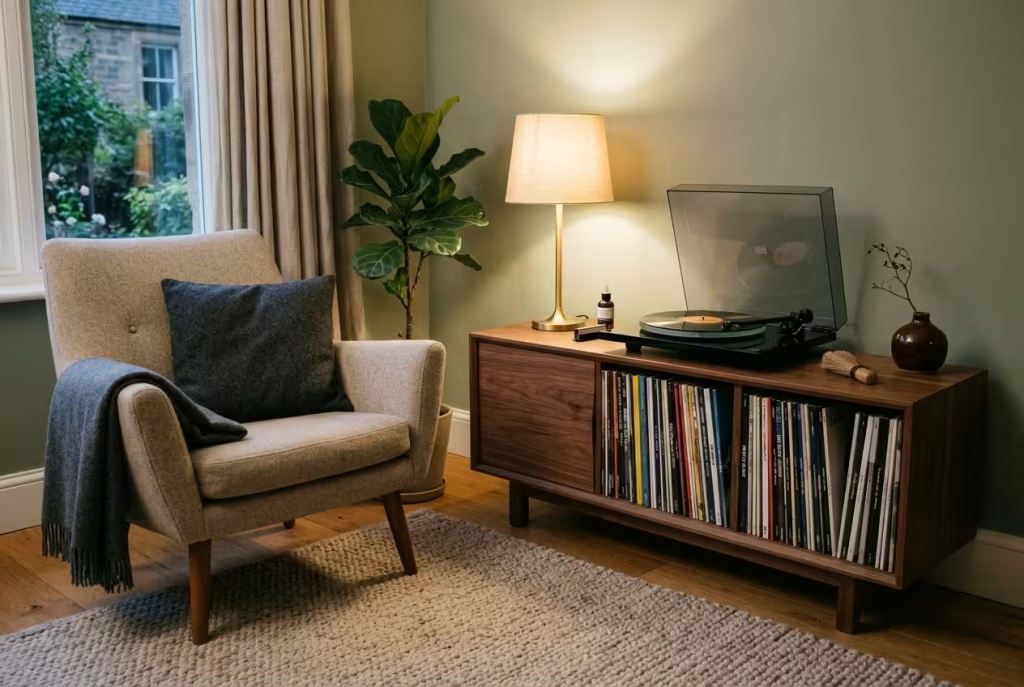
Japanese listening bars made the case that music deserves a place of its own, and the idea shrinks gracefully into a British corner. Pair one low cabinet with a single comfortable chair, a warm lamp and a wool rug, in walnut, oatmeal and one darker accent. Aim the light across the spines so titles read without glare, and keep the collection out of direct sun, which the Library of Congress warns against.
Design for one seat and design it properly. A side of an LP lasts around 20 minutes, which means the rhythm of the evening is stand, flip, sit, repeat. Those small movements are part of the pleasure, so make the walk between chair and deck short and clear of coffee tables. The corner should feel like a place you retire to, not a shelf you pass.
The feeling: an hour that belongs only to you, with the phone in another room.
Zone Four Wall and Display Ideas
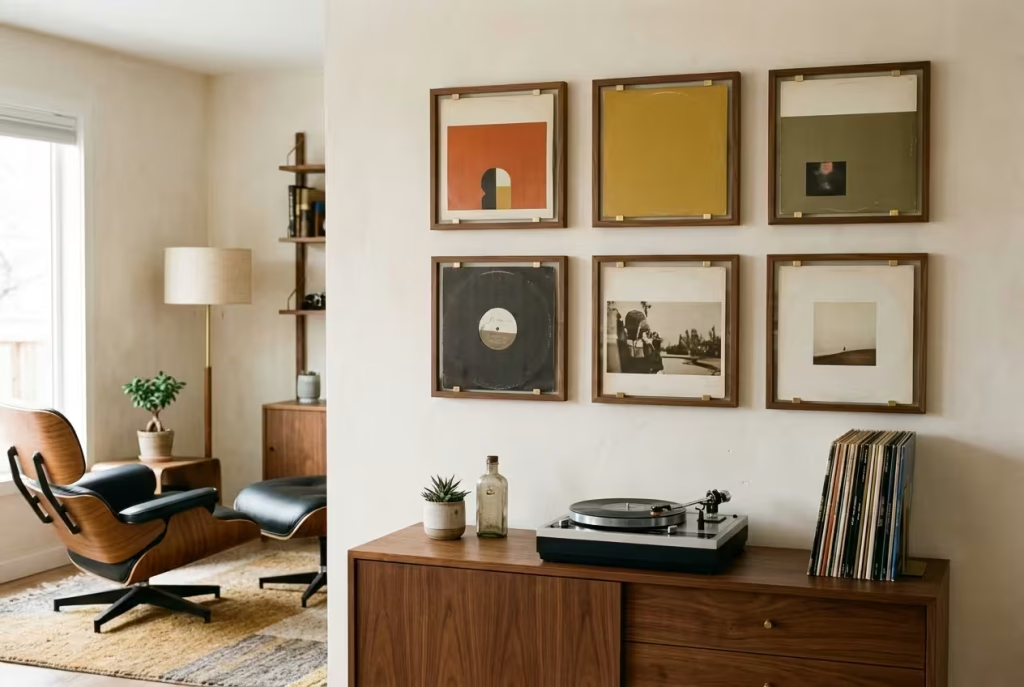
Some records deserve a gallery rather than a shelf. Display suits the albums you play most, or the ones that make you smile across the room.
15. Floating Groove Shelves and Acrylic Ledges
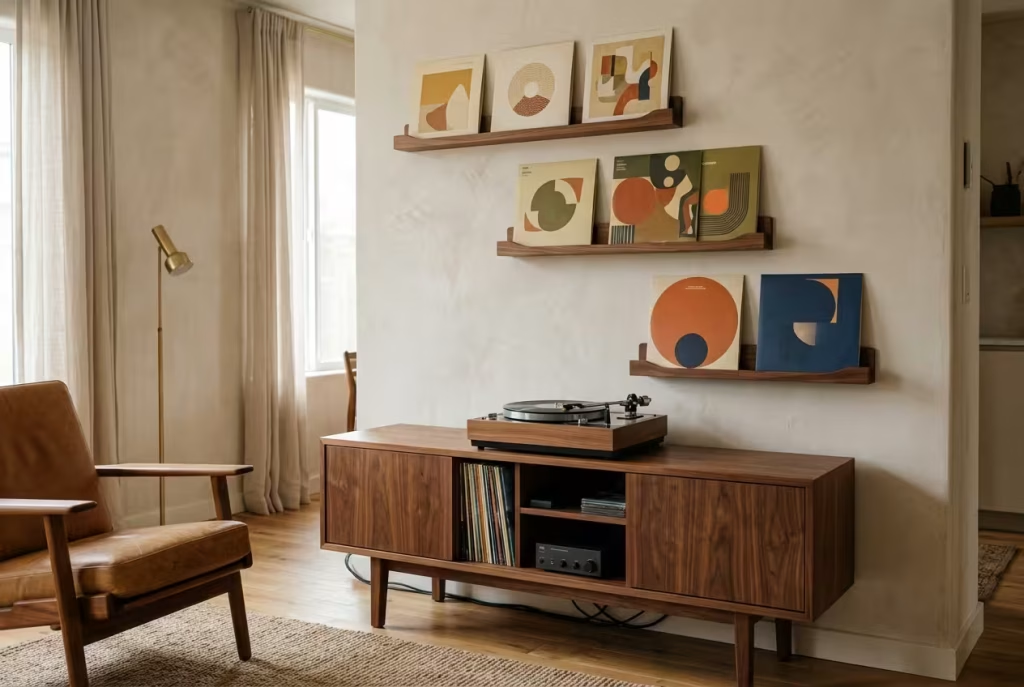
Let the cover do the decorating. A curved groove along a floating shelf, such as the Etsy design sold at about $29 to $42, holds three LPs without a ledge hiding the artwork, and mounting hardware is included. Clear acrylic ledges go a step further: an eight-pack of upsimples shelves costs about $14, each ledge carries one or two records, and the plastic all but disappears.
The usual best use is above the turntable. The record goes on the platter, the cover stays on the wall, and when the side ends you swap both, so your wall changes with your mood. Mind the limits, though. Acrylic ledges are generally rated around 5 lb each, so they suit single sleeves, and the covers fade in sun. Anything heavier belongs on studs or proper anchors, and one r/vinyl thread about a heavy, loaded wall shelf directly over a turntable drew a chorus of alarmed replies.
The verdict: a light, cheap way to rotate the albums of the week.
You May also Like: 15 Gray and Green Living Room Ideas: How to Pair Gray and Green for a Stylish Space
16. The Wood Frame Display
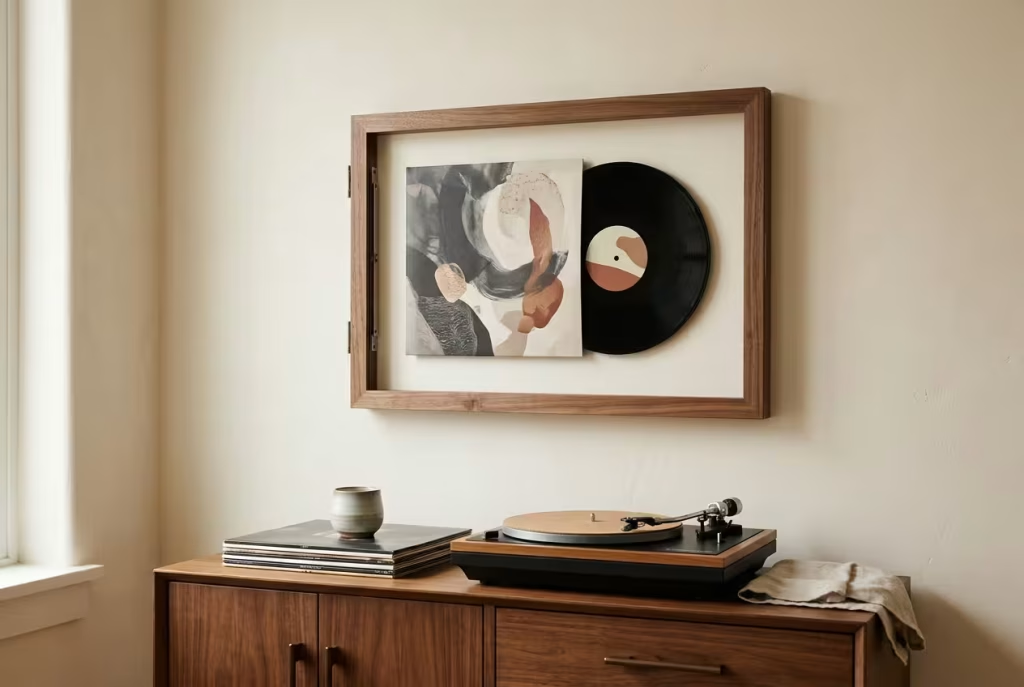
Somewhere between a picture frame and a shelf, a wooden record frame such as the Bix Design Shop piece (about $97, in walnut or oak) puts a favourite on show with a restrained silhouette. It reads as art, so it suits the space above a credenza or at the end of a hallway.
This is the right home for a record that means something, a wedding pressing or an anniversary mix. CCS Vintage reports customers framing such discs beside the cover on the wall, and notes that a single record displayed flat behind glass creates no stacking pressure. Choose a wall that stays shaded, since sunlight fades covers and warms the disc.
The heart of it: you are hanging a memory you can also play.
17. The Now-Playing Holder
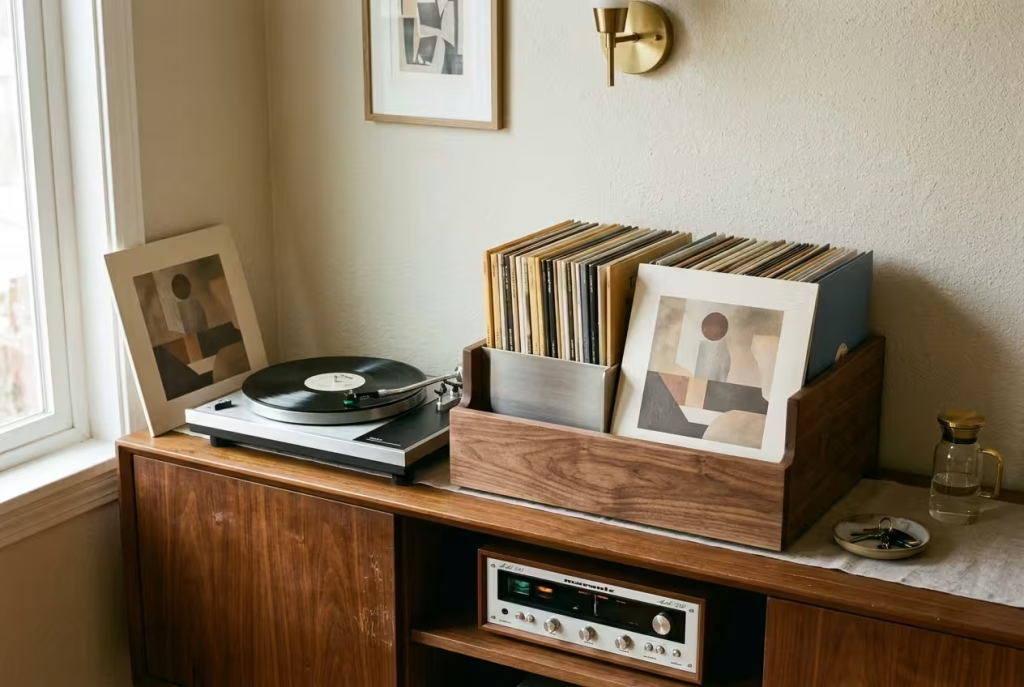
Keep what you are hearing in view. The Optage walnut holder (about $49.99) is made from solid walnut with stainless steel dividers that slot in without tools, and it holds 50 to 75 LPs upright while leaving a front groove for the current album. Capacity drops with thick gatefolds, and a 100-LP version costs about $89, so size it with your own collection in mind.
For something humbler, a collector on r/vinyl cut the front of a decorative wooden crate low, so it doubles as a display for about 30 favourites and new arrivals. The Upton LP stand, in powder-coated steel at about $59, does a similar weekly-rotation job in a minimalist style.
The psychology is simple. A favourite on view gets played, and one buried on the bottom shelf rarely does.
Zone Five Small Spaces and Portable Solutions
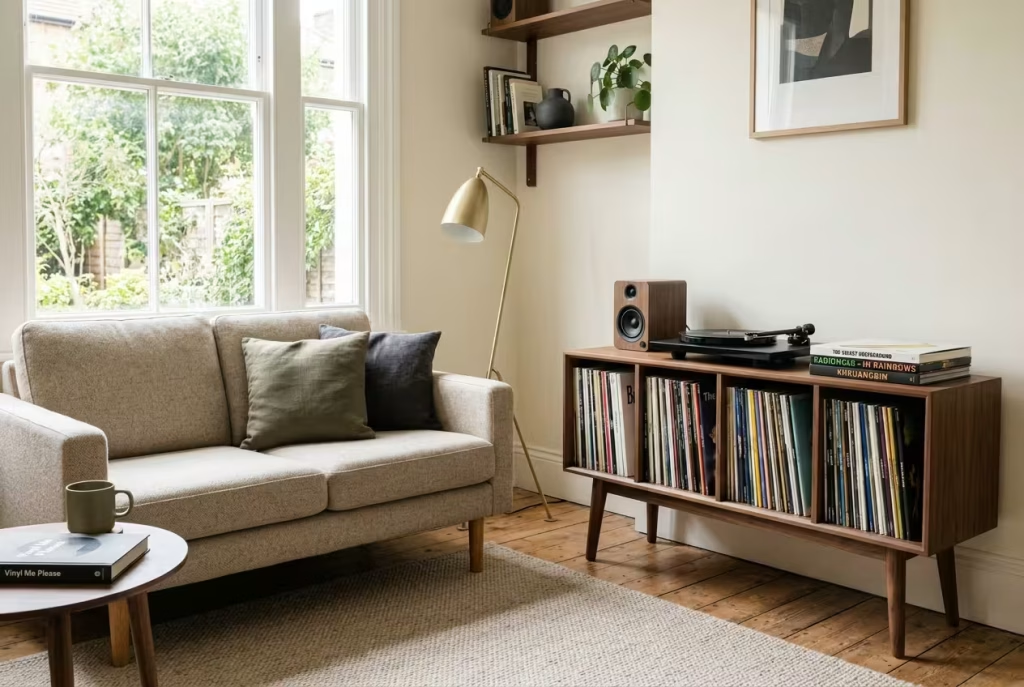
Not every room has space for a credenza, and not every collection is ready to be settled. These options flex with real life.
18. The Crate on Feet, or the Storage Ottoman
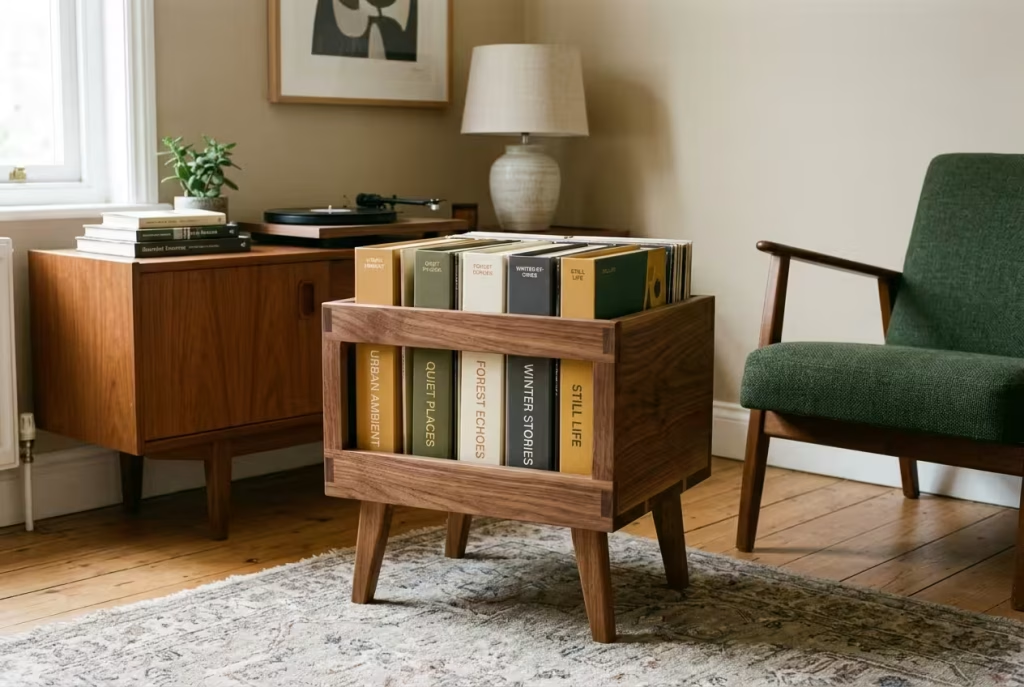
A crate raised on feet keeps records clear of floor dust and damp and gives a mid-century look for modest money. At the top end sits the USM record crate ($1,275), which holds up to 75 LPs behind perforated sides and has handles and small corner feet. Form & Finish, in Connecticut, makes plywood crates after its founder grew tired of seeing records in milk crates. Its Chelle vinyl cube (24 x 19 x 20.5 in) comes with a removable crate on soft-close slides, flat-packed with a screwdriver assembly.
Further down the ladder, the Crosley wood crate (about $41) holds 75 albums but keeps its shape best at about 60. The foldable H&M basket (about 60)collapsesflatwhenempty,andtheZICOTOlinenbox(16.99) holds 50 or more and travels well. For a clever home-made option, one r/vinyl owner dropped a vinyl crate inside a storage ottoman, supported on thick plywood with sliders underneath so it rolls across the floor.
A word on weight. A full box is heavy to lift, so one forum member warns against the biggest sizes, which become impossible to move once full.
Who it suits: spare records, small collections and anyone moving house.
19. The Tiered Magazine-Rack Stand
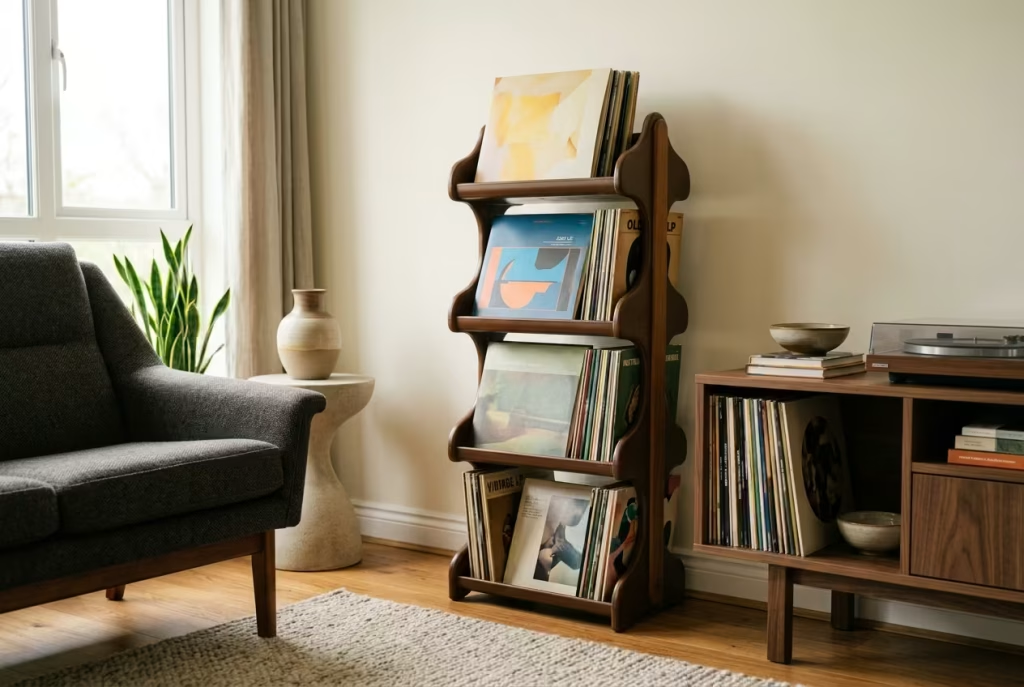
Sometimes the answer is hiding in another category. Kartell’s magazine rack by Giotto Stoppino (about $295, or roughly $236 when discounted at Lumens) has four tiers that suit a small collection sorted by mood, artist or genre. Architectural Digest recommends it for people with a modest collection. At the other end of the scale, the KAIU holder at about 40takesupto50albums,andUrbanOutfitters’Lolastand(329) brings mid-century lines to a corner.
These pieces will never hold a serious library, and that is their charm. They frame a handful of favourites like a small exhibition, which is a lovely way to start. Keep any 7-inch singles in their own compartment, since the Library of Congress advises against mixing diameters, and an r/vinyl thread on clever 7-inch storage shows how many people struggle with this.
The moral: a few records, well shown, can feel richer than a hundred stacked in the dark.
Getting the Playing Zone Right
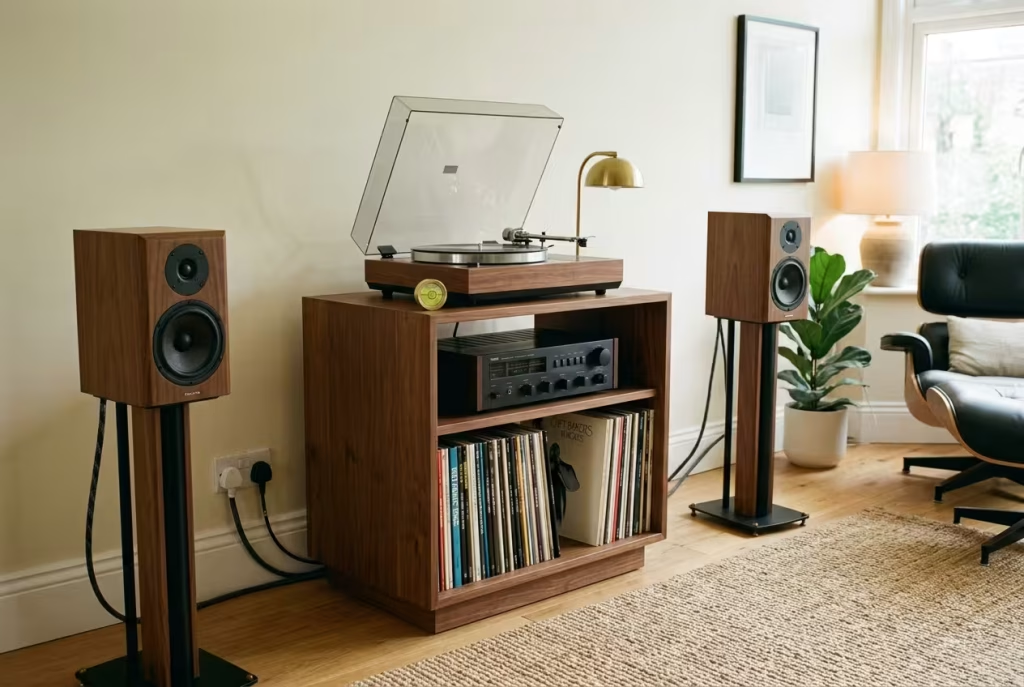
Whichever cabinet wins your heart, the top surface does a second job as a workbench for a delicate machine. A few minutes with a spirit level and a tape measure will pay you back every evening.
| Check | Target | Why it matters |
| Surface height | About 75 to 90 cm | Lets you cue a record without stooping |
| Level | Bubble dead centre | A tilted deck tracks badly and wears unevenly |
| Dust-cover clearance | Lid fully raised with room to spare | Stops the lid jamming under a shelf or against a wall |
| Rear access | Enough gap for plugs and leads | Saves you dragging heavy furniture out each time |
| Ventilation | Vents uncovered | Trapped heat is bad news for the amplifier and the deck |
| Speaker distance | On separate furniture where possible | Keeps vibration from feeding back to the stylus |
The wobble test is free. Give the piece a firm shake before you put anything on it, then press on the top while a record plays and listen for any change. If a unit shifts, wedge it, shim it or choose another.
The Great Kallax Debate, Settled With Numbers
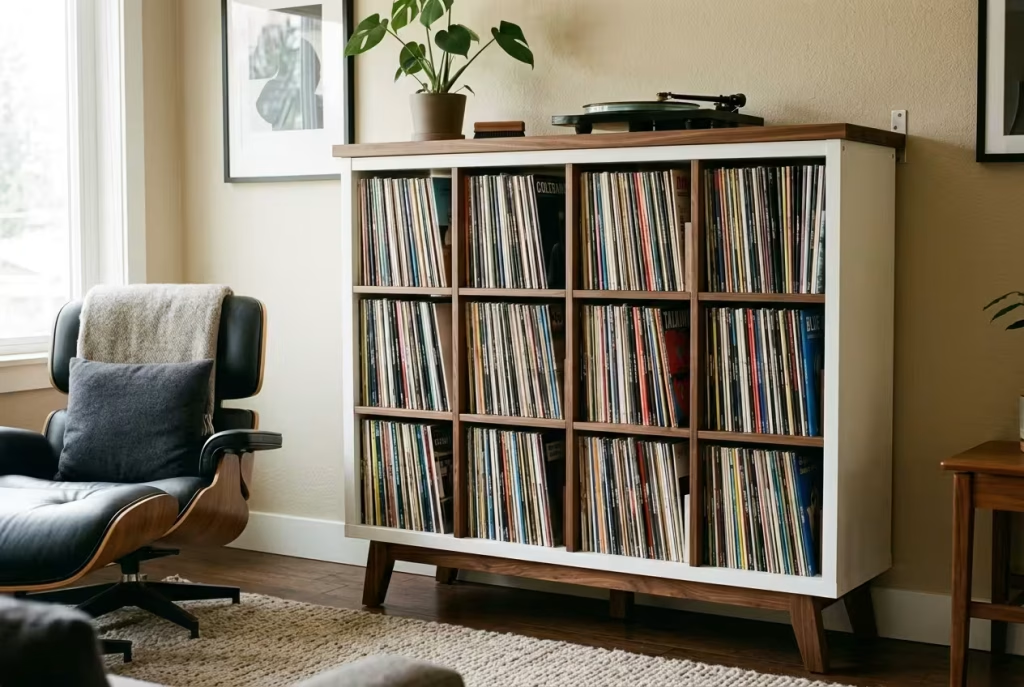
Collectors argue over the Kallax with the heat of football fans arguing about a manager. One camp swears by it, the other says it makes a room look like a stockroom. The figures give you something firmer than opinion.
| Fact | Figure | Source type |
| IKEA’s rated load per shelf | 13 kg (29 lb) | Manufacturer |
| Records per cube | About 50 to 90, depending on sleeves | Owner reports |
| Weight of a full cube | About 16 to 25 kg | Calculated from LP weights of 250 to 400 g |
| Interior cube size | About 33.5 cm square | Retailer listing |
| Load per metre at the rating | About 39 kg per metre | My calculation |
| Library of Congress average | About 52 kg per metre | Library of Congress |
The rating works out near 39 kg per metre, which sits below the Library of Congress average. Yet owners report years of loaded service, and one AudioKarma member’s units have stood full for seven years. The sensible reading is that a Kallax can work if you respect it: stack smaller units, add centre supports, anchor it to the wall and keep the weightiest records low. A forum user quotes IKEA’s Ivar at 30 kg per shelf, although that deserves a check before you rely on it.
Two competitors in our audit also got Kallax arithmetic wrong. One says a 4×4 holds only 200 records, yet 16 cubes at 50 to 90 each hold roughly 800 to 1,440. Another puts 90 to 110 records in 30 cm, which is generous for ordinary sleeves. Neither mistake is dramatic, but both could leave a buyer under-provisioned.
As for the sneer that Kallax-style units lower the tone, the loudest critic on r/vinyl, a veteran with thousands of records, objects less to the material than to the way cubes sit on the floor and weigh a room down. Raise the unit, give it a timber top, and a good deal of the objection melts away.
Sorting It Once It Is Home
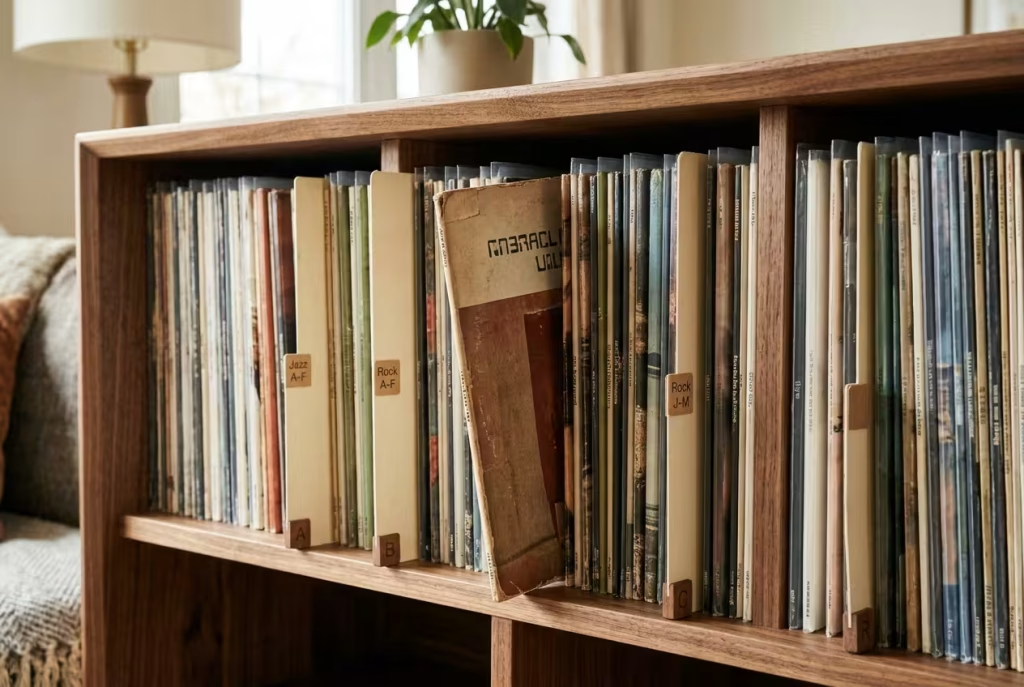
Storage is only half the story. A system you enjoy using keeps the collection alive. Real collectors have tried most of these:
| Method | Why people like it | Watch out for |
| Alphabetical by artist | Quick to find anything, and the CCS Vintage founder used it for a few hundred records | Needs dividers as the collection grows |
| Genre tabs plus letter dividers | One r/vinyl owner used both and plays daily since | Tabs can catch on sleeves if packed tight |
| Chronological | A perennial favourite in r/vinyl debates | Awkward for compilations and reissues |
| A ‘now playing’ shelf | Keeps favourites visible and reachable | Needs a habit of returning them |
Two tips from AudioKarma regulars make life easier. Leave a little breathing room, so you can lift an album half its height and lower it down without dragging the neighbours. And if outer sleeves keep sliding out when you pull a record, open them on the same side as the jacket, or top-load them. Opinions on outer sleeves are split: some owners remove them entirely and accept shelf wear, while others value the protection. As one forum member said, the right method is whichever suits you.
Where the Overflow Goes
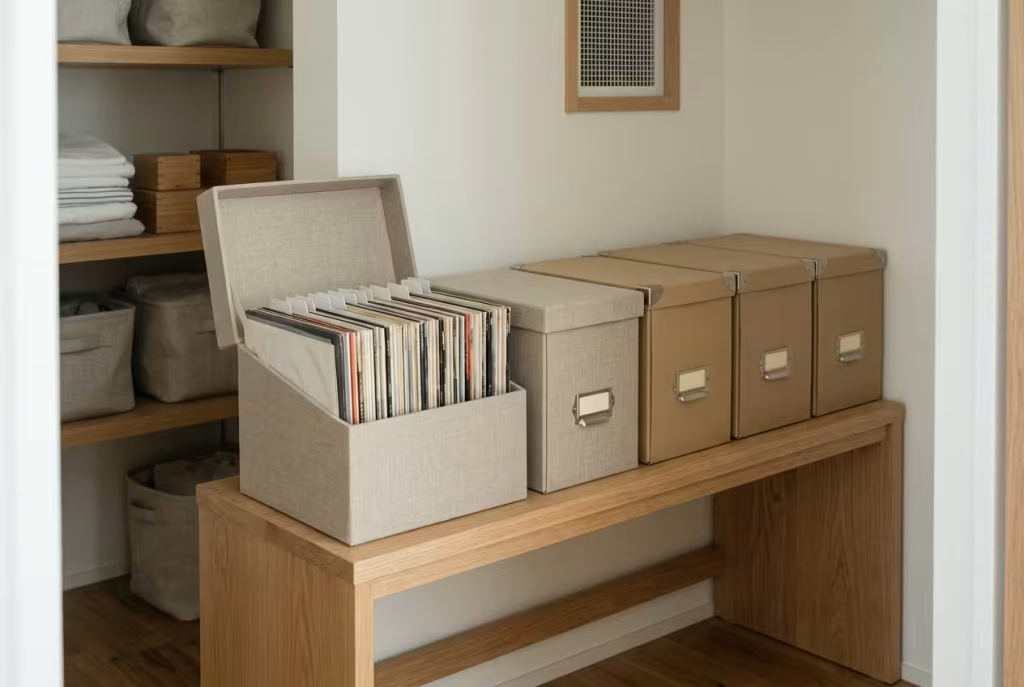
Every growing collection eventually spills over, and the most honest advice on r/vinyl is that records are treasured clutter. A veteran suggests deciding how many cubic feet of living space you will give them, choosing furniture that earns its keep in other ways, and putting plain, utilitarian storage out of the main room. Another route is to sell what you no longer play, which several owners swear by.
If you do need overflow storage, owners offer a few tried solutions:
- 100-LP record cases, which stack neatly and make a particular artist’s cache feel special when you fetch it
- A closet shelf or the space under a kitchen island, dry and out of sight
- Plain crates or sturdy boxes, as long as they do not become too heavy to lift
One caution from the Library of Congress: stay away from attics and basements, where leaks and temperature swings do their damage, and choose acid-free, low-static containers if you can.
Safety Checks Before You Load a Single Sleeve
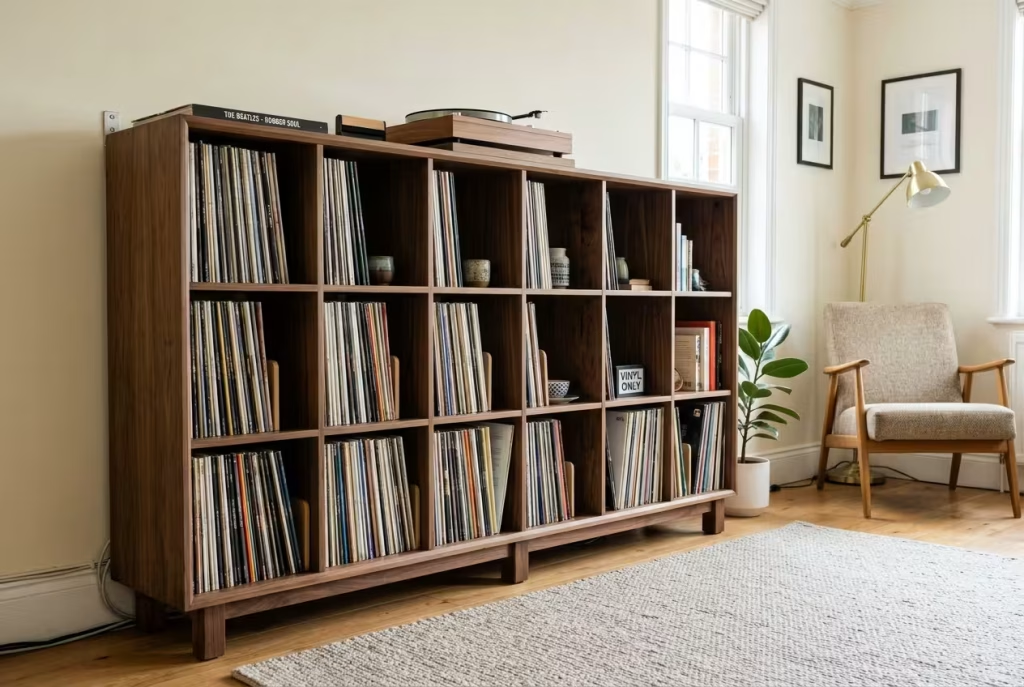
Heavy shelving is a safety matter as much as a style choice. IKEA’s own assembly instructions warn that furniture tip-over can cause serious or fatal crushing injuries and must be prevented with the wall attachment supplied. An AudioKarma owner of a Kallax puts it simply: attach it to the wall securely.
| Risk | What to do |
| Tip-over | Fit the wall brackets supplied, with fixings suited to your wall type |
| Overloaded shelf | Check the rated load, keep heavy records low, add centre supports |
| Uneven floor | Level the unit before loading, then anchor it |
| Loaded wall shelf | Fix into studs, and never mount above a turntable |
| Heat | Keep records away from radiators, vents and fires |
| Leaning records | Fill bays, add dividers or bookends |
| Trailing cables | Keep leads tidy and clear of walkways |
If you rent, check your tenancy agreement before drilling, and consider a freestanding unit with a low centre of gravity.
The Price Ladder What Each Budget Buys
| Tier | Typical spend | Examples from our research |
| Starter | Under about £100 | Kallax (£49), ZICOTO box (17),upsimplesledges(14), VASAGLE stand ($32) |
| Mid-range | About £100 to £500 | Crosley crate (41),Optageholder(50), Modway Render ($165), Wayfair media shelves (about $500) |
| Investment | About £500 and above | Urban Outfitters Clara (599),Kartellrack(295), vintage Danish teak ($1,118 to 2,388),USMcrate(1,275) |
| Bespoke | Several thousand | Custom builds; the most elaborate installations start at about $20,000 |
Prices are US figures where noted, so convert and verify. The starter tier is the best place to experiment, and a piece in the mid-range often outlasts an impulse purchase from the top. Buy what you can afford now and keep room to grow.
Keeping Vinyl Happy in a Living Room
A beautiful cabinet is wasted if the room cooks the records. The Library of Congress offers a handful of easy wins:
- Keep the room cool and stable, with humidity around 35 to 40 per cent where possible.
- Avoid attics, basements and anywhere damp.
- Stay away from radiators, vents and direct light.
- Handle discs by the edge and label, with clean, dry hands, and keep food and drink well clear.
- Let a cool record come up to room temperature before playing.
- Clean with canned air, and consider polyethylene inner sleeves in place of worn paper ones.
None of this is fussy, only forethought. A little discipline once, at setup, protects a collection for decades.
Why the Right Cabinet Changes How You Listen
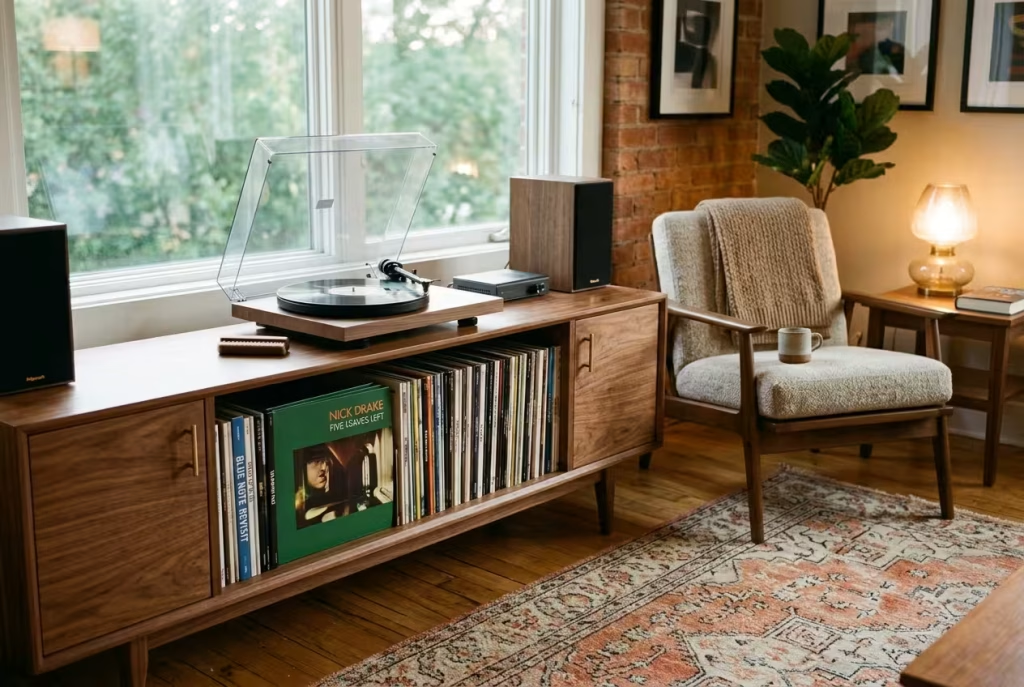
There is a quiet logic to ritual. When a favourite is easy to reach, and the furniture around it feels good to touch, you play more music and scroll less. The r/vinyl collector who carried his albums up from the basement found that a small change in access made a large change in habit.
Memory does some of the work as well. The CCS Vintage founders keep eight records pressed from playlists they made for moments that mattered, from an anniversary to a Christmas, in a small vintage cabinet with glass doors that close on magnets. They did not need 75 slots. They needed a place that gave those records presence. Whether you own eight records or eight hundred, the principle holds: the furniture should honour what it holds.
A mid-century room helps that feeling along. Walnut tones, tapered legs and soft lamplight make a space you want to settle into, and a record cabinet that fits the room becomes part of the evening rather than a corner of clutter.
Mistakes Worth Dodging
- Buying the exact size that fits today, with no room for what you will collect next year
- Trusting a listed capacity without checking clear internal depth
- Closing a door on a loaded shelf only to find it will not shut
- Standing speakers on the same shelf as the turntable
- Mounting a loaded shelf above the deck
- Leaving tall units unanchored
- Parking the cabinet beside a radiator, vent or fire
- Stacking records flat for ‘just a few weeks’ that turn into years
Final Thoughts Make Room for the Music
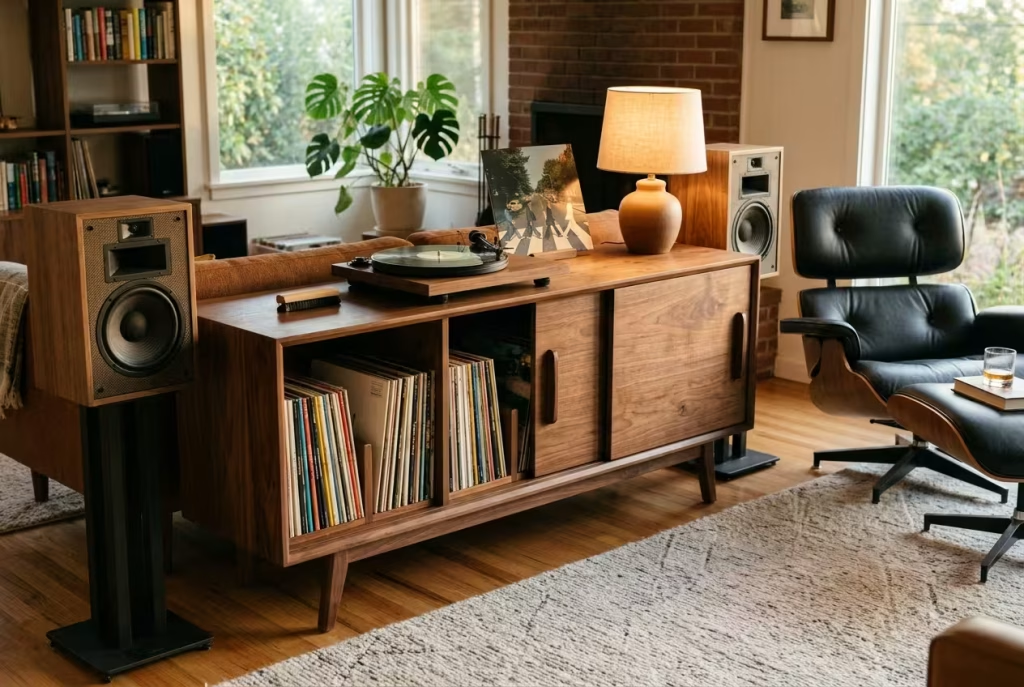
The best cabinet is the one that makes you reach for a record on an ordinary Tuesday. Measure your collection, respect the weight, keep the speakers apart from the deck and choose a finish that warms the room. Do that, and your records will stand flat, safe and ready, a collection that holds its value and its charm for years to come.
Frequently Asked Questions
How many records fit per metre of shelf?
Plan on about 170 to 270 records per metre, which is 50 to 80 per 30 cm, depending on sleeve thickness. Gatefolds, box sets and 180 g pressings push the number down. Add 30 to 40 per cent spare room, because collections grow faster than most people expect.
Is an IKEA Kallax strong enough for vinyl?
It can work, but IKEA rates each shelf at 13 kg and a full cube holds roughly 16 to 25 kg. Many owners report years of use with no sagging, while others report bowing. Stack smaller units, add a centre support under heavy cubes and anchor the unit to the wall.
Do I need to anchor record shelving to the wall?
Yes, for tall or heavily loaded units. IKEA warns that tip-over can cause serious injury and says the wall attachment supplied must be used. Level the unit first, and choose fixings that suit your wall, whether brick, plaster or plasterboard.
Why must records be stored upright?
A flat stack presses on the grooves below and can encourage warping over time. The Library of Congress advises storing discs on edge, with sturdy dividers every 4 to 6 inches (10 to 15 cm) that support the whole face of the sleeve.
Can the turntable share a shelf with the speakers?
It is best not to. Speaker vibration travels through the furniture and can cause feedback or skipping. Use separate stands where you can, or isolation pads and a platform if space is tight, and keep the deck level on a solid, heavy surface.
Do record cabinets with doors work?
They can, but check the clear interior depth and close the door against a real sleeve before buying. Sliding doors avoid hinge swing, which is the commonest complaint. Aim for at least 33 cm of clear depth, and ask for tape-measure photographs on second-hand pieces.
How deep should a record cabinet be?
A 12-inch sleeve is about 31.5 cm square, so look for at least 33 cm clear inside, and more if you use outer sleeves. Vintage cabinets often measure 40 to 50 cm deep overall, which leaves ample room once the back panel is allowed for.
How do I make a Kallax look mid-century?
Add tapered legs (about $20 to $40 for four), fit doors, and top it with solid timber. Mount the legs slightly inward so the back sits flush to the wall, and fit a centre leg under heavy cubes. Adding a plinth or underframe is a neat alternative.
Is a vintage mid-century cabinet worth the money?
If you love the look and the depth suits LPs, yes. Dealer listings run from about $1,118 to $2,388. Check for sun fading, loose veneer and wobbly legs, and ask for interior measurements in writing before you commit.
What is the best record storage for a small flat?
A record player stand column, a tiered rack or a crate on feet. These hold anything from a handful to about 100 records without swallowing the room. Keep the turntable at 75 to 90 cm and leave room behind it for cables.
Should records go in outer sleeves?
It is a matter of taste. Outer sleeves protect covers, though they can drag out when you pull a neighbour. Open them on the same side as the jacket and leave a little slack above the records. Some collectors skip them and accept shelf wear.
How should I store 7-inch singles and gatefolds?
Keep 7-inch records in a compartment of their own, since the Library of Congress advises against mixing diameters. Give gatefolds and box sets extra width and a stronger shelf, as they are thicker and heavier than a standard LP.