

French Country Living Room Ideas: 25 Cozy Cottage-Inspired Designs for a Charming, Relaxed Home
There’s a particular kind of room that makes guests go quiet for a second before they say anything. Not because it’s showy. Quite the opposite, really. It’s the sort of living room where the sofa looks like it’s been sat in properly, where the mirror above the mantel has a bit of foxing round the edges, and where nothing matches on purpose. That’s French country style doing what it does best: making a house feel like it’s been loved for decades, even if you moved in last spring.
There’s something almost quietly rebellious about that, if you think about it. So much of modern interior design chases newness. Fresh paint, unmarked upholstery, everything from the same collection. French country style does the opposite on purpose. It takes the things most decorating advice tells you to hide, a chip, a fade, a wonky leg, and turns them into the whole point. That’s why the style tends to attach itself so easily to real memories: the armchair that was your gran’s, the mirror you found propped against a skip and couldn’t quite walk past, the table with a burn mark from a candle nobody owns up to. None of it gets thrown out here. It gets given pride of place.
Think about the last time you walked into a house that felt instantly, properly comfortable, the kind where you kicked your shoes off without really deciding to. Chances are it wasn’t the newest house you’d been in, or the tidiest. It was probably the one with a bit of history sitting quietly in the corners: a well-used throw over the arm of a chair, a shelf of books with cracked spines, a lamp that’s slightly the wrong shade of warm but somehow makes the whole room feel like an evening rather than an afternoon. French country style is, at its heart, an attempt to build that feeling on purpose rather than waiting decades for it to happen by accident.
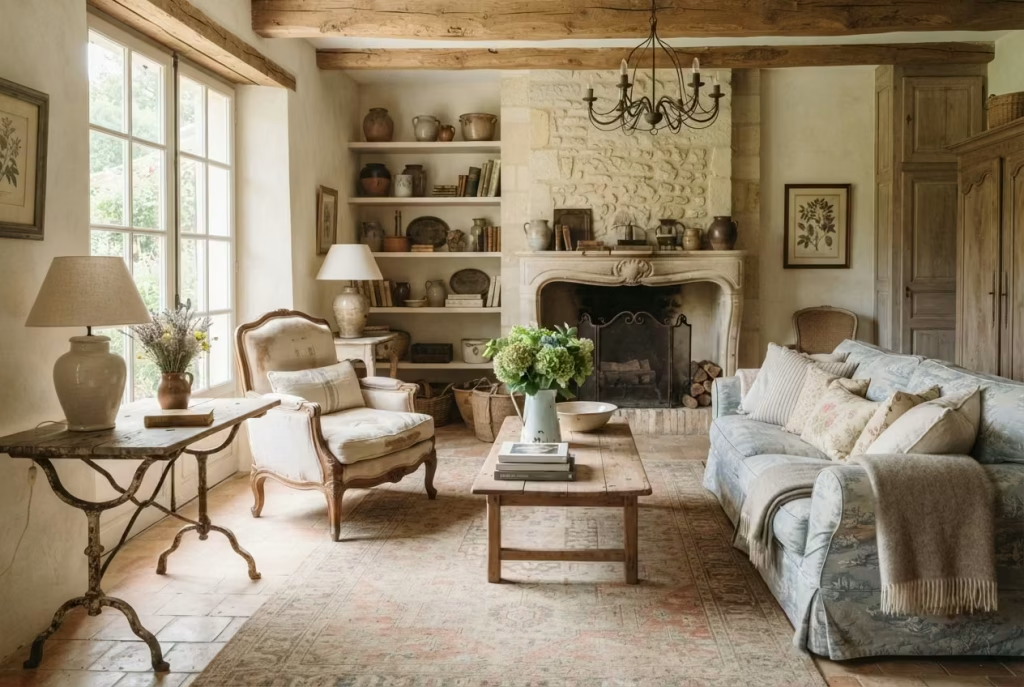
French country living rooms have had a quiet but persistent moment for a while now, and it shows no sign of fading. Part of that staying power comes down to something the fast-trend styles can’t offer: it doesn’t ask you to start from scratch. Grandma’s chair, a flea-market find, that slightly wonky side table you can’t bear to throw out, they all have a home in this style, provided you know where to put them and what to pair them with. It’s a forgiving style, and in a world of decorating advice that so often demands perfection, that forgiveness is worth something. There’s real relief in a design philosophy that doesn’t ask you to hide your history to fit in.
This guide runs through 25 genuine, workable ideas for bringing French country charm into a living room of any size, plus the bits nobody else seems to cover properly: how to tell it apart from the styles it constantly gets muddled with, how to stop it tipping into “cluttered flea market” territory, whether it holds up with pets and children in the house, why it feels the way it does psychologically, what it costs to pull off, and how to keep the whole thing feeling like a home rather than a showroom, sound, scent and all.
Quick Answer
French country living room style blends rustic, natural materials (weathered wood, wrought iron, stone, linen) with refined, curvy furniture shapes (think Louis XV-style chairs) in a soft, muted colour palette of creams, greys and faded blues, greens or yellows. The look is built on imperfection: aged finishes, mismatched vintage pieces and layered textiles like toile, ticking stripes and florals, arranged so the room feels collected over time rather than bought in one trip.
What Is French Country Style, Really? (And What It Isn’t)
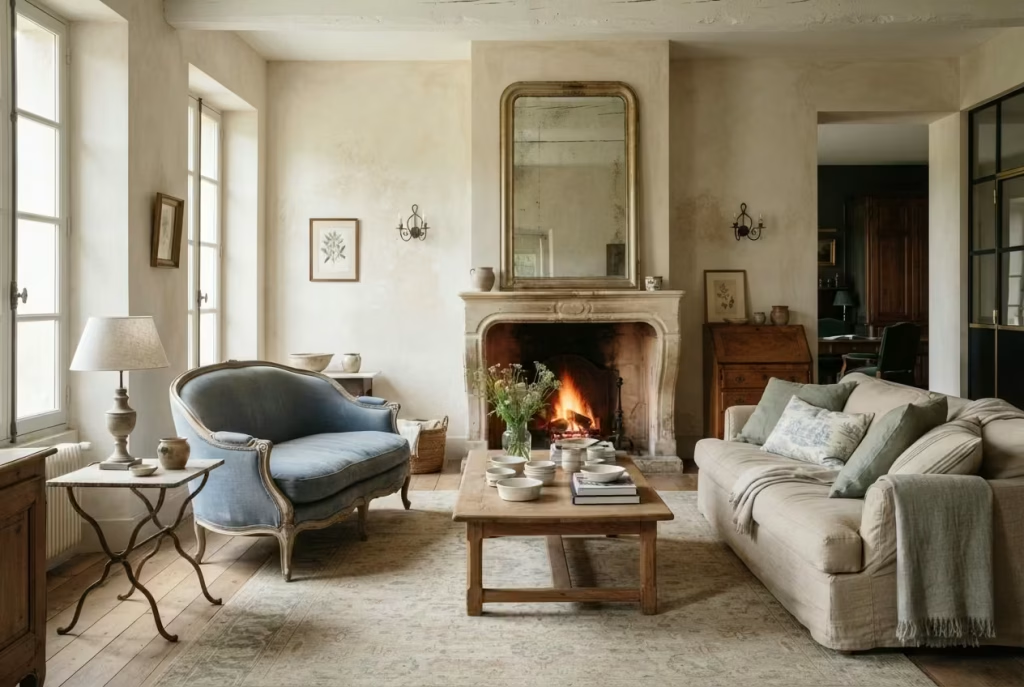
Before diving into the ideas themselves, it’s worth clearing something up, because it trips up more people than you’d think, and getting it wrong is usually the reason a room ends up feeling “almost right” without anyone being able to say why. French country gets lumped in with half a dozen other “cosy vintage” looks online, and the labels get used almost interchangeably despite meaning genuinely different things. If you’ve ever bought a piece thinking it screamed French country only to have it look faintly out of place once it’s home, this is very likely why, and it’s a genuinely common source of quiet decorating frustration nobody quite talks about.
French country style takes its cues from rural Provence: rustic textures, sun-faded colours, a mix of rough plaster and polished antiques, the sort of interior you’d imagine behind a pair of blue shutters on a farmhouse that’s watched several generations come and go. Parisian style, by contrast, leans urban and a touch more austere, all herringbone floors, tall windows and understated elegance with far less pattern, more the flat above a boulangerie than the farmhouse down the lane. English country style shares the layered, collected feel but tends toward richer, darker colours (deep reds, forest greens) and chintz rather than toile, and carries a slightly more formal, stately-home undertone. Farmhouse style strips things back further still, favouring shiplap and stark whites over ornate detailing, and reads as considerably plainer and more pared-back. Shabby chic is the most easily confused with French country, since both love a distressed finish, but shabby chic is almost entirely pastel-pink-and-white and skews far more feminine and fussy than the earthier, more balanced French look, which always keeps one foot in something a little more rugged.
Here’s the differences side by side.
| Style | Colour Mood | Key Materials | Furniture Shapes | Overall Feel |
| French Country | Muted neutrals, faded blue/green/yellow | Wood, wrought iron, stone, linen | Curved, Louis XV/XVI-inspired | Rustic elegance, lived-in |
| Parisian | Soft neutrals, occasional black accent | Herringbone wood, brass, glass | Sleek, tailored | Understated, urban |
| English Country | Deep reds, greens, florals | Dark wood, chintz, tartan | Traditional, boxy upholstery | Layered, formal-cosy |
| Farmhouse | Whites, greys, stark neutrals | Shiplap, reclaimed wood | Simple, straight lines | Pared-back, functional |
| Shabby Chic | Pastel pink, white, cream | Distressed painted wood, lace | Feminine, ornate | Soft, romantic |
Once that distinction clicks, choosing pieces gets a lot easier, because you stop second-guessing whether a find is “right” for the room. If it’s rustic, curvy and a little imperfect, it probably belongs. And there’s real relief in that clarity, because so much of decorating anxiety comes from not trusting your own eye. Once you know the rules of the style, you stop needing permission for every choice you make, and shopping (whether at auction or simply browsing online on a Sunday evening) stops feeling like a minefield and starts feeling like a genuinely enjoyable hunt.
Why This Style Feels the Way It Does
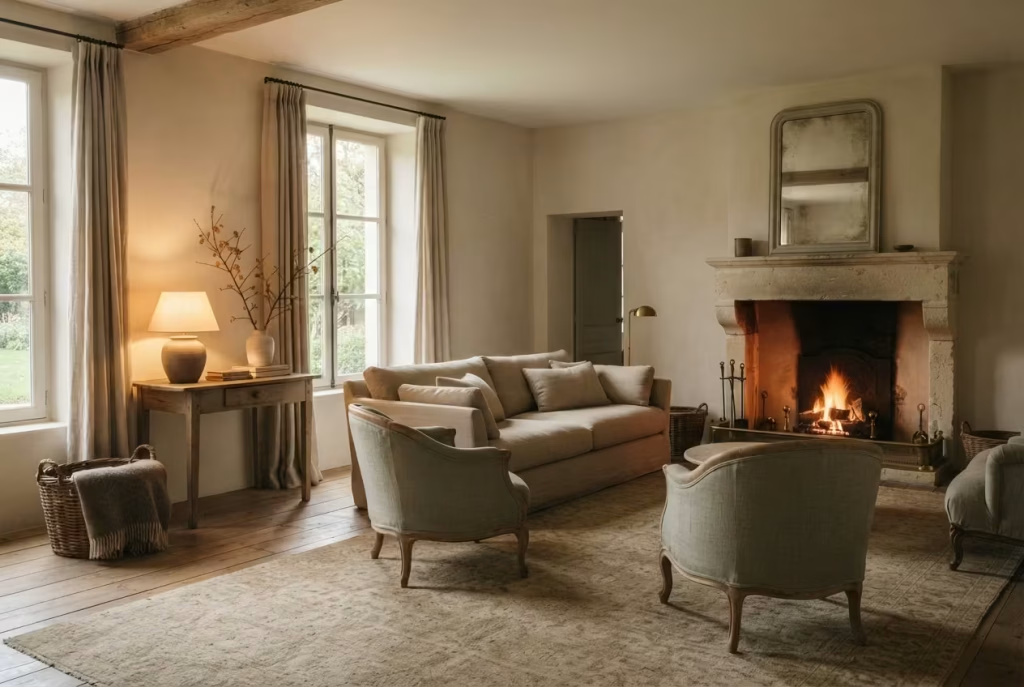
It’s worth pausing on this before getting into the ideas themselves, because understanding why a room feels a certain way makes every choice afterwards easier to trust. A great deal of modern living, screens, open-plan glass boxes, everything gleaming and replaceable, quietly asks us to feel a little disconnected from our own homes. French country style pushes back against exactly that. A worn armchair or a foxed mirror carries visible evidence of time passing, and there’s a real, well-documented psychological comfort in objects that show their age: it signals permanence, safety, somewhere that isn’t going anywhere. That’s a large part of why a room finished this way tends to make people exhale a little when they walk into it, even if they couldn’t put their finger on why.
There’s also the layering itself, the mix of textures, the soft lighting, the muted rather than jarring colours, which together do a lot of quiet work in making a space feel calming rather than stimulating. Harsh light and hard, glossy surfaces keep a room feeling alert, the way an office does, always slightly on. Soft light, natural fibres and rounded furniture shapes do the opposite, encouraging the sort of unhurried evening where nobody’s rushing to leave the sofa. Curved furniture in particular plays a subtle role here that’s easy to overlook: rounded edges read, at a purely instinctive level, as gentler and less threatening than sharp corners, which is part of why a room full of cabriole legs and softly rolled arms feels inherently more relaxing to sit in than one built from hard right angles.
There’s a genuinely human reason the mismatched, collected-over-time approach resonates so widely too. A room where every single object was chosen for a reason, rather than bought as part of a matching set, tells a quieter version of your own story back to you every time you sit down in it. That’s not something you can buy off a showroom floor in an afternoon, however much money is on the table, and it’s precisely why French country rooms so rarely feel cold or impersonal, even when they’re genuinely grand. None of this needs to be complicated to work. It simply needs to be understood, so that every choice from here on serves the feeling you’re actually after, rather than just the look.
The Colour Palette Where Every French Country Room Starts
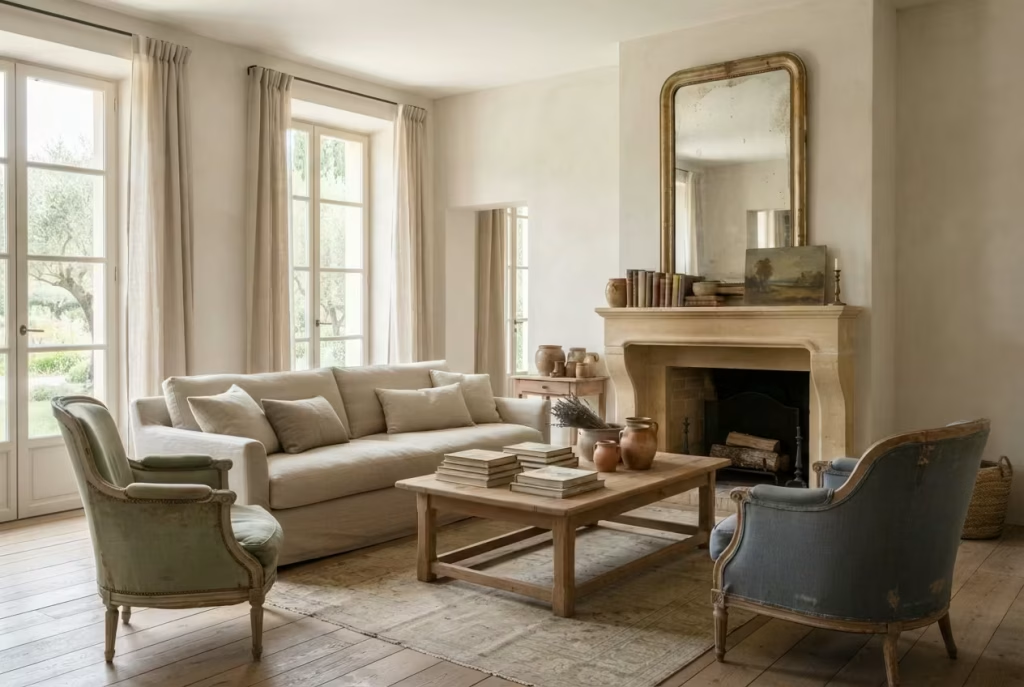
Get the palette wrong and nothing else in the room quite lands, however good the individual pieces are. Get it right and even a mismatched, thrown-together mix of furniture reads as intentional. Colour is doing more work here than almost any other decision you’ll make, because it’s the one thing touching every surface in the room at once, and it’s usually the first thing your eye registers before it’s had time to notice anything else.
1. Build From a Warm Neutral Base
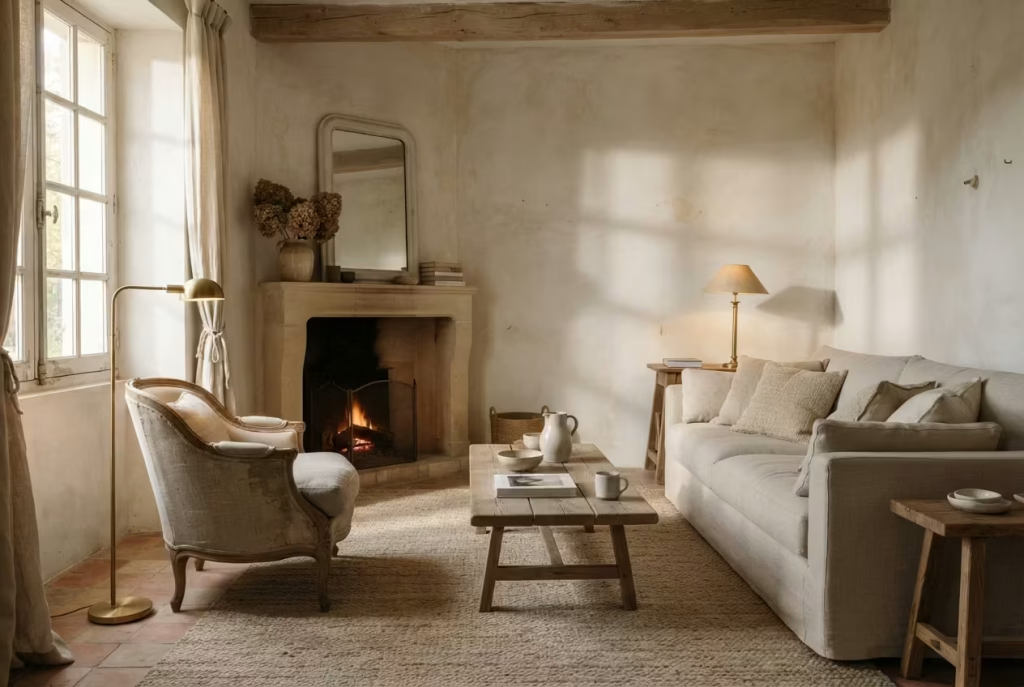
Skip the ultra-crisp, cool-toned whites that modern minimalist rooms love. French country walls want warmth: think chalky off-white, buttermilk, or a soft greige that still has some yellow or pink undertone to it. Picture the colour of old limewashed plaster in a farmhouse that’s stood for two centuries; it’s never stark, always a little soft round the edges, the sort of colour that seems to hold onto the last of the afternoon light long after the sun’s actually gone down. A cold, blue-white will fight everything else you put in the room, making even a beautifully chosen antique look slightly clinical by association, so test a sample on the wall before committing and check it under both daylight and lamp light in the evening, since a colour that looks perfect at midday can turn surprisingly grey once the lamps go on. It’s a small piece of homework that saves an enormous amount of regret further down the line, once furniture, curtains and rugs are all already in the room.
2. Add Soft, Faded Accent Colours
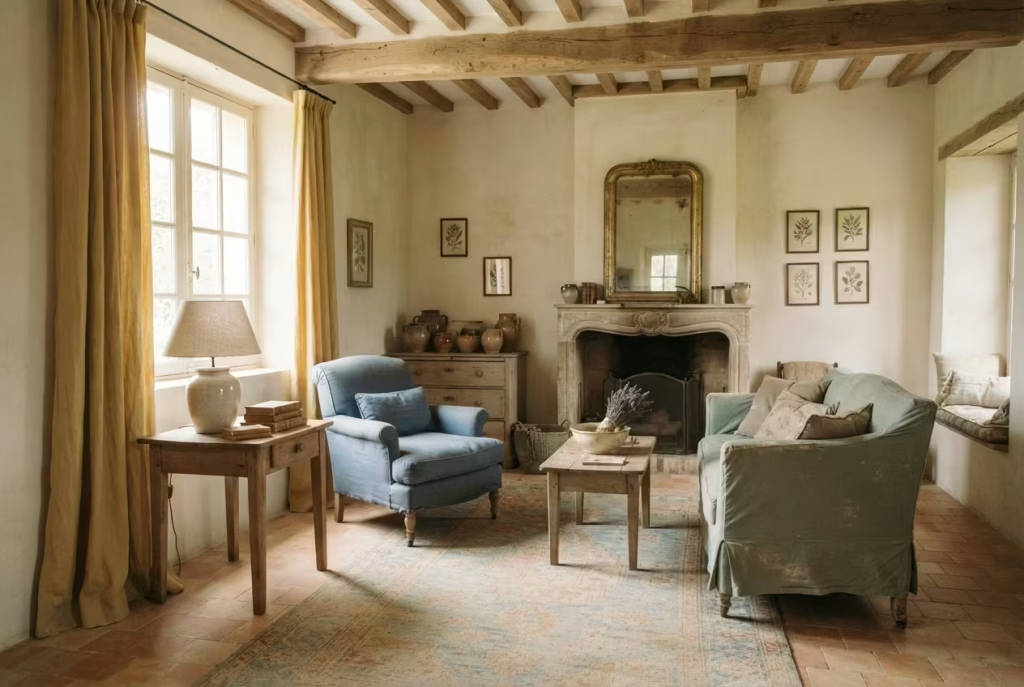
Once the base is sorted, bring in one or two accent shades that look like they’ve spent thirty years in the sun: dusty Prussian blue, sage green, faded mustard. These work best on smaller elements first (a chair, a set of curtains, a runner rug) rather than an entire feature wall, since French country style rarely goes big and bold with colour. There’s a reason for that restraint beyond taste alone: a fully saturated colour reads as “new” almost instantly, while a softened, slightly greyed-down version of the same shade reads as though it’s already lived a life. Layer them thoughtfully rather than all at once, and the room will feel like it evolved gradually, which is exactly the point, and exactly the effect that’s so hard to fake once you rush it. Give yourself permission to add colour slowly, over months rather than a single weekend; the pause between purchases is doing genuine work.
3. Don’t Be Afraid of a Deeper Tone, In Moderation
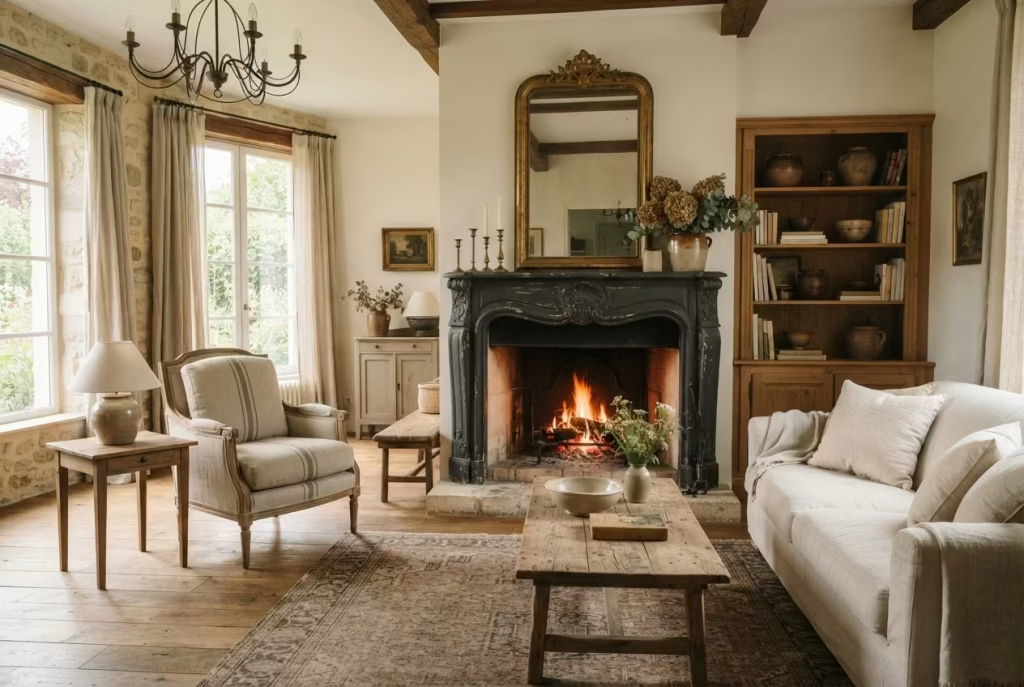
A common myth is that French country has to stay pale throughout. It doesn’t, and rooms that stay pale from floor to ceiling can end up feeling a little flat and one-note, missing the depth that gives the eye somewhere to rest. A charcoal-painted fireplace surround, a navy velvet armchair, or a set of dark, aged wooden beams overhead can add real depth and stop the room feeling washed out, doing for the space what a good shadow does for a photograph. The trick is balance: pair any darker element with plenty of warm wood and soft linen nearby so it grounds the space instead of dominating it, otherwise a single dark piece can end up looking stranded rather than intentional. Think of the dark note the way you’d think of a single low, resonant chord underneath a lighter melody; it doesn’t need to be loud to be felt.
4. Use Wall Colour to Frame Architecture, Not Compete With It
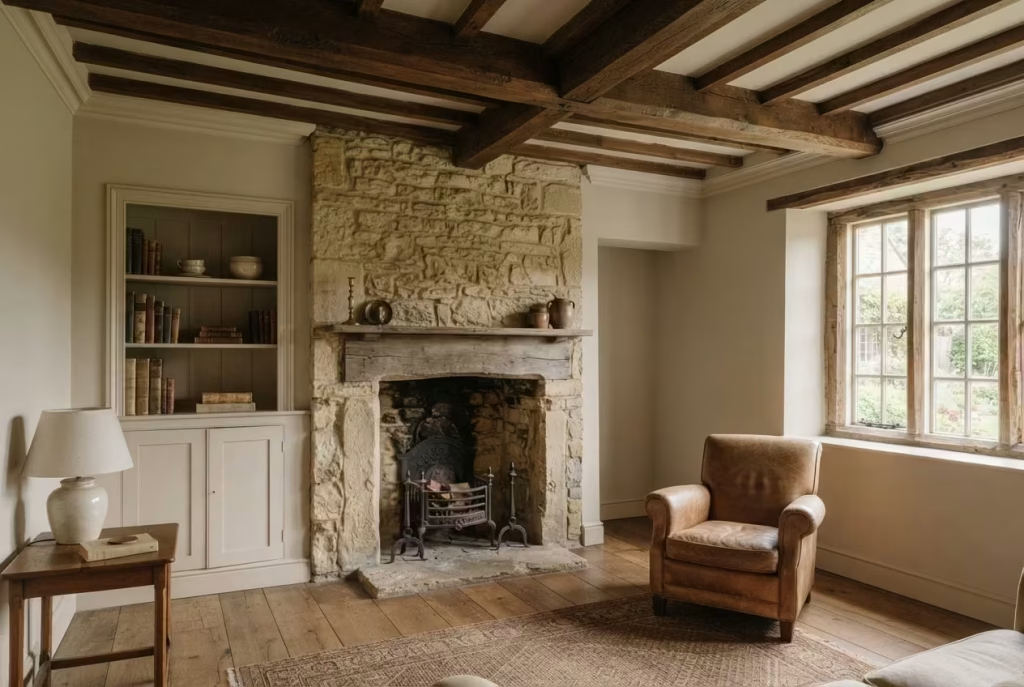
If you’re lucky enough to have exposed beams, a stone chimney breast, or original cornicing, let the paint colour do the supporting work rather than the starring role. A soft neutral on the walls, with woodwork picked out in a slightly lighter or slightly darker shade of the same family, draws the eye to those original features instead of fighting them for attention. It’s a small act of restraint that pays off enormously, because the architecture itself is doing the storytelling; paint colour just needs to get out of its way and let it speak, the way a good frame never tries to outshine the painting inside it.
Furniture and Seating: Comfort First, Perfection Never
5. Choose a Linen-Slipcovered Sofa as Your Anchor
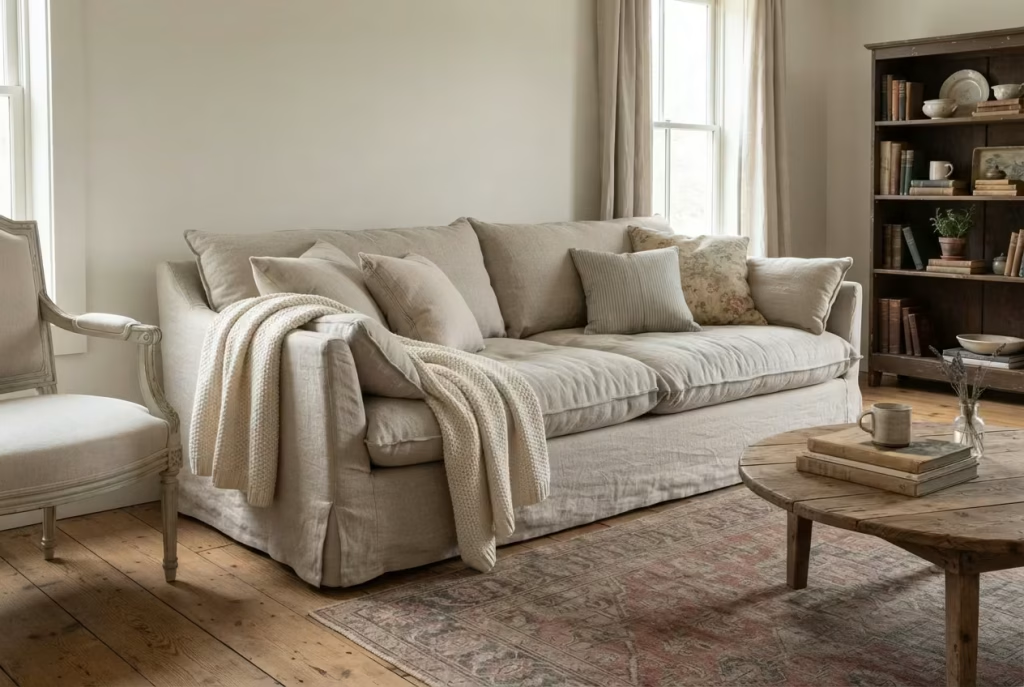
A relaxed, linen-covered sofa in a soft neutral is the safest, most versatile starting point for French country seating. It’s forgiving of everyday life, softens with age rather than looking tired, and pairs equally well with a formal Louis-style chair or a battered old wingback. There’s something genuinely comforting about a sofa you’re not afraid to actually sink into, cushions collapsing under your weight, throw slightly askew, rather than one you perch on carefully so as not to disturb it. That difference matters more than it sounds; a sofa that demands care changes how you actually use a room, whereas one that welcomes mess changes how often you choose to spend an evening in it. If you already own a sofa with cleaner, more modern lines, a loose linen slipcover in the right colour can do most of the transformation for a fraction of the cost of buying new, and has the added bonus of being removable and washable when life, inevitably, gets a bit messy on it.
You May also Like: Best Warm Neutral Paint Colours That Never Feel Flat
6. Mix Seating Styles Rather Than Matching Them
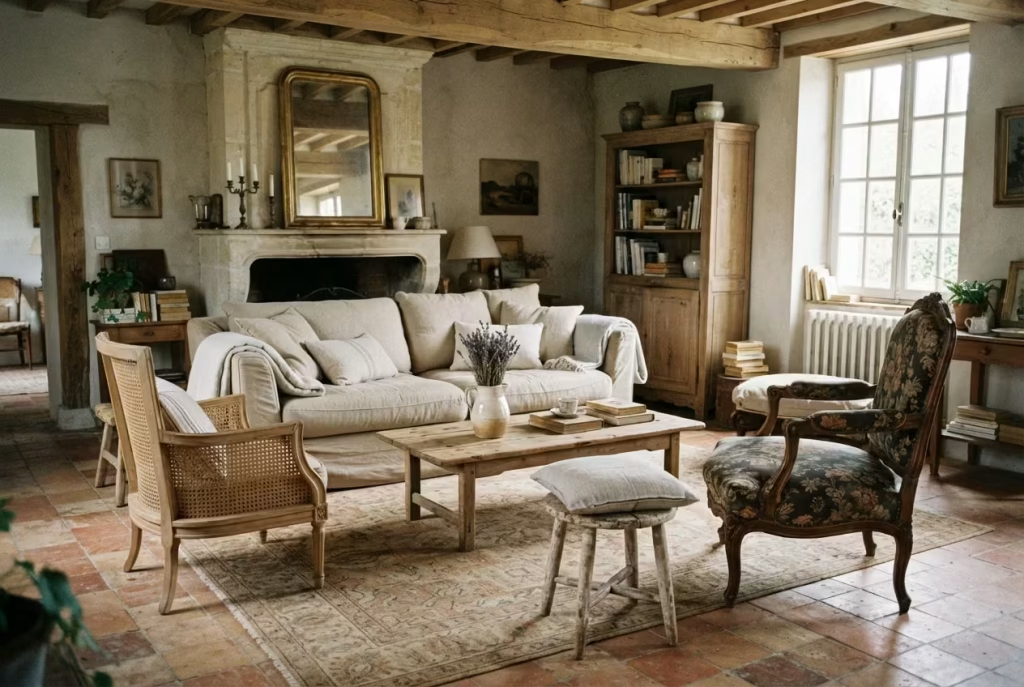
This is where a lot of newcomers to the style get nervous, because it goes against everything a showroom teaches you about buying “a suite.” French country interiors deliberately avoid matching sets. Pair that linen sofa with one carved wooden armchair, one rattan or cane-backed chair, and perhaps a small upholstered stool. The contrast in materials and silhouettes is what gives the room its collected-over-time feel, so resist the urge to buy everything from one supplier in one afternoon. It can feel like a small leap of faith the first time you deliberately choose pieces that don’t match, but that’s precisely the leap the style asks of you, and it’s usually the moment a room stops looking like a catalogue page and starts looking like somewhere real people actually sit. Trust that instinct once, and it gets considerably easier the second time round.
7. Bring In a Louis XV or Louis XVI-Style Chair
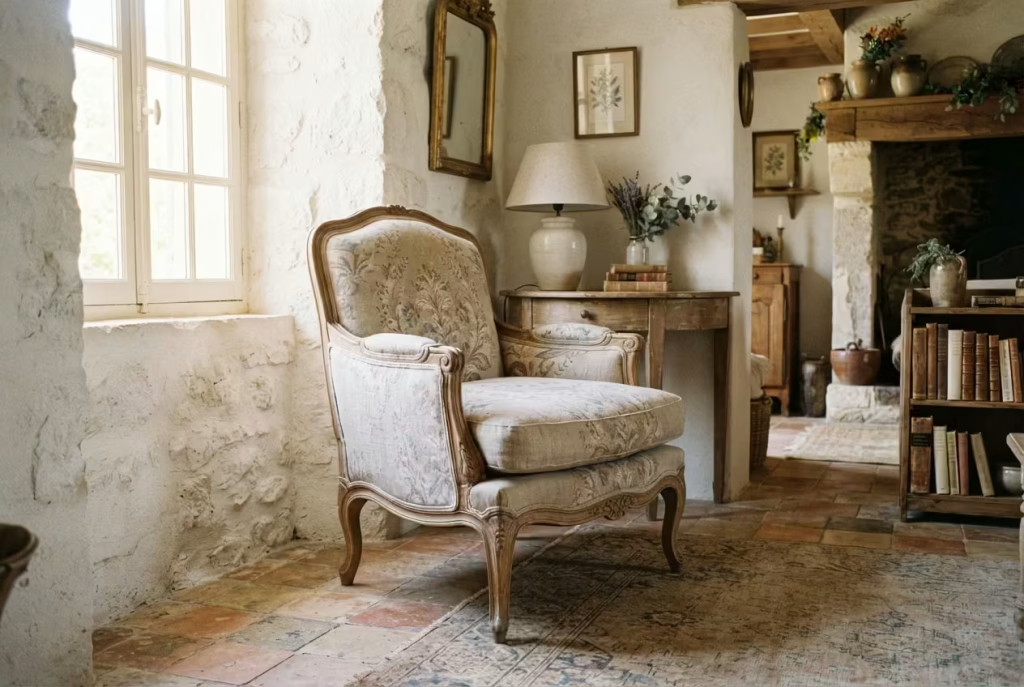
If there’s one furniture shape that instantly signals “French country” to the eye, it’s the curved, cabriole-legged Louis-style chair, whether that’s a full bergère armchair or a simple slipper chair tucked in a corner. These shapes trace back to 18th-century French court furniture, later softened and rusticated as the aesthetic filtered out into farmhouses and provincial homes over the following centuries, which is part of why the shape still carries that faint whisper of old-world elegance even in its plainest form. You don’t need an authentic antique; a well-made reproduction with a distressed or gently gilded frame does the job just as well, and reupholstering an old frame in a linen or faded floral fabric is often cheaper than buying new outright, while also giving an otherwise unremarkable secondhand find a completely new lease of life. There’s a particular satisfaction in that kind of rescue project that a straightforward new purchase simply can’t replicate.
8. Choose a Coffee Table With Some Age to It
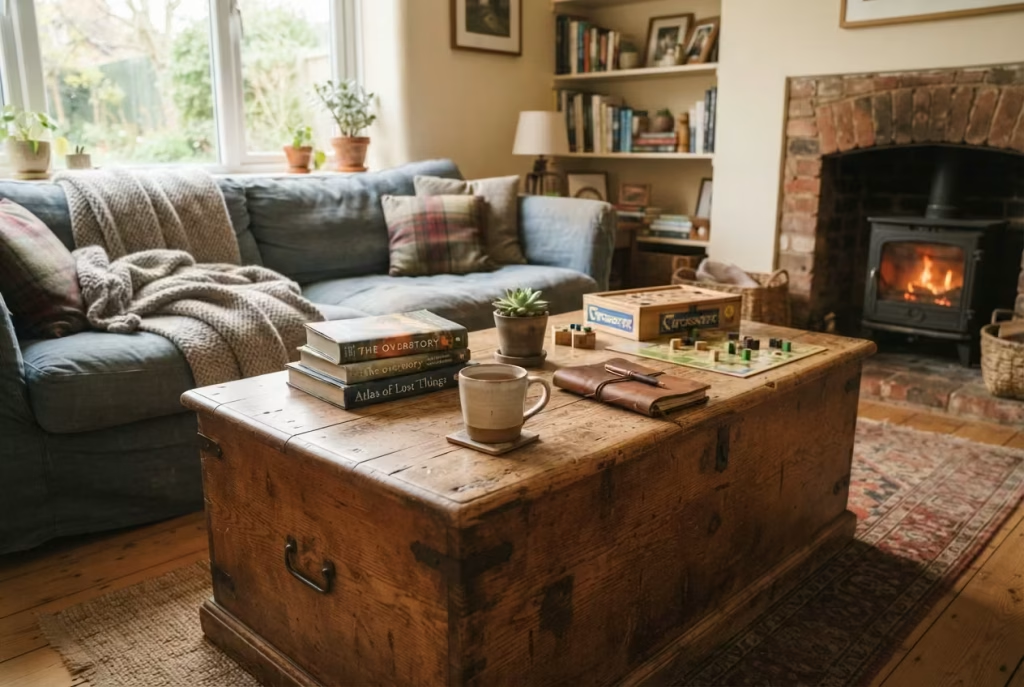
A solid wood coffee table with visible grain, a few honest scratches, or a painted-and-distressed finish grounds the seating area far better than anything glossy or glass-topped. If a genuinely old table isn’t in the budget, an old trunk, a repurposed wine crate, or even a salvaged door laid across low legs can stand in beautifully and adds a real conversation-starting story to the room, the sort of piece a guest ends up asking about halfway through a cup of tea. There’s a quiet pleasure in resting a mug on a surface that’s clearly survived plenty of mugs before yours; it takes the pressure off keeping everything pristine, which in turn makes the whole room easier to actually relax in, board games and all, rather than a space reserved for best.
9. Add a Vintage Armoire or Open Bookshelf for Height
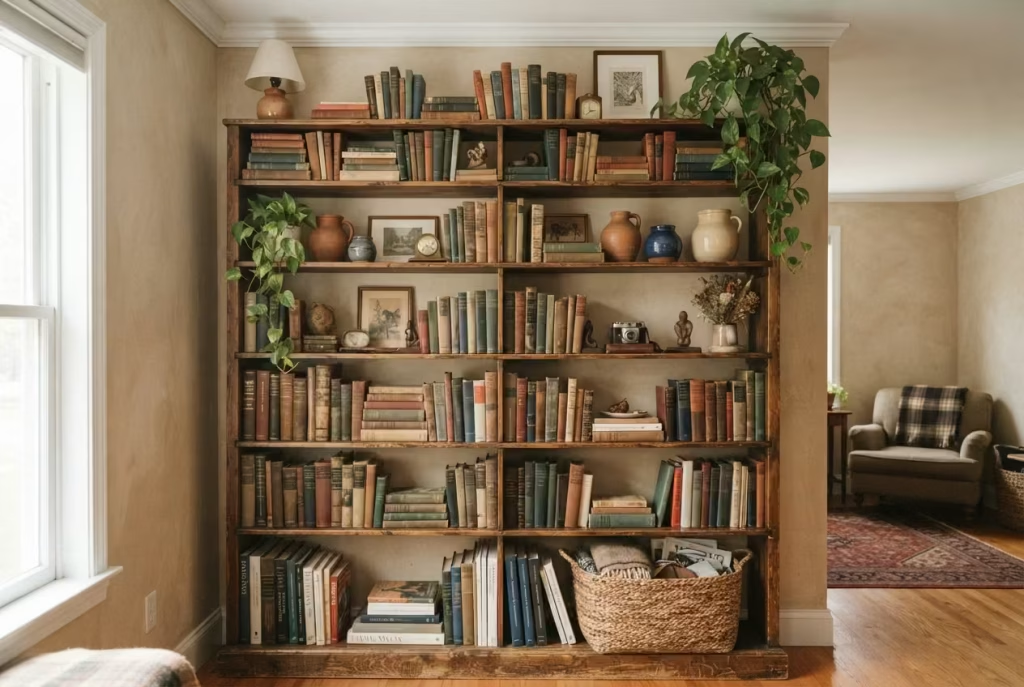
A tall, freestanding piece such as an armoire or a well-stocked bookshelf does two jobs at once: it fills vertical space that a room full of low, curved furniture can otherwise lack, and it gives you somewhere to display the accumulated bits and pieces (ceramics, stacked books, a woven basket) that make the style feel genuinely inhabited rather than staged for a photograph. Beyond the practical storage it offers, a tall piece like this also does something subtler for the room’s rhythm, drawing the eye upward and stopping a space full of squat, curvy furniture from feeling visually flat. A well-filled bookshelf in particular tends to become a small, unspoken portrait of whoever lives there, which is exactly the kind of quiet personality this style thrives on.
The Fireplace: The Room’s Quiet Centrepiece
10. Let a Stone or Limestone Surround Do the Heavy Lifting
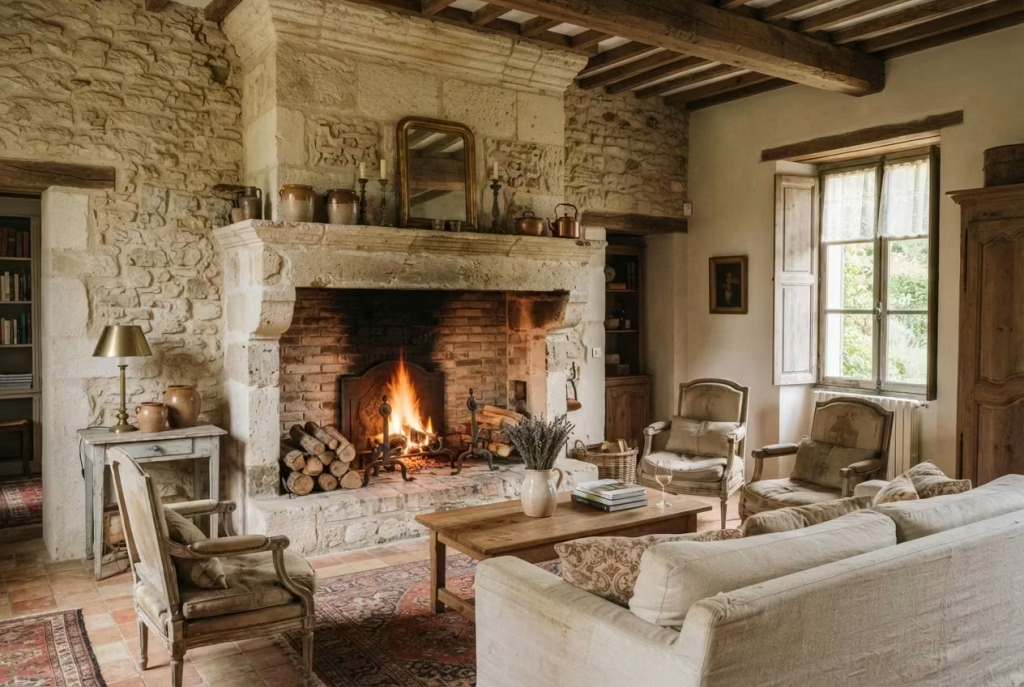
If your living room has an original stone or brick fireplace, resist the temptation to render it smooth or paint it a flat, modern colour. The texture and imperfection are the whole point, and a French country room built around a raw stone or limestone surround will always feel more authentic than one relying purely on furnishings to carry the style. There’s a reason the fireplace tends to be the one feature every version of this style, however loosely interpreted, keeps in common: it’s the literal and emotional heart of the room, the spot everyone’s chair eventually angles towards without anyone quite planning it that way, the same pull a fire has held over a room for as long as people have been gathering round one.
11. Add a Reclaimed Wood or Painted Mantel
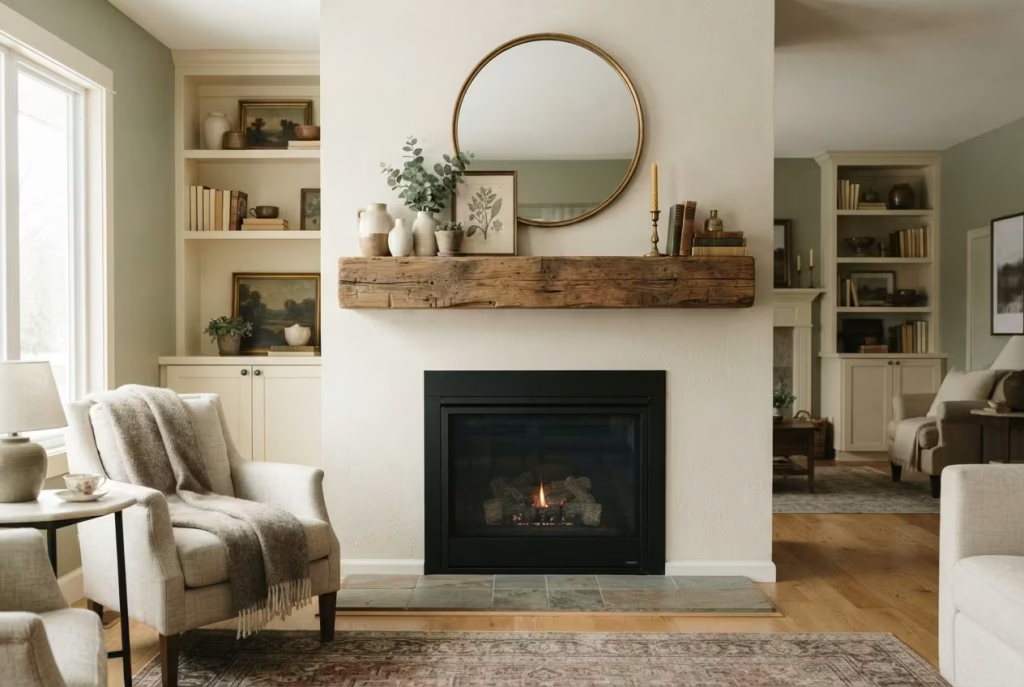
Where the fireplace itself is more modern or plain, a reclaimed wooden beam mounted as a mantel, or an existing mantel given a chalky, hand-painted finish, brings in age and warmth instantly. Even a faux mantel surround, built purely for styling purposes around an existing fire or a decorative fireplace insert, can create the illusion of a much older architectural feature, and it’s a surprisingly effective bit of theatre for a relatively modest outlay, often transforming a flat, builder-grade fireplace wall into the focal point of the entire room, and in turn giving the whole space something to organise itself around.
12. Style the Mantel With Restraint, Not Clutter
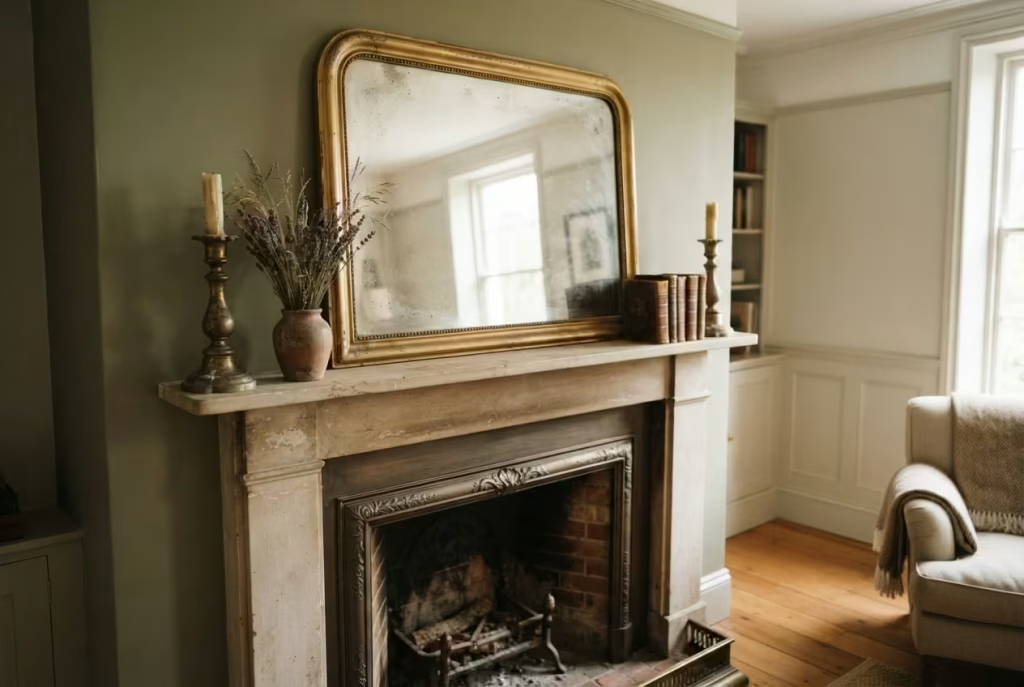
This is the one spot in the room where less genuinely is more. A single large, softly foxed or gilt-framed mirror, a pair of aged candlesticks, and perhaps one small vase of dried lavender or a stack of well-worn books is plenty. Layer objects at varying heights rather than lining everything up in a neat row, and leave visible breathing room between pieces so the eye has somewhere to land. A mantel crowded with a dozen small trinkets stops reading as curated and starts reading as cluttered almost overnight, so treat every single object you place there as though it has to earn its spot, the way a good bookshelf earns every title on it rather than simply filling space.
Lighting: Getting the Glow Right
13. Hang a Wrought Iron or Crystal Chandelier
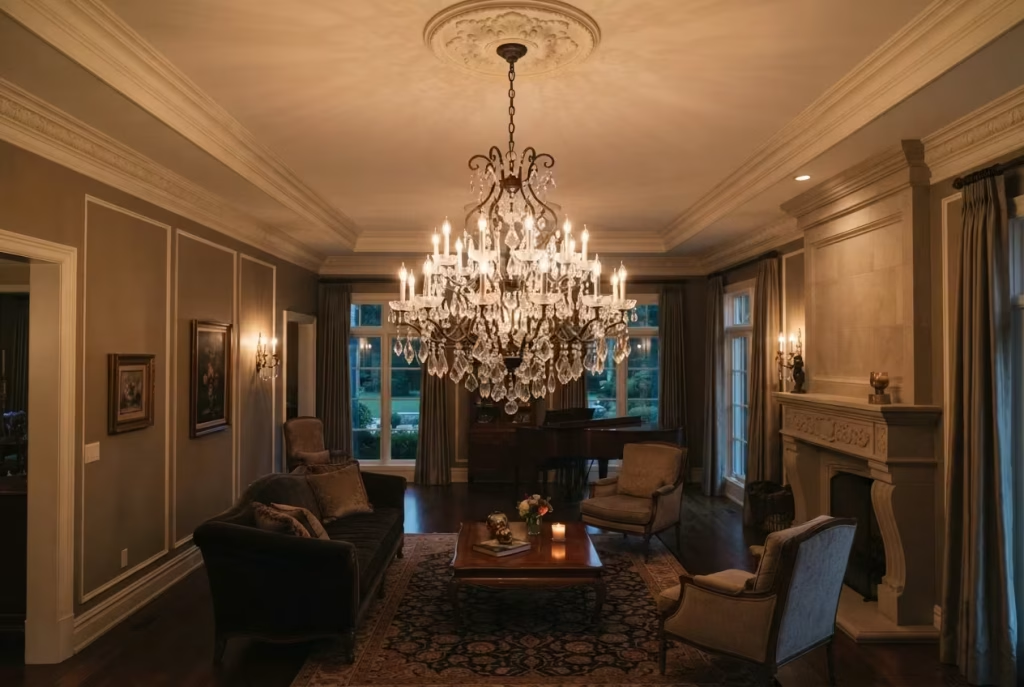
A statement chandelier is close to non-negotiable in this style, whether that’s an ornate crystal fixture for a more formal room or a simpler wrought iron design with a handful of candle-style bulbs for a rustic feel. If ceilings are on the lower side, choose a smaller-scale or flush-mount design rather than skipping the chandelier altogether, since even a modest fixture does a lot of the stylistic heavy lifting, and there’s genuinely something about the way light scatters and flickers through crystal or catches on wrought iron that a flat overhead spotlight can never quite replicate. It’s the kind of detail people rarely name consciously when they walk into a room, yet somehow always notice is missing when it isn’t there.
14. Layer in Table Lamps and Wall Sconces
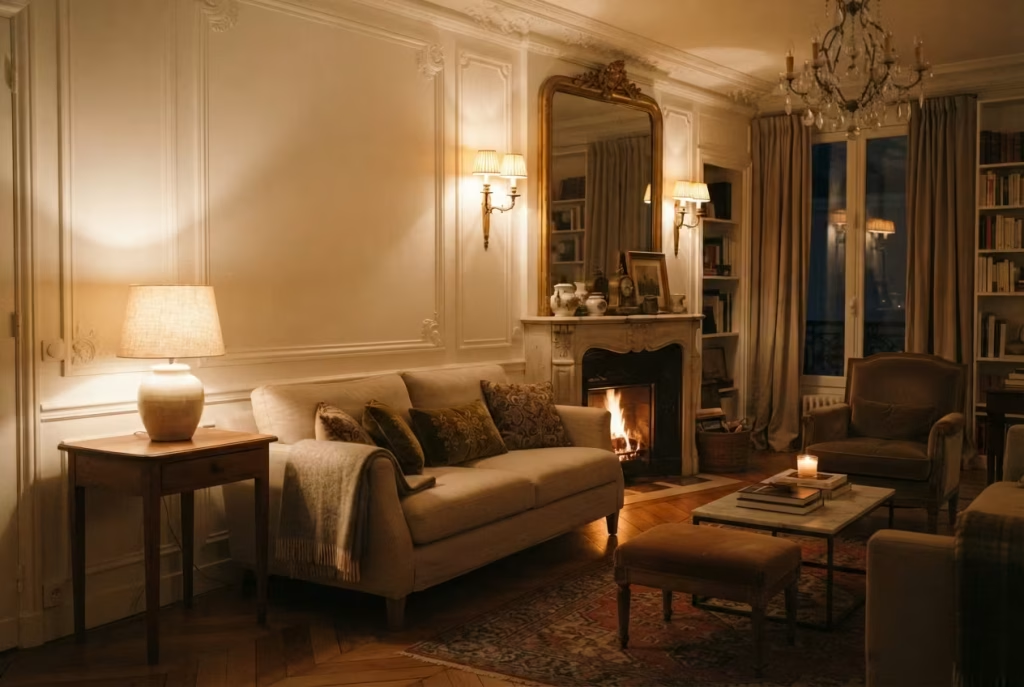
French interiors rarely rely on a single overhead light source, and for good reason: one bright bulb overhead flattens a room and kills the softness the whole style depends on, casting flat, even light across everything in a way that leaves nowhere for shadow or warmth to gather. Add a table lamp with a linen or pleated shade beside the sofa, a pair of wall sconces flanking the fireplace or a mirror, and you’ll have a room that glows warmly from several directions rather than one that’s simply “on” or “off,” the kind of layered light that makes an evening at home feel like an occasion rather than an afterthought. Try switching off the main light entirely one evening and living only by lamps for a few hours; most people notice almost immediately how differently a room settles around them.
You May also Like: 20 Italian Fireplace Ideas That Bring Timeless European Warmth to Your Home
15. Choose Warm Bulbs Over Cool White
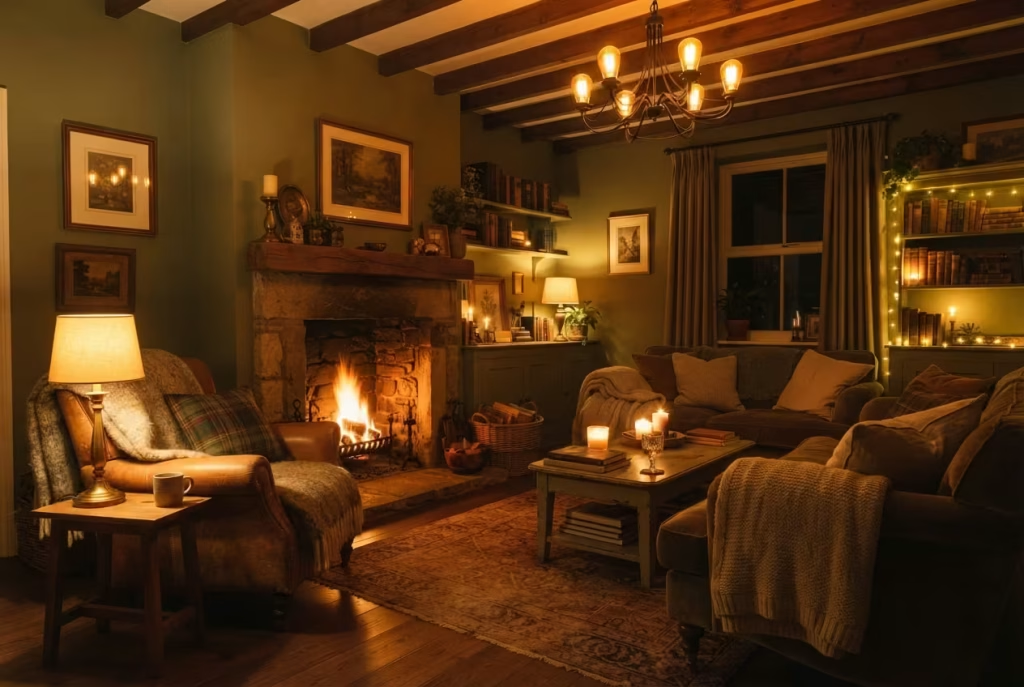
It sounds like a small detail, but bulb temperature makes or breaks the mood here. A warm white bulb (roughly in the 2700K range) gives off that soft, golden, almost candlelit quality the style is built on, whereas anything cooler or bluer reads as clinical and undoes a lot of the warmth you’ve worked to create elsewhere in the room. It’s one of the cheapest changes on this entire list, a few pounds spent on the right bulbs, and one of the ones people notice least consciously while feeling its effect the most, a genuinely outsized return for such a small outlay.
Textiles and Fabrics: Where the Character Lives
16. Introduce Toile de Jouy in Small Doses
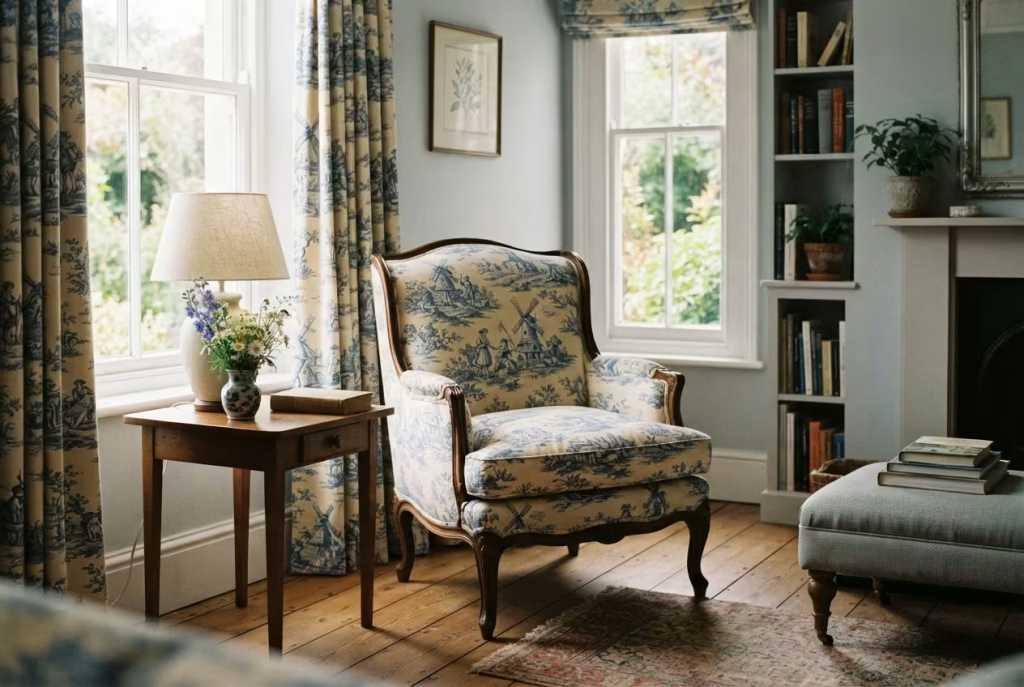
Toile, the densely printed pastoral fabric usually rendered in blue or red on a cream ground, is about as quintessentially French as patterns get, its scenes of shepherdesses, windmills and country idylls dating back to 18th-century textile printing in the town of Jouy-en-Josas, just outside Paris. Used across an entire room it can feel overwhelming, closer to wallpaper-turned-upholstery than a considered accent, but on a single armchair, a scatter cushion or a set of curtains, it instantly signals the style without shouting about it, letting the pattern tell its little pastoral story in one corner of the room rather than narrating the whole space at once.
17. Layer Stripes, Checks and Florals Together
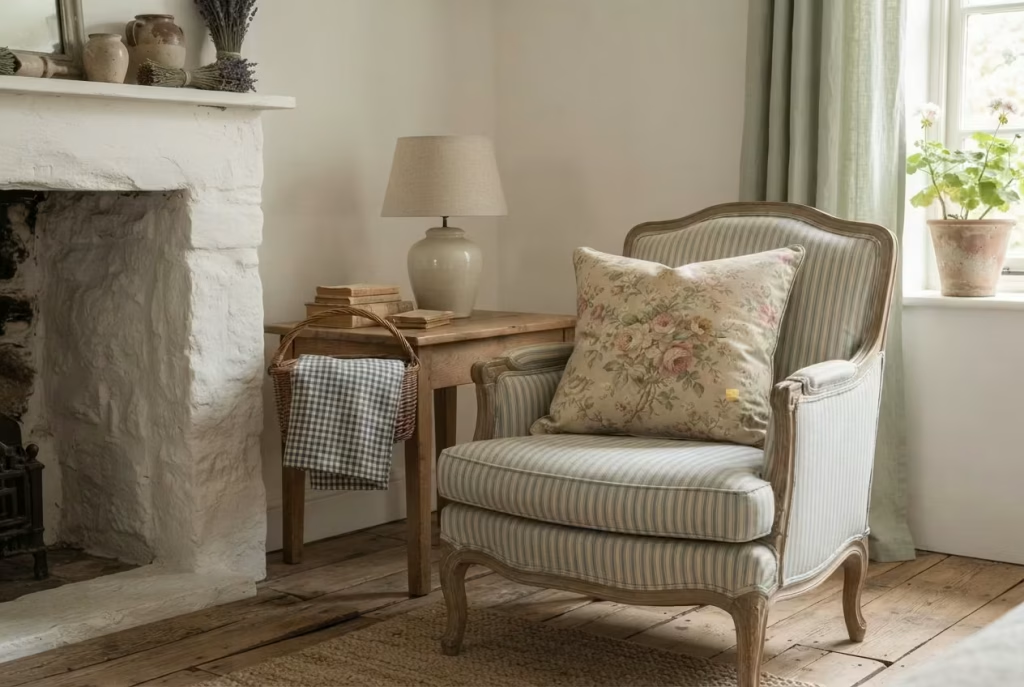
Rather than sticking to one pattern, French country rooms typically mix two or three: a ticking stripe on one chair, a faded floral on a cushion, perhaps a simple gingham somewhere small. The trick to keeping this from looking chaotic is to keep them within the same soft, faded colour family, so the patterns read as a considered collection rather than a jumble sale. Think of it less like matching and more like a conversation between fabrics, each one different enough to have something to say, but all speaking the same quiet, muted language, the visual equivalent of old friends finishing each other’s sentences rather than strangers talking over one another.
18. Choose Natural Fibres Over Synthetics
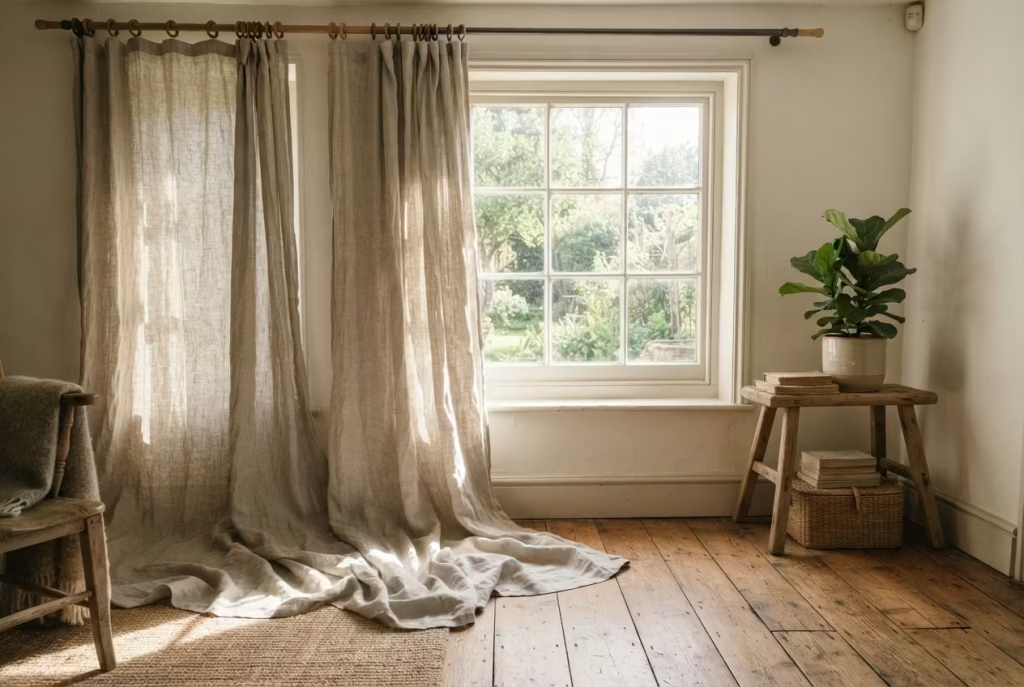
Linen, cotton and wool are the backbone fabrics of this style, and it isn’t purely aesthetic. Natural fibres age and soften in a way synthetics simply don’t, developing exactly the kind of relaxed, slightly rumpled character that suits the room, whereas a synthetic blend tends to hold its shape stiffly for years and then simply wear out rather than mellow. A linen curtain that hangs loosely to the floor, rather than a stiff, perfectly tailored drape, does more for the mood than almost any other single choice, the fabric pooling slightly at the base the way it would in an old farmhouse where nobody measured the drop to the millimetre. There’s an honesty to that imperfect drape that a perfectly hemmed curtain simply can’t offer.
19. Add a Vintage or Faded Rug Underfoot
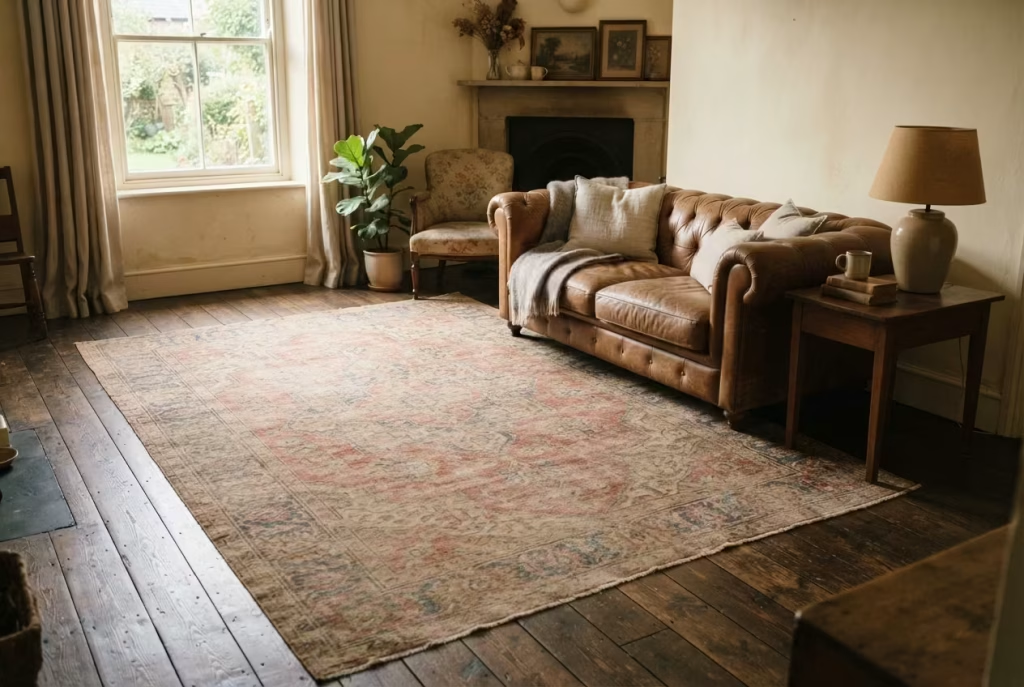
A jute or sisal rug brings natural texture and works well as a neutral base layer, while a genuinely aged or deliberately faded Persian or Turkish rug adds pattern and warmth without looking new. Avoid anything with a crisp, saturated colour or a machine-perfect pattern, since a slightly worn-looking rug does more to age a room convincingly than almost any other single piece, and it’s often the very first thing a practised eye will notice is “off” in a room that’s otherwise trying hard to look period-appropriate. Bare feet notice it too, in their own way; a well-worn wool rug has a softness underfoot that nothing brand new quite matches.
You May also Like: 25 Farmhouse Living Room Ideas
Walls and Architectural Details
20. Consider a Plaster or Limewash Finish
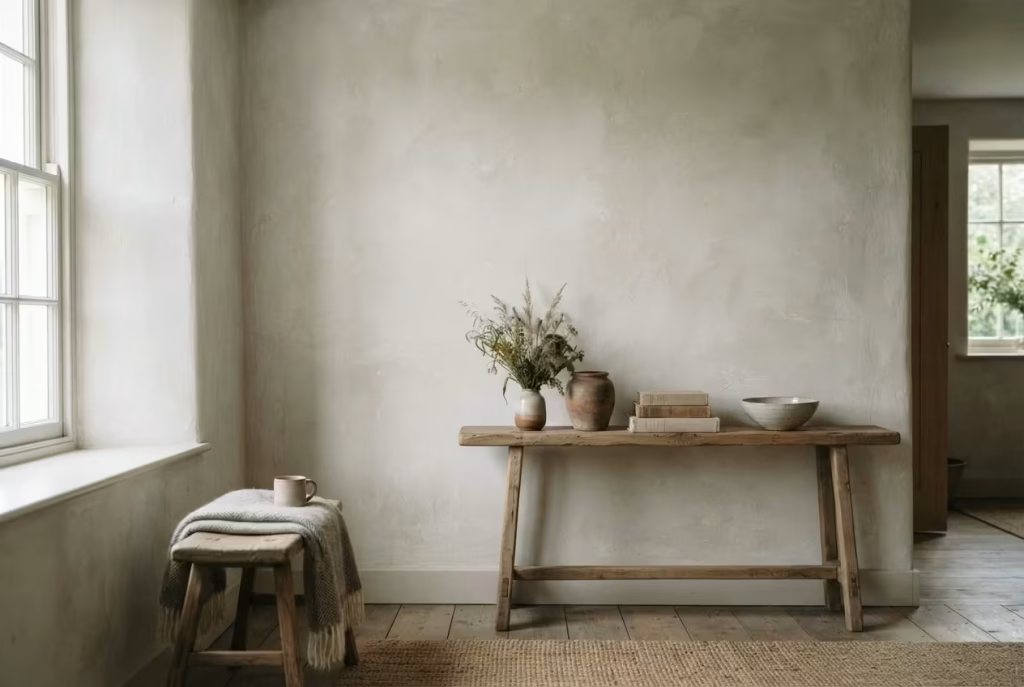
Where budget and structure allow, a genuine limewash or plaster paint finish on the walls adds a subtle, uneven texture that flat modern paint can’t replicate. It catches the light differently throughout the day, shifting almost imperceptibly from morning to evening, which is a big part of why rooms finished this way photograph so beautifully and feel so different to stand in compared with a wall finished in a single flat sheen. Run your hand across a limewashed wall sometime; the faint chalky texture under your fingers is doing more for the room’s character than most people ever realise.
21. Add Panelling or Wainscoting for Instant History
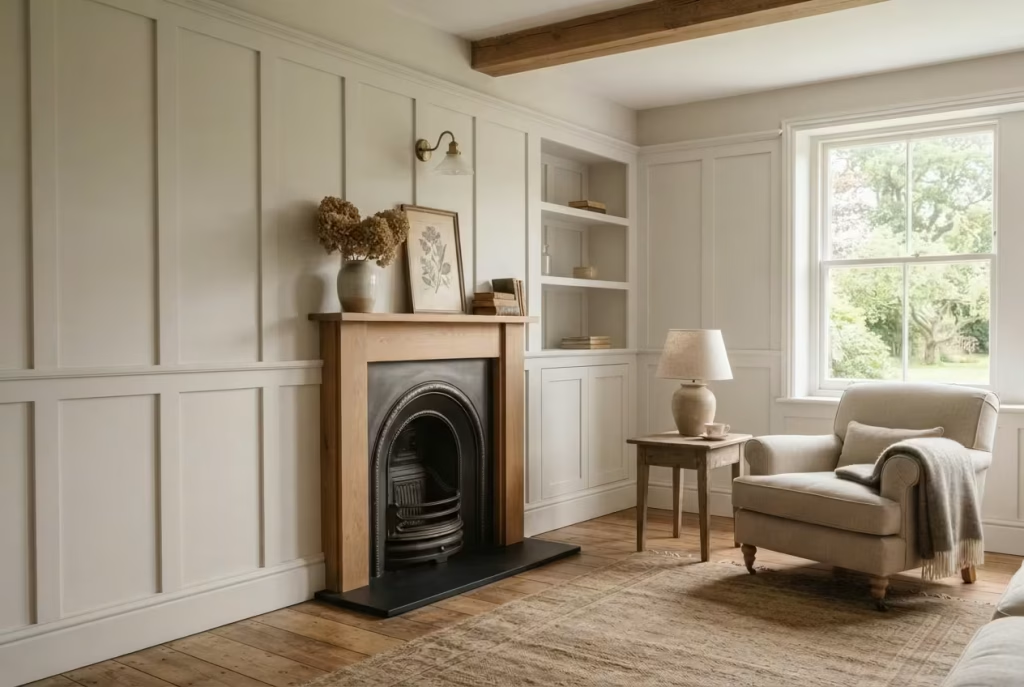
Wall panelling, whether traditional raised-and-fielded or a simpler shaker-style board-and-batten, gives a newer or plainer room a sense of age it might otherwise lack. Painted in the same soft neutral as the rest of the wall, or picked out a shade lighter, it adds architectural interest without needing a single extra accessory, effectively doing the work of a dozen smaller decorative choices in one single structural move, and giving even a fairly modern box room a genuine sense of having been there far longer than it has.
22. Hang a Gallery of Mismatched Vintage Frames
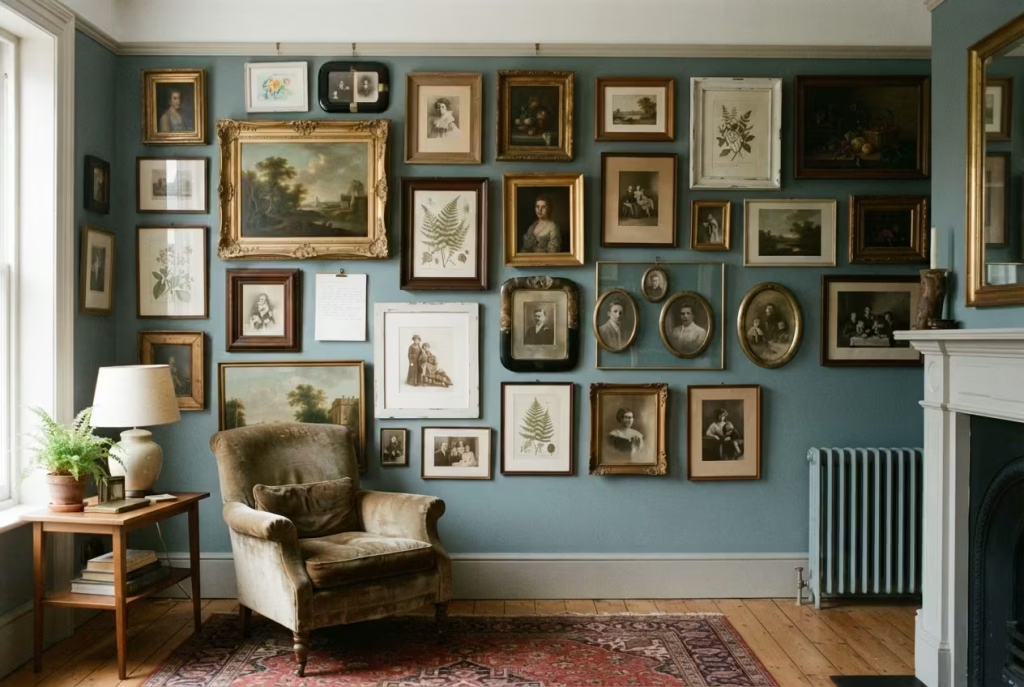
A wall of old oil paintings, botanical prints or family portraits, hung in a genuinely mismatched set of frames (some gilt, some plain wood, some painted white), does more for the “collected over generations” feel than almost any single statement piece could. Vary the frame heights slightly rather than lining everything up on a strict grid, since the imperfection is doing real work here, and a wall like this tends to become the one part of the room guests linger over longest, piecing together a story from images that were never meant to form a matching set. It’s worth including at least one piece that means something personal to you rather than purely decorative, since that’s usually the one people end up asking about.
Accessories and Finishing Touches
23. Display Everyday Objects as Decor
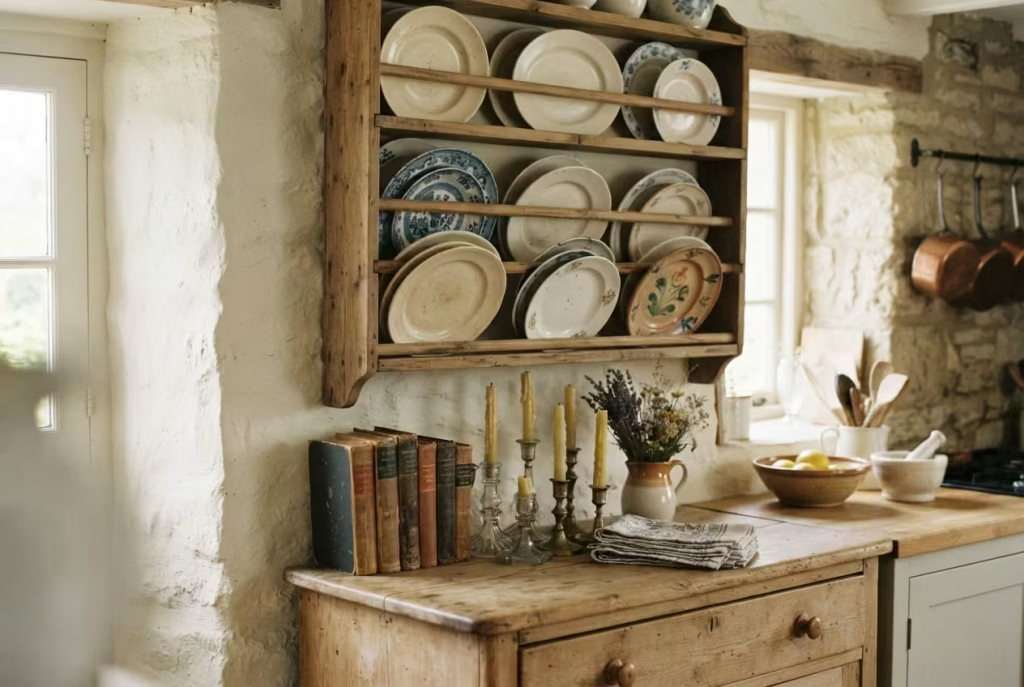
Ceramic plates leaned on a plate rack, a collection of glass or brass candlesticks, a stack of well-thumbed books; French country style has always treated functional, everyday objects as decoration in their own right, rather than hiding them away. It’s an easy, low-cost way to add personality without buying a single new “decor” item, and it carries a genuinely different feeling to buying decorative objects specifically for show, since everything on display has actually earned its place through use, rather than being purchased purely to be looked at.
24. Bring in Fresh or Dried Botanicals
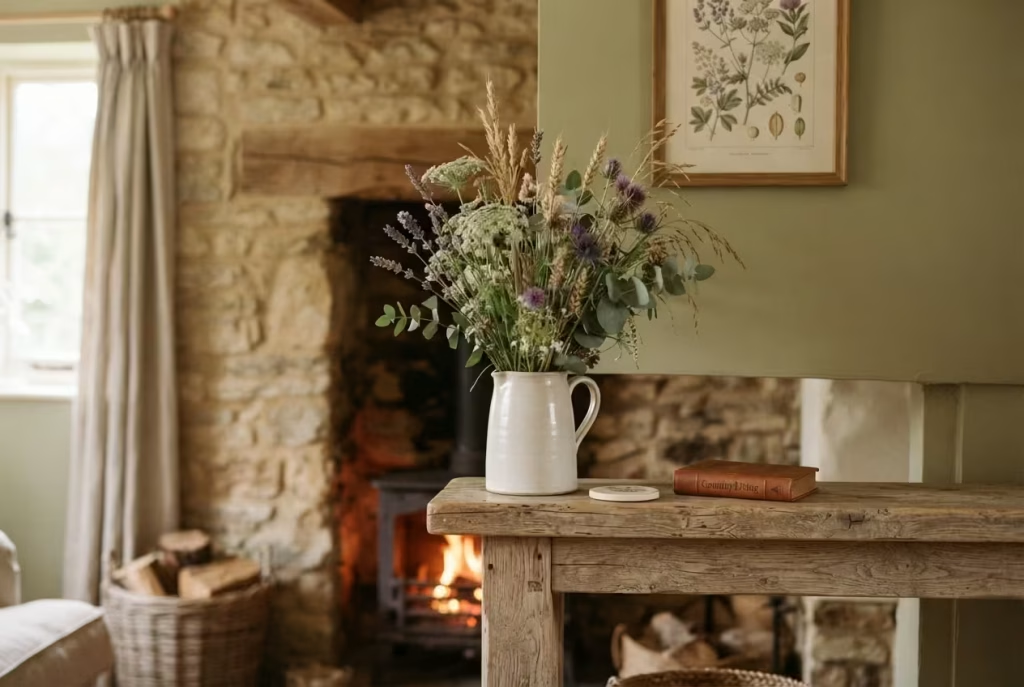
A simple vase of garden flowers, a jug of dried lavender, or a bundle of wheat stalks on the mantel connects the room back to the countryside the style is named for. Keep the vase itself understated (plain ceramic or glass rather than anything ornate) so the flowers or foliage remain the focal point, and there’s a small but genuine seasonal pleasure in swapping what’s in that vase as the year turns, wildflowers in summer, dried stems and berries once the weather closes in. Scent plays its own quiet part here too; a bunch of dried lavender does something for a room that no candle quite manages, a soft, herbal note that settles into soft furnishings over weeks rather than announcing itself the moment you walk in.
Small Living Rooms: Making the Style Work in a Compact Space
25. Scale Everything Down, But Keep the Same Ingredients
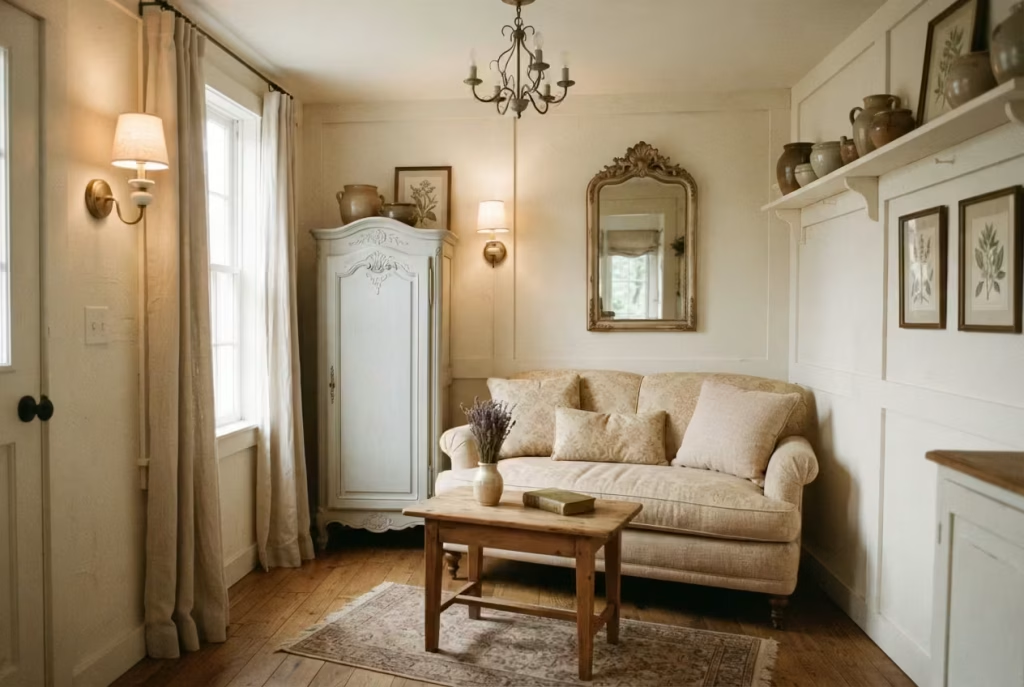
The good news for anyone working with a smaller room is that French country style doesn’t need square footage to work, it needs the right proportions. Choose a smaller-scale chandelier or a single statement pendant instead of a sprawling fixture, opt for a loveseat rather than a full three-seater sofa, and lean on wall-mounted sconces instead of floor lamps to free up walking space. A single well-chosen vintage piece (one good armoire, one genuinely lovely mirror) will do more for a small room than five smaller trinkets competing for attention, and leaving roughly 900mm to a metre of clear walking space around the main seating area will stop even a fully styled small room from feeling cramped. If anything, a smaller room can wear this style particularly well, since there’s less space for anything to feel scattered, and every choice you make carries proportionally more weight, meaning even modest budgets tend to go further than they would in a larger space.
How to Avoid It Looking Dated or Like a Flea Market Exploded
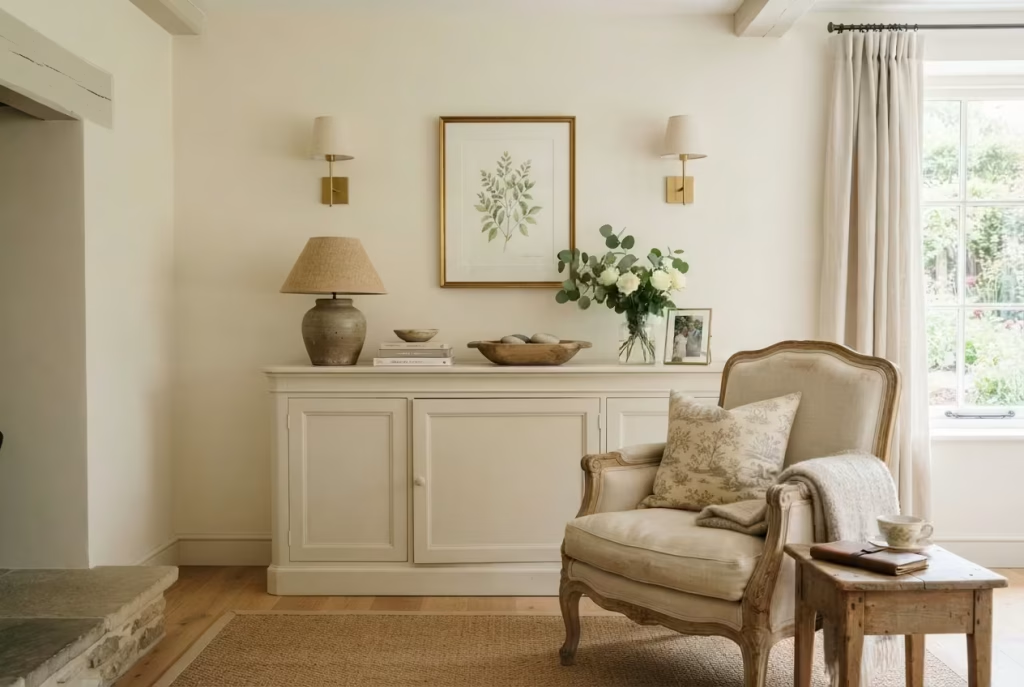
This is the question that comes up more than almost any other once people commit to the style, and it’s a fair one, because French country can tip into “tired” territory faster than most other looks if it isn’t handled with a bit of care. It’s also, understandably, the thing people worry about most before they’ve even started, that fear of ending up somewhere between charming and chaotic without quite knowing which side they landed on.
The late American designer Charles Faudree, who more or less defined this look for a generation of homeowners in his book on the subject, put it best: a room should feel like it’s overflowing with character, but it should never tip into cluttered or overpowering. That distinction matters enormously, and it’s worth sitting with for a moment rather than rushing past. Overflowing means every surface has something considered on it, something with a reason to be there. Cluttered means every surface has something, full stop, with no thought given to why. The difference between the two often comes down to a single question you can ask of any object before it goes on display: would you miss it if it disappeared tomorrow? If the honest answer is no, it probably doesn’t need to be there.
There’s also a genuine, real-world version of this problem worth flagging: homeowners who decorated in this style years ago and have since watched their own rooms slide from charming into dated often point to the same culprits, a wall colour that’s gone slightly yellow with time, drapery or upholstery in a fabric that felt fresh a decade ago but now reads as heavy and dark, and faux florals that have quietly become dusty and lifeless rather than characterful. The fix in almost every one of these real makeovers is the same: refresh the paint to something a touch softer and more neutral, swap heavy or dated drapery for lighter linen, update the lighting, and add one or two pieces of genuinely fresh artwork, all while keeping most of the existing furniture exactly where it is. You very rarely need to start again from scratch. You need to edit, and there’s something quite freeing in realising that a room you’ve fallen slightly out of love with can usually be won back with a handful of careful changes rather than a full replacement. It’s a bit like an old friendship that’s gone a little stale; you don’t need to end it, you just need to spend a bit more thoughtful time on it.
A few practical rules that keep the balance right:
- Limit yourself to two or three patterns in any one seating area, not five or six.
- Give every surface a “job”: display, function, or both, never decoration for decoration’s sake alone.
- Choose one or two genuinely worn or antique pieces rather than filling the room with reproductions that all look distressed in exactly the same factory-finished way.
- Step back and photograph the room occasionally. Clutter is far easier to spot in a photo than standing in the middle of it, since a photograph strips away the memory of why each object is there and shows you only what’s actually visible.
Is French Country Living Room Style Pet-Friendly?
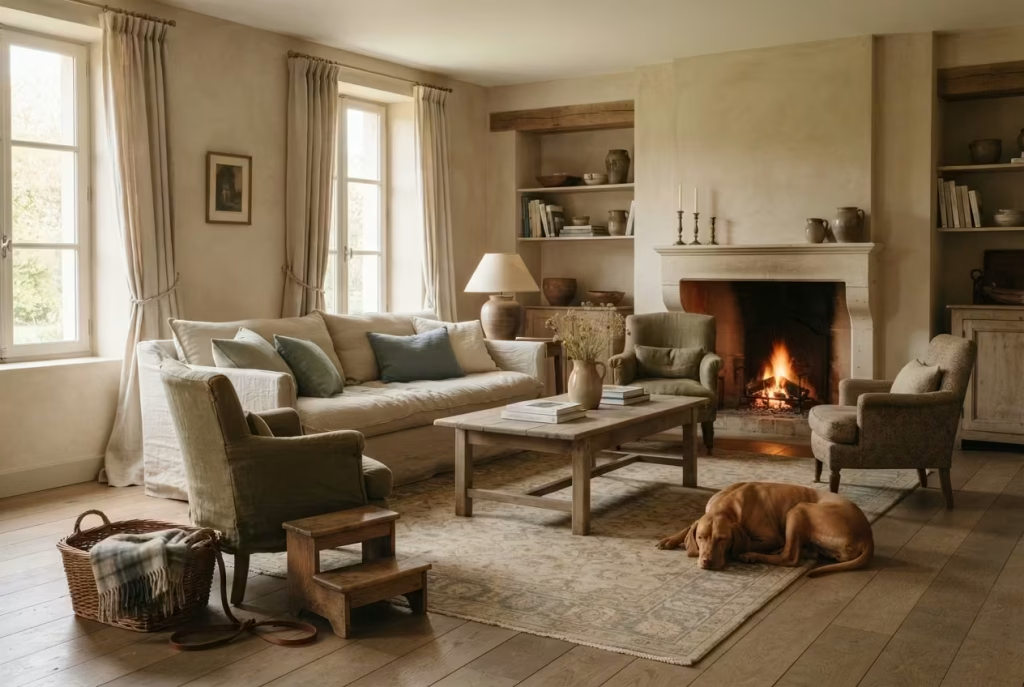
It’s a genuinely underserved question, and the honest answer is yes, with a few sensible fabric choices along the way. Homeowners on design forums have specifically flagged pet steps as a natural, welcome addition to a French country living room, since a low wooden or upholstered step tucked beside a favourite armchair fits the rustic, lived-in aesthetic far more comfortably than it would in a sleek modern room, where it might stick out as an obviously practical, slightly clinical add-on rather than something that quietly belongs. There’s something rather fitting about that too; a style built around welcoming imperfection was never going to have much trouble welcoming a dog that occasionally sheds on the good chair.
Where households need to think a little harder is fabric choice. Chenille, velvet and corduroy trap pet hair and are genuinely hard to keep looking fresh, whereas tightly woven fabrics like twill or a good performance linen shed hair far more easily and wipe clean. Delicate fabrics such as silk, boucle or loosely woven linen are also the most likely to snag under a cat’s claws, so save those for cushions rather than the main sofa if you share your home with a cat. A washable slipcover, which suits the relaxed French country look anyway, is one of the simplest ways to future-proof a sofa against both pets and general family life, and there’s a nice bit of overlap here between what looks right and what actually holds up, since the loose, slightly rumpled slipcover this style already loves happens to be one of the most practical choices going.
| Fabric | Pet-Friendly? | Notes |
| Performance linen/twill | Yes | Wipes clean, resists snagging |
| Velvet/chenille/corduroy | No | Traps hair, hard to clean |
| Silk/boucle | No | Snags easily under claws |
| Washable cotton slipcover | Yes | Easy to remove and launder |
| Leather (aged/distressed) | Yes | Wipes clean, ages well with use |
What Does It Actually Cost to Achieve This Look?
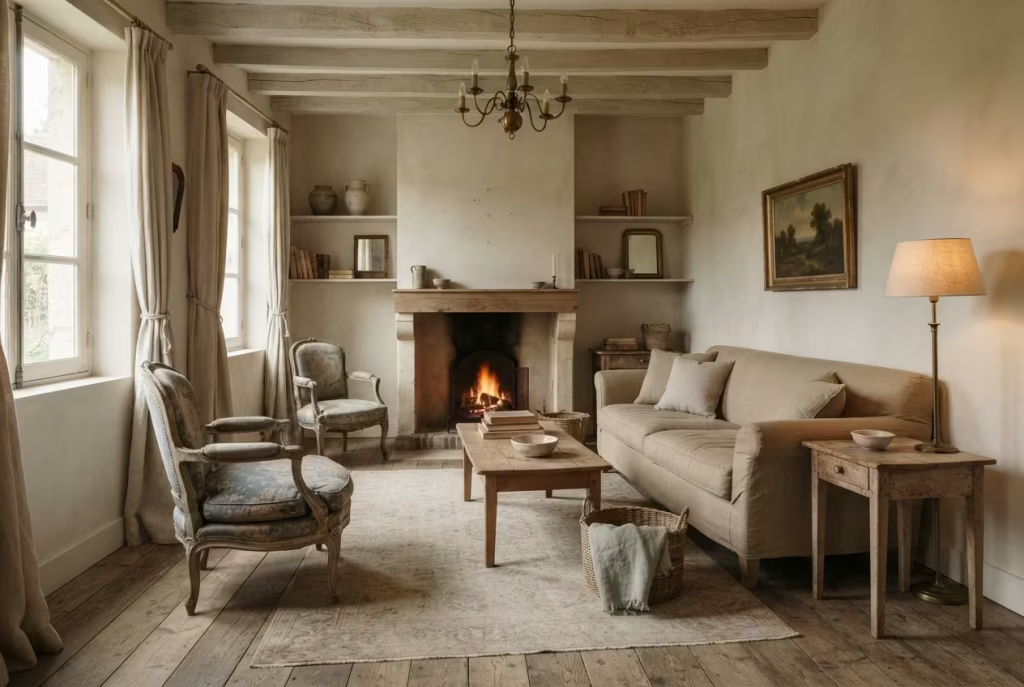
One of the loveliest things about French country style is that it was never built around buying everything new. It grew out of homes furnished gradually, over years, often with pieces inherited or picked up secondhand, and that same approach works brilliantly on a modern budget too. In a way, working within a tighter budget doesn’t fight against this style, it actually plays directly into how it was always meant to come together in the first place, one careful find at a time rather than a single delivery van’s worth of matching furniture.
| Budget Tier | What You Can Realistically Achieve | Typical Approach |
| Low (under a few hundred pounds) | Paint refresh, linen throws and cushions, charity-shop or secondhand furniture finds, DIY distressing | Paint existing furniture, source secondhand, sew or buy ready-made linen soft furnishings |
| Mid-range | One or two reupholstered vintage chairs, a proper chandelier, quality curtains | Mix a few new “anchor” pieces with existing or secondhand furniture |
| Higher | Genuine antiques, custom joinery (panelling, built-in shelving), bespoke curtains and upholstery | Sourced from antique dealers, auction houses, and made-to-measure suppliers |
Flea markets, auction houses, charity shops and even a decent sanding-and-painting weekend on furniture you already own will get most homeowners a long way toward the look before a single new item needs buying. It’s a style that genuinely rewards patience over impulse purchases, and there’s a real satisfaction, arguably even more than the finished room itself, in knowing exactly where each piece came from and what you did to bring it back to life. Ask most people with a genuinely convincing French country living room to tell you about one piece in it, and you’ll usually get a proper story rather than a receipt.
Bringing It All Together
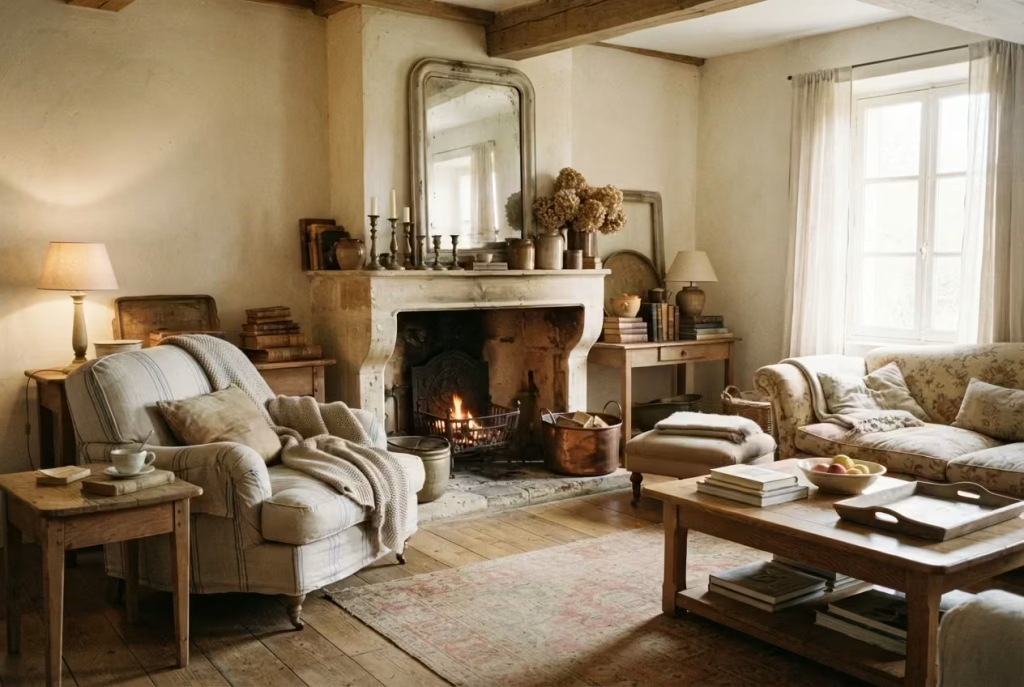
The real secret of French country style, the bit that never quite makes it into the moodboard version, is that it was never meant to look finished. It’s a style built for houses that are actually lived in, where a chair gets a bit more worn each year and nobody minds, where the mirror above the fireplace has been there so long nobody remembers where it came from, and where the whole room feels like it’s quietly telling you to sit down, stay a while, and not worry too much about the cushions.
That’s ultimately the emotional heart of the whole thing. Every idea in this guide, the colour choices, the mismatched chairs, the softened light, the mantel dressed with restraint, is really in service of one single feeling: a room that welcomes you home rather than one that asks you to keep it tidy on its behalf. Start with the palette, choose furniture you’d actually want to sink into rather than furniture that photographs well, and let the room fill up slowly with things that mean something. That, more than any single idea on this list, is what makes a French country living room feel genuinely charming rather than merely styled, and it’s why, years from now, it’ll be the room people remember, rather than simply the room they saw once in a photo.
Frequently Asked Questions
What’s the difference between French country and French Provincial style?
French Provincial generally refers to the more refined, formal end of the same broad tradition (think elegant Louis-style furniture and a more polished finish), while French country leans slightly more rustic and relaxed. In everyday use, the two terms overlap a great deal and are often used interchangeably, so don’t worry too much about drawing a hard line between them when you’re shopping or styling.
Is French country style the same as farmhouse style?
No. Farmhouse style favours a starker, plainer palette (lots of white and shiplap) with minimal ornamentation, while French country embraces curved, ornate furniture, warmer colours and a good deal more pattern. If your instinct is toward soft curves and a bit of romance, French country is the better fit; if you prefer clean, simple lines, farmhouse will feel more natural.
How do I stop my French country living room looking cluttered?
Stick to two or three patterns per seating area, give every displayed object a clear purpose, and favour a small number of genuinely characterful pieces over lots of similarly distressed reproductions. Step back and photograph the room occasionally to spot clutter you’d otherwise miss standing in it, and ask yourself of any single object whether you’d genuinely miss it if it vanished tomorrow.
Is French country decor expensive?
It doesn’t have to be. Secondhand furniture, charity shop finds and a bit of DIY painting or distressing will get most rooms most of the way there. Save any real spending for one or two “anchor” pieces, like a proper chandelier or a reupholstered armchair, rather than trying to buy the whole look at once, and let the room grow gradually rather than all in one weekend.
What colours work best in a French country living room?
A warm, chalky neutral base (off-white, buttermilk, soft greige) works best on the walls, with faded accent colours such as dusty blue, sage green or muted mustard introduced through furniture and textiles rather than paint. Avoid cool, blue-toned whites, which tend to fight the warmth everything else in the room is trying to create.
Can French country style work in a small living room?
Yes. Scale the furniture down (a loveseat instead of a full sofa, a smaller chandelier or single pendant), lean on wall sconces to save floor space, and choose one or two genuinely good vintage pieces rather than filling the room with smaller trinkets. Smaller rooms often wear this style especially well, since there’s less room for anything to feel scattered.
Is a velvet sofa practical for a French country living room?
Velvet looks lovely but isn’t the most practical choice for households with pets or young children, since it traps hair and marks easily. A tightly woven linen or performance fabric gives a similar softness with far less maintenance, and a linen slipcover has the added benefit of being removable and washable when life gets messy.
How do I mix patterns without it looking chaotic?
Keep every pattern within the same soft, faded colour family and limit yourself to two or three patterns in any one area (for example, a stripe, a floral, and a plain textured fabric) rather than introducing a new pattern with every cushion. Think of the patterns as characters in the same story rather than unrelated voices competing to be heard.
Do I need a chandelier for the room to feel authentically French country?
It helps enormously, but it doesn’t need to be grand. A smaller wrought iron fixture or a flush-mount design works just as well in a lower-ceilinged room as a full crystal chandelier does in a grander one, and even a modest version does a surprising amount of the stylistic heavy lifting on its own.
Is French country style pet-friendly?
Yes, provided you choose the right fabrics. Tightly woven linen, twill and washable cotton slipcovers hold up well against pet hair and claws, while velvet, chenille and delicate silks or boucles are best avoided on main seating. A pet step tucked beside a favourite armchair fits the rustic, lived-in aesthetic naturally rather than looking like an afterthought.
How do I stop French country decor looking dated over time?
Refresh the wall colour every so often to a soft, current neutral, swap out any heavy or aged drapery for lighter linen, update lighting fixtures, and rotate in fresh artwork or florals rather than letting the same faux arrangement sit for years. Most of the furniture underneath rarely needs replacing, only editing, and a handful of small, considered changes will usually bring a tired room back to life far more effectively than starting again.
Can I combine French country with a more modern living room?
Absolutely, and many of the most liveable versions of this style do exactly that. Pair one or two clean-lined modern pieces (a simple sofa, a contemporary coffee table) with genuinely characterful French country accents (a chandelier, a vintage mirror, one curved chair) rather than trying to make every single element period-accurate. The blend often feels more personal, and more honestly lived-in, than a room that’s been styled to match a single era too rigidly.
Why does French country style feel so much more relaxing than sleeker, more modern rooms?
A large part of it comes down to the mix of soft light, natural fibres, muted colour and rounded furniture shapes, all of which read as calming rather than stimulating at an instinctive level, in contrast to the hard edges and bright, flat light common in more minimalist spaces. The visible imperfection also plays a genuine role, since objects that show their age tend to signal permanence and safety rather than austerity.