
20 Halloween Dining Room Decorating Ideas for Spooky Centerpieces, Elegant Tablescapes & Finishing Touches
A hands-on guide to dressing your dining room for Halloween, from showstopping centrepieces to the tiny details that make guests lean in and whisper, “How on earth did you do that?”
Your Dining Table Deserves a Night in the Spotlight
Most of the year, the dining table is a workhorse. It carries homework, unopened post, the Sunday roast and the odd jigsaw that never quite gets finished. Come the last week of October, it can finally play a leading role, and that is precisely why Halloween suits it so well. Everyone ends up around it eventually, whether they came for the food, the gossip or the sweets hidden in the cauldron.
The trouble is that a great many Halloween tables fall flat. Some drown in plastic spiders until the whole thing resembles a jumble sale in a crypt. Others stay so timid that nobody notices the decorations at all. The sweet spot lies somewhere in between: a table with a clear point of view, enough drama to stop guests in their tracks, and enough sense to leave room for the gravy boat.
That balance is what the 20 ideas below are built around. They are grouped into four layers, so you can pick one idea from each and have a finished room, or pull out all the stops and use the lot:
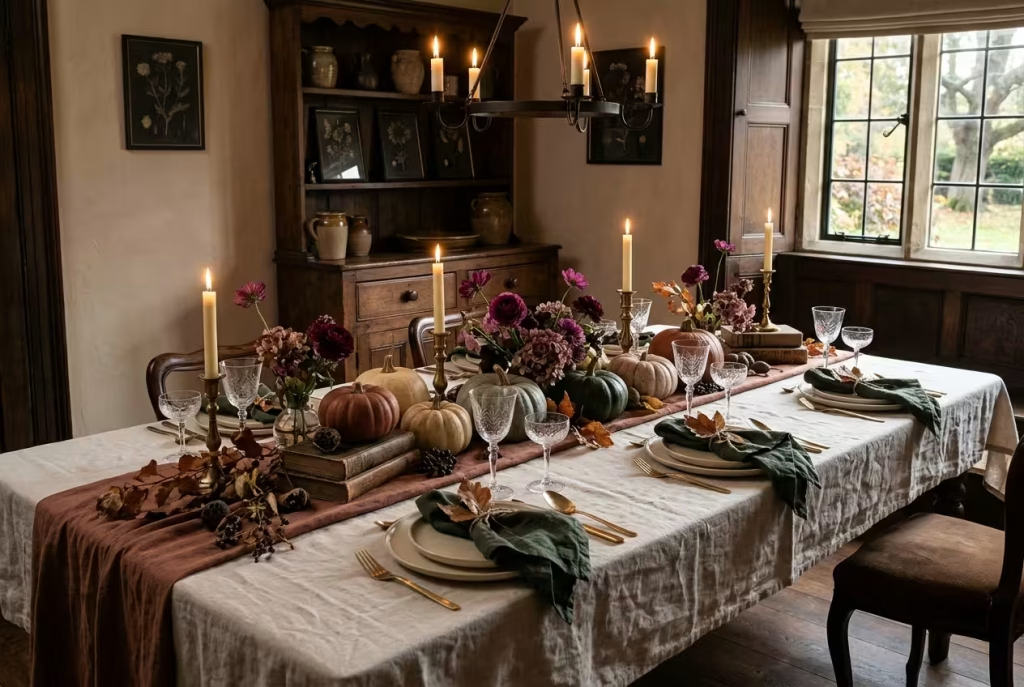
- Spooky centrepieces (ideas 1 to 7) to anchor the table
- Elegant tablescapes (ideas 8 to 13) for a polished, grown-up look
- Overhead and wall drama (ideas 14 to 16) to carry the mood up and out
- Finishing touches (ideas 17 to 20) where the real magic tends to hide
Along the way you will find real measurements, safety notes that might genuinely save your evening, and shortcuts for a table that has to be back to normal by Monday breakfast.
The Quick Answers
How tall should a Halloween centrepiece be? Keep it at or below 30cm (12 in) so guests can see one another across the table. If you want height, go well above eye line instead, by hanging things from the ceiling.
How far should candles sit from decorations? At least 30cm (12 in) from anything that can burn, according to fire-safety guidance from the US National Fire Protection Association (NFPA).
What colours work besides orange and black? Deep green, oxblood, plum, silver, dusty pink and warm rust all read as stylish rather than kitsch.
Is it safe to serve punch from a carved pumpkin? Only with care. A carved pumpkin left at room temperature for more than two hours enters the food-safety danger zone, so chill the shell, fill it late and keep a food-safe bowl inside.
How high should a chandelier hang over a dining table? Between 75 and 90cm (30 to 36 in) above the tabletop, on a dimmer with warm 2700K to 3000K bulbs.
Should I use scented candles on a Halloween dinner table? No. Strong fragrance competes with the food, so stick to unscented candles at the table and save the scent for the hallway.
Get the Numbers Right Before You Buy a Single Cobweb
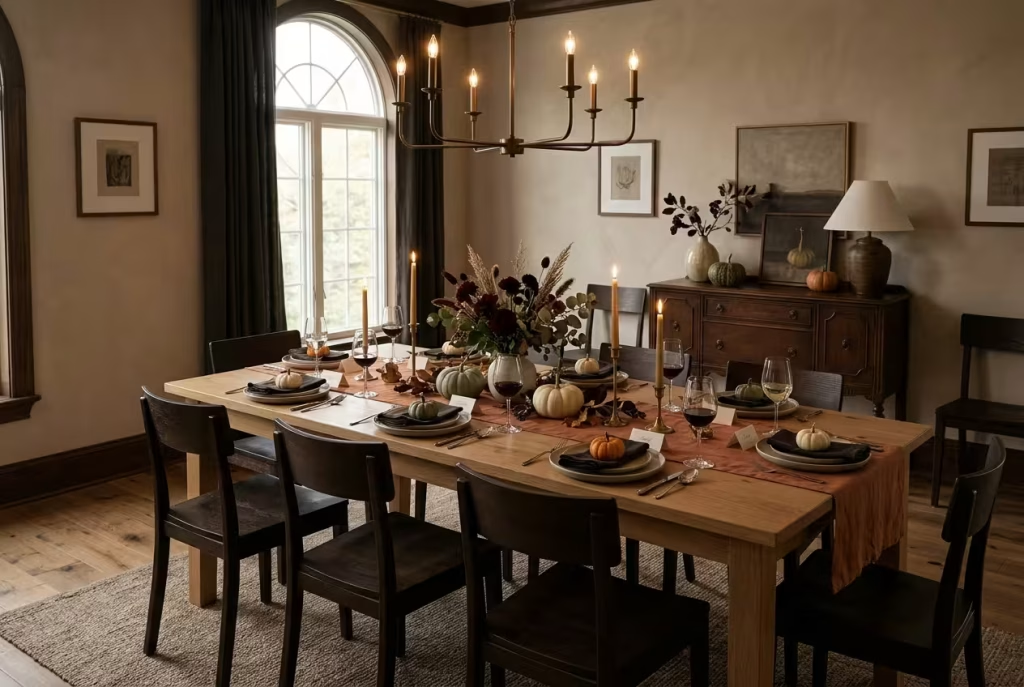
The devil really is in the detail where table styling is concerned. A centrepiece that looks glorious in a photograph can turn dinner into a game of peekaboo if it sits an inch or two too tall. Save this table, and measure twice before you cut, paint or hang anything.
| What you are sizing | Rule of thumb | Metric |
| Centrepiece height | At or below 12 in, or hung well above eye line | 30cm |
| Centrepiece width | About one third of the table width | Leaves elbow room |
| Space per guest | 24 in wide by 15 in deep | 60cm by 38cm |
| Runner overhang | 6 to 12 in at each end, or flush with the edge | 15 to 30cm |
| Tablecloth drop | 6 to 8 in for everyday, 10 to 15 in for formal | 15 to 20cm, or 25 to 38cm |
| Chandelier height | 30 to 36 in above the tabletop, plus about 3 in for every extra foot of ceiling over 8 ft | 75 to 90cm |
| Light bulbs | Warm white, dimmable | 2700K to 3000K |
| Table for 6 to 8 guests | 72 to 80 in long | 183 to 203cm |
| Table for 8 to 10 guests | 80 to 92 in long | 203 to 234cm |
| Table for 10 to 12 guests | 92 to 110 in long | 234 to 280cm |
| Walkway behind chairs | 2 to 3 ft | 60 to 90cm |
Two of these figures do most of the heavy lifting. The 30cm height limit keeps conversation flowing, because nobody wants to spend the pudding course shouting round a twig sculpture. And the 24-inch allowance per guest stops the place settings turning into a battle for elbow room once the crackers, glasses and serving dishes arrive.
A practical test: before guests turn up, sit in each chair for a few seconds and check you can see the face opposite. If you cannot, remove one layer. Less is more, and the table will still look brilliant.
Part One Spooky Centrepieces
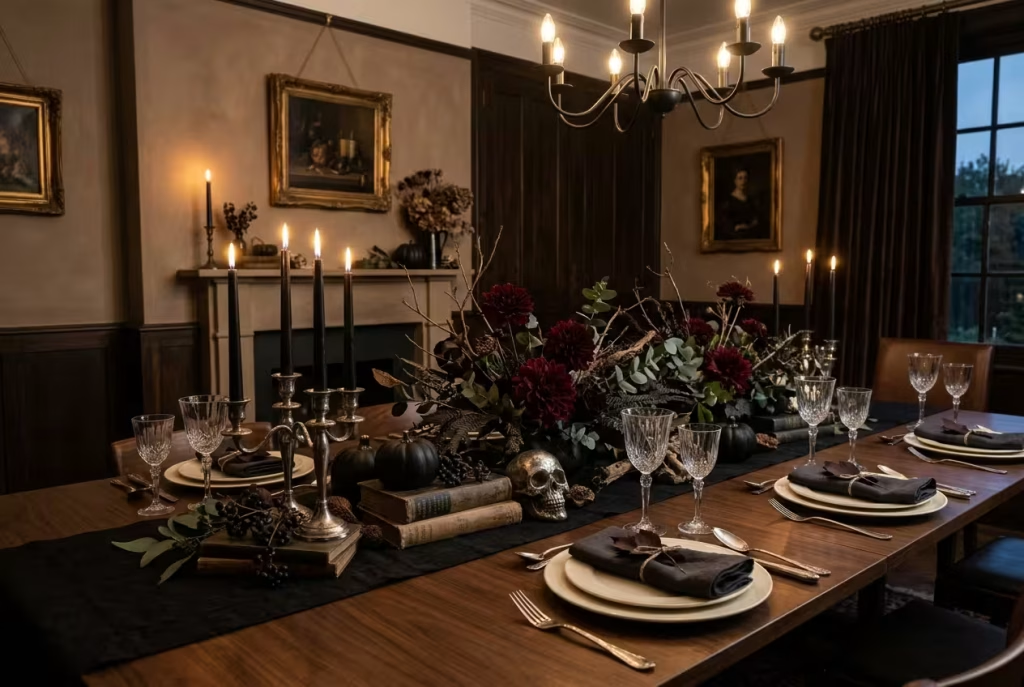
A centrepiece does the talking before anybody has sat down. Think of it as the first line of a ghost story: it should hook people and promise more to come.
1. The Apothecary Candle Cluster
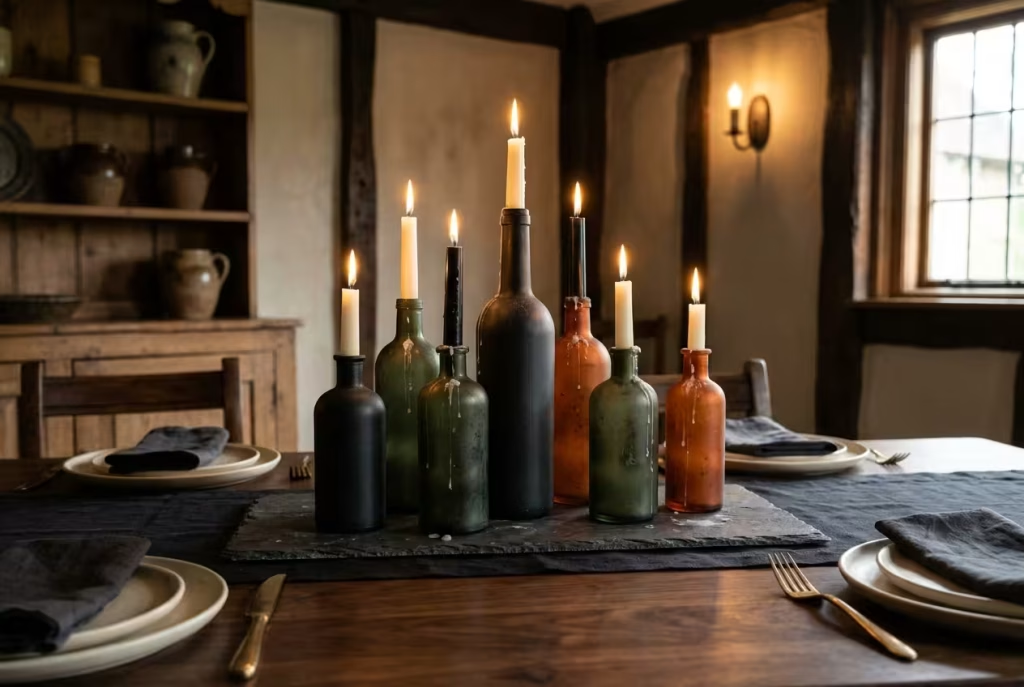
There is a reason a row of old bottles and flickering candles feels so cinematic. It echoes every cellar, chemist’s shop and fairy-tale kitchen we half remember from childhood, and this idea borrows that feeling for the price of a can of spray paint.
What you need
- Five to seven empty bottles in mixed shapes: squat sauce bottles, old brown medicine bottles, short wine bottles
- Matt spray paint in black, moss green or burnt orange
- Unscented tapers, about 2cm thick
- A metal tray, slate board or old baking sheet to catch the wax
How to make it
Soak the bottles in warm soapy water so the labels slide off, then rub away any glue with a little cooking oil. Spray outdoors in two thin coats rather than one heavy one, which stops runs, and give the paint a full day to cure. Slot a taper into each neck. If one wobbles, wrap its base in a strip of foil to wedge it snug.
How to arrange it
Odd numbers look natural, whereas even ones feel stiff and shop-bought, so cluster five or seven with the tallest bottle in the middle. Mind the sums: a bottle plus a full 25cm taper will tower well over 30cm, so choose squat bottles and trim the tapers to 12 to 15cm. That way the flames stay below eye line and nobody gets dazzled over the soup.
Light the candles a few minutes before the doorbell rings, because the first drips take a little while to run. The wax will crawl down the glass like something from a witch’s kitchen, and no two bottles will ever end up looking alike. Peel any spills off the tray once cold.
Roughly 30 minutes of work plus drying, and £10 to £20 if you buy the paint and candles new.
2. A Skull Under Glass, Perched on a Stack of Old Books
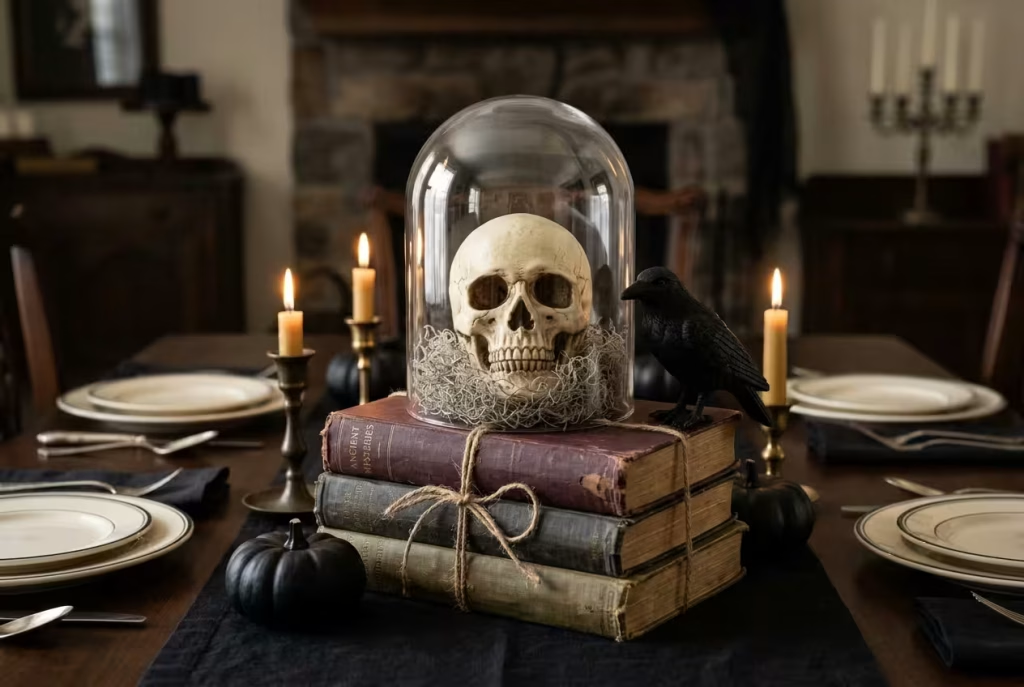
Charity-shop hardbacks come with a ready-made past. Somebody once wrote a name inside the cover, pressed a flower between the pages, or dog-eared a favourite chapter. Stacking a few of them beneath a skull gives your table a sense of history that no brand-new prop can fake, and it costs about a pound a book.
Tie two or three together with twine, set a glass cloche on top, and shelter a skull inside with a nest of Spanish moss at its base. A raven figurine perched on the books outside the glass completes the scene. It would sit happily in Miss Havisham’s parlour.
Height is the catch. Books and glass add up quickly, so do the maths before you buy:
| Element | Approximate height |
| Two slim hardbacks, tied together | 6 to 8cm |
| Glass cloche | 18 to 20cm |
| Skull and moss inside | Fits within the cloche |
| Total | About 26cm, safely under the 30cm limit |
To give the books a weathered look, brush the page edges with cold black tea and leave them to dry flat overnight. The cloche does a second job as well: it keeps fake cobwebs, dust and curious fingers off the display, which matters when children are around.
Fifteen minutes to assemble. Under £15 if you already own a cloche.
3. A Skull Vase Overflowing With Moody Blooms
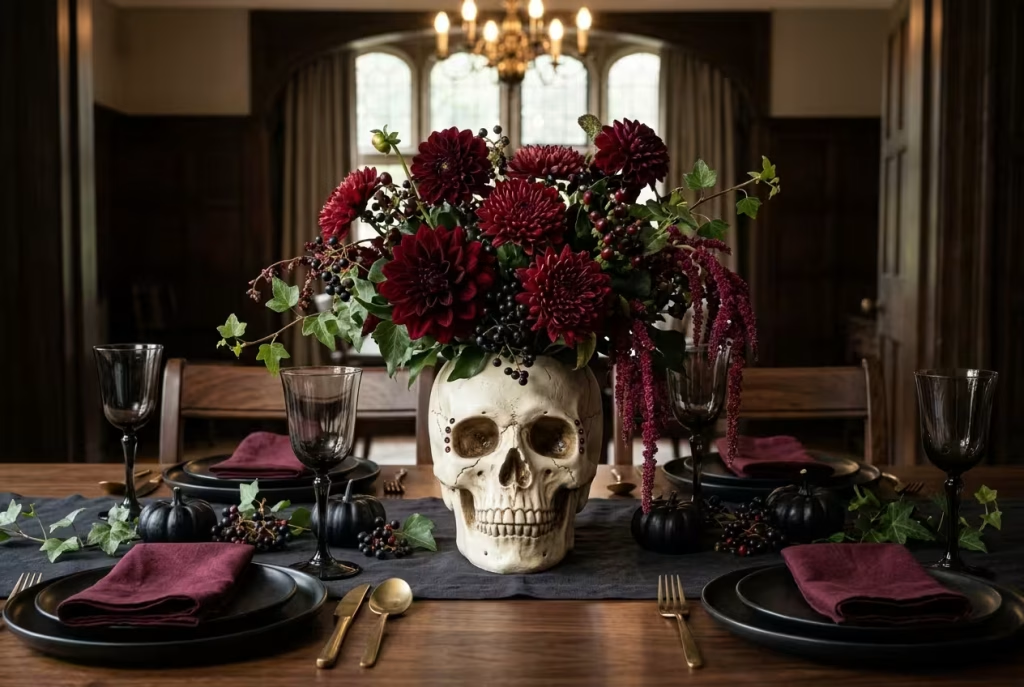
Beauty and decay have always been uneasy companions, and this centrepiece puts them side by side. A skull spilling over with dark petals looks both lovely and unsettling, which is exactly the tension Halloween thrives on.
- Choose a faux skull with a lift-off top, then slide a small glass jar or tumbler inside it.
- Wedge the jar with gravel or small stones so it cannot tip when the flowers go in.
- Stretch clear florist tape across the jar’s rim in a criss-cross grid. The squares hold each stem where you place it.
- Fill the jar about two thirds full with cold water.
- Build in layers: foliage first, then the larger blooms, then the delicate stems that finish the job.
- Strip every leaf that would sit below the waterline, or the water turns murky within a day.
For a UK October palette, think burgundy dahlias, deep red chrysanthemums, hypericum berries, trailing ivy and the tassel-like amaranthus. Dahlias are thirsty and short-lived, so buy them the day before and top up the water on the morning itself. A scattering of self-adhesive rhinestones around the eye sockets adds a dash of Morticia Addams glamour. Finally, trim the tallest stem so the whole arrangement stays under 30cm.
Allow about 40 minutes, and budget £15 to £30 for flowers and a skull.
4. The Pumpkin Punch Bowl (and a Word About Food Safety)
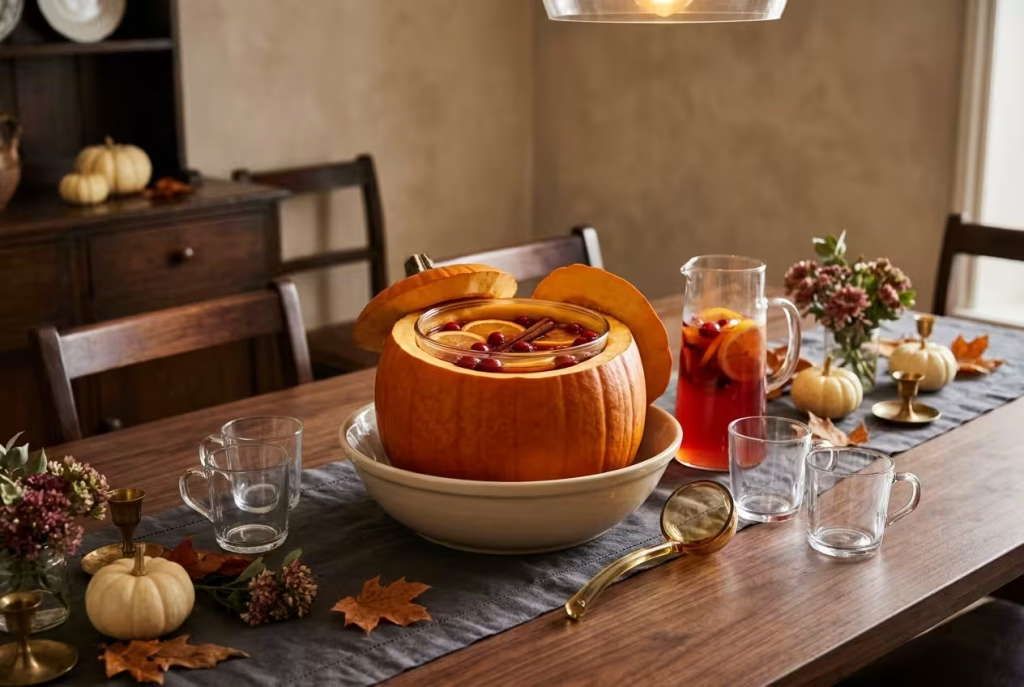
Picture the host ladling a glowing punch from a pumpkin while guests cluster round with empty glasses. That small ritual does more to break the ice than any seating plan. It also needs a little thought, because a carved pumpkin is a surprisingly fussy vessel.
Choosing and preparing the pumpkin
Pick a medium pumpkin with a flat base and no soft spots. Slice off the top, scrape out the seeds and strings, and wipe the inside clean. Shave a thin slice from the base if it rocks. Stand it inside a larger bowl so it cannot tip, and chill the empty shell in the fridge beforehand so the punch stays cold for longer.
The safety bit most blogs skip
- Michigan State University Extension warns that a carved pumpkin left at room temperature for more than two hours enters the food-safety danger zone, where bacteria multiply fast.
- Food-policy academics put it simply: a pumpkin is either an ingredient or a decoration, never both.
- So slip a food-safe glass bowl inside as a liner, fill it as late as possible, and bin the shell the next day instead of making soup.
What to pour
A non-alcoholic mix of apple juice, cranberry juice and sliced oranges, topped with ginger beer just before serving, looks gloriously murky in the orange glow. A medium pumpkin holds less than you might expect, so keep a chilled jug in the fridge for refills.
Twenty-five minutes of prep and £5 to £8 for the pumpkin.
5. Specimens in Test Tubes
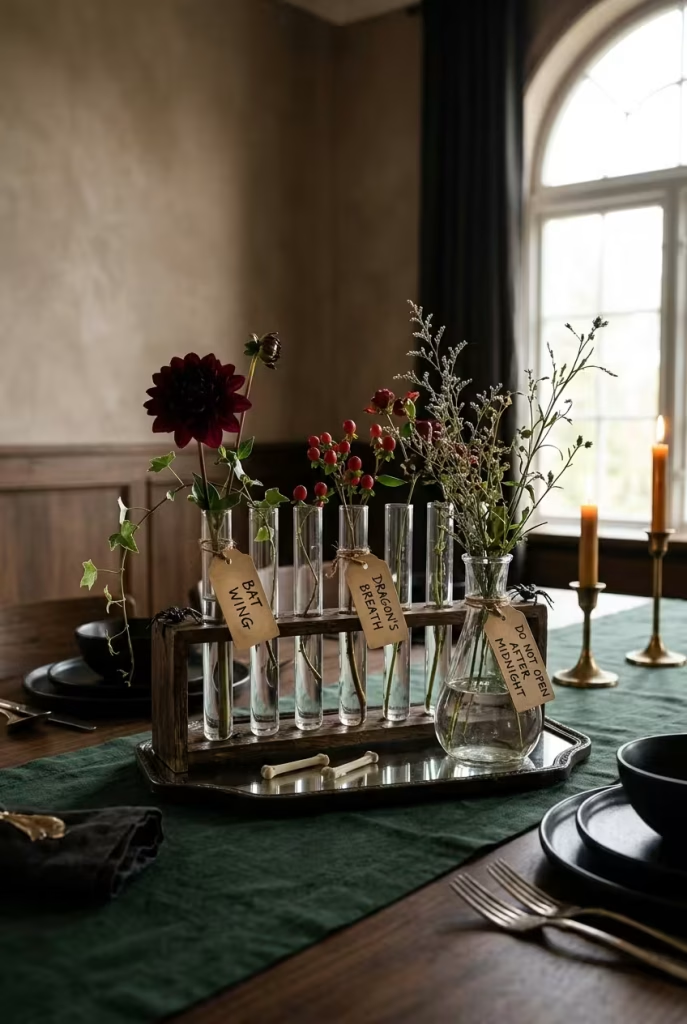
If your idea of Halloween leans more mad scientist than haunted manor, this centrepiece is your natural home. It rewards close inspection, and guests invariably end up wandering round the table reading every label with a drink in hand.
Gather test tubes, small chemistry flasks and slim bud vases, then stand them in a wooden rack or on a mirror tray so the glass catches the candlelight. Fill each with a single stem of something dark and dramatic: a deep red dahlia, a sprig of berries, a trailing ivy tendril. A couple of small bones or a plastic spider climbing the glass finishes the effect.
Labels are what turn a tidy flower display into a laboratory. Tie brown paper tags round the necks and write on them in your best spidery handwriting:
- Eye of newt
- Witch’s whisper
- Dragon’s breath
- Bat wing, finely ground
- Do not open after midnight
Space the tubes about 5cm apart, keep the tallest stem within 30cm, and refill with fresh water on the day. Because each tube takes only one stem, a single supermarket bunch goes a surprisingly long way.
Twenty minutes to set up, and £10 to £25 depending on how much glassware you borrow or buy.
6. Black Branches and Blackbirds
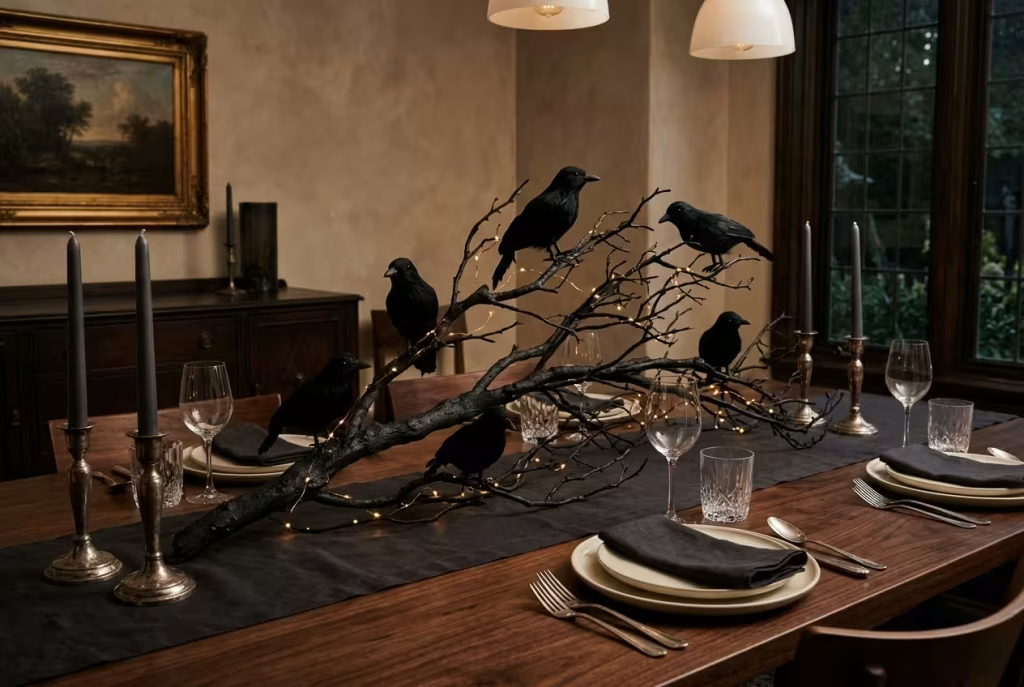
Tall arrangements block sightlines, yet a bare branch is one of the most evocative shapes in autumn. The trick is to lay it on its side. A fallen bough running down the table feels like a path through a haunted wood, and nobody has to crane their neck round it.
Collect fallen branches from the garden, or ask a neighbour with a tree that needs pruning. Let them dry indoors for a day, then spray them outdoors. Perch a few faux crows along the length, and weave in a string of battery-powered fairy lights to catch the shadows.
| Finish | The look | Worth knowing |
| Matt black | Charred, gothic, dramatic | Pairs beautifully with silver and candlelight |
| Acid green | Playful, witchy, unexpected | Add black crows to stop it feeling cartoonish |
| White wash | Frosted, ghostly, elegant | Suits a pale, grown-up palette |
One firm rule: dry twigs and naked flames are poor companions. Stick to LED lights, and keep any real candle at least 30cm from the wood. Used this way, a handful of free branches creates a runner that looks as though it grew there.
Forty-five minutes plus drying time, for well under £12.
7. A Haunted Village Under the Chandelier
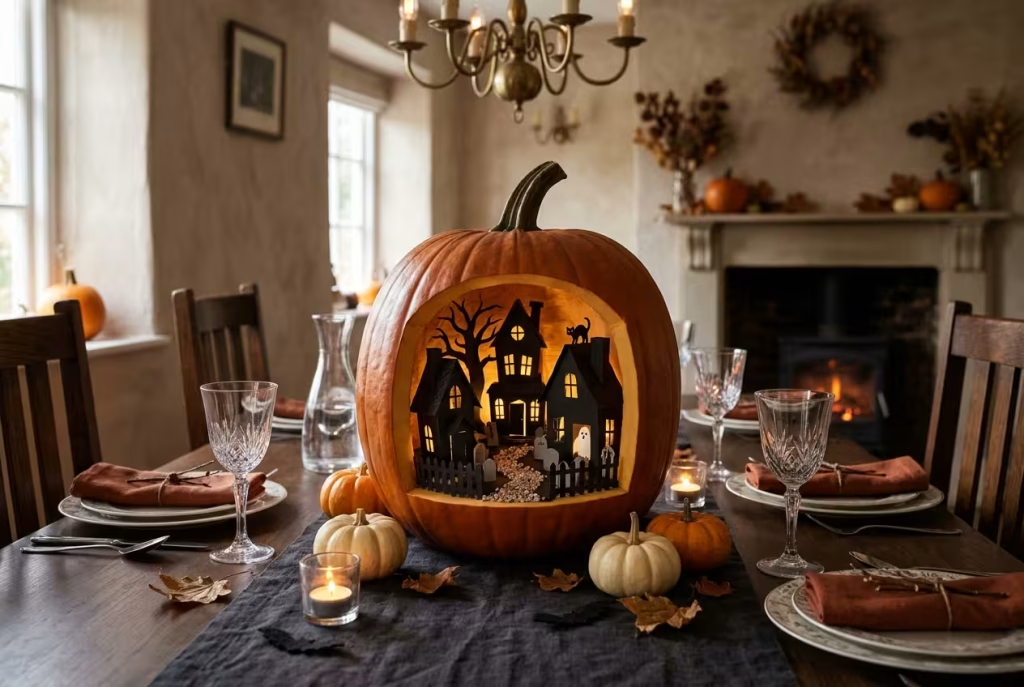
Some of the best Halloween memories are made at the kitchen table with paper, scissors and a child who insists the house needs a ghost on the roof. This centrepiece turns that afternoon into the star of the supper table, and grown-ups tend to be just as captivated as the little ones.
There are two easy routes. For the first, cut a hole in the side of a craft pumpkin with a serrated knife, then fill it with a paper haunted house, a bare paper tree and a toy-sized picket fence, lit from inside by flickering LED tea lights. For the second, paint a cardboard box black, cut out glowing windows, and dress the roof with orange moss.
Keep the whole scene under 30cm, and use LED lights throughout, since paper and real flames should never share a room. Add mini pumpkins or felt bats around the base for scale. Then step back and watch the table slow down as guests lean in to find the tiny details: a face at the window, a crooked gravestone, a cat on the roof.
Allow one to two hours, and £10 to £20 for supplies.
You May also Like: 26 Best Halloween Decor Ideas for Living Rooms: Stylish & Spooky
Part Two: Elegant Tablescapes
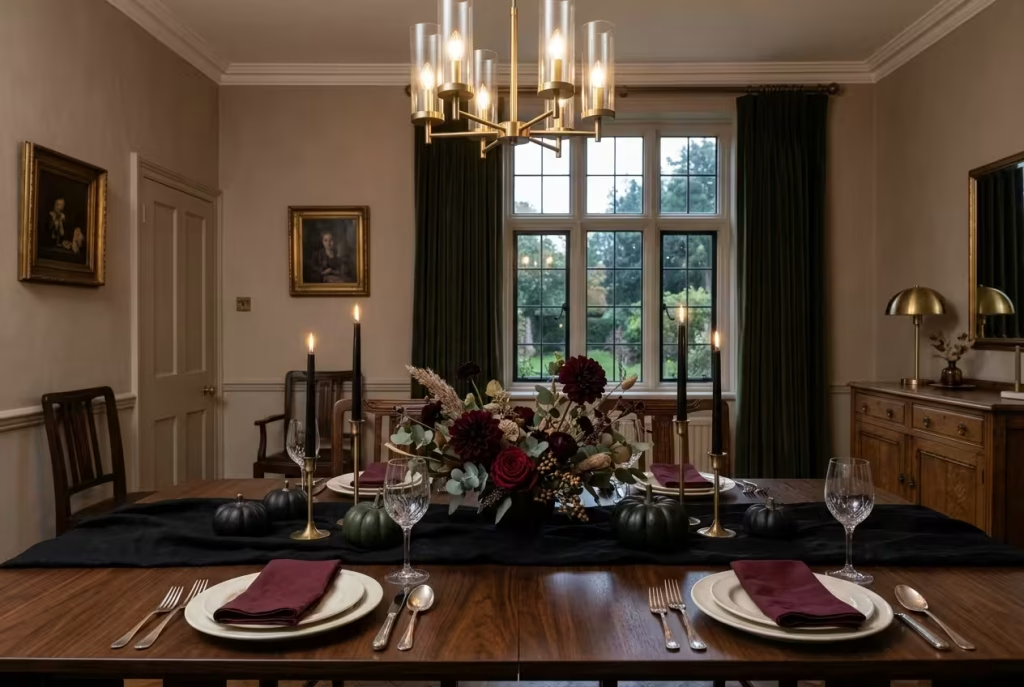
Not everyone wants a graveyard on the table. If you would rather your guests said “stunning” than “scary”, these six looks keep the eerie edge and trade the gore for gloss.
8. Black, Silver and Candlelight: The Gothic Setting
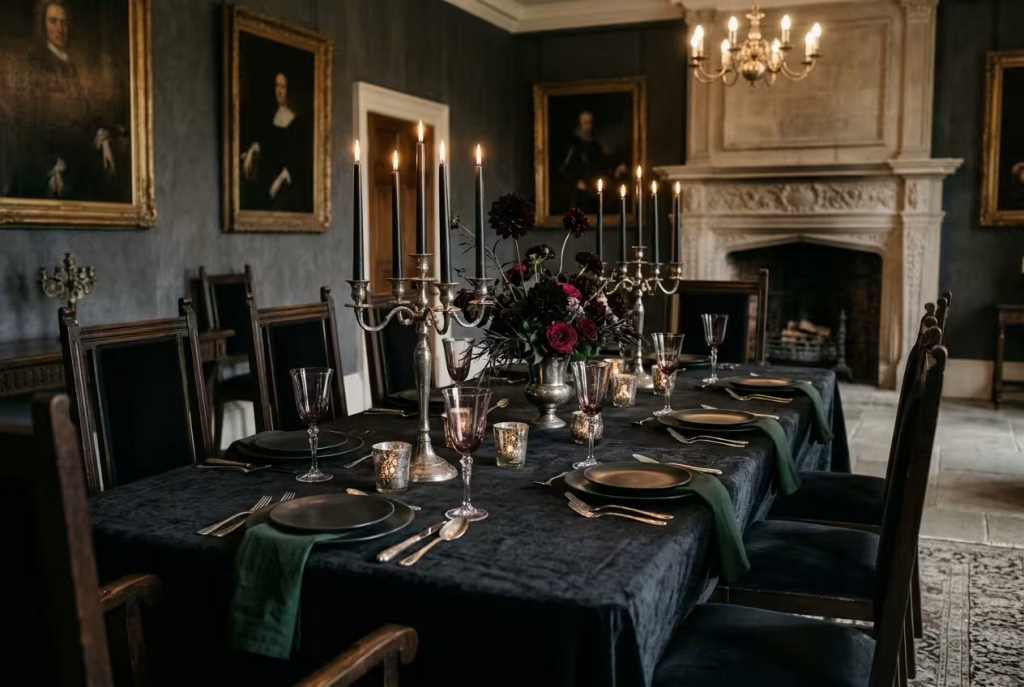
Imagine walking into a grand dining room at midnight, where every surface seems to hold its breath. That hush is what this setting is after. It is the little black dress of Halloween tables: timeless, flattering and far harder to get wrong than it looks.
Build it in five layers, working from the table outwards:
- The cloth. A dark linen or velvet cloth with a 15 to 20cm drop gives the whole scene a calm backdrop.
- The plates. Black or charcoal plates with silver cutlery and tall goblets. Matt finishes look richer than glossy ones.
- The metal. A tarnished candelabra or two. Heirloom silver that has never met a polishing cloth looks gloriously neglected, which is the effect you want.
- The light. Mercury glass votives scattered like small moons, plus tapers leaning at a deliberate angle for that abandoned-manor air. Each one needs a sturdy holder.
- The flowers. A tall vase of near-black dahlias or burgundy roses, with the stems kept airy.
Two cautions keep the look elegant. First, too much black can swallow a table whole, so break it up with one contrasting colour such as oxblood glassware or deep green napkins. Second, mind your heights. Many designers advise keeping anything on the table below 30cm, or lifting it well above 60cm, because flames and florals at eye level glare and block faces. A tall candelabra works only if it is slim enough to see through.
About 45 minutes to set, and £20 to £60 unless you can raid the loft.
9. The Looking-Glass Landscape
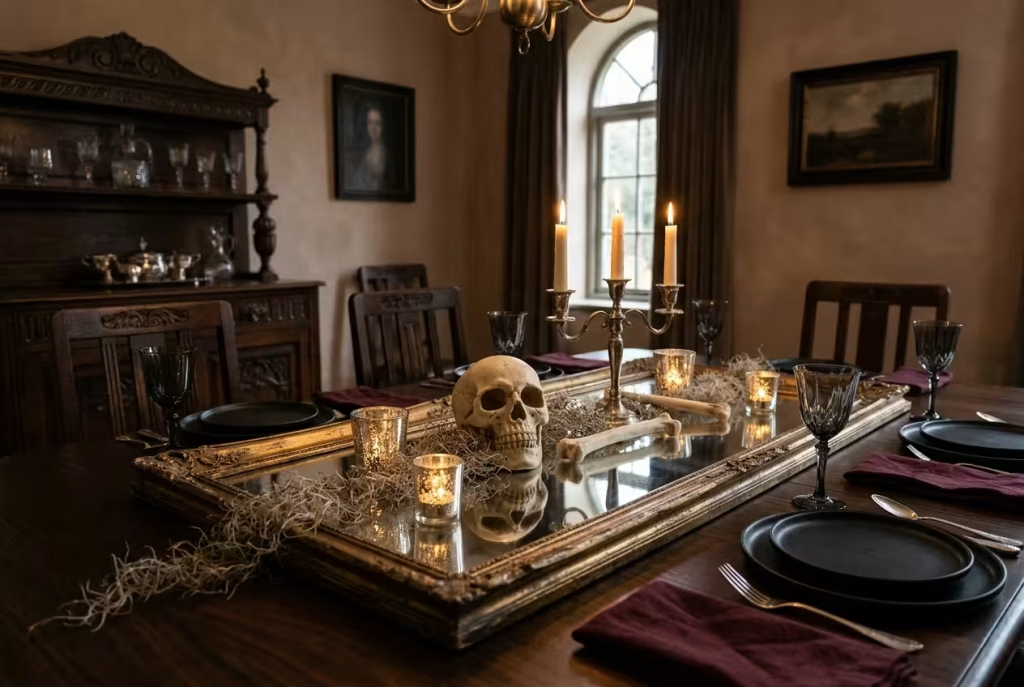
A mirror laid flat on the table behaves like a still, black pond. It doubles every flame, so five candles read as ten, and it gives the eye somewhere to wander. Dress it with a skull, a few bones, drifts of Spanish moss and a candelabra, and the whole composition feels like a haunted lake at dusk.
Where to find a suitable mirror
- A charity shop or car boot sale, where ornate gilt frames turn up for a few pounds
- An old hallway or bedroom mirror that you can borrow for the week
- A plain frame given an aged finish with metallic paint and a dab of antique wax
Aim for a tray roughly 30 by 60cm on a standard 90cm-wide table, which sits comfortably inside the one-third width guideline and leaves room for plates. Stick felt pads under the frame so it cannot scratch the wood, check it sits flat, and think twice about using a heavy mirror if toddlers or boisterous guests will be reaching across.
Moss and open flames do not mix, so choose flameless candles on the mirror itself. Real tapers can stand beside it, at least 30cm from the moss. The effect is just as moody, and your insurance company will thank you.
About 30 minutes, and £0 to £25 depending on what you find.
10. Black Lace and White Tapers
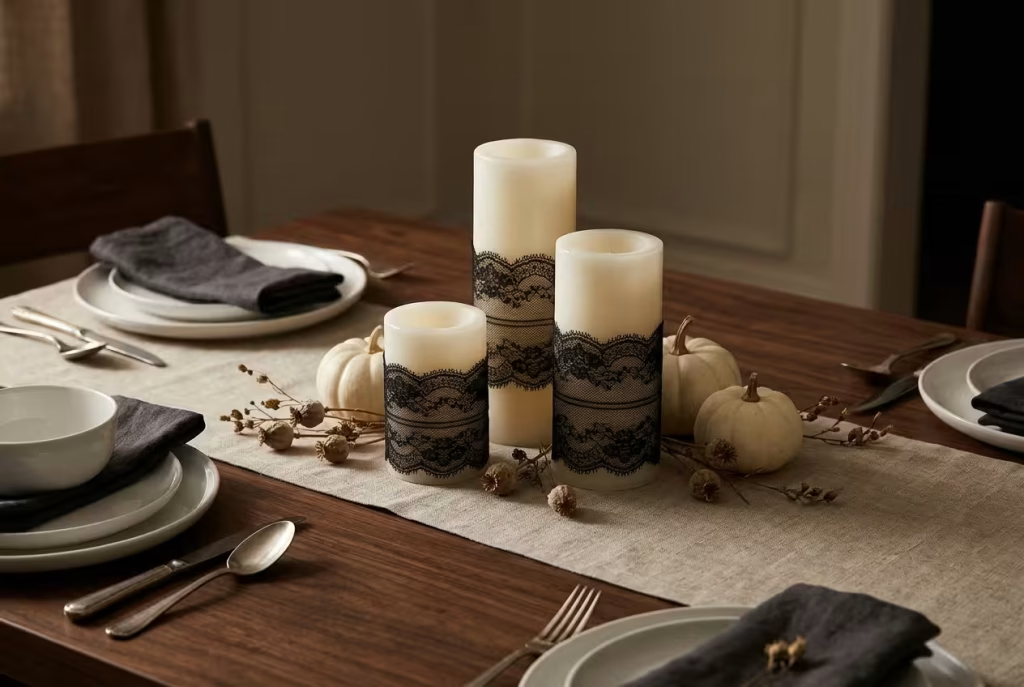
Lace carries a quiet, faintly sad romance. It reminds us of bridal veils, grandmothers’ tablecloths and tea in the good china. Against bone-white candles it turns gothic without a single plastic skull in sight, which makes it a lovely choice for a dinner where conversation, not shock value, is the main event.
Gather white candles in three or four heights, roughly 10, 15 and 20cm, and wrap strips of black lace around the lower third of each. Secure the lace with glue dots or a thin ribbon tied at the back. Cluster them on a plain linen runner, then tuck a few white pumpkins and a scattering of dried seed heads around the base for texture.
There is one non-negotiable rule: lace burns. Where a flame is involved, keep the lace well below the wick, or switch to flameless pillar candles, which you can wrap right to the top with no worry at all.
| Candle type | How far up the lace can go | Verdict |
| Real taper or pillar | Lower third only, well below the flame | Pretty, but needs watching |
| Flameless pillar | The full height | Safest, and ideal for homes with children or pets |
Twenty minutes, and £8 to £15.
11. The Enchanted Forest Floor
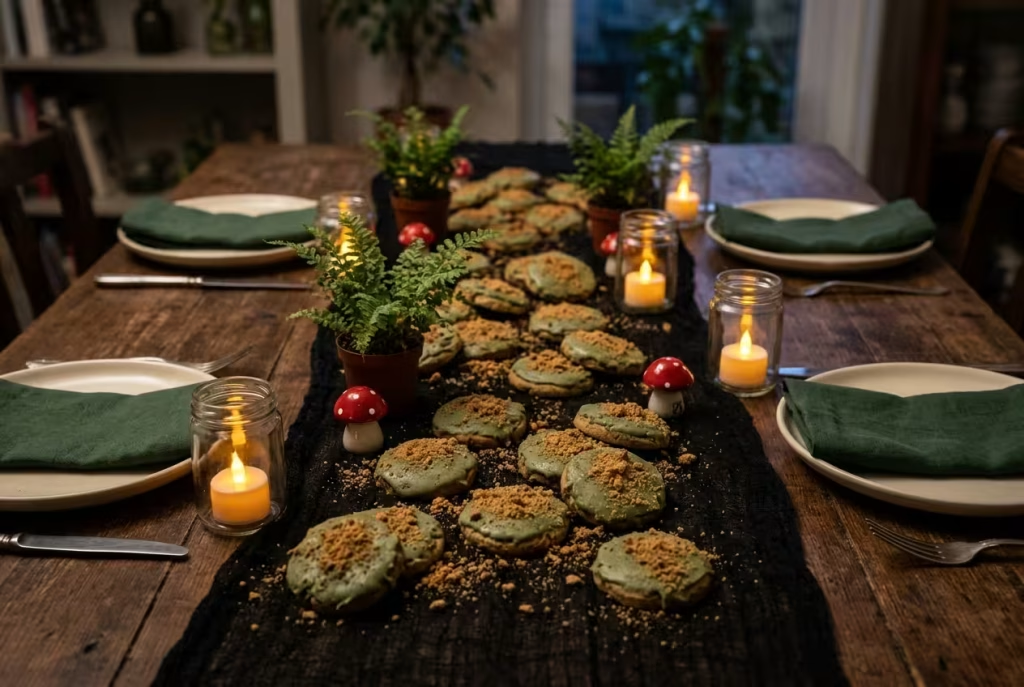
There is something deeply comforting about food that doubles as decoration. This table makes the biscuits part of the scenery, so the display slowly shrinks as the evening goes on, and everyone gets to nibble a bit of the woods.
Lay an inexpensive black gauze runner, about 30 to 40cm wide, down the centre of the table. Bake a batch of round biscuits, ice them in moss green, and dust them with crushed digestive crumbs to look like forest soil. Around 20 to 24 biscuits will carpet the runner of a table for six. Between them, nestle jars of LED tea lights, a few tiny potted ferns and the odd toadstool.
Bake the day before and store the biscuits in an airtight tin so the icing sets properly. On the night, scatter them just before guests arrive. Keep the whole arrangement below 30cm, and remember that gauze is highly flammable, so any real candle belongs well away from it.
About an hour, mostly baking, and £10 to £18.
12. Blush, Plum and Bubblegum A Gentler Kind of Ghoul
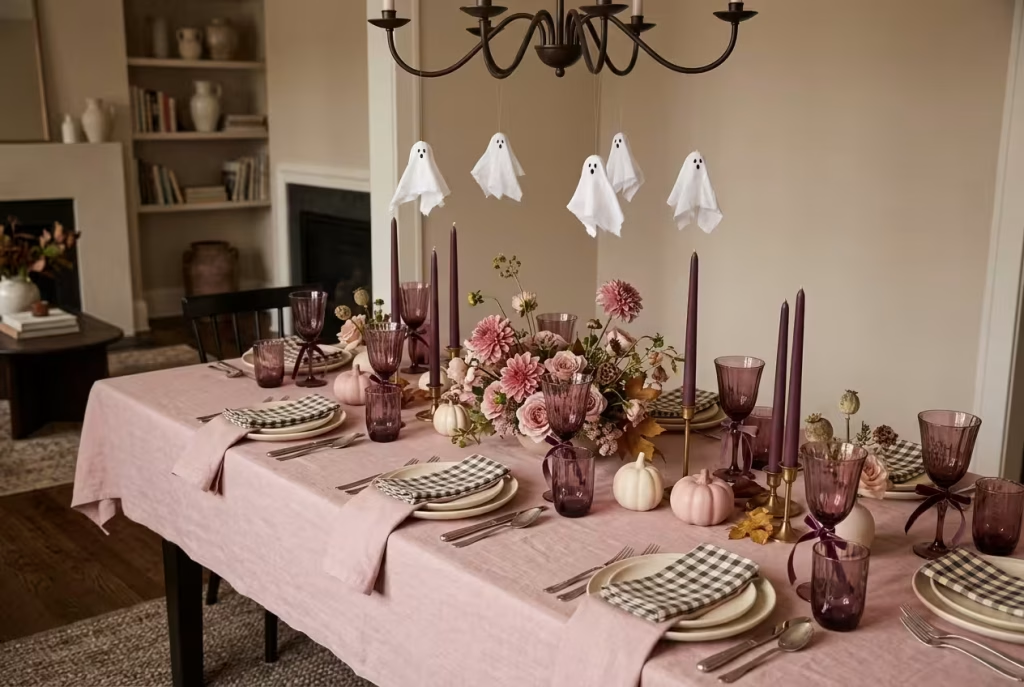
Not everyone enjoys being frightened, and not every home suits black. If your guests include nervous children, or you simply find fright nights a little much, this softer palette proves that Halloween can be charming without a single drop of gore.
The secret is a simple design rule: sixty per cent of one colour, thirty of a second, and ten of a sharp accent.
| Role | Colour | Where to use it |
| Main (60%) | Dusty pink | Tablecloth, napkins, flowers |
| Support (30%) | Deep plum | Glassware, candles, ribbon |
| Accent (10%) | Black or cream | Ghosts, place cards, checkerboard details |
Dangle a few white ghosts from the chandelier, set out checkerboard napkins, and tuck pink blooms among mini pumpkins. Designers often caution against fluorescent orange and lime green because those shades tip a table into kitsch, so repeating three tones is what keeps this scheme polished. You will end up with a table that photographs beautifully and still raises a smile.
About 40 minutes, and £15 to £35.
13. Harvest Halloween: Rust, Terracotta and Textured Pumpkins
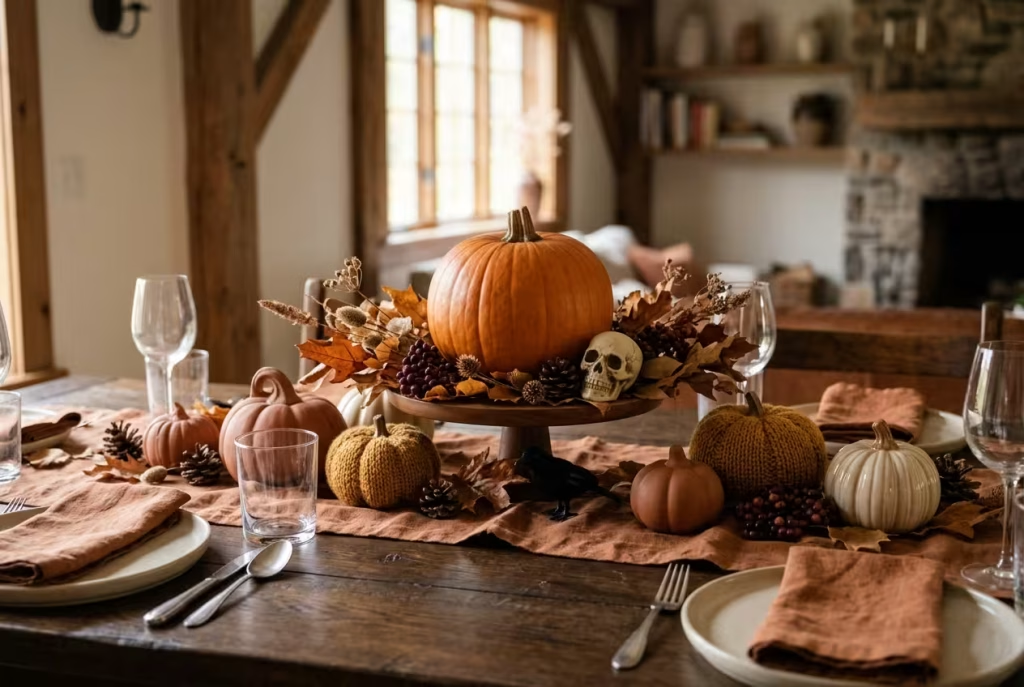
For many people, October is less about ghouls and more about the first proper chill, the smell of woodsmoke and the relief of a warm kitchen. This table honours that feeling and sneaks in just enough eeriness to qualify as Halloween.
Build a base of earthy tones: rust linen, terracotta napkins, ceramic pumpkins, knitted gourds and a scattering of berries, pine cones and dried leaves. Then add a single eerie note, such as a small skull or a crow, so nobody mistakes it for Harvest Festival.
Mixing real and faux pieces keeps it believable and keeps it cheaper:
| Type | Lifespan | Best used for |
| Real, uncarved pumpkins | Several weeks in a cool room | The pedestal showpiece |
| Faux ceramic or fabric pumpkins | Years | The repeating supporting cast |
| Dried leaves and seed heads | A few weeks | Fill and texture |
Give your favourite pumpkin its own pedestal, so it can stand proud. The real bonus is longevity: this scheme carries you from Halloween through Bonfire Night and well into November, so the effort earns its keep many times over.
About 30 minutes, and £15 to £40.
Part Three Overhead and Wall Drama
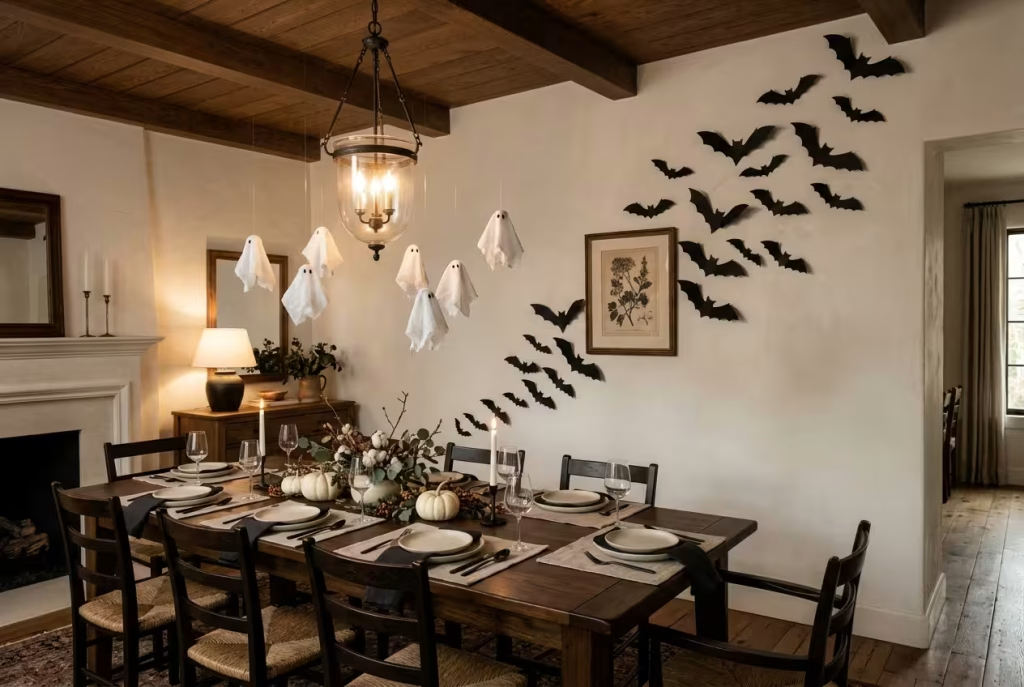
Sightlines limit what you can pile onto the tabletop, but the space above it is wide open. Using the ceiling and walls lets you add bags of atmosphere without sacrificing a single square inch of dinner space.
14. A Coven of Witches’ Hats Overhead
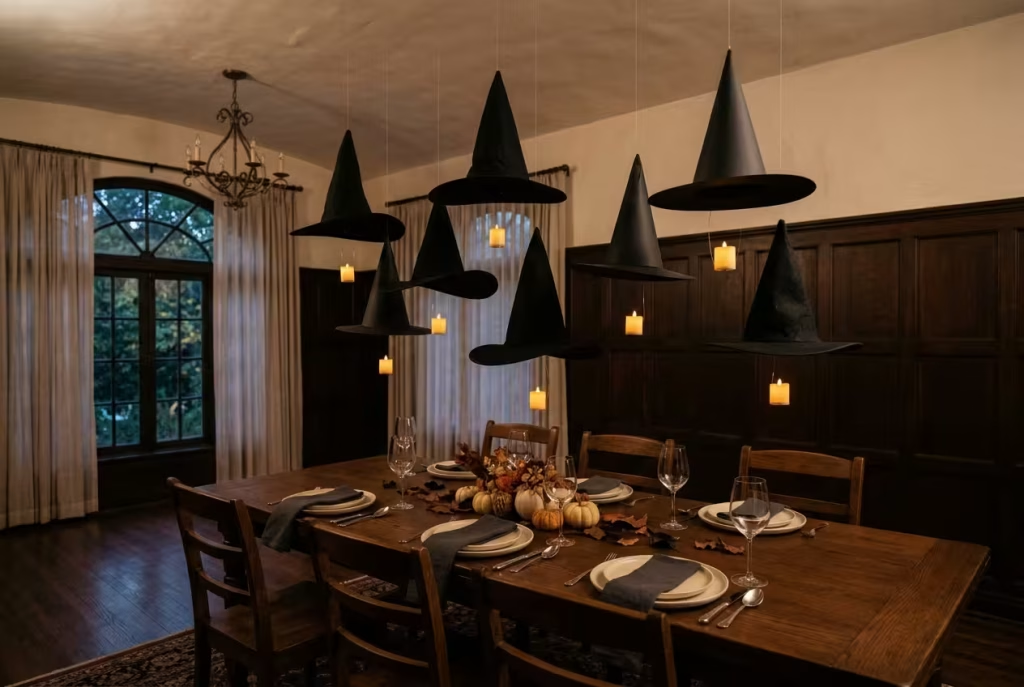
Remember the first time you walked into a great hall lit by floating candles, even if that hall only existed on a cinema screen? A cluster of witches’ hats hovering above the table captures that spell. It looks as though a coven paused mid-flight to sample the soup, and it costs next to nothing.
Choose lightweight hats in felt or card, because anything heavy has no business dangling over dinner plates. Hang seven to nine over a table of about two metres, staggering them at three different heights and spacing them 30 to 40cm apart. Tie each to clear fishing line, and fix the line to ceiling hooks, a light rail or a lightweight rod secured at both ends. Keep the lowest brim at least 90cm above the tabletop so seated guests never crane or duck.
For extra enchantment, suspend battery-powered candles from fine wire between the hats so they seem to float. Keep whatever sits below them low, so the lights take centre stage.
One firm boundary applies: never hang paper, card or felt above a real flame. Use flameless candles directly beneath the hats, and save real tapers for the sideboard.
About 45 minutes, and £10 to £25.
15. Chandelier Makeover: Cobwebs, Leaves and a Broom
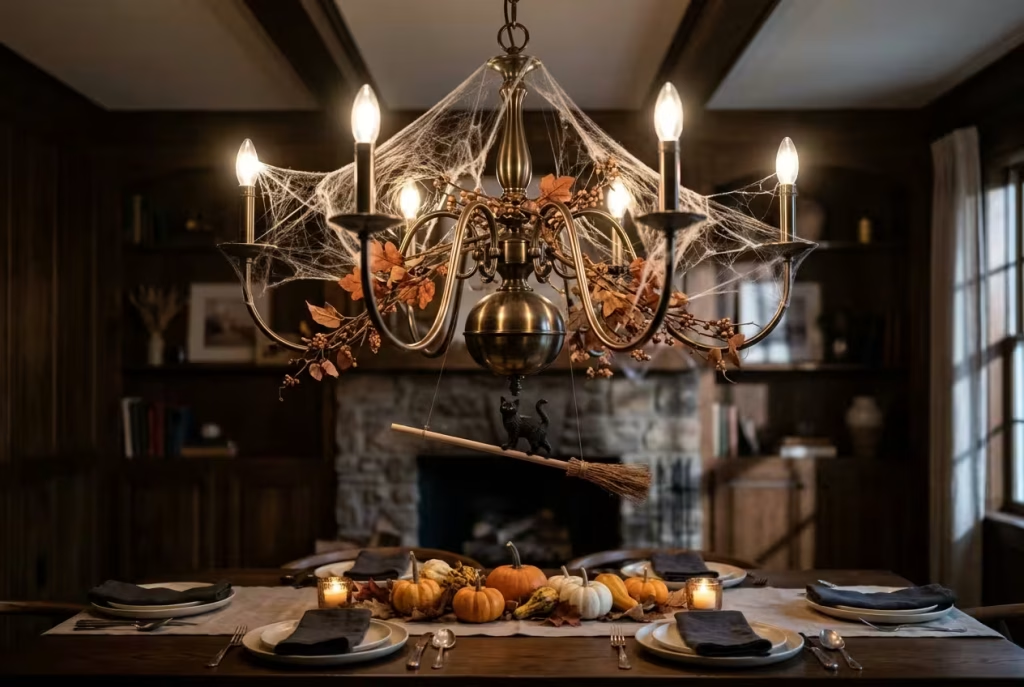
Guests glance up at the chandelier whenever the laughter peaks, which makes it the most underused stage in the house. If you already own one, you hold the best Halloween prop going.
Start by stretching a thin web of fake cobweb loosely across the arms, pulling it into wisps rather than clumps so it looks aged, not shop-bought. Tuck in a few autumn leaves, then perch a small skeleton or black cat on a broom suspended beneath it. Keep everything featherlight, and never hang anything from a fitting that sags.
Heat is where care matters. US fire statistics from the NFPA show that nearly half of home fires caused by Halloween decorations start because something sat too close to a heat source. So:
- Swap in cool-running LED bulbs before you start
- Keep webbing loose and well clear of the bulbs
- Feel the arms after the light has been on for 20 minutes, and remove anything that is warm to the touch
Check the height too. The fitting should hang 75 to 90cm above the tabletop, with roughly 7.5cm more drop for every extra 30cm of ceiling above a standard 2.4m room. Too low and it dominates the table, too high and it floats away from the scene.
About 30 minutes, and £8 to £20.
You May also Like: 24 Easy Halloween Kitchen Decor Ideas: DIY Spooky Touches and Budget-Friendly Cute Accents
16. Bats in Flight Across the Wall
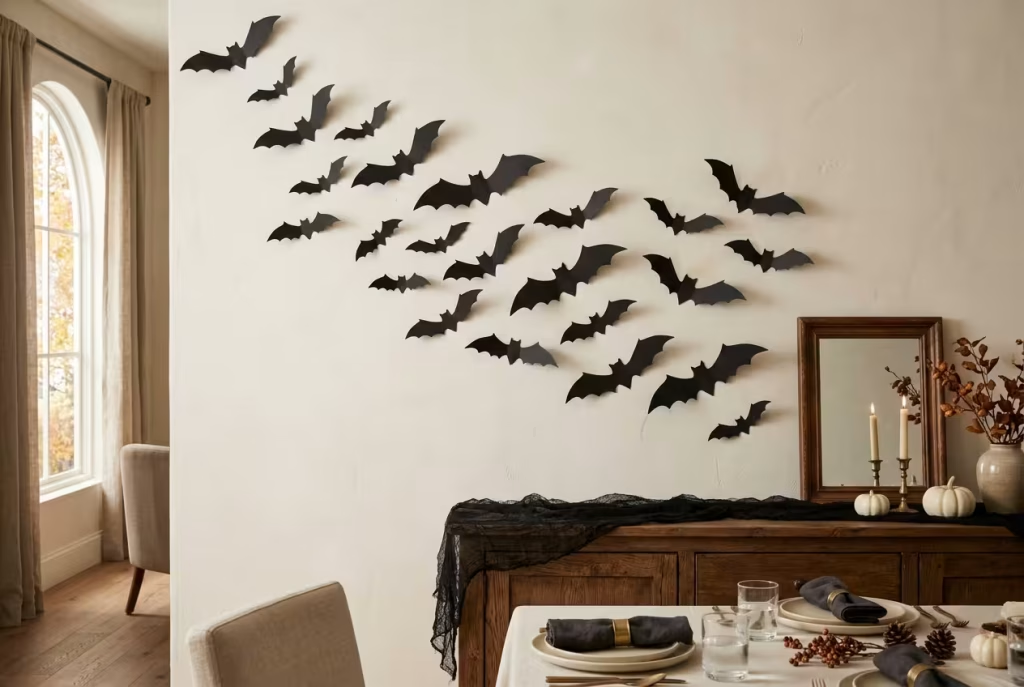
A flock of paper bats is the best money-to-impact ratio in all of Halloween. A few sheets of black card, a pair of scissors and an hour in front of a film will give you a swarm that fills an entire wall. Better still, if you rent, low-tack adhesive strips protect the paintwork.
Mix three sizes so the flock looks natural, then spiral them out from a corner or frame the dining room doorway so they seem to escape into the hall.
| Size | Approximate wingspan | How many for a typical wall |
| Small | 8cm | 8 to 10 |
| Medium | 14cm | 5 to 8 |
| Large | 22cm | 2 to 4 |
Bend each pair of wings gently upwards before sticking, so the bats cast tiny shadows and look three-dimensional. Paper bats also flutter whenever someone opens a door, which adds an uncanny touch that no static decoration can match. Drape a length of black gauze over a mirror or sideboard beneath them, and the wall starts to feel like part of the story rather than a backdrop.
About an hour, and under £6.
Part Four Finishing Touches
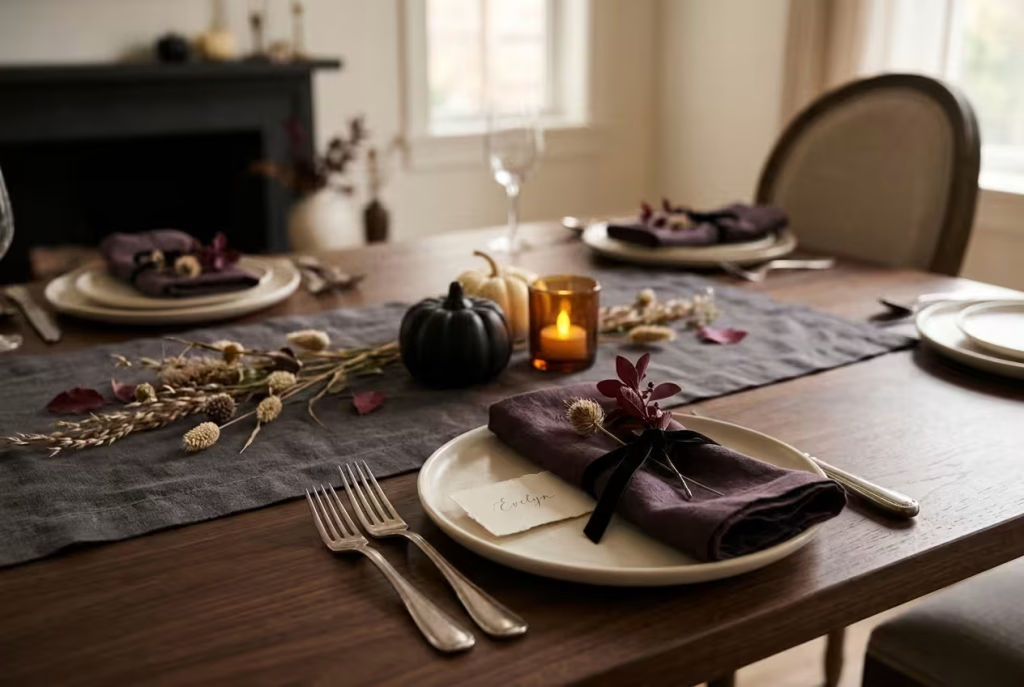
The icing on the cake is rarely the biggest thing in the room. These four ideas add the last ten per cent that makes a table feel genuinely finished.
17. Light the Room Like a Film Set
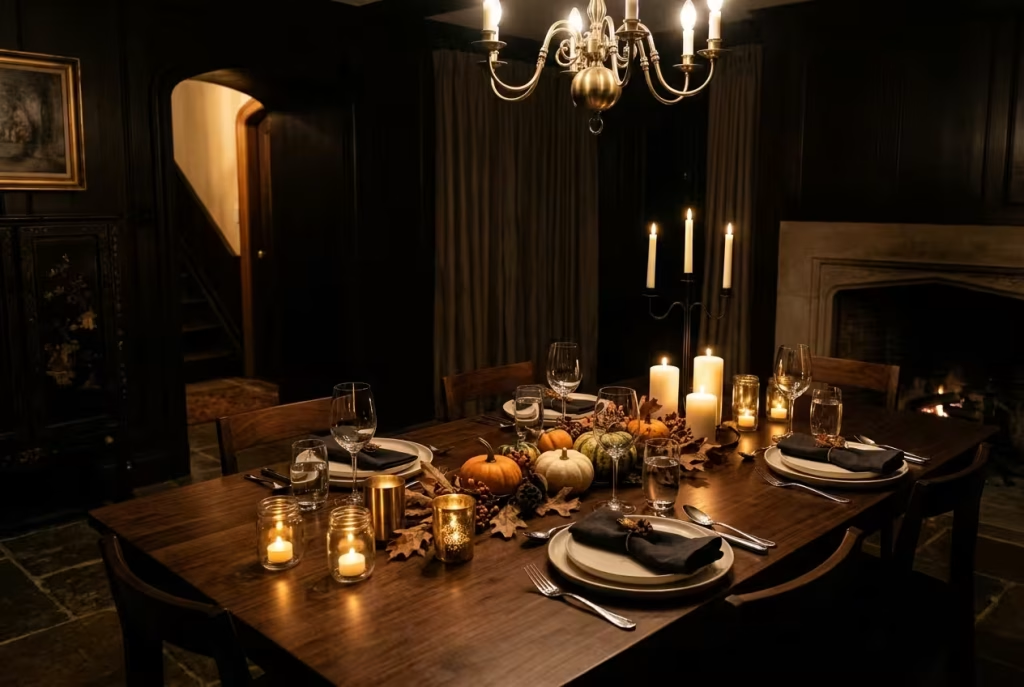
Candlelight is the oldest dinner-party trick there is, and it still works. Dim, warm light softens faces, flatters food and slows everybody down, which is exactly what a long supper needs.
Switch the chandelier to warm-white bulbs of 2700K to 3000K, and put it on a dimmer so it can run bright for serving and soften once the plates are cleared. No dimmer switch? A smart warm-white bulb does the same job without any rewiring.
Then layer, as a film’s lighting designer would:
| Layer | Source | Height | Notes |
| Low | Tealights in glass jars | 5 to 8cm | Safe wherever there is space around them |
| Middle | Pillar candles | 10 to 20cm | Group in threes for impact |
| Tall | Tapers or candelabra | Over 60cm | Keep slim, so sightlines stay clear |
| Overhead | Dimmed chandelier | 75 to 90cm above the table | Switch it low once everyone sits down |
Use flameless candles anywhere near gauze, moss, lace or paper, and reserve real flames for open spots with at least 30cm of clearance. As a finishing flourish, dim the surrounding rooms too, so the table glows like the one lit window in a dark house.
About 20 minutes, and £6 to £25.
18. Place Settings With Personality
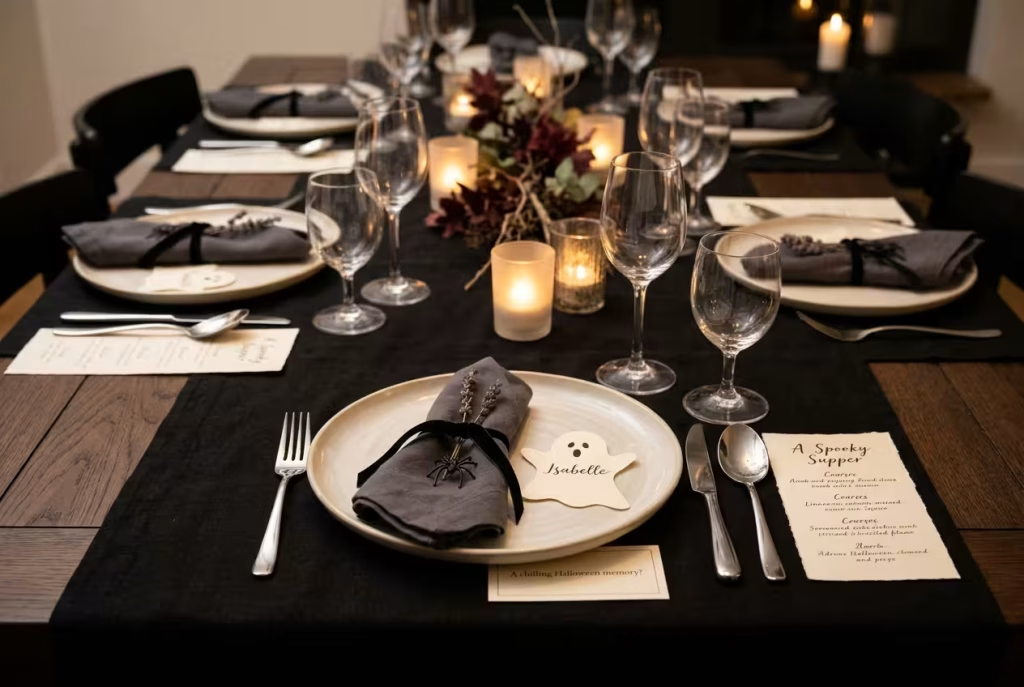
Guests spend most of the evening looking at their own plate, so give them something worth looking at. Each seat is a tiny stage set, and the small surprises you hide there are the ones people mention afterwards.
Dress every place with a short checklist:
- A cloth napkin, folded into a bat or tied with black ribbon
- A ghost-shaped place card with the guest’s name in spidery handwriting
- One tiny prop: a mini skull, a plastic spider or a sprig of dried lavender
- A handwritten menu card, which also feels wonderfully grown-up
Place cards double as a seating plan, and a well-chosen plan is the best icebreaker you will ever own. Seat chatty people beside quiet ones, and keep couples apart for the evening.
For extra connection, tuck a small card under each plate with a question to be answered between courses, such as “What is the scariest thing that ever happened to you?” Laughter usually follows within minutes.
Restraint matters, because each setting needs roughly 60cm of width and 38cm of depth. Keep props small enough that glasses, cutlery and bread plates still fit, and a black tablecloth makes a reliable backdrop that most people already own.
About 30 minutes, and £5 to £20.
19. The Sideboard as Cabinet of Curiosities
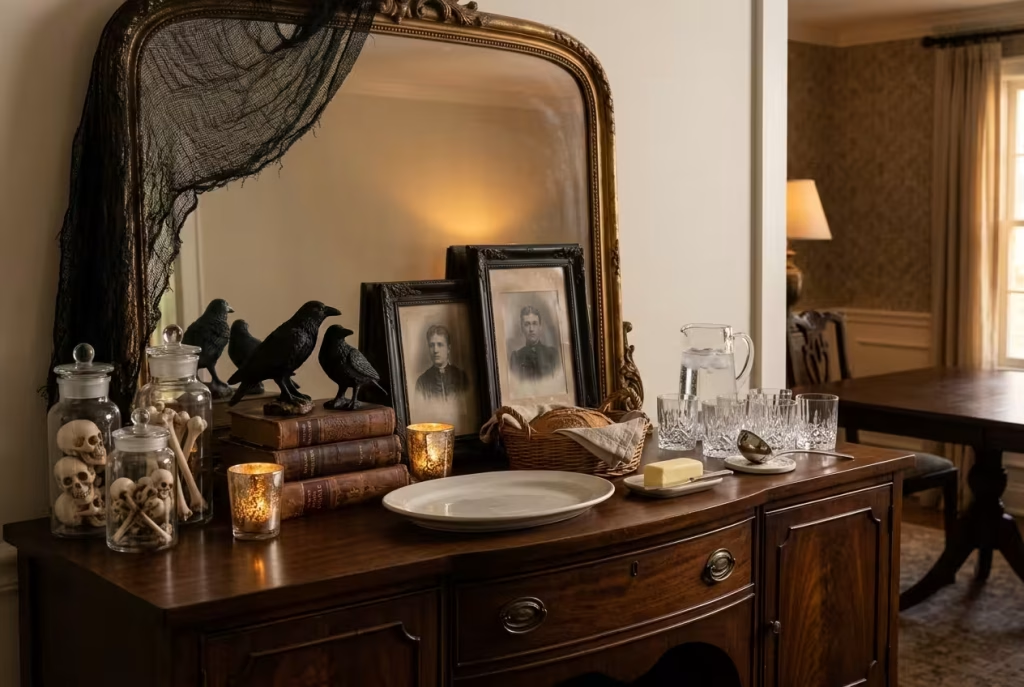
Your sideboard is the supporting actor, and it deserves a decent script. When it works, guests drift towards it before they ever sit down, and that first glimpse from the front door sets the tone for the evening.
Fill it with apothecary jars brimming with skulls, a few vintage books, mercury glass votives and a raven or two. Prop old framed photographs along the back, where their stern faces will seem to follow guests round the room. Drape creepy cloth over the mirror above, and the corner takes on the air of an abandoned study.
But this surface also has a job to do, because platters, bread baskets and water jugs need somewhere to land. Divide it into thirds:
| Zone | Share of the surface | What goes there |
| Display | One third | Jars, books, photographs, candles |
| Serving | One third, left clear | Platters, bread, butter, salad bowls |
| Drinks | One third | Jugs, glasses, the punch ladle |
Vary heights across the display, using books as risers, and group objects in threes. The result looks collected over decades instead of bought in a single afternoon.
About 45 minutes, and £10 to £30.
20. Sweet Things, Sinister Garnishes and a Scent-Free Table
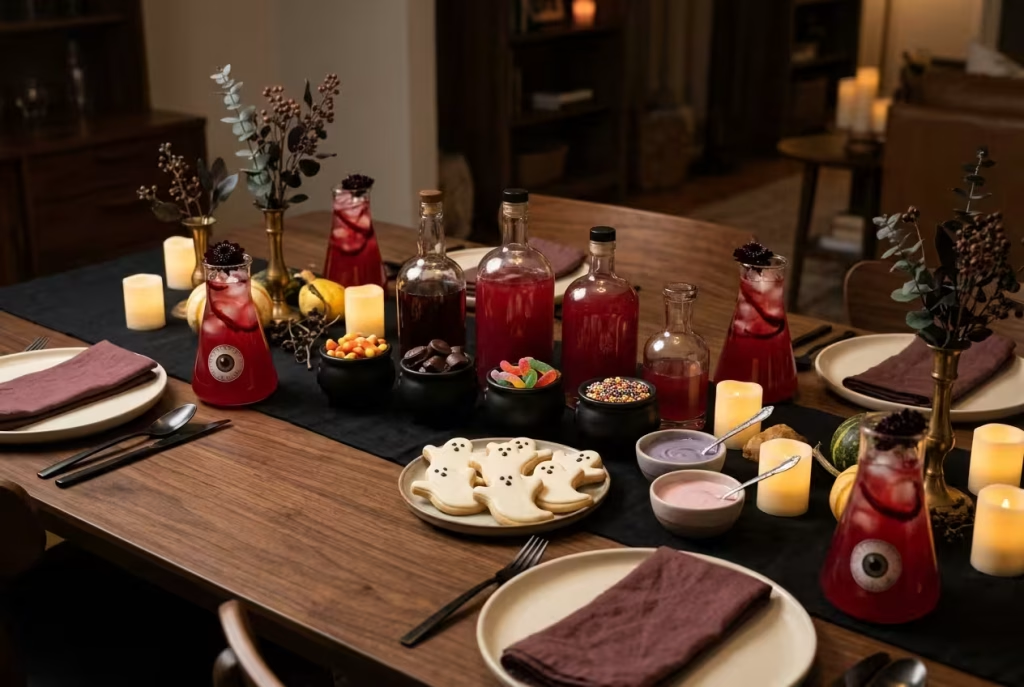
Food is decoration you can eat, and it is the part of the table people remember longest. A single clever detail on a plate often gets more comments than a whole shelf of props.
Drinks. Turn mismatched jars and flasks into “eyeball” glasses by decoupaging printed eyes onto the base with craft glue, then sealing them with a few extra coats. Keep the liquid away from the paper, since the artwork is not food safe. Rim cocktail glasses with a swirl of blood-orange syrup and finish with a single edible dark flower.
Sweets. Offer small jars of sweets as mini cauldrons along the table, and set out plain ghost-shaped biscuits with bowls of icing. Letting guests decorate their own gives the evening a natural second act, and it keeps children and adults happily busy after the main course.
Scent. Strong candle fragrance competes with the flavour of the food, so choose unscented candles at the table. Save your cinnamon or pumpkin-spice candles for the hallway, where guests meet the smell of autumn the moment they step inside, then enjoy a clean-smelling dinner.
The last word on finishing touches is simple: edit. When you think you are done, remove one thing. The table will be better for it.
About an hour, and £8 to £20.
Why a Little Effort at the Table Pays Off
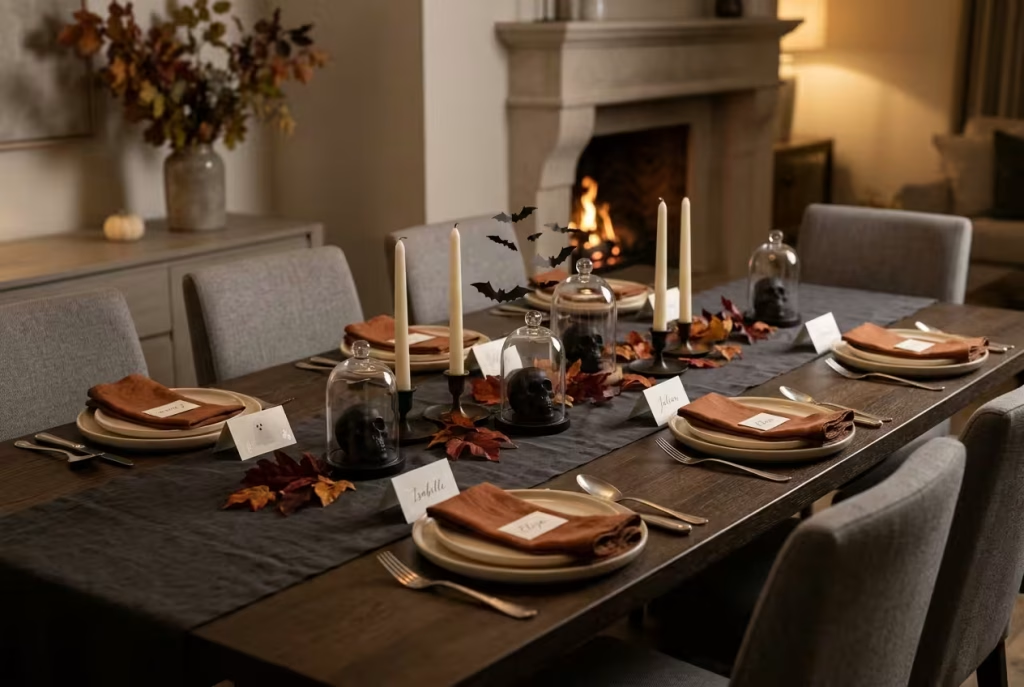
A decorated table is more than a pretty picture. It tells guests, before anybody says a word, that you planned this evening with them in mind. That small signal of care tends to loosen shoulders, start conversations and keep people in their seats long after the last plate has been cleared.
The practical side matters just as much as the pretty side. Keeping centrepieces below 30cm means people can see one another, and good conversation depends on eye contact. Leaving room for platters, bread baskets and jugs means nobody has to balance a gravy boat on their knee. Warm, dimmable light is easy on faces and flattering to food. In short, the most atmospheric Halloween tables are also the most hospitable ones.
And there is a gentler reason to bother. Halloween is one of the few evenings when grown-ups are positively encouraged to play. A skull in a cloche, a flock of paper bats or a handwritten ghost place card gives everyone permission to be a little silly, and silliness, shared over a good meal, is a rare and precious thing.
Fire and Food Safety The Fine Print That Protects Your Evening
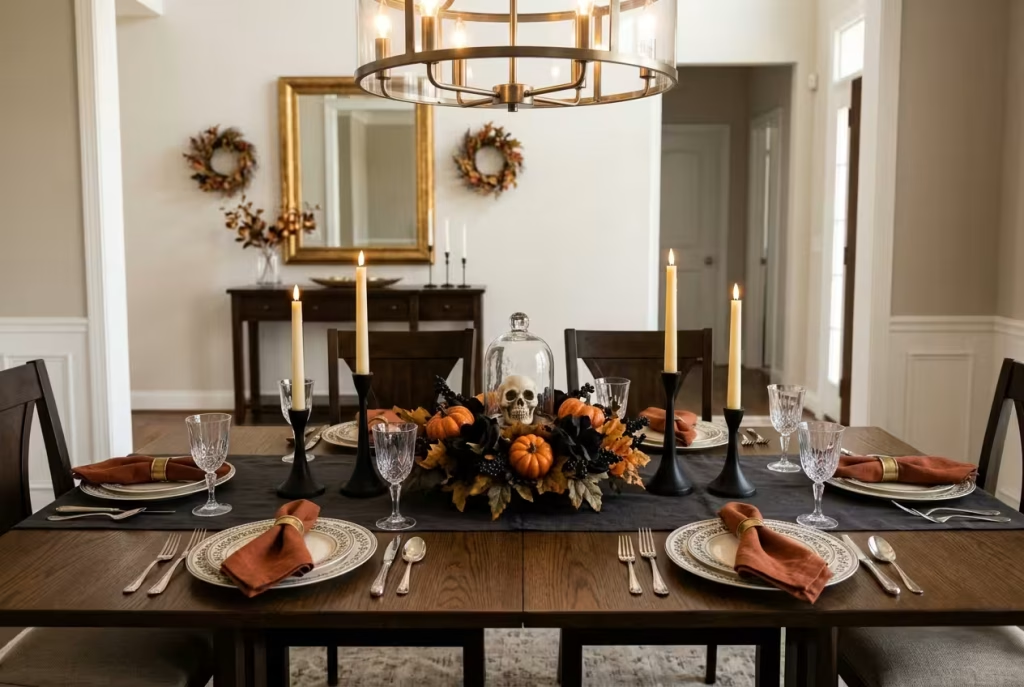
It is better to be safe than sorry, and a few sensible habits keep a spooky supper from turning into a genuine emergency. The NFPA reports that, in the United States, an annual average of 832 home fires began with Halloween decorations between 2019 and 2023. Nearly half (47 per cent) happened because decorations sat too close to a heat source, and around a third started with candles. Dried flowers, cornstalks and crepe paper ignite easily, which is worth remembering when you plan a table full of moss, gauze and paper.
| Hazard | Why it matters | Simple fix |
| Real candles near decor | Roughly a third of Halloween decoration fires start with candles | Keep at least 30cm (12 in) clear of anything flammable, and use flameless candles near gauze, lace, moss and paper |
| Decorations near heat | 47% of decoration fires involve items too close to a heat source | Use LED bulbs on the chandelier, keep webbing loose, never wrap it round hot bulbs |
| Dry, brittle materials | Dried flowers, cornstalks and crepe paper catch fire easily | Keep them well away from flames, or swap in fabric and card |
| Carved pumpkin punch bowl | A carved pumpkin left over two hours at room temperature enters the bacterial danger zone | Chill the shell, fill late, use a food-safe liner and bin it next day |
| Scented candles | Strong fragrance competes with the flavour of the meal | Choose unscented candles at the table |
| Hanging decor | Heavy items on thin line can fall onto plates and guests | Use lightweight pieces, strong ceiling hooks and clear fishing line rated for the weight |
| Blocked routes | Exits and walkways are no place for props | Keep doors and hallways clear, and leave 60 to 90cm behind chairs |
| Unattended flames | Candles left alone cause trouble fast | Blow them out whenever you leave the room, and keep them out of reach of pets and small children |
What Will It Cost? A Realistic Budget Guide
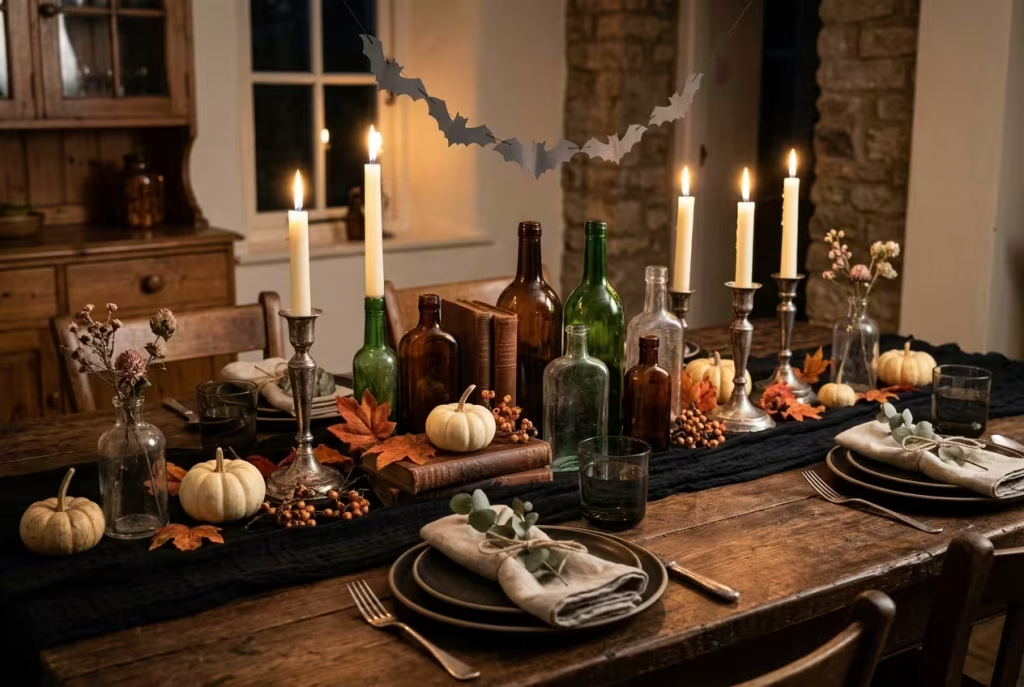
Halloween décor does not need to cost an arm and a leg. A thrifty table can look every bit as rich as an expensive one, so long as you choose a tight palette and repeat it. The figures below are indicative UK ranges and will vary with where you shop.
| Budget tier | What it covers | Best ideas to try |
| Under £30 | Recycled bottles, charity-shop books, paper bats, lace and tealights | Ideas 1, 2, 10, 16 and 17 |
| £30 to £80 | A skull vase, fresh flowers, a black gauze runner, hats and fishing line, themed napkins | Ideas 3, 5, 11, 12, 14 and 18 |
| £80 and above | Silver candelabra, mercury glass, a mirror tray, quality faux pumpkins, a chandelier refresh | Ideas 8, 9, 13, 15 and 19 |
A few simple habits stretch the money further. Raid your loft before the shops, buy second-hand glass and silver, and pick decorations that double as autumn decor so they earn their keep for six weeks rather than one night.
Your Make-Ahead Timeline
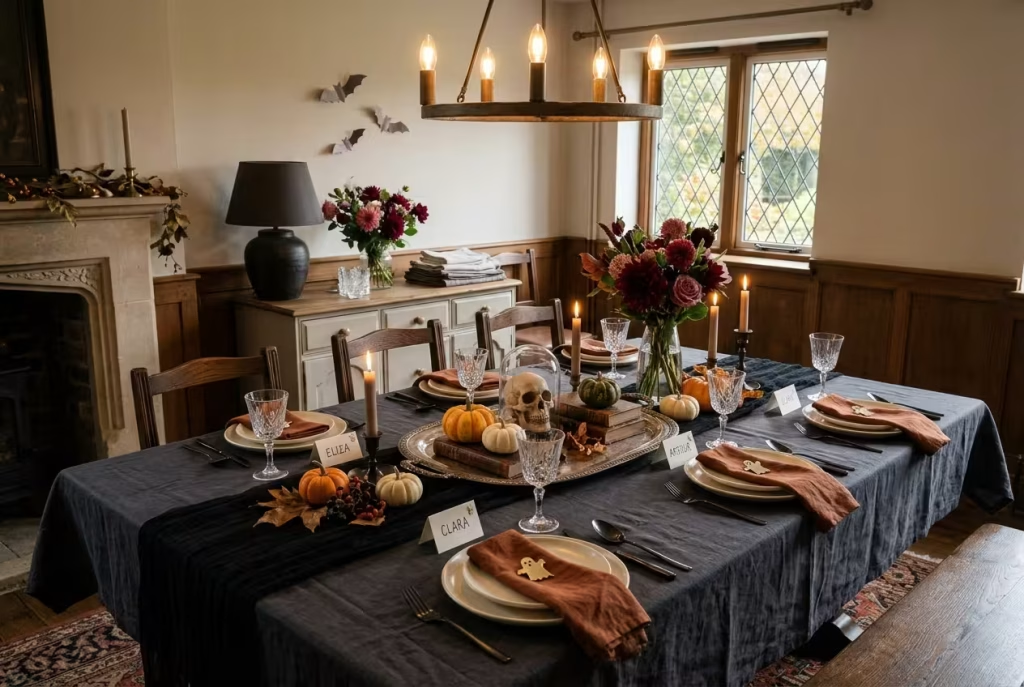
Planning ahead is half the battle. Spread the work across the fortnight and the day itself feels calm instead of frantic.
| When | What to do |
| Two weeks before | Pick a three-colour palette, scour charity shops, spray-paint bottles and branches outdoors, cut out paper bats |
| One week before | Hang hats and bats, test the lighting, set up the sideboard, order or buy flowers |
| Two days before | Buy fresh flowers, bake cookies, iron the linen |
| The day before | Lay the cloth, runner and non-perishable props, fold napkins, write place cards |
| The day itself | Fill the pumpkin punch bowl late, arrange fresh flowers, set out candles |
| One hour before | Dim the lights, light the tapers, then sit in each chair to confirm you can see across the table |
If your table has to return to everyday duty quickly, build the centrepiece on a tray. Lift the whole thing away in a single move, and you have your table back in under five minutes.
Final Thoughts Let the Table Tell the Story
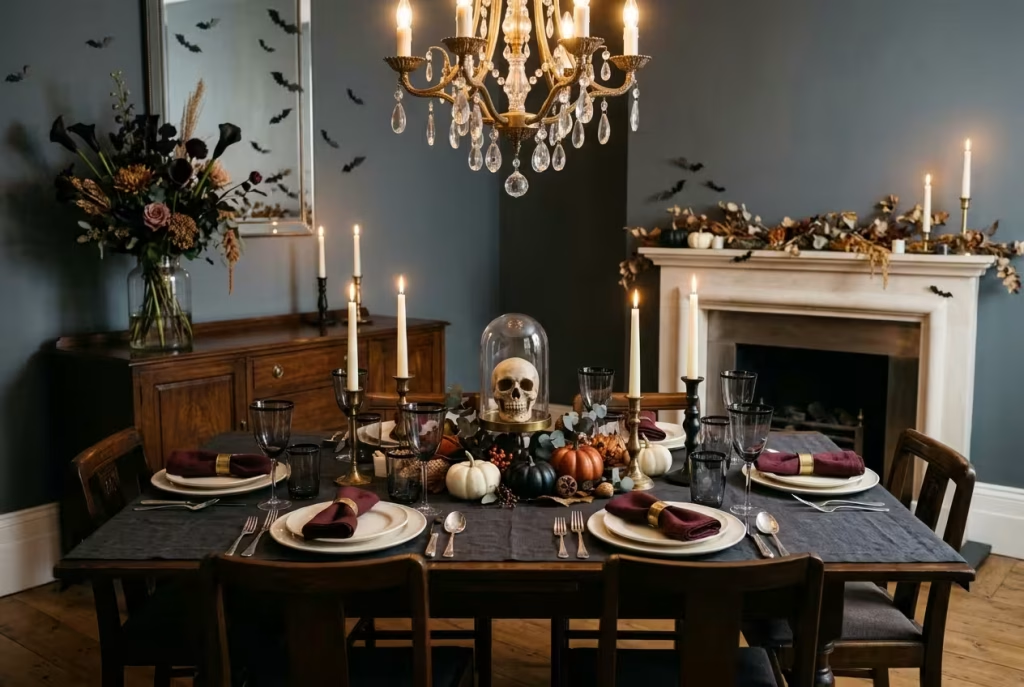
The best Halloween dining rooms are not the ones with the most props. They are the ones with a clear idea, a tidy palette and a dash of daring, where every detail earns its place and nothing gets in the way of dinner. Start with one idea from each layer, measure twice, mind the candles, and leave a clear patch for the pudding.
When the lights dim, the first taper catches and your guests step through the door, you will see it in their faces: that small intake of breath that says the effort was worth every minute. Happy haunting.
Frequently Asked Questions
How tall should a Halloween dining table centrepiece be?
Keep it at or below 30cm (12 in) so guests can see across the table. Some designers also allow up to about 35cm. Anything taller works only if it sits well above eye line, such as items hung from the ceiling.
How do I decorate a dining room for Halloween without it looking cheap?
Choose a limited palette of two or three colours, repeat it, and favour natural or antique-looking materials such as glass, metal, moss and old books. Avoid fluorescent orange and lime green, and let a few quality pieces do the work instead of dozens of plastic extras.
Can I use a real pumpkin as a punch bowl?
Yes, with care. Hollow it out, set it inside a larger bowl, chill the shell beforehand and slip in a food-safe liner. A carved pumpkin held at room temperature for more than two hours enters the food-safety danger zone, so fill it late and discard it the following day.
How far should candles be from decorations?
At least 30cm (12 in) from anything that can burn, including gauze, lace, moss, paper and dried flowers. Where that is not possible, switch to flameless candles.
Are scented candles suitable for a dinner table?
Generally not. Strong fragrance clashes with the flavour and smell of food. Use unscented candles at the table and keep scented ones in the hall or another room.
How high should a chandelier hang above a dining table?
About 75 to 90cm (30 to 36 in) above the tabletop, adding roughly 7.5cm for every extra 30cm of ceiling height above 2.4m. Fit warm 2700K to 3000K bulbs on a dimmer.
Is it safe to decorate a chandelier with cobwebs?
It can be, if you take care. Use LED bulbs, which stay cooler, keep webbing loose, and never wrap it tightly around bulbs. Check that nothing feels hot after the light has been on for about 20 minutes.
What size tablecloth do I need for my dining table?
Add twice your chosen drop to both the width and length of the table. A drop of 15 to 20cm suits everyday use, while 25 to 38cm looks more formal. For a 183cm (72 in) table with a 20cm drop, you need a cloth of about 223cm in length.
How many guests fit at a given dining table?
As a guide, 183 to 203cm seats six to eight, 203 to 234cm seats eight to ten, and 234 to 280cm seats ten to twelve. Allow roughly 60cm of width per person.
What colours work for Halloween besides orange and black?
Oxblood, deep green, plum, silver, dusty pink, terracotta and cream all feel stylish. Stick to three tones and repeat them across the table, walls and ceiling decor.
How do I decorate a small dining room for Halloween?
Go vertical. Hang hats or bats from the ceiling and walls, and keep the tabletop to a single low tray. A modest table needs a modest centrepiece, around one third of its width, so there is space for plates and dishes.
How early can I decorate the dining room for Halloween?
Wall decor, bats and hanging hats can go up two weeks ahead. Save fresh flowers, pumpkin punch bowls and cookies for the last two days.