




How to Create an English Country Christmas Look with Family Heirlooms
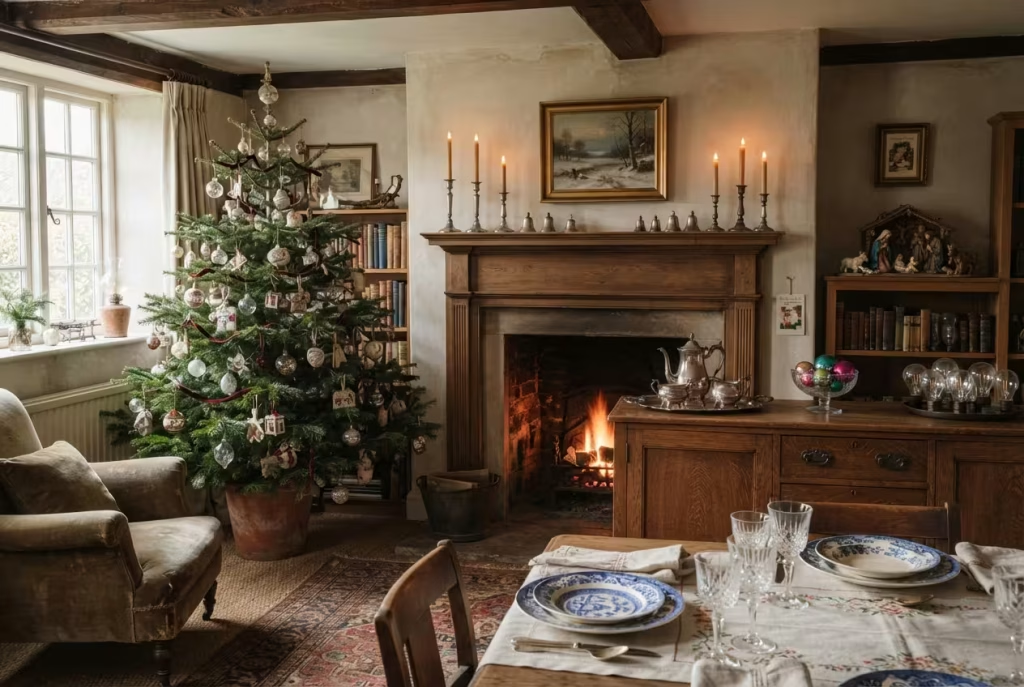
Somewhere in the loft, or at the back of a sideboard, there is a box that smells faintly of tissue paper and time. Inside sit a glass bauble with a worn cap, a stocking stitched by someone who is no longer around to hang it, perhaps a nativity short of one shepherd. None of it would turn heads in a shop window. All of it is exactly what an English country Christmas is made from.
The style was never about a matching set. It grew in houses where decorations piled up over generations, greenery came in from the garden and nobody fretted if the tree leaned a little towards the window. This guide shows you how to build that layered, lived-in look around the pieces you already own, how to keep fragile treasures out of harm’s way, and how to keep the peace when everyone has a view on the angel.

Quick answer: the look in a nutshell
An English country Christmas look layers evergreen, berry reds, bottle greens, tartan, linen and aged brass around pieces you already own. To build it with family heirlooms, lay everything out, keep what matters, give each piece a job, add only a few new touches such as ribbon and greenery, make fragile or old items safe, then photograph and label the scheme for next year.
The anatomy of an English country Christmas

Interior designer Lauren Gilberthorpe, speaking to Homes & Gardens, describes English country style as a blend of traditional and modern influences, built on comfort and a connection to nature, with antiques set against natural materials. Christmas simply turns up the volume. Five ingredients do most of the work:
- Evergreen in quantity: holly, ivy, fir and bay, draped rather than arranged.
- A nature-led palette: berry red, bottle green, cream and the muted brown of old oak.
- Texture on texture: tartan, velvet, linen and ticking stripe.
- Aged metal: brass, copper and tarnished silver, never shiny new chrome.
- Soft, low light: candles in sturdy holders, warm-white bulbs, firelight where you have a hearth.
Nothing on that list has to be bought new, which is rather the point. The look also leans on customs far older than any social feed:
| Tradition | Where it comes from | How to use it today |
| Greenery through the house | London chronicler John Stow recorded homes decked with holly, ivy and bay in an account dated 1444 | Swags of ivy and holly along shelves, frames and the mantel |
| The kissing bough | Popular in Georgian homes, hung with apples, oranges, ribbons and candles | A hoop wrapped in ivy and hung with fruit in the hall |
| The door wreath | Nineteenth-century “welcome rings” of holly, ivy, cones and ribbon | One generous wreath on the front door |
| The decorated tree | Queen Charlotte set one up at Queen’s Lodge, Windsor, in 1800; Prince Albert imported spruce from Coburg in 1840 | A tree trimmed with old pieces and a few new ones |
| Homemade trimmings | By 1860, middle-class parlour trees carried candles, sweets, fruit and handmade decorations | Children’s crafts, dried orange slices, ribbon bows |
Historical details drawn from English Heritage and the National Trust for Scotland.
You May also Like: 21 Christmas Mountain Lodge Living Room Design Ideas
A palette that forgives mismatched pieces
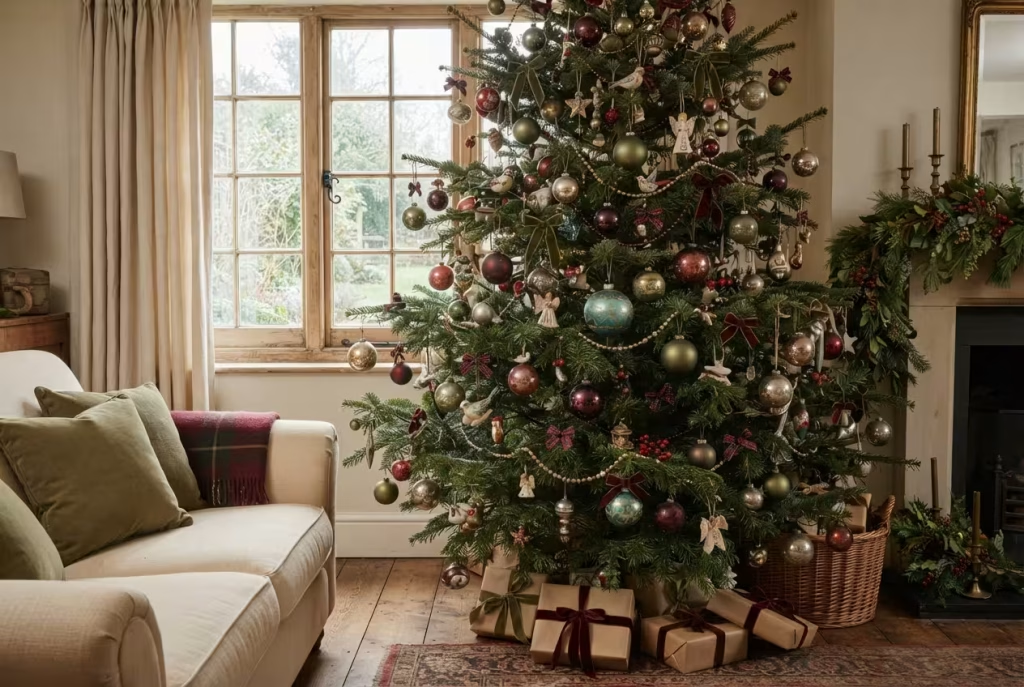
Inherited decorations seldom arrive in a coordinated colourway, so let the room make the rules instead of the ornaments. Birdie Fortescue, in a Christmas guide for SheerLuxe, describes starting from the colours already in a house and building outwards, matching new decorations to the room’s palette to keep a feeling of calm. Applied to a family collection, that becomes a four-part routine:
- Borrow two anchor shades from the room. Look at the curtains, sofa, rug and woodwork, and pick the two colours that appear most.
- Add one seasonal accent. Berry red suits most schemes, while bottle green steadies a room that is already warm with red.
- Let the aged pieces carry the shine. Faded silver, tarnished brass and softly clouded glass supply the glitter, so keep brand-new metallics in the minority, or they will outshout the old.
- Treat odd colours as spice. A turquoise bauble from a favourite aunt reads as personality when it sits among forty others, and as an intruder when it is one of three.
Why old pieces do the heavy lifting
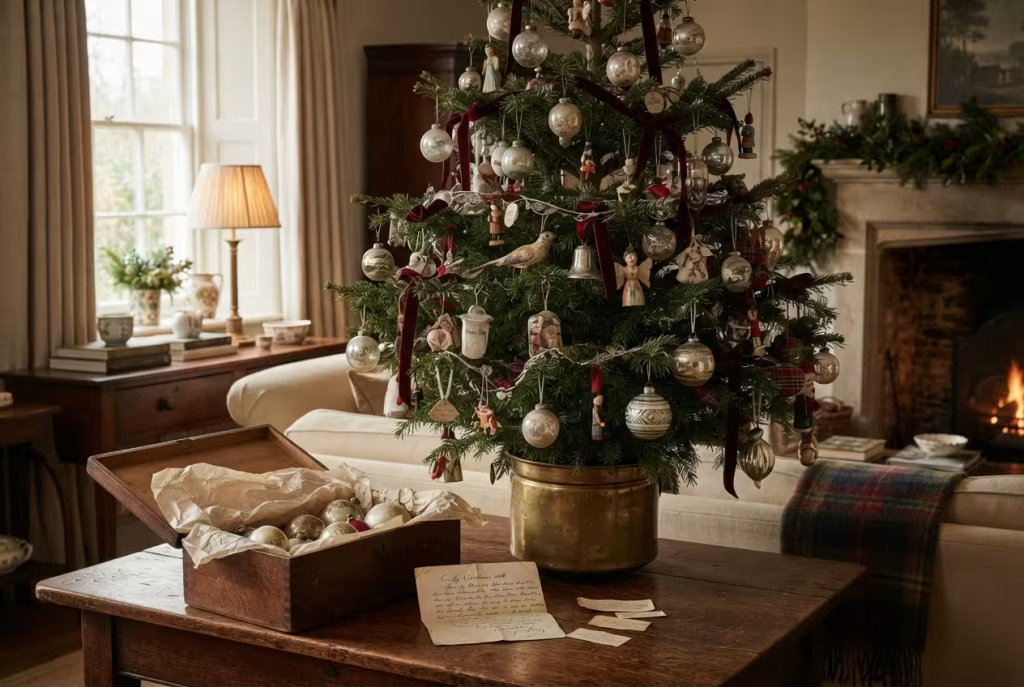
Walk into West Barsham Hall in Norfolk, built in the 1900s by Flora Soames’s great-grandparents, and the philosophy hits you in a single glance. Flora, a fabric and interiors designer, told House & Garden that the house absorbs whatever you pile on it, that she is no devotee of less is more, and that every decoration on her tree means something to her. She sees the collection as the opening line of a conversation with her children about their own childhood Christmases.
That is the emotional engine of the look. Candlelight and tartan set the scene, but a bauble that hung on your grandmother’s tree gives a room its pulse. Decluttering forums, where people wrestle with exactly this, arrive at the same place from the other direction: the comfort lives in decorating together and in the stories told while you do it, so the objects matter most when somebody is there to explain them.
A word of realism, too. Flora admits to growing wary of costly vintage baubles that a child promptly treads on. Treasure is meant to be enjoyed, yet some pieces deserve a quieter seat than the lowest branch.
Before a single piece comes out of its tissue, give it a voice. Three questions, put to whoever is nearby, do the job:
- Who last hung this, and where? A hazy answer such as “Nan’s tree, by the window” is plenty to anchor a memory.
- What is odd about it? A bell with a particular ring, a bird missing a tail feather, a tin that rattles. Quirks are what children remember.
- What should the next owner know? Write the answer down; step one shows where it goes.
Not every question will have an answer, and that is fine. Julia Konya is still trying to trace the Chinese porcelain mark on a plate from her great-grandparents, with only two books to go on so far, yet the plate hangs in her kitchen regardless. A documented “we do not know yet” is a story in its own right.
Grief deserves a gentler word. If this is the first Christmas with a loved one’s decorations, you owe nobody a full house. One reader who inherited just three of her grandmother’s ornaments says they are enough to bring her back every time she looks at the tree. Hang a few, keep the rest wrapped, and let the collection come out at the pace your heart sets.
A six-step method for dressing a home with heirlooms
Step on: lay everything out and write it down
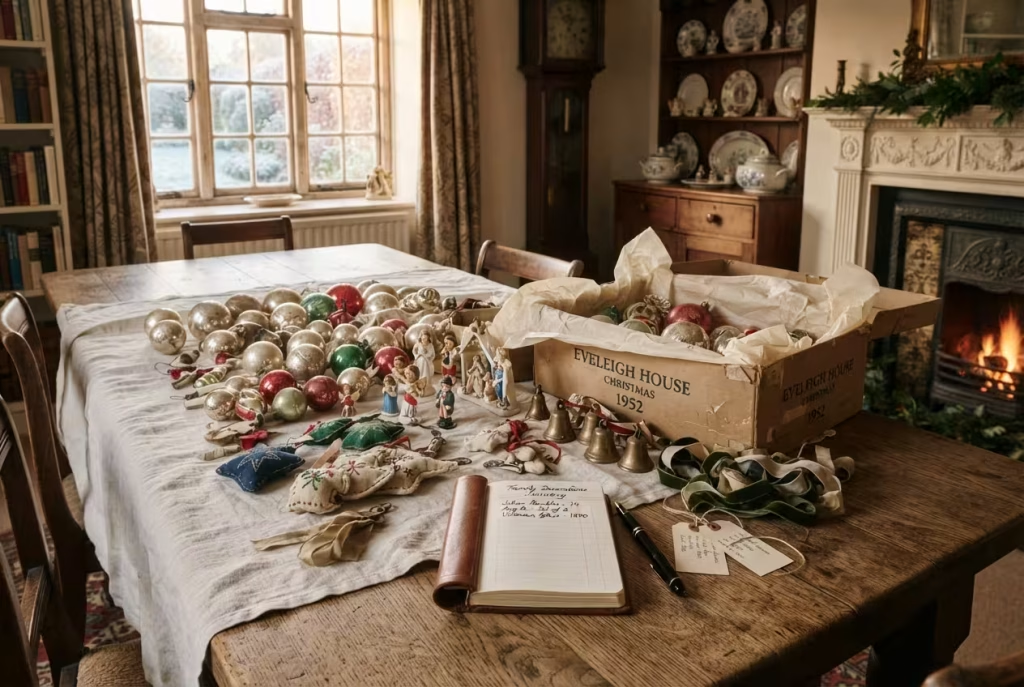
Bring every box down on the same day and spread the contents over a clean sheet. Seeing the whole collection at once is the only fair way to judge it. Photograph the lot, then start a simple inventory:
| Item | Came from | Year or place | Material | Condition | This year’s job |
| Silver glass bauble (example) | Great-aunt Joan | 1950s, Norfolk | Blown glass | Cap a little loose | Mid-tree, inner branch |
A tag is worth its weight in gold. Blogger Julia Konya of Cuckoo4Design inherited a painting with a note from her grandmother attached to the back, dated 1995, and that scrap of writing is part of why the picture matters to her. Give your own pieces the same gift: three lines on a small acid-free tag covering who, when, and one sentence on why it matters. Tie it to the box rather than the ornament.
Sort by condition as you go. A traffic-light system settles most arguments before they start:
| Light | What you find | What to do |
| Green | Firm cap, intact loop, no flaking or cracks | Hang on a sturdy inner branch |
| Amber | Loose cap, thinning silvering, small chips, brittle ribbon | Show in a bowl, on a shelf or in a shadow box |
| Red | Cracks, crumbling paint or fabric, sticky or camphor-scented plastic | Rest it in a box and ask a conservator if it is valuable |
Do not skip the unglamorous pieces. A chipped wooden angel often has the best story in the box.
Step two: edit with a kind eye
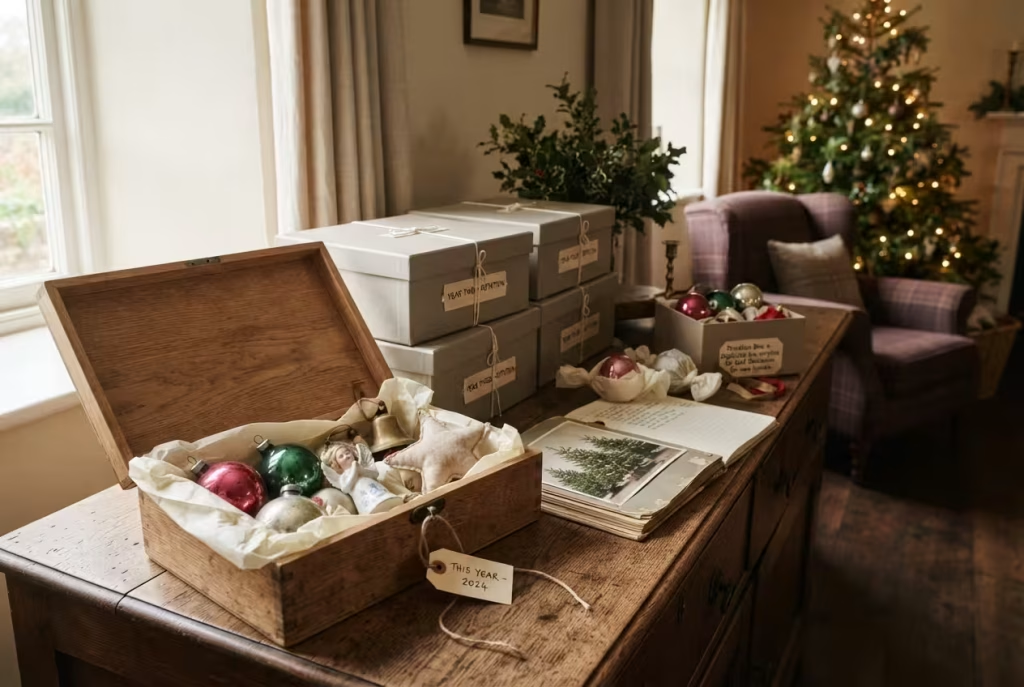
Editing is not the same as erasing. When sentiment and style collide, sentiment should win, because colour schemes are easy to replace and a great-grandmother’s bell is not. Readers in decluttering communities offer tried and tested ways to cut through the pile:
- Hunt for duplicates. How many plain silver baubles will a single tree actually carry?
- Remember that old is not automatically special. Ordinary glass balls can go so the vintage shapes shine.
- Set a ceiling. Popular rules include a fixed number of bins, or around a hundred ornaments for a full-size tree.
- Pass things on early in the season. Buy Nothing groups, church collections and food banks were all praised, and one reader gave away whole boxes with a short description, gone within hours.
- Do not reopen the boxes you have decided on. Store the cull separately and donate it after Christmas, so you stop making the same decision every year.
- Rotate. A five-year rotation, with sets resting between turns, is perfectly respectable.
Letting go is gentler when a piece has somewhere to go. Several readers said that picturing a family unwrapping a box of ornaments for the first time made parting with surplus easier, and one photographed each cull to keep in an album that lives with the remaining decorations. Pick a route that suits the piece:
| Route | Suits | Worth knowing |
| Family first | Anything with a story | Offer before donating; some relatives will be delighted |
| Buy Nothing or Freecycle groups | Whole boxes of ordinary baubles | One reader gave away entire boxes with a short description, and they went quickly |
| Church or food-bank collections | Clean, intact decorations | A congregation in one thread collected them for a food pantry’s Christmas boxes |
| Young households | Matching sets, plain glass | New couples and first-time renters often have bare trees and tight budgets |
| Gift wrap | Small, unbreakable pieces | Tuck one into the ribbon in place of a bow |
Step three: give every piece a job
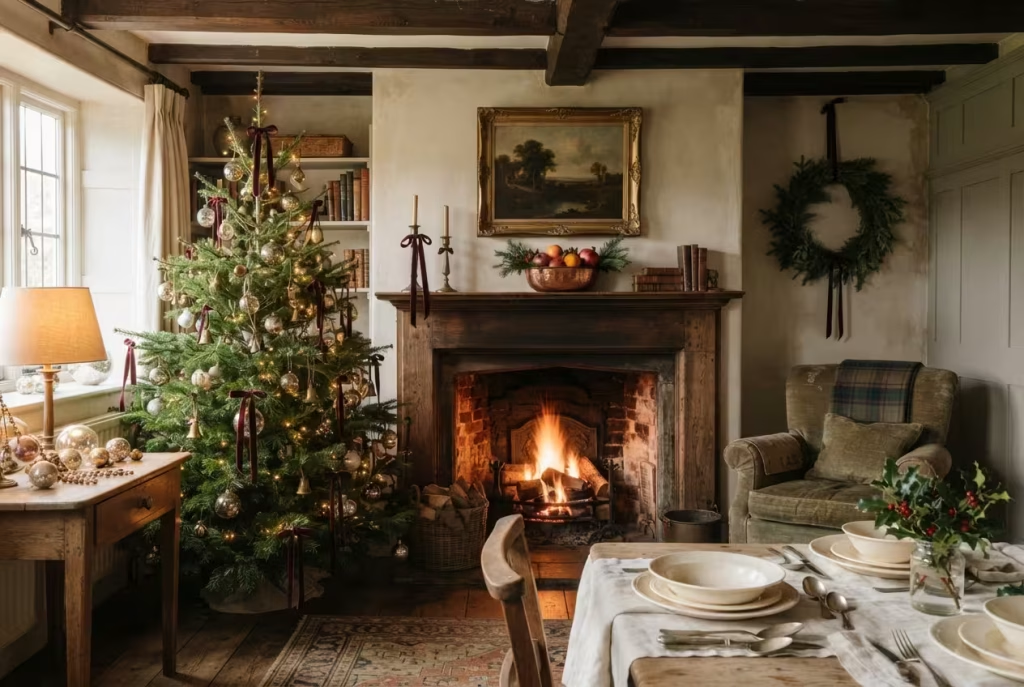
A collection looks chaotic when everything is shouting at once. It looks composed when each piece has a role:
- The anchor: a painting, a nativity or a large silver piece that holds the eye.
- The thread: ribbon, tartan or greenery repeated through the room to link unlike objects.
- The sparkle: glass baubles, bells and small mirrors that catch candlelight.
- The table-setters: china, silver and linen that earn their keep on Christmas Day.
- The welcomer: a wreath or bough that greets people before they reach the hall.
Three habits turn those roles into a room that feels composed:
- One anchor per surface. A mantel with a painting, a pair of brass candlesticks and a bowl of fruit reads as generous. Add a fourth focal point and the eye starts to scramble.
- Repeat the thread in three places at three heights. Velvet ribbon on the tree, on the wreath and round a candlestick links a room faster than any matching set.
- Put sparkle where light can reach it. Glass tucked into a dark corner wastes its talent. Set it opposite a window or beside a lamp so it can do its work.
Step four: weave in the new
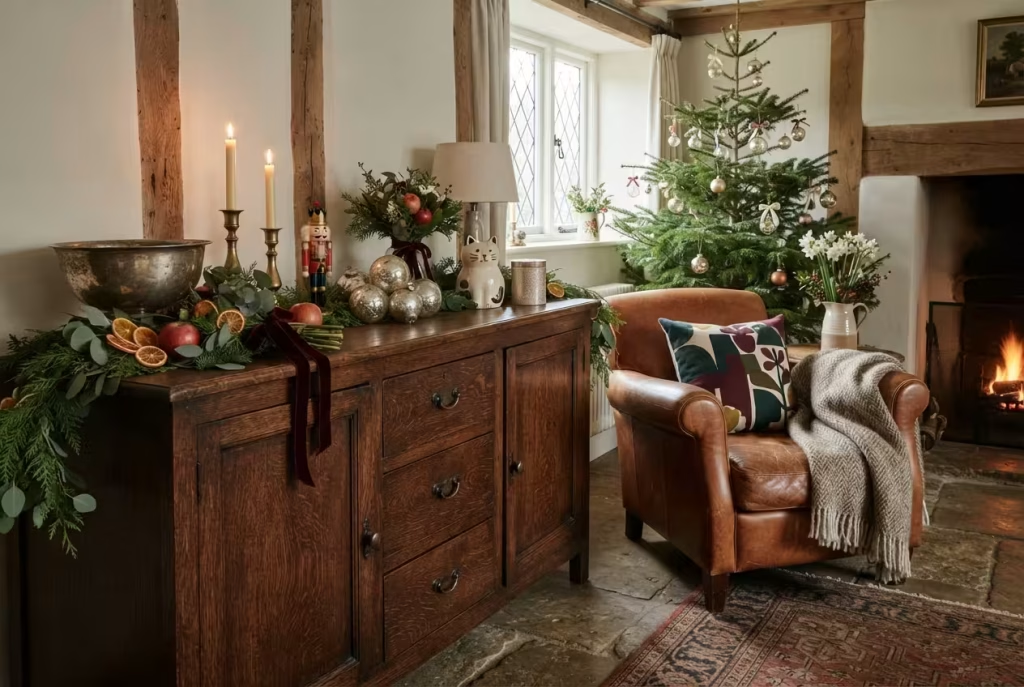
Flora Soames has a mantra worth borrowing: fold what is old into what is new. In practice, let the new things be few and consumable. Ribbon, greenery, candles and fruit all supply the thread while the old pieces supply the story. Julia Konya finds that modern curtains and cushion patterns stop antiques looking stuffy, and she mixes wood, marble, leather and fabric rather than chasing a matching set. A little humour helps, too. Her cat plates and a glittery canister keep the grander pieces from taking themselves too seriously.
Stylist Genevieve Harris, who has restored her 600-year-old Sussex farmhouse since 2016, hangs vintage glass baubles from curly willow and berry branches, then ties bright ribbon bows among them. It is a lesson in letting a humble branch play second fiddle to the glass.
A short shopping list keeps the new pieces in service of the old:
| Buy | Why | Sits well beside |
| Velvet or woven ribbon in two tones | The cheapest way to link unlike objects | Glass baubles, painted wooden pieces |
| Armfuls of garden or market greenery | The style is built on evergreen in quantity | Silver, brass, candlesticks |
| Dried orange slices and apples | They echo Georgian boughs, and designers quoted by Homes & Gardens list dried oranges and fruit among this season’s tree and wreath trends | Tartan, copper, wood |
| Paperwhite bulbs started weeks ahead | Flora Soames forces hers for the mantel | A family jug or silver bowl |
| Plain candles in heat-resistant holders | Candlelight that follows London Fire Brigade advice | Inherited candlesticks |
| Cream linen napkins | A quiet ground for patterned china | Mismatched plates |
Step five: make it safe before it goes up
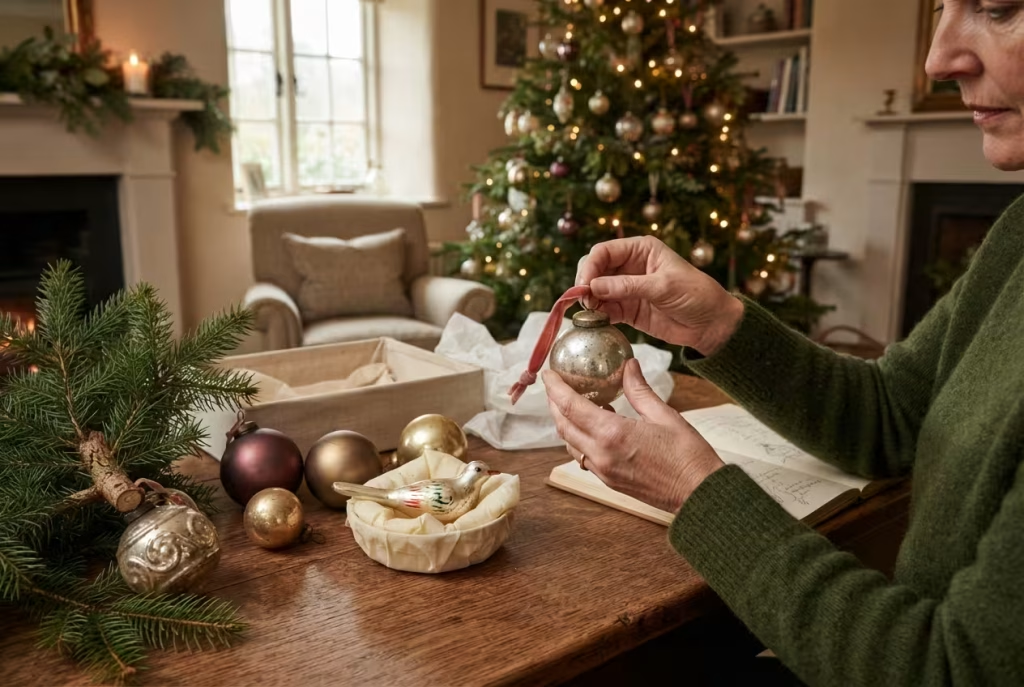
A stitch in time saves nine. Check every cap, loop and hanger on old glass before it meets a branch, and decide now which pieces are display-only. Old lights, early plastics and berried greenery each have their own rules, set out in the sections on greenery and protection below.
Run through five quick checks before anything goes up:
- Cap and loop. Wiggle gently. If either moves, thread ribbon through the loop, or retire the piece to a bowl.
- Weight against branch. Heavy glass belongs close to the trunk, where branches are thickest.
- Heat. London Fire Brigade advises against attaching decorations to lights or heaters, since they can overheat, so keep ornaments well clear of bulbs and radiators.
- Reach. Anything irreplaceable goes above toddler and pet height.
- Flame. Candles live nowhere near the tree, the cards or the curtains.
You May also Like: 25 Christmas Room Decor Ideas That Bring Comfort, Charm, and Holiday Cheer
Step six: record it, pack it, pass it on
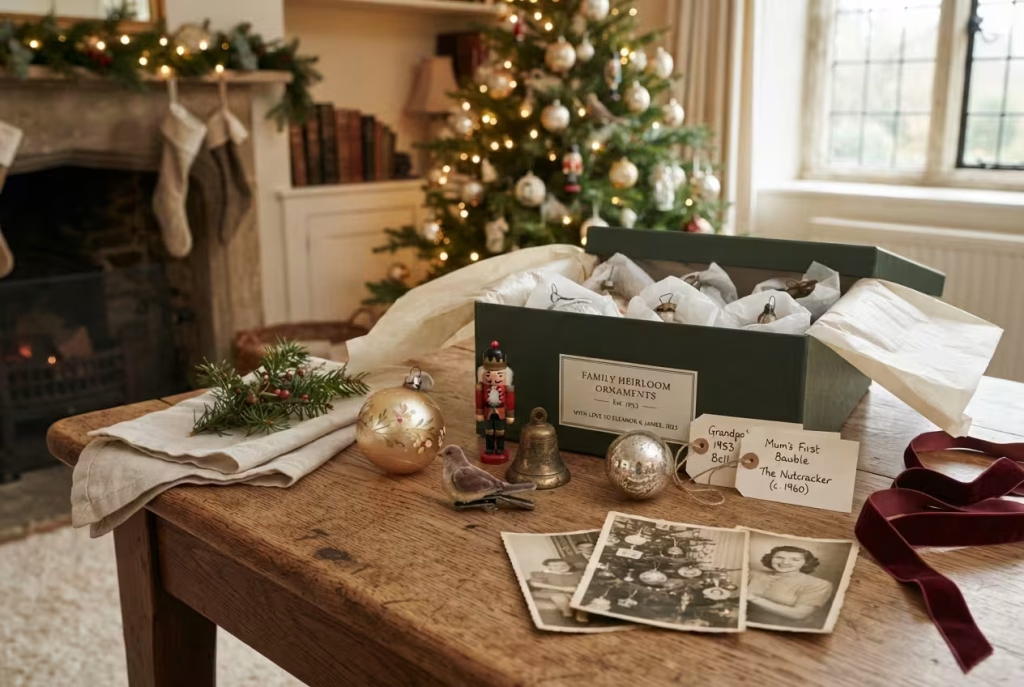
Before anything comes down, photograph the room from the doorway and take close-ups of the combinations you loved. Jot down where each treasure hung. Pack in tissue, label the box, and think about who might inherit the collection. Readers suggest giving a handful of pieces when a child gets a first home or marries, which tends to land better than a tote they never asked for. Better a few well-loved pieces with their stories attached than a box that quietly turns into a burden.
Assemble a hand-down kit while the collection is fresh in your mind:
- five to eight chosen pieces, wrapped in acid-free tissue
- a card for each, with its story in your own handwriting
- one photograph of the piece on a tree, ideally with a person in the frame
- a short note on care, including any celluloid or fragile finishes
Hand it over while you are still around to explain it. Readers who treasure their inherited decorations often say they love them because they remember helping a grandparent hang them, which is a reminder that the helping, not the glass, is the real inheritance.
Heirloom by heirloom where each piece shines
| Heirloom | Best spot | Display tip | Watch for |
| Blown-glass baubles | Inner tree branches, or heaped in a glass bowl | Check the cap and loop; swap a tired hanger for ribbon | Knocks from small children and pets |
| Silver bells, tea sets, candlesticks | Mantel, sideboard, dining table | Group in threes at different heights | Harsh polishing on delicate plated pieces |
| Embroidered stockings and linens | Mantel, banister, table | Use laundry-safe linens; hang fragile embroidery out of reach of flame | Archivists advise against washing antique fabric ornaments |
| Handmade and painted wooden ornaments | Low branches, wreath | Label with name and year | Fading in strong sun |
| Nativity sets | Hall table, bookshelf, mantel end | Photograph the set; wrap each figure separately | Figures go missing in busy hallways |
| Paintings, prints, framed cards | Above the mantel, in the hall | Have a framer check a loose canvas before it hangs | Heat and smoke above an open fire |
| China and glassware | Dining table | Mix with plain white to calm the pattern | Dishwashers and temperature shocks |
| Early plastic and celluloid pieces | Display only, away from heat | Store separately from other items | Flammable; degrades into acidic gas |
| Old light strings | A shelf or dresser, unplugged | Admire the coloured glass bulbs | Frayed wiring and cracked insulation |
Ten ideas worth borrowing
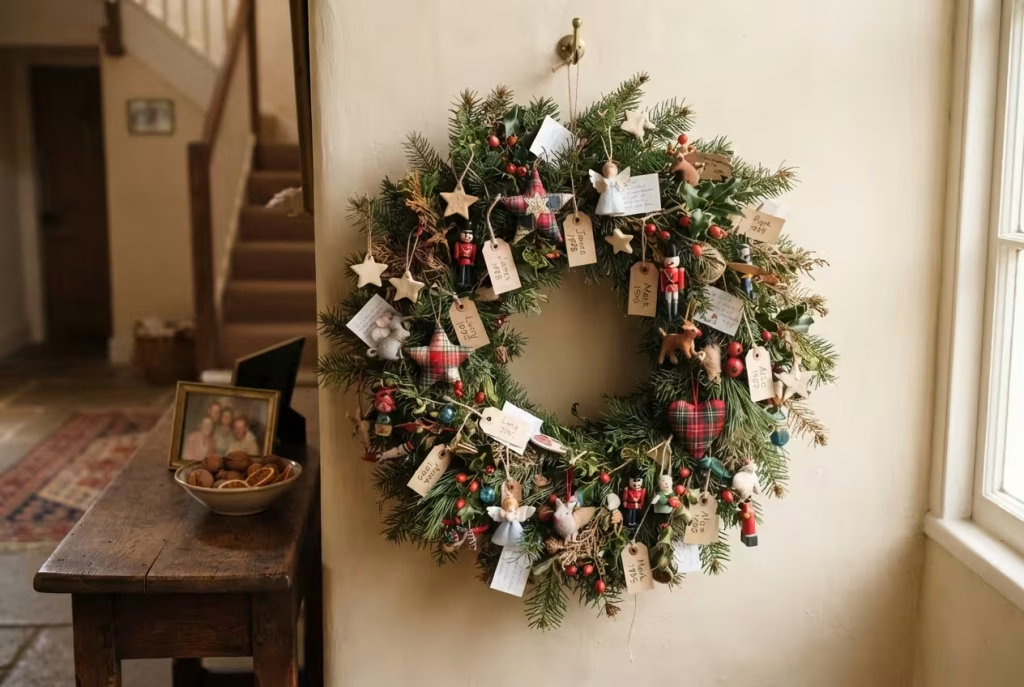
1. A wreath for the small things. Children’s school-made trinkets and tiny trims rarely survive a full tree, but they crowd happily onto a wreath. Readers who do this label each piece with a name and a year, so the wreath doubles as a family diary. Use a plain ring, wire the pieces on firmly and hang it indoors, well away from candles and radiators.image
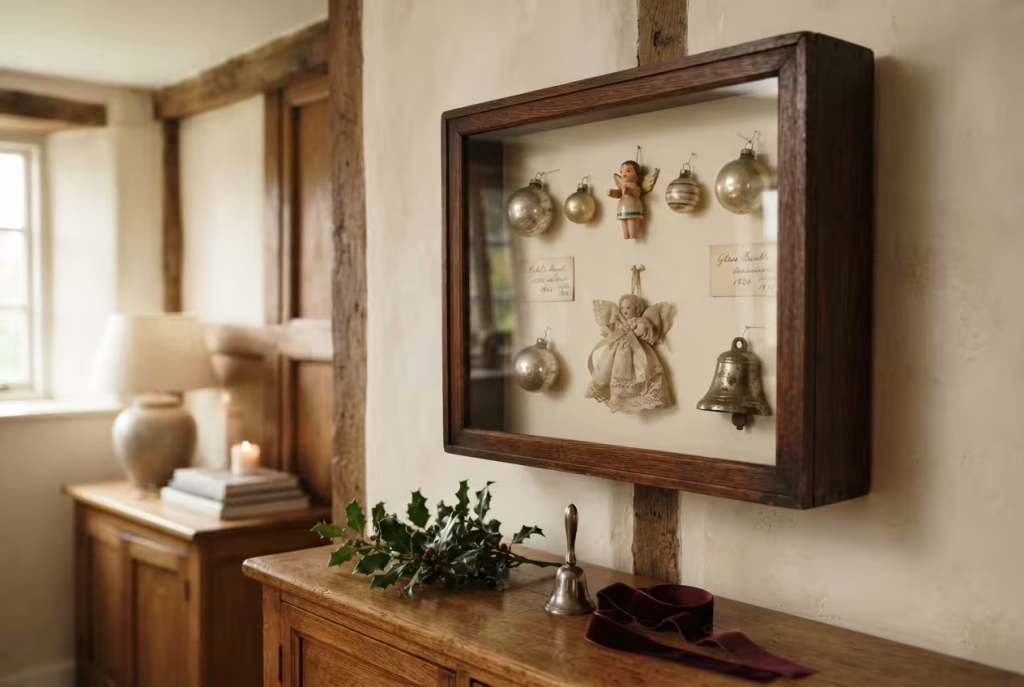
2. A shadow box for the fragile. Pieces in the amber band of the condition test often fare best behind glass. Several readers framed theirs in shadow boxes, which also frees a piece from yearly dismantling. Hang it out of direct sun and mount it on plain card, because the National Trust warns that sticky-backed mounts release pollutants that harm old objects.
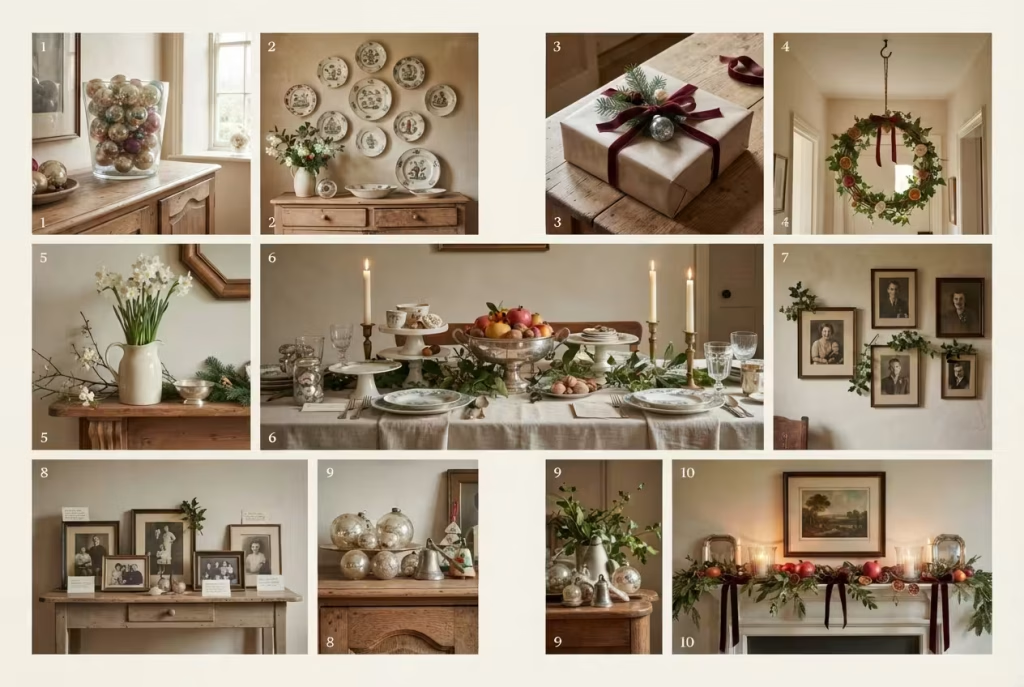
3. A glass vase of baubles. Readers suggest heaping ornaments in large glass vases, an idea that suits pieces with weak hangers. Stand it on a sideboard in a window’s light and let the old glass do what it does best, which is catch the sun.
4. The Christmas plates, hung. Julia Konya hangs her parents’ Bjorn Wiinblad Christmas plates above the buffet one year and in the living room the next. Moving them about spreads light exposure and wear, and a plate that changes rooms gathers fresh associations each time.
5. Ornaments in place of bows. Gift wrap is where small, unbreakable decorations earn their keep. Genevieve Harris skips tape, securing the paper folds with woven and velvet ribbons that cross and tie into a bow, then slots in foliage sprigs and miniature baubles. The recipient gets a present and a keepsake in one.
6. A scaled-down kissing bough. English Heritage describes boughs made from two or four crossed hoops forming a sphere, some up to a metre and a half across. Georgian versions carried apples, oranges, coloured ribbons and paper roses. Make yours half the size, wrap it in garden ivy, add fruit and ribbon, and hang it from a sturdy ceiling hook in the hall, never from a light fitting.
7. Paperwhites in a family jug. Flora Soames forces hers weeks ahead and loads them onto the mantel among garden branches. Start a few bowls several weeks before you want flowers, then pot them into a jug or silver bowl. Narcissus bulbs are poisonous if eaten, so keep them out of reach of pets.
8. A table built in layers. Flora favours candles and flowers at different heights and plenty of fruit, while Genevieve Harris shows her cakes on vintage stands. Lift one inherited bowl or tureen on a stand, tuck fruit around its base, and let the tablecloth be the quietest thing there.
9. Holly and ivy behind the pictures. One Mumsnet contributor describes tucking sprigs behind picture frames every Christmas, a habit passed down from her mother. It costs nothing and links walls to mantel. Keep berried sprigs high, and keep greenery away from lamps and from any frame hanging above a fire.
10. A memory table. Set aside a console or windowsill for photographs of the people who owned your pieces, in glazed frames, with their items beside them. The National Trust recommends glazed frames for prints. Add a card for each person with their name and one line about them. Visitors stop, read and ask questions, which is exactly the point.
Room by room: putting the pieces to work
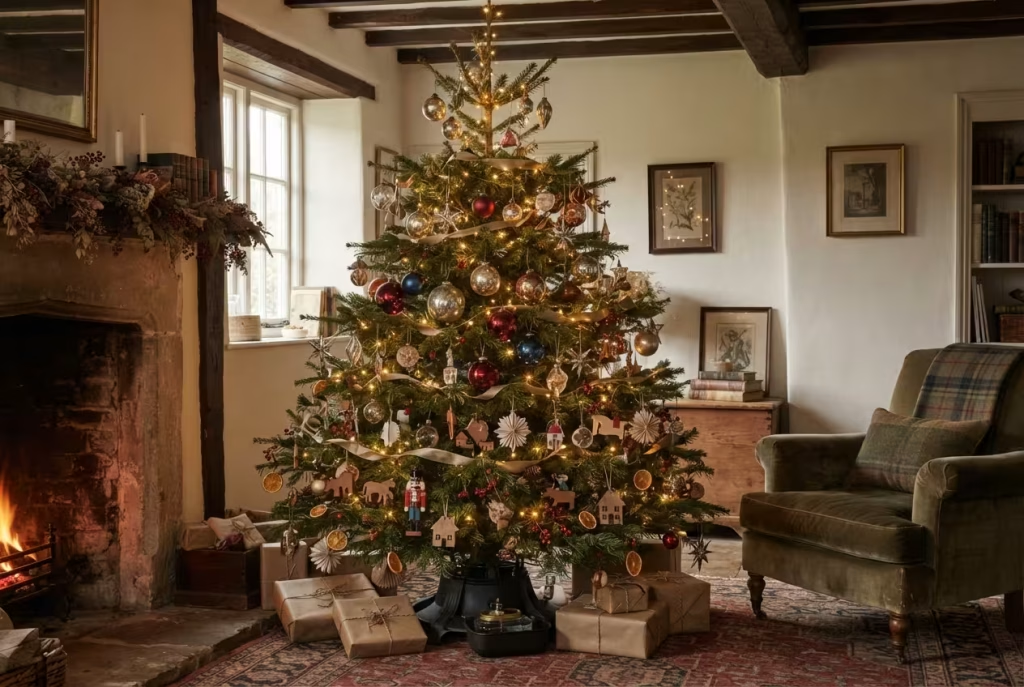
The tree. Hang sound glass on sturdy inner branches, where it sits safe from swinging arms and curious paws, and give the hardy wooden and paper pieces the lower tiers. Flora Soames mixes nostalgic wooden cutouts with sparkly kitsch and drapes metallic ribbon from a vintage fabric dealer. Her one firm rule is no coloured or flashing lights, and warm, steady LEDs are the safest way to follow it. Fruit and dried orange slices nod to the Victorian parlour tree and cost next to nothing.
A reliable order of work runs like this. Lights go on first, then the largest pieces deep inside near the trunk, then smaller sparkle further out, with wooden and handmade pieces on the lower tiers and ribbon last, so you can see where it is needed. Keep candles off the tree altogether. London Fire Brigade warns that trees dry out and can burn quickly, with flames spreading in seconds, so keep the stand topped up with water.
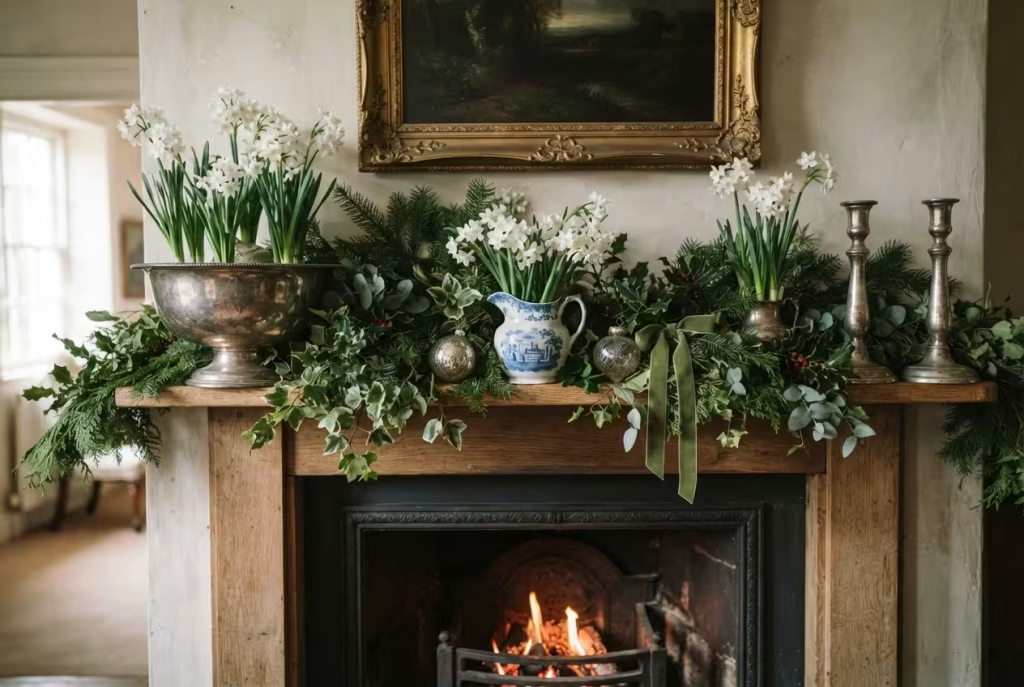
The mantel. Flora loads hers with branches cut from the garden and paperwhites forced weeks before, calling it the obvious canvas, and the effect is a feast for the eye. Heavier silver sits at the ends, with a painting or mirror above. If you light a fire or stove, follow the appliance instructions and keep combustible greenery, paper and textiles well clear of the heat.
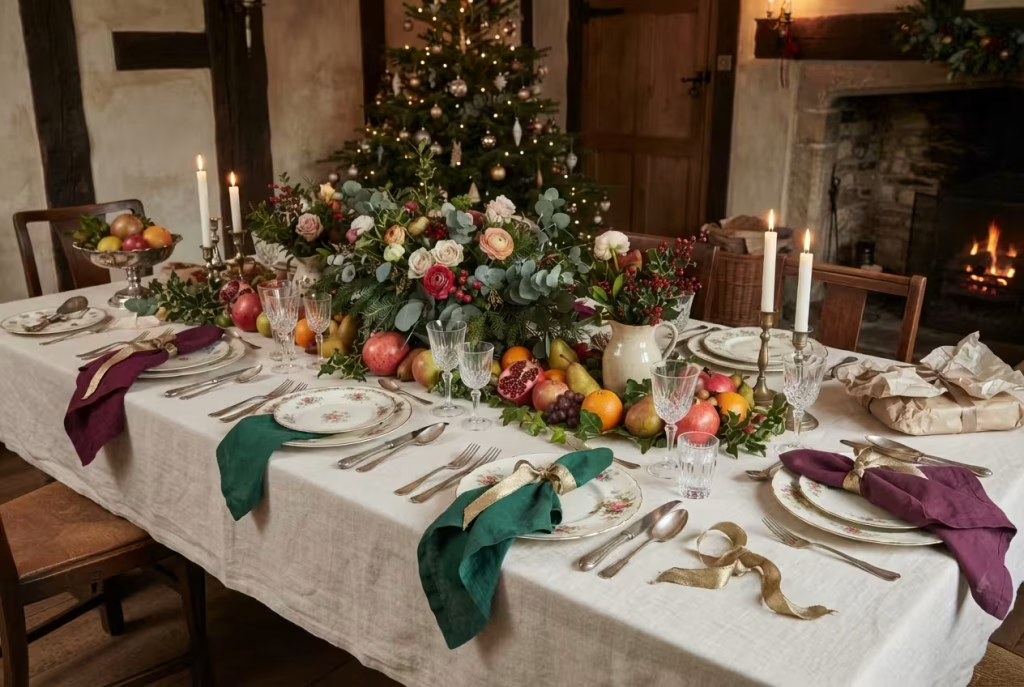
The dining table. Give inherited china and silver pride of place and let the rest run loose. Flora ties jewel-dyed napkins with metallic ribbon, stands candles and flowers at different heights, and piles on fruit. She likes the napkins unfolded and the wrapping paper strewn, since the aftermath is part of the magic.
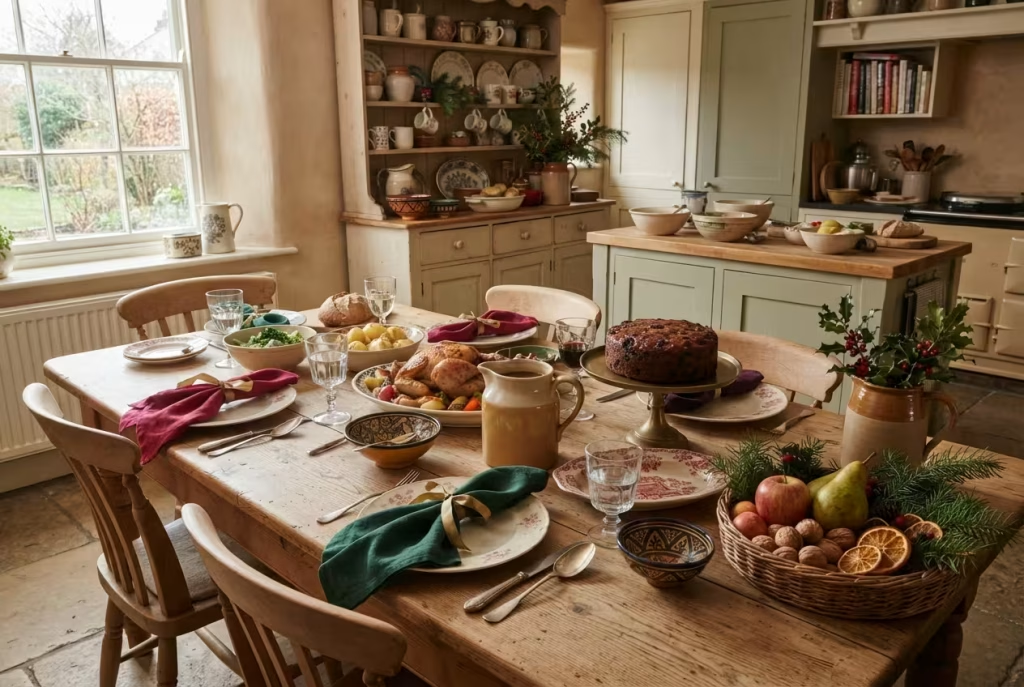
The kitchen. Flora Soames’s Christmas lunch table is thrown together at the last minute from things gathered on her travels, slotted around old favourites that reappear every year, such as a set of jewel-dyed napkins bought years ago from a dealer. Take the hint. The kitchen is where inherited treasures can be used rather than looked at, whether that is a family jug for the gravy or a cake stand with a long history of birthdays.
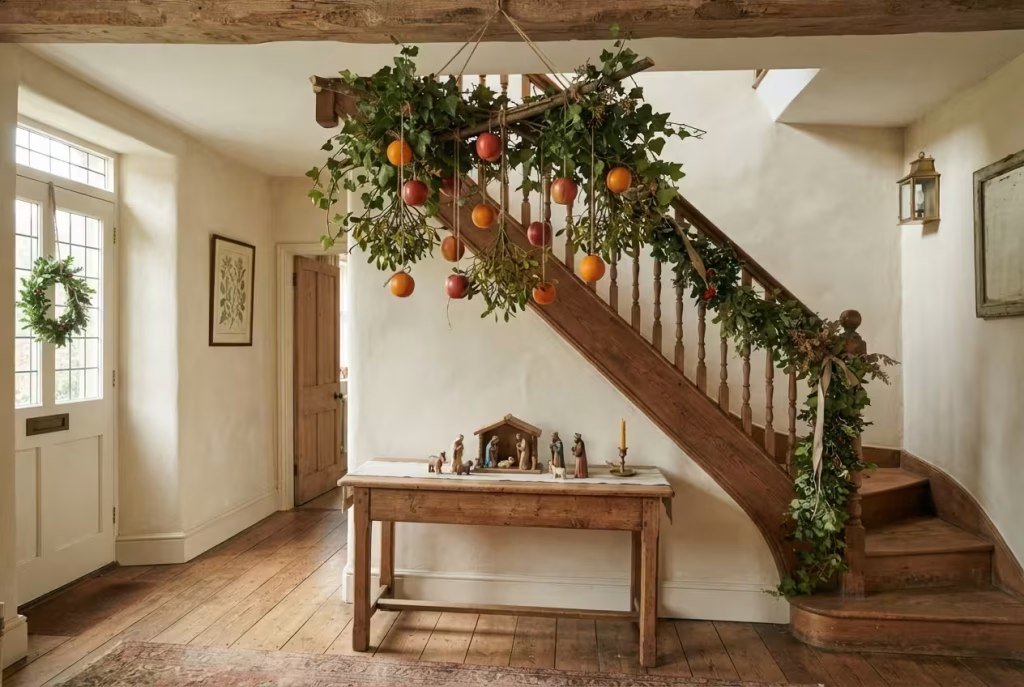
The hall and stairs. A hall rewards a single bold gesture. Hang a kissing bough, wrapped in ivy and hung with apples and oranges, or drape a garland up the banister. Keep the nativity on a table out of the traffic line.
The hall is where treasures meet strangers: neighbours, delivery drivers, guests in muddy boots. Keep the most breakable pieces off the floor and off the console nearest the door, and favour things that welcome, such as a brass bell, a bowl of clementines or a runner of fir.
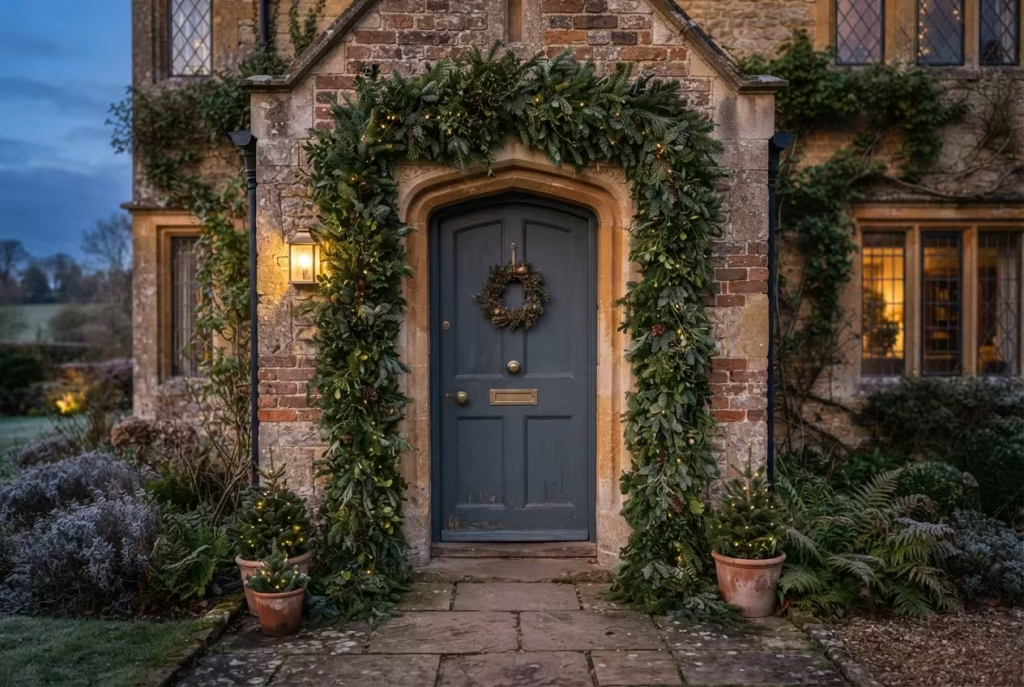
The front door. Genevieve Harris binds conifer branches to a long length of string, each overlapping the last, then hangs the garland from four screws set into the brick and threads in outdoor fairy lights. If you rent or live in a listed building, use removable hooks and check what is allowed first.
If screws are off limits, loop a ribbon over the top of the door or use a removable hook, and take the greenery down after Twelfth Night so it does not rot against the paintwork.
You May also Like: Vintage Christmas Decor Ideas Create a Cozy, Nostalgic Home This Festive Season
Greenery from the garden what is safe, legal and kind
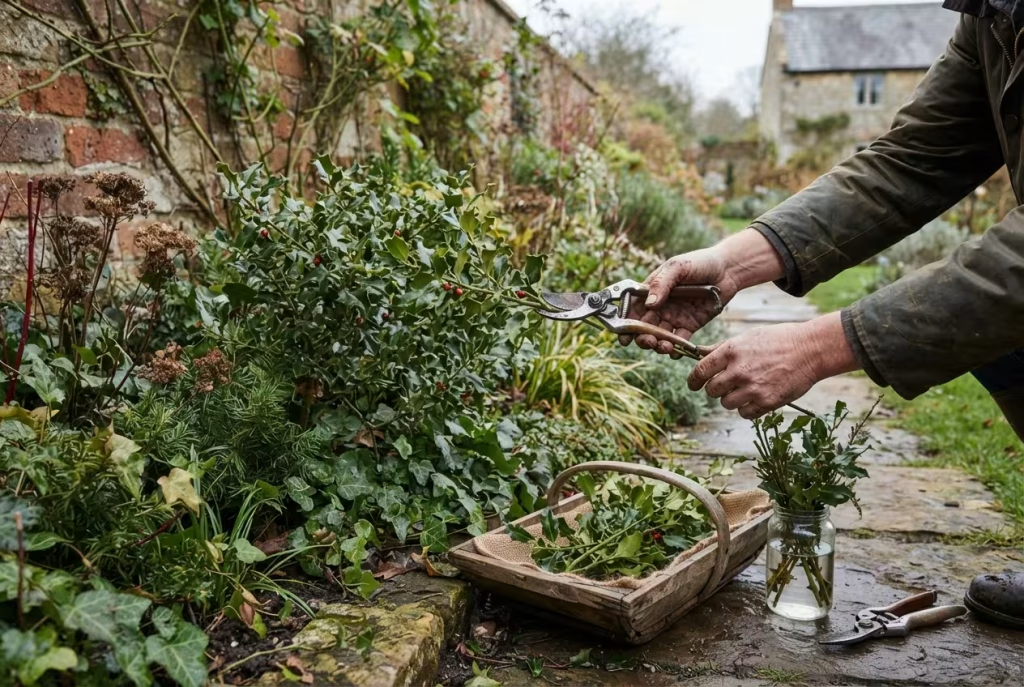
Greenery is the cheapest part of the look and the part most often handled carelessly. Start with the law, which is simpler than the folklore suggests:
- Ask first. The Woodland Trust and the RHS both say you need the landowner’s permission before gathering wild mistletoe.
- Never uproot. The BSBI’s code of conduct says uprooting any plant is illegal without the landowner’s permission, and its guidance suggests taking no more than one in twenty.
- Mind protected places. East Sussex County Council advises against picking in Sites of Special Scientific Interest or taking protected species.
- Think of the wildlife. Over-picking mistletoe can harm the mistletoe marble moth, a UK conservation priority.
Your own garden is the kindest source. Genevieve Harris’s list for the season includes ivy, holly, conifer, fir and cypress, plus bracken, willow, hazel, birch and dogwood twigs and interesting seed heads. Use clean, sharp secateurs, take only a few stems from any one plant, and stand cut stems in water overnight somewhere cool before arranging. If mistletoe grows on your own trees, the RHS says it can be cut back quite hard to supply branches for decoration.
Then check what is poisonous before it reaches a low shelf:
| Plant | Risk | Sensible handling |
| Holly | Berries contain saponins that irritate the gut | Hang high; sweep up fallen berries |
| Mistletoe | All parts toxic if eaten; white berries tempt children and pets | Hang out of reach |
| Ivy | Can irritate pets’ skin and upset stomachs if chewed | Keep off floors and low surfaces |
| Yew | The seeds inside the berries are poisonous | Skip it in homes with small children or pets |
| Real tree | Chewed needles may irritate pets’ mouths and stomachs | Keep the stand topped up with water; a dry tree burns quickly |
Sources disagree on how many holly berries it takes to harm a child, so do not gamble on a number. If anything is eaten, seek medical or veterinary advice straight away.
Protecting what cannot be replaced
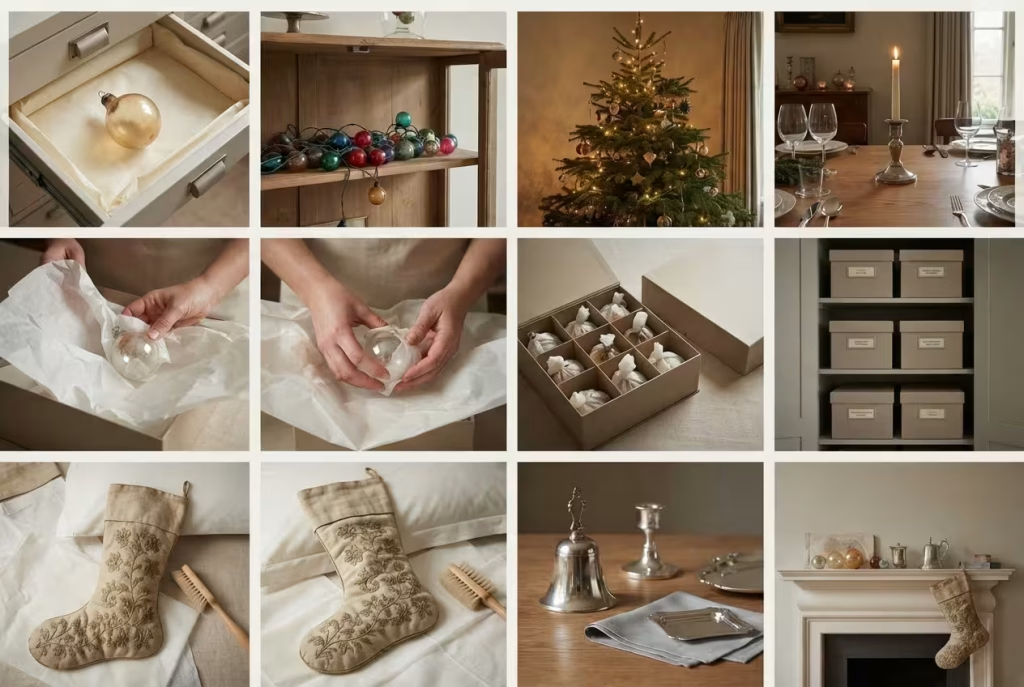
Respect early plastics. Cellulose nitrate, sold as celluloid, was used for ornaments and toys in the first half of the twentieth century. Conservators at the Museum of Fine Arts, Boston, note that it is flammable, should be stored apart from other objects, and releases acidic gas as it degrades, which can attack nearby metals such as silver and copper. If a vintage figural ornament feels feather-light, has an amber tint or carries a faint camphor whiff, assume the worst. Keep it away from candles, bulbs and the mantel, store it somewhere ventilated, and ask a conservator if it matters to you.
Retire old lights. Oxfordshire Fire and Rescue Service points out that lights packed away for twelve months can become electrically unsafe. Its advice is to check them, switch them off at bedtime and replace bulbs only with the same type and rating. RoSPA’s Elizabeth Lumsden urges replacing blown bulbs immediately, and housing-safety guidance notes that a dead bulb can make its neighbours overheat. Electrical Safety First recommends LEDs over filament strings because they run at extra-low voltage, which lowers shock risk. The practical answer for heirloom lights is simple: admire the old coloured glass bulbs on a shelf and light the tree with modern warm-white LEDs.
Treat candles with respect. London Fire Brigade’s advice is blunt: use heat-resistant holders on a stable surface, keep naked flames away from decorations, curtains, papers and furniture, never leave them unattended, and put them out before bed. The Brigade renewed the warning in December 2025 after a run of candle fires across the capital. If you love real candlelight, keep it on the dining table where people are sitting, and use flameless candles near the tree, the mantel greenery and any old paper, fabric or celluloid pieces.
Pack like an archivist.
| Do | Avoid |
| Wrap each piece in acid-free, unbuffered tissue | Newspaper, which can transfer ink and acid |
| Use rigid, divided boxes, with a second box around the first | Stacking heavy objects on top |
| Store indoors somewhere dry and cool | Attics, garages and basements with big temperature and humidity swings |
| Keep boxes off the floor, away from damp | Plastic wrap against fabric, where moisture can trap and cause mildew |
| Put stockings in tissue or a cotton pillowcase | Washing antique fabric ornaments; see a conservator |
| Dust gently with a soft brush or cloth | Water on hand-painted or antique glass |
Archivists and storage firms differ on plastic bins. Cardboard breathes, while plastic guards against spills and pests. Whichever you pick, keep it dry and lifted off the floor.
Textiles and silver want different care. The National Trust’s advice for precious textiles is to minimise handling and exposure to light, dirt, damp and insects, and to rotate pieces annually so fading is spread evenly. Museum guidance adds that you should wash your hands before touching old fabric, avoid lotions that can stain it and keep displays out of direct sun. Light damage cannot be wholly prevented, so a stocking that hangs for the festive fortnight is better off than one on show all year. For silver, the Trust suggests cleaning as rarely as possible with specialist silver cloths rather than abrasive polishes, which is good news for anyone who loves a little tarnish.
When the family has opinions
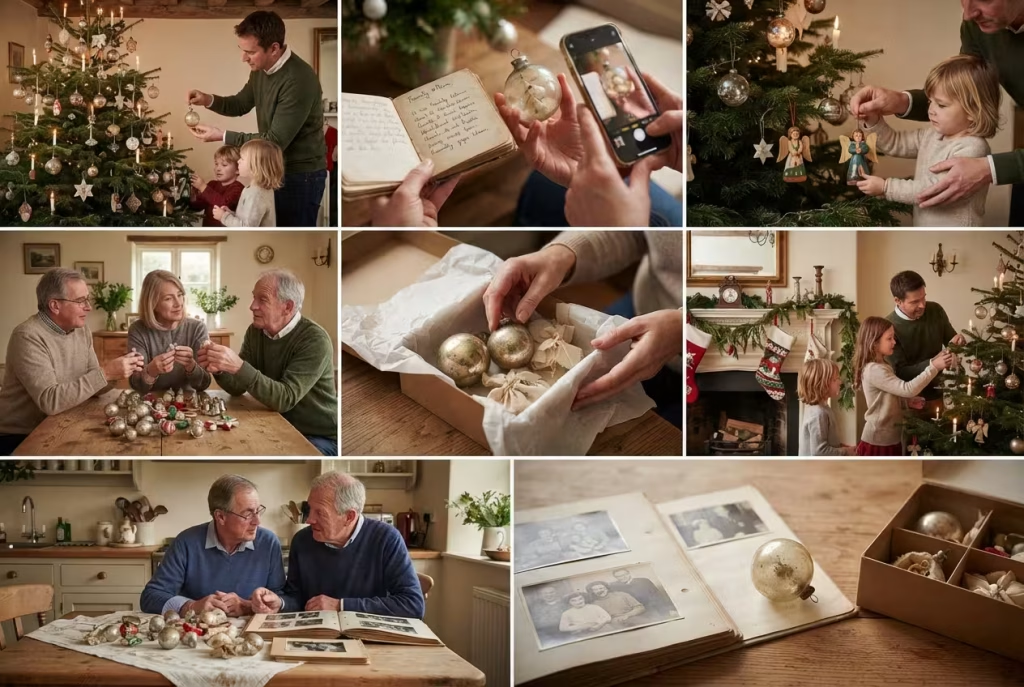
Heirlooms rarely arrive without feelings attached. Here is how households tend to keep the peace.
Use or store? One of the most upvoted replies to a mother puzzling over a tote of ornaments from her grandmother argued that pieces only gain meaning once children have seen them on the tree. Others warned that gifted collections can turn into guilt-ridden storage. The middle road is to hang a few each year, tell the story, and save a handful for later.
What if something breaks? It will, sooner or later. A Guardian feature once aired the fallout when a daughter smashed an inherited bauble: tears, a sharp word and two days of silence. Hang the irreplaceable pieces yourself, hand children the hardy wooden and paper ones, and photograph treasures so you know what you are missing. Easy does it.
Splitting the spoils. Ask every family member to pick about five pieces that matter most to them, and ask relatives before anything is donated. Sibling squabbles tend to melt when everybody has had a say.
Inherited but not loved. One reader put it well: the love someone had for you is not stored in the object. Photograph it, thank it, keep one if you must, and let the rest bring joy elsewhere.
Decorating day tension. Guardian readers asked to judge a mother-daughter decorating row suggested splitting the job in two: one day for the keeper of the traditions to set her fixed displays, a second for everyone to add finishing touches.
Words that help. The hardest part is often the first sentence. Try “I would love to keep this one, and I want you to have first pick of the rest”, or “This was Gran’s, so I would rather it went somewhere it will be used than into a box.” Both honour the piece without making anyone feel marked.
Permission to release. Not every inherited object arrives with warm feelings. One reader said she parted with some pieces because the memory attached to them was not a happy one, and felt lighter for it. Keeping a collection is a choice, never a debt.
A gentler Christmas calendar for heirloom decorating

| When | What to do |
| Late November | Bring boxes down, inspect lights, inventory and edit |
| First week of December | Dress the mantel, hall and door; add fresh greenery last so it looks its best |
| Christmas week | Top up the tree stand, check lights nightly, never leave candles unattended |
| Twelfth Night to mid-January | Photograph, record, wrap in tissue and label; Georgian households took everything down on Twelfth Night, and it remains a tidy date for packing |
You May also Like: 24 Christmas Pathway Lighting Ideas That’ll Make Your Home Glow Easy, Dazzling & Cozy
The last bauble
An English country Christmas does not ask you to buy a thing. It asks you to look again at what is already in the house, to give the chipped and the faded a place near the light, and to tell the story once more while somebody small is listening. Do that, and the greenery, the tartan and the candles simply fall into line behind it. Hang the glass gently, and let the tree lean where it likes.
Your questions answered
What is an English country Christmas style?
It is a warm, layered, nature-led look built on evergreen, berry red, bottle green, tartan, velvet, linen and aged brass, with antiques mixed among newer pieces. Comfort comes before perfection, and candlelight does the rest.
How do I decorate with family heirlooms without it looking cluttered?
Edit first, then give each piece a job: one anchor per surface, a thread of ribbon or greenery to link the rest, and room to breathe. One reader tip is to store everyday decor in the Christmas bins while the festive pieces are out.
Should I hang fragile heirloom ornaments or keep them boxed?
Hang the sound ones. Check the cap and loop, place them on sturdy inner branches and keep them away from toddlers and pets. Display the most fragile pieces in a padded bowl or on a shelf, where they still get their moment.
How should I store antique ornaments?
Wrap each in acid-free, unbuffered tissue, box them in rigid, divided containers, and keep them indoors somewhere cool, dry and off the floor. Avoid attics and basements, and never use newspaper.
Can I use my grandparents’ old fairy lights?
It is best not to plug them in. Old insulation and wiring can fail, and fire services advise checking any stored lights each year. Display them unplugged, or have an electrician assess them, and light the tree with modern LEDs.
Are old celluloid ornaments dangerous?
They can be. Celluloid is flammable and can release acidic gas as it ages. Keep it away from candles, bulbs and heat, and store it apart from other objects.
How do I mix old and new?
Keep the new to a few consumables such as ribbon, greenery and candles. Use modern cushions and curtains to stop antiques looking stuffy, mix metals and finishes, and allow one playful touch.
What colours suit an English country Christmas?
Berry red, bottle green, cream and warm brown, plus tartan in muted tones. Many designers keep lights warm and steady, and Flora Soames rules out coloured or flashing strings altogether.
Is it legal to pick holly, ivy and mistletoe from woodland?
Only with the landowner’s permission. Never uproot plants, avoid protected sites and species, and take sparingly. Your own garden or a reputable seller is the safer source.
Are holly, mistletoe and ivy poisonous?
Yes, to varying degrees, for children and pets. Holly berries and mistletoe are the main worries, ivy can irritate, and yew seeds are poisonous. Hang them high and sweep up fallen berries.
What if I inherit ornaments I do not like?
Photograph them, keep one if it stirs a memory, and pass the rest on early in the season through Buy Nothing groups or charity collections. The memory is not stored in the object.
How do I share heirlooms between children or siblings?
Let each person choose about five pieces that matter most, ask relatives before donating anything, and give a starter set when a child gets a first home. Write the story on a tag so it travels with the piece.
How should I display antique stockings and linens?
Keep them out of direct sun and away from radiators and fire heat, hang them for the festive fortnight rather than all year, and rotate pieces from year to year, as National Trust conservators advise. Wash your hands first, and store them in tissue or a cotton pillowcase afterwards.
Is it safe to use real candles near heirloom decorations?
Only with care. London Fire Brigade says candles belong in heat-resistant holders on stable surfaces, away from decorations, curtains and paper, and never unattended. Use flameless candles near the tree, greenery and any old fabric or celluloid pieces.
How do I keep a real tree safe when it carries antique glass?
Keep the stand topped up so the tree does not dry out, stand it away from radiators, and hang the heaviest glass near the trunk where the branches are strongest. A dry tree burns quickly, so keep naked flames well away from it.
Sources and further reading
Checked November 2026. Facts about family stories and decorating come from House & Garden (Flora Soames, December 2025), The English Home (Genevieve Harris, December 2025), Cuckoo4Design, English Heritage and the National Trust for Scotland. Reader experiences come from public decluttering threads and a Guardian “You be the judge” feature. Safety and care guidance:
- Family Tree Magazine: how to preserve holiday heirlooms
- MFA Boston CAMEO: cellulose nitrate
- National Trust: how to care for your precious objects
- London Fire Brigade: festive candle warning
- Oxfordshire Fire and Rescue: Christmas lights safety
- Woodland Trust: foraging guidelines
- RHS: mistletoe
- BSBI: code of conduct
- Homes & Gardens: what is English country decor
SEO title: English Country Christmas with Family Heirlooms: A Guide Meta description: Learn how to build an English country Christmas look around family heirlooms: a six-step method, safe display, storage, greenery rules and a 12-question FAQ. URL slug: /english-country-christmas-family-heirlooms/