




23 Moody Dark Cottagecore Christmas Living Room Ideas for a Cozy, Enchanted Holiday
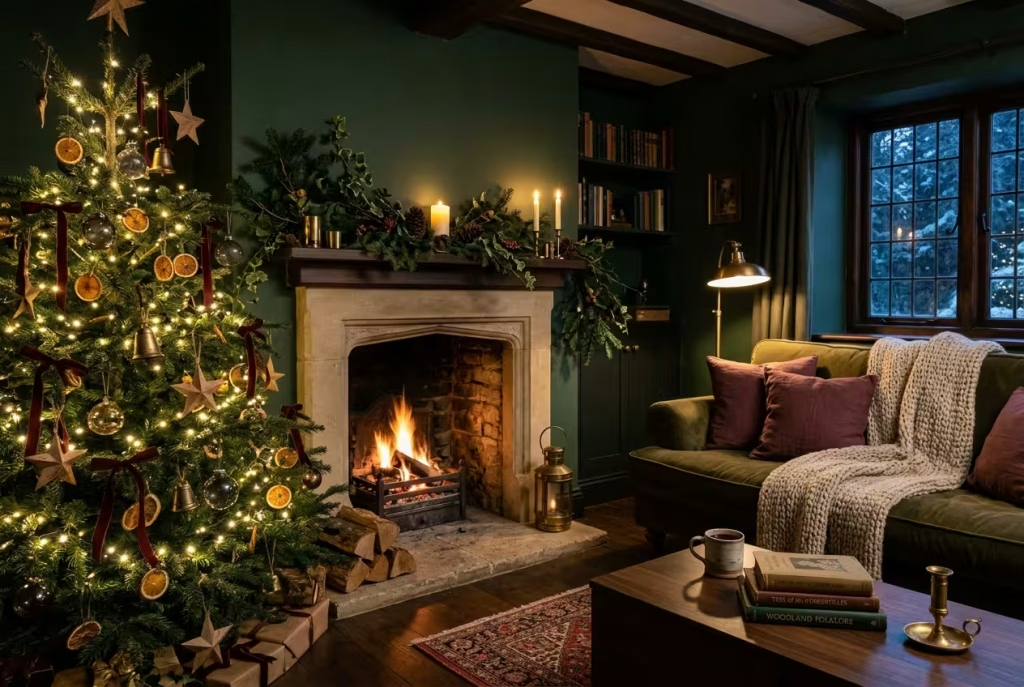
Picture a living room at four o’clock on a December afternoon. The light outside has long since thrown in the towel, the walls have sunk into a deep forest green, and the only brightness comes from a cluster of beeswax tapers, a string of warm bulbs threaded through fresh fir, and dried orange slices glowing like tiny stained-glass windows. Nothing in the room is raising its voice. Everything murmurs, and you find you have no wish to leave.
That hush is the whole point of a moody dark cottagecore Christmas. It borrows the handmade, garden-and-larder spirit of cottagecore, turns the lights down low, and lets deep colour, real greenery and living flame do the heavy lifting. It sits a long way from the glossy black plastic tree on one side and the pastel gingerbread village on the other, and it is far kinder to your purse than either, because so much of it can be foraged, dried, thrifted or made at the kitchen table.
Below you will find 23 ideas grouped by zone, from walls and trees to mantels, lamps and a reading corner. You will also find the practical bits most guides skip: how to keep dried botanicals away from flame, which festive plants are a worry around cats and dogs, the colour temperatures that make a dark room glow rather than sulk, and what to do if you rent, have no fireplace, or share your sofa with a television.
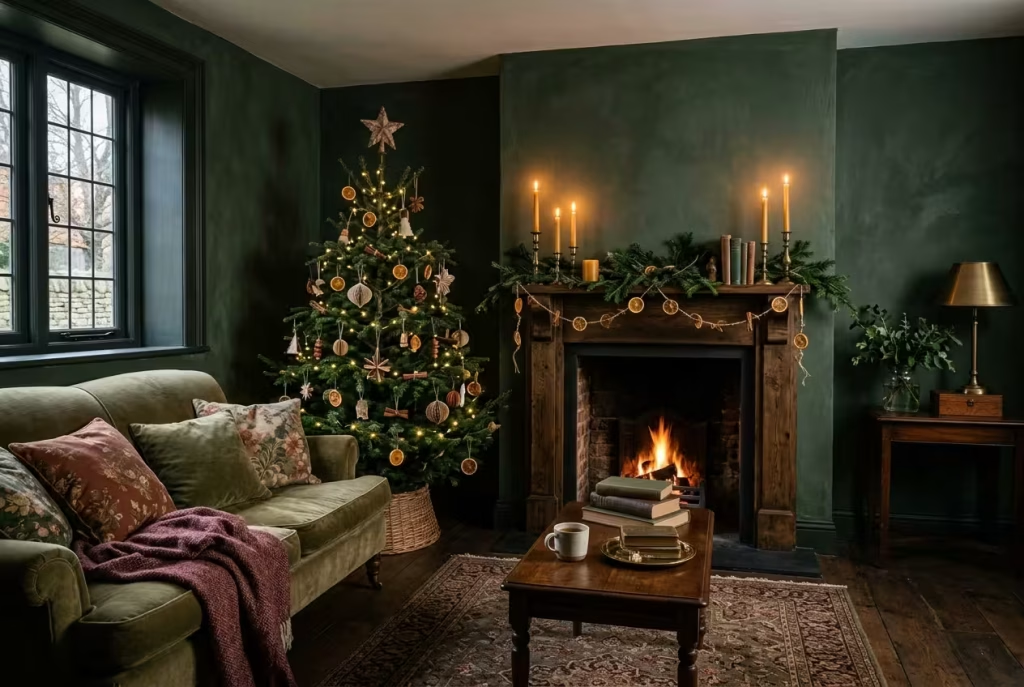
Quick answer: what is a moody dark cottagecore Christmas living room? It is a festive room built on a deep, natural palette (forest green, oxblood, walnut brown, aged brass), dressed in real greenery, dried fruit, wool, velvet and old books, and lit mainly by warm lamps and candles rather than a bright overhead bulb. The look is collected rather than matched, handmade rather than shop-bought, and designed to feel like a cottage on the edge of a winter wood.
You May also Like: A Complete Guide about How Do You Decorate a Rented Living Room for a Japandi Christmas?
The five rules behind the look fir Moody Dark Cottagecore Christmas Living Room
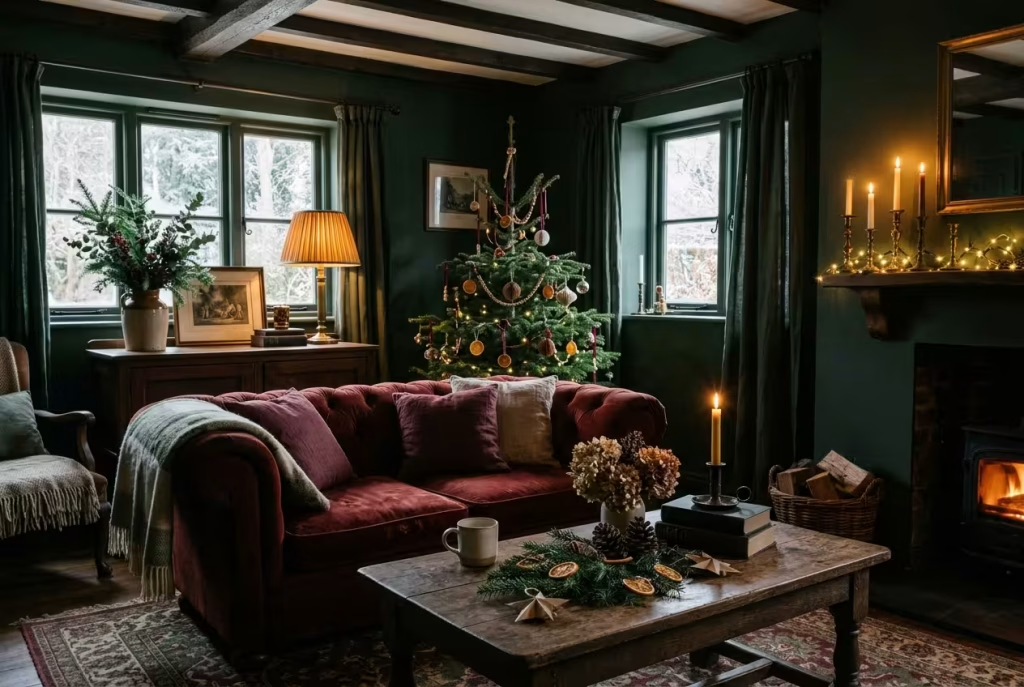
Every idea in this guide leans on the same handful of principles. Hold on to these and you can improvise freely.
- Three or four colours, repeated. A tight palette reads as a decision. A dozen colours read as a clearance aisle.
- Materials with a past. Wood, wool, linen, velvet, beeswax, glass, paper and dried fruit would all have been at home a century ago.
- Collected, never coordinated. Mismatched candlesticks and a bauble with a chipped cap beat a boxed matching set every time.
- Low, warm, layered light. Lamps and flame at several heights, with the ceiling light switched off.
- A plan for flame and for four-legged guests. Settle where candles may go and which plants are off limits before you buy a single stem.
Why it feels so old a short history of the look
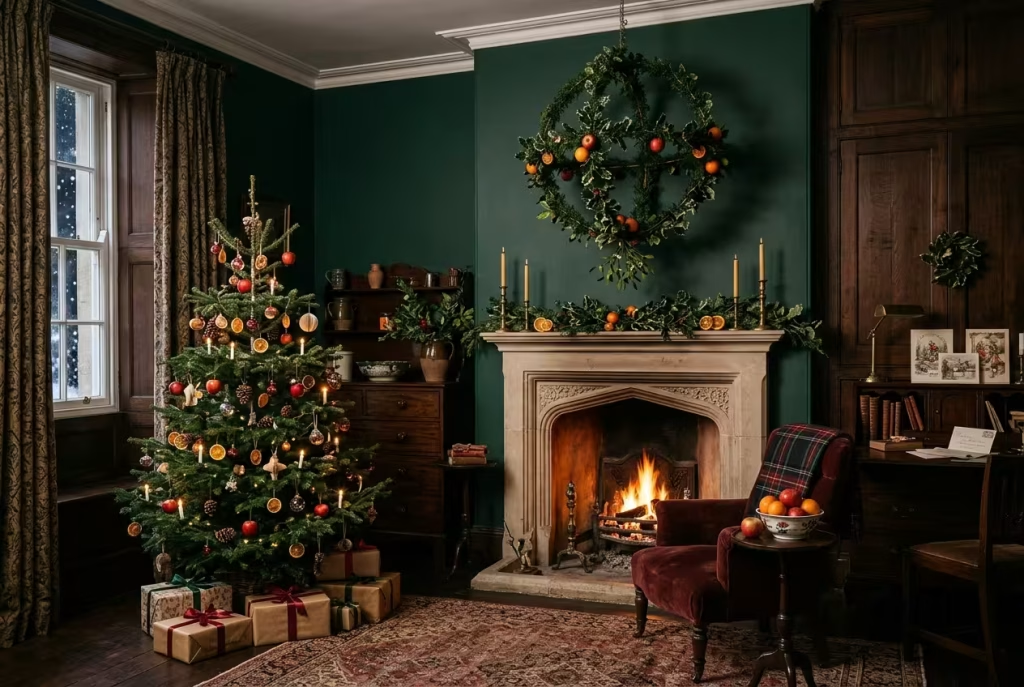
Much of what reads as antique in this style really is. Medieval carols already sang the praises of holly and ivy, and before the Christmas tree took hold in British homes in the 1840s, many households hung a kissing bough: two hoops crossed into a globe, dressed in evergreens, apples, oranges and candles, with mistletoe dangling from the base. Then, in 1848, the Illustrated London News printed an engraving of Queen Victoria, Prince Albert and their children gathered round a decorated tree at Windsor, and the picture travelled far enough to turn a German custom into a national habit.
The Victorians also gave Christmas its taste for the shadowy: ghost stories told by firelight, A Christmas Carol, and, in more recent times, the BBC’s long run of festive M R James adaptations. Bookish decorators who live this aesthetic all year round can smell a costume at fifty paces, and a recurring grumble on Reddit’s dark academia forum is that most online ideas are glossy imitations with no roots. Lean on the real traditions (greenery, fruit, paper, candles and stories) and your room will pass the sniff test.
Will it work in your room?
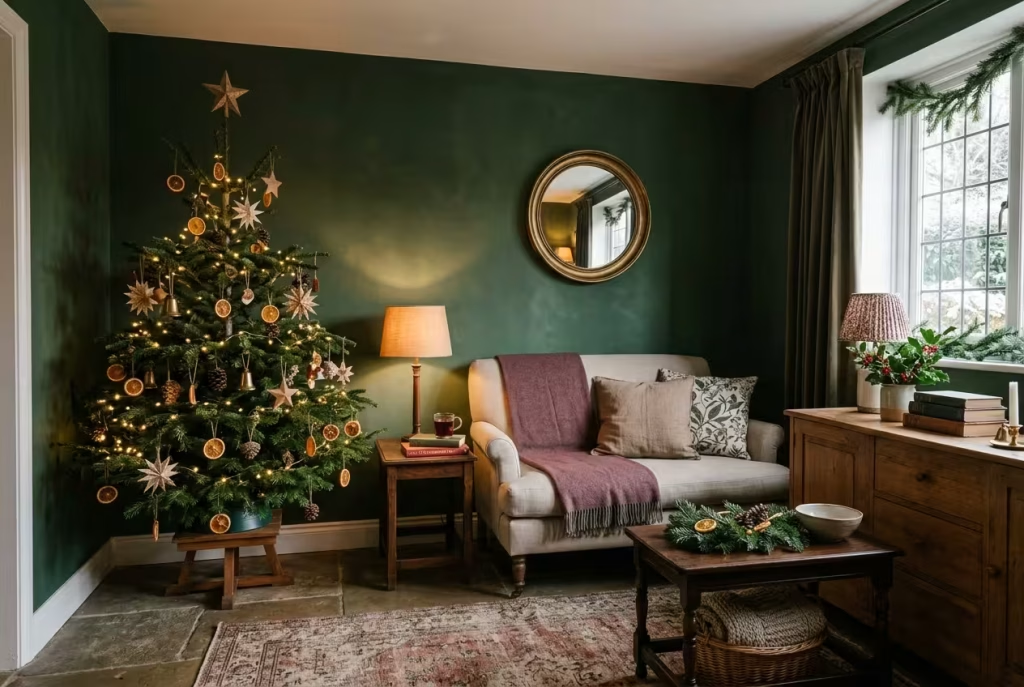
Almost certainly, and the gentlest way to find out is to match your own situation against the table below. A small, north-facing sitting room can carry deep colour beautifully, provided warm lamps stop the corners from vanishing. A rented flat can borrow the mood from fabric and flame. A house full of paws and small hands simply needs a handful of swaps.
| Your situation | What helps most | Ideas to start with |
| Small or north-facing room | Lamps at three heights, a mirror, deep colour on a single wall | 2, 14, 15 |
| Renting | Fabric for depth, a tabletop tree, furniture standing in for a hearth | 2, 5, 13 |
| Open-plan space | A rug, a lamp cluster and one dark wall to mark out the zone | 2, 14, 18 |
| Cats or dogs | Faux mistletoe and holly, flameless candles, trimmings hung high | 7, 11, 12, 20 |
| Young children | Flameless candles, nothing breakable at floor level | 8, 11 |
| A tight budget | Foraged, thrifted and homemade pieces | 4, 6, 7, 22 |
Walls, colour and the bones of the room
1. Choose four colours and hold the line
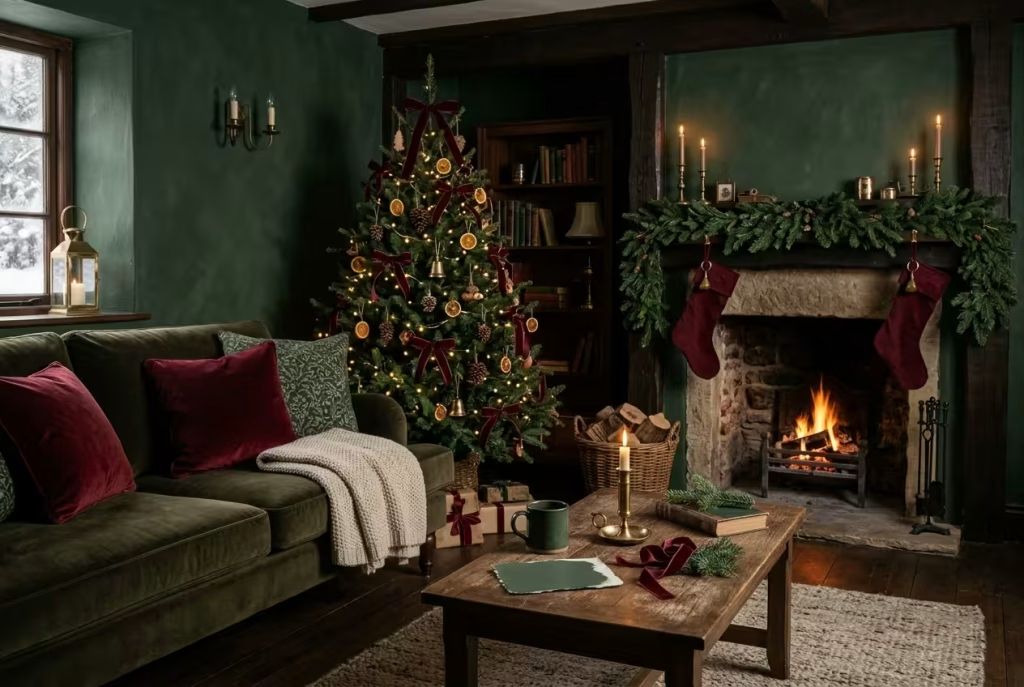
Moody does not mean muddy. The rooms that glow rather than sulk are built on a tight palette repeated like a refrain, and four tones will do the job. Keep the reds closer to brown than to postbox, and let a pinch of cream stop the whole scheme from sinking.
| Role | Colour | Where it turns up |
| The base | Forest or moss green | Walls, velvet cushions, fresh garland |
| The warm note | Oxblood, plum or claret | Ribbon, stockings, one generous throw |
| The earth | Walnut, chestnut or tobacco brown | Wood, book spines, wrapping paper, linen |
| The glint | Aged brass or candle gold | Bells, candlesticks, picture frames |
| The softener | Cream or oatmeal, used sparingly | Chunky knits, gift tags, a pillar candle |
Place each colour in at least three spots across the room and the eye reads intention rather than accident. Designers often lean on a rule of thumb for proportion: roughly 60 per cent base colour, 30 per cent secondary, 10 per cent accent. Here that means green doing most of the work, brown and wood tones supporting it, and oxblood and brass arriving in small, deliberate hits.
Before you buy anything, run a quick audition. Gather a scrap of velvet, a length of ribbon, a brass candlestick, a paint swatch and a sprig of fir, set them on the table you intend to dress, and look at them under lamplight rather than daylight. If they hum together, you have your palette. If one jars, it is that piece you swap, not the whole scheme.
2. Go deep on the walls, or borrow the depth if you rent
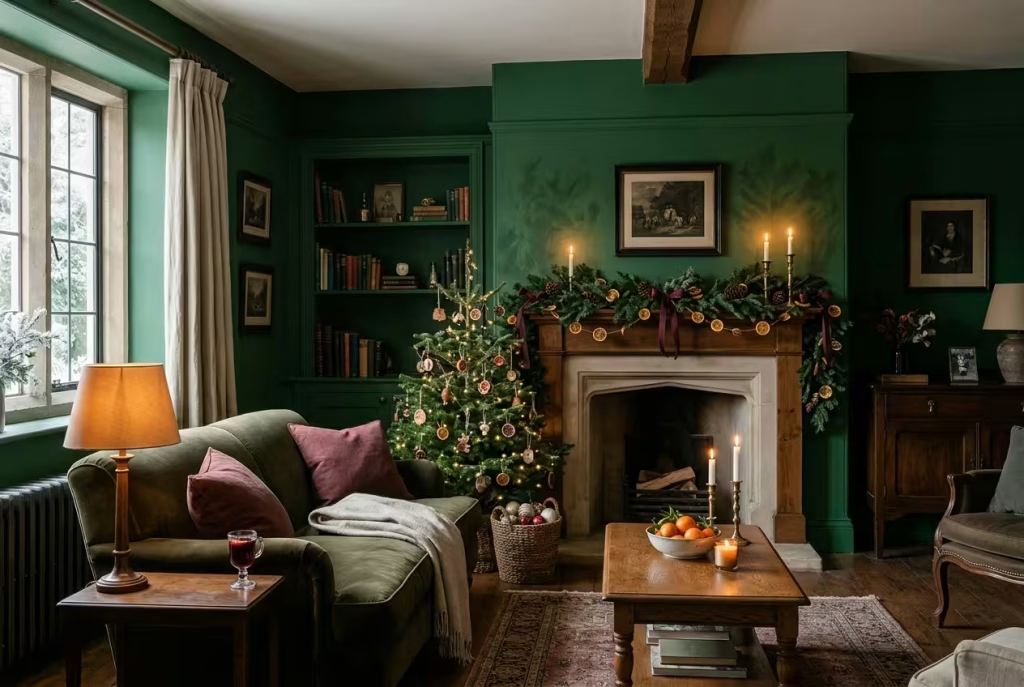
Deep colour is the biggest stage-setter you have, and the finish matters as much as the shade. A matt or chalky paint swallows glare and gives greens a velvety look, whereas a sheen bounces every stray lamp straight back at you. Paint a large test board rather than a postage-stamp swatch, then watch it at breakfast, mid-afternoon and by lamplight, because a deep green can drift from near-black to bottle-bright inside a single day.
If four dark walls feel like a leap, choose the one the eye meets first: the chimney breast, or the wall behind the sofa. A single wall wrapped in forest green, with the others left a soft off-white, gives you the hush without the full commitment. For extra drama, carry the same tone over bookcases, skirting and picture rail, so the room wraps round you like a cloak. Dark paint does not automatically shrink a room, since saturated colour tends to blur the corners, but it does ask for more light sources than a pale room would. That is what the lamp section below is for.
If the walls are not yours to paint, borrow the depth:
- Floor-length curtains in velvet or heavy linen, in moss or oxblood
- One very large dark botanical print, leant on a console or hung with removable fixings
- A freestanding bookcase packed with cloth-bound spines
- A wool throw across the sofa back in a tone that matches your chosen palette
3. Make the television vanish
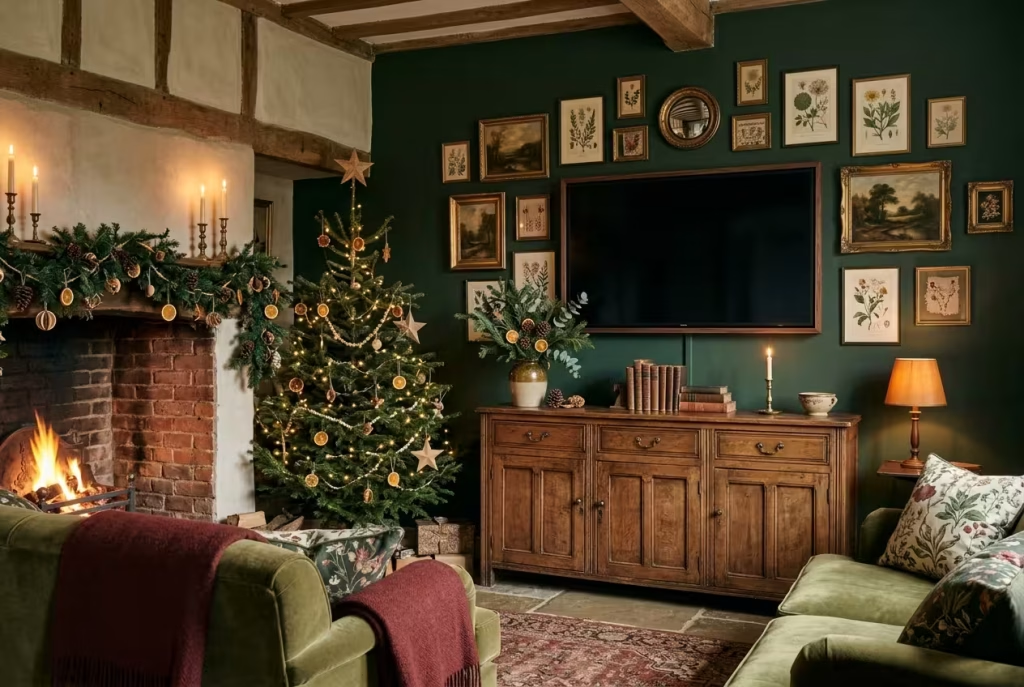
A blank black rectangle is the one thing a cottagecore room cannot forgive. Out of sight is out of mind, so give the screen somewhere to hide, and pick the route that suits your skills and your landlord.
- Frame it. One Redditor with an ordinary television built a frame from wood trim, so the screen reads as a painting when switched off. Measure the set, mitre the trim, paint it to match the wall or a shade deeper, and leave a gap behind and above for air, because a television that cannot vent will run hot.
- Hang a gallery around it. Arrange small botanical prints and mirrors on either side, and the set becomes one piece in a larger composition rather than the star of the wall.
- Close it away. A low cabinet with doors, or a bookcase with a pair of doors across the middle shelf, hides the screen entirely on the evenings you want the room’s story to take over.
- Move it off-axis. Shift the set to a side wall, so the tree and hearth are the first things the eye lands on when you walk in.
Art-style televisions exist, though they cost considerably more, and a framed ordinary set gives you most of the charm for a fraction of the price. The reward is a room where, on Christmas Eve, nobody reaches for the remote because the fire, the tree and the lamps have already taken the stage.
The tree, dressed from the hedgerow and the larder
4. Trim a tree that looks gathered, not bought

The most convincing dark cottagecore tree looks as if someone raided the hedgerow and the larder on the same afternoon. The secret is to dress it in layers, in a sensible order, so the result feels collected rather than crowded.
- Lights first. Warm white LEDs, wound from the trunk outwards along each branch. Slip a few strands behind where the orange slices will hang, so they glow like church glass.
- Heavy pieces next. Brass bells and glass baubles in smoky or amber tones, with a few worn old ones tucked deep among the boughs, where the lights can catch them.
- Natural finds. Dried orange slices, cinnamon sticks tied in twine bundles, pine cones, seed heads and little posies of dried herbs, scattered unevenly rather than at regular intervals.
- Ribbon last. Velvet in oxblood or moss, knotted in plain bows straight onto the branch tips. A single bow looks like a gift from a neighbour, while swags look like a shopfront.
A word on restraint: leave pockets of bare green between clusters, because a tree needs room to breathe, and that negative space is what makes each piece look chosen. If a tree seller offers spare trimmings, take them gladly, as the offcuts of fir make superb free filler for the mantel garland and the tabletop tree.
How to dry the oranges (low and slow wins):
- Slice about 6 mm (a quarter of an inch) thick and blot each slice with kitchen paper.
- Lay the slices on a wire rack set over a tray, or on a lined tray.
- Set the oven low, at roughly 80 to 105°C (175 to 225°F). The cooler end keeps the colour brighter, while higher heat turns the slices browner.
- Dry for 3 to 7 hours depending on thickness, flipping every hour. They are ready when no longer juicy, slightly pliable and not brown. A dehydrator takes around eight hours and keeps the lightest colour.
- Cool completely. Tacky slices need longer. Store them flat in an airtight tin or a paper bag somewhere dry, and they will see you through several Decembers.
Slicing with a sharp knife or a mandoline gives the most even results, and uneven slices dry at different rates, so sort thin from thick onto separate trays. Thread a loop of jute through each slice with a darning needle once cool, and keep a handful of spares, as a few always curl or darken. The scent drifts through the house the moment the oven warms, and for many people that smell alone is the first true sign that December has begun.
5. A tabletop tree for rooms with no floor to spare
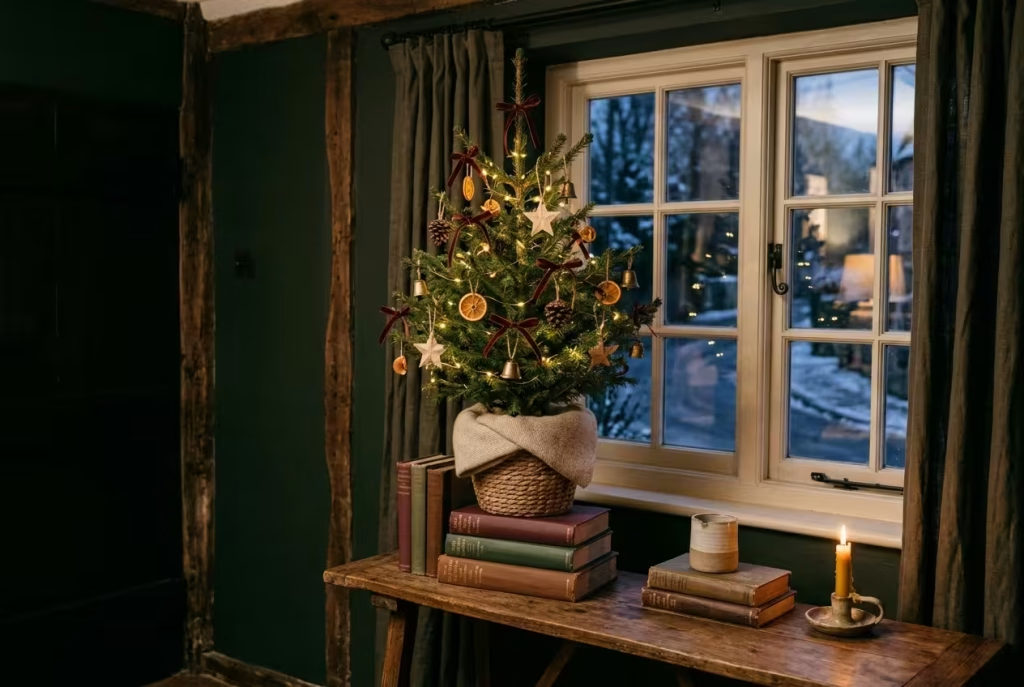
A small fir on a console, a stool of stacked books or a wooden crate can carry as much enchantment as a six-footer, and it hands the floor back to you. It is the ideal answer for a rented room, a narrow sitting room or a household with a curious cat, since everything can hang from ribbon and nothing needs fixing to the wall.
- Raise it. Stand the pot on a stack of cloth-bound books, a crate or a sturdy stool, so it sits at eye level and the lights reach the room rather than the carpet.
- Disguise the pot. Slip it inside a basket, a zinc bucket or a folded wool blanket tied with twine, instead of buying a shop-bought skirt.
- Scale everything down. Cut miniature slices from clementines, make paper stars the size of a thumb, and choose thin velvet ribbon.
- Mind the position. A window corner lets passers-by see the glow from outside, a small gift to the street, but keep it clear of radiators, fires and candles.
A real tree needs its stand topped up with water, and an artificial one should carry a fire-retardant label or a genuine CE mark. Neither is glamorous, and both are worth getting right before the first bauble goes on.
6. Stars and baubles made from old books and tea-stained paper

This is the idea bookish decorators on Reddit keep returning to, and it costs next to nothing. It also carries a lovely emotional charge, since a paperback nobody wanted becomes the most personal ornament on the tree. Use damaged or duplicate copies from a charity shop, never a book that anyone might still wish to read.
- Tear out a handful of pages and cut them into equal rectangles.
- Fold each rectangle back and forth like a fan, then pinch it in the middle and fold it in half.
- Glue the two outer edges together to make a half-star, join two half-stars into a full one, and loop a thread through the top.
For sheet music or plain paper, brew a pot of strong tea, dab it on with a soft brush, and dry it flat before folding, and the page picks up a foxed, old-library tint. Hang the finished pieces on the tree, along a bookshelf or from the picture rail. They give a soft, papery rustle when the door opens, and they make a quiet nod to everyone who has ever read beside this fire.
7. Popcorn and cranberry strings that feed the birds afterwards

A string of plain, unsalted popcorn, threaded with raw cranberries for a flash of red, is a Victorian nursery habit with real staying power. It is also one of the few decorations that improves the more people help, because it hands children, and grown-ups who are secretly children, something to do with their hands on a dark evening.
- Pop the corn a day ahead. Slightly stale popcorn is firmer and far less likely to shatter under the needle.
- Use strong thread and a blunt needle. Doubled cotton thread, knotted at the end, holds the weight; push gently to avoid cracking each kernel.
- Alternate with cranberries. Three pieces of popcorn to one berry gives a rhythm, and the berries add the oxblood note your palette wants.
- Keep it plain. No butter and no salt, so the strings can go outdoors for the birds in January. Cut them into short lengths, as long loops of thread outdoors can tangle small birds.
If a dog shares your home, hang the strings above nose height or skip this idea altogether, as the temptation may prove too much.
8. Kraft-paper gifts and a basket at the foot of the tree

Glossy paper looks out of place here. Wrap presents in brown kraft paper, tie them with cotton string, and tuck a sprig of dried lavender or fir under each knot. Add a handwritten tag on cream card, and every parcel becomes part of the display rather than something to clear away. Plain kraft is also generally easier to recycle than glittery or foil-coated wrap, so the look is kinder to the bin as well.
A few finishing touches that cost pennies:
- A cinnamon stick or dried orange slice threaded onto the string
- A strip of old sheet music as a band round a small box
- A wax seal in oxblood, pressed onto the knot
- A torn strip of tartan or velvet instead of a bought bow
Pile the finished gifts into a wicker basket or a weathered crate, which hides the tree stand and gives the base a lived-in look. Keep wrapped gifts and the tree well clear of any fireplace, and use a metal spark guard across the opening if you light a real fire.
You May also Like: 23 Modern Burgundy Christmas Living Room Ideas for a Cozy, Elegant Holiday
Mantel, hearth and the flicker of flame
9. A mantel garland of real greenery, hung loose and lopsided

Perfect symmetry belongs to hotel lobbies. A mantel garland that sags a little to one side and spills over the edge looks as if it grew there, and the slight untidiness is the whole point.
Build it in three layers: a fir-heavy base for body, ivy for trailing movement, and a few touches of colour such as burgundy ribbon, brass bells or dried slices. Anchor it with small hooks or clear fixings so nothing slides, and take care on polished stone or marble, which scratches easily. A real garland lasts as long as it stays cool and out of draughts, so check it weekly and replace any sections that shed needles at a touch.
One caution belongs here. A garland that slips can land on an open fire, so if you burn real logs, keep the greenery clear of the opening and the flame. Holly and ivy are also best hung out of reach of pets.
10. Beeswax tapers in a mismatched family of holders
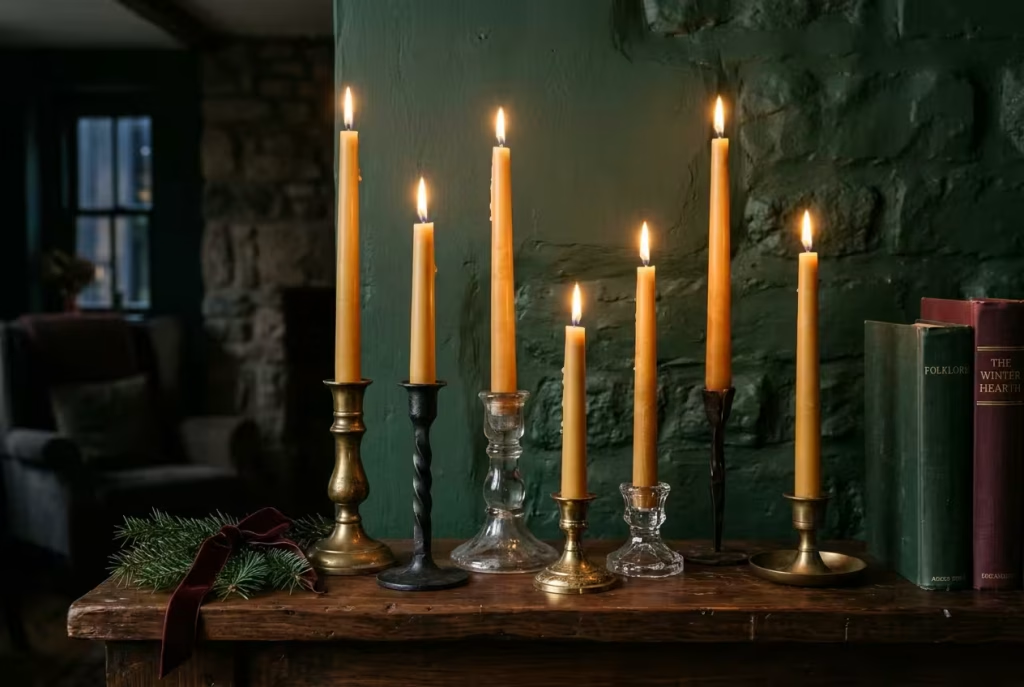
A cluster of candles in a dim room is the most effective piece of theatre in this style, and a surprisingly small number does the job. Gather tapers of different heights in brass, iron and old glass holders that do not match, and group them in odd numbers on the mantel or a side table. Beeswax tapers burn slowly and carry a faint honey scent that suits the mood.
Candle care that keeps the evening safe:
- Stand each candle in a stable, non-flammable holder.
- Trim the wick to about 6 mm (a quarter of an inch) before lighting.
- Never leave a lit candle unattended, and snuff it out well before it burns down to any greenery beneath.
- Keep clear of draughts, which make flames flare and drip.
As for distance, some guidance says 30 cm from anything combustible, while Dublin Fire Brigade advises at least one metre from anything flammable. With dried botanicals and paper decorations in the room, treat one metre as the minimum.
11. Flameless candles in the places a real flame has no business
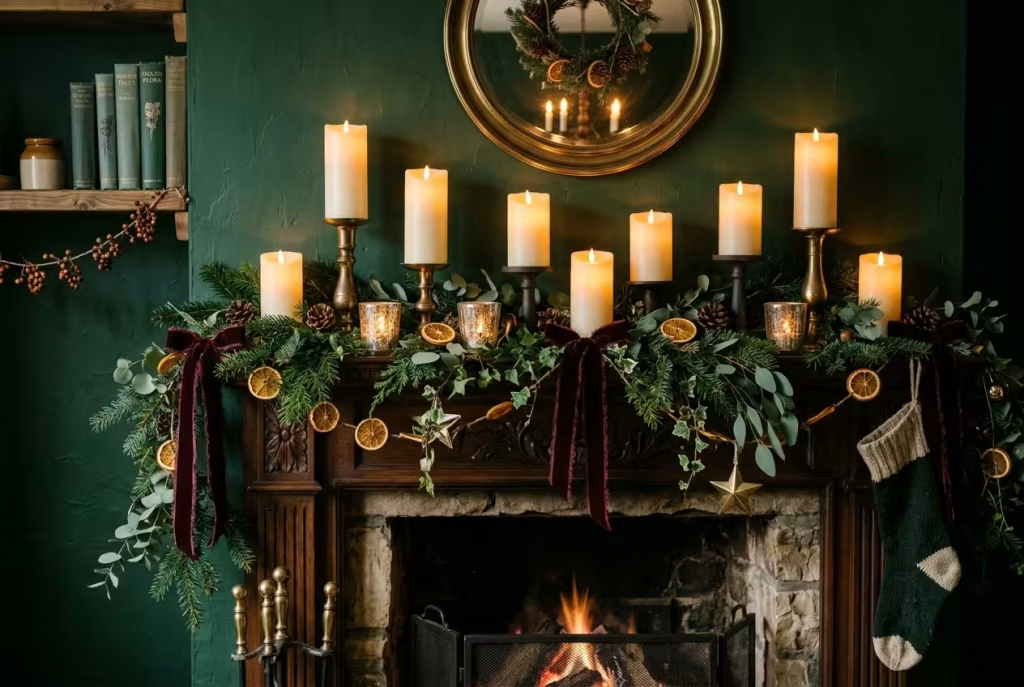
Good flameless candles give the same amber glow with none of the worry, and they have come a long way from the flat, flickerless plastic of a decade ago. Choose warm, gently flickering versions, ideally with a timer so they switch themselves on and off and nobody has to remember to snuff them out.
They earn their keep in four spots:
- On any mantel dressed with dried material
- On shelves with paper garlands or old books
- On a windowsill beside curtains
- Anywhere a child or pet can reach
Never put candles of any kind on a real or artificial tree. For the best of both worlds, run flameless candles through most of the room and keep one or two real tapers in a safe, bare spot, such as a stone hearth or a tray in the middle of a table. Nobody will be able to spot which is which.
12. A kissing bough to hang where the tree can’t reach
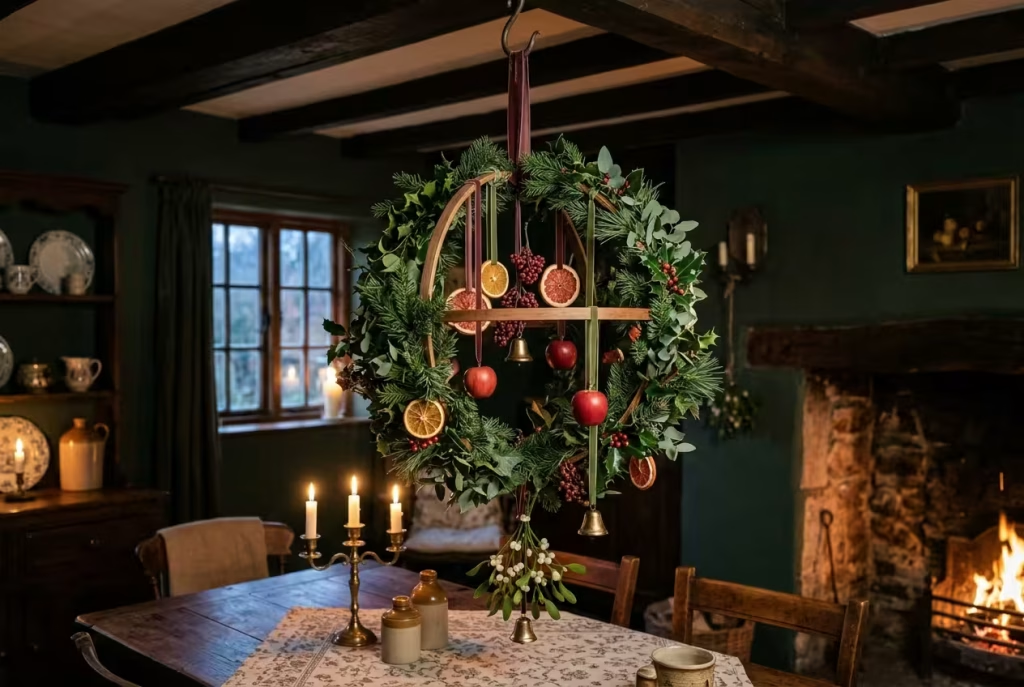
This is the older, wilder cousin of the Christmas tree, and it is easier to make than it looks. It also offers something no tree can: movement. A kissing bough turns slowly in the warm air of the room and catches the light from a different angle every hour of the evening.
- Bind two hoops, wooden or metal, into a sphere, fixing them at top and bottom with wire.
- Wrap the frame thickly with evergreens, working from the top down so the ends hide.
- Hang a few red apples and dried oranges inside the globe on ribbon.
- Tie ribbon at the top for hanging and a sprig of mistletoe at the bottom.
- Hang the whole thing from a ceiling hook rated for the weight, above a table or doorway.
Use faux mistletoe if you share your home with animals, since mistletoe is toxic to cats and dogs, and keep any real greenery well out of reach.
13. No fireplace Borrow a hearth from the furniture you already own
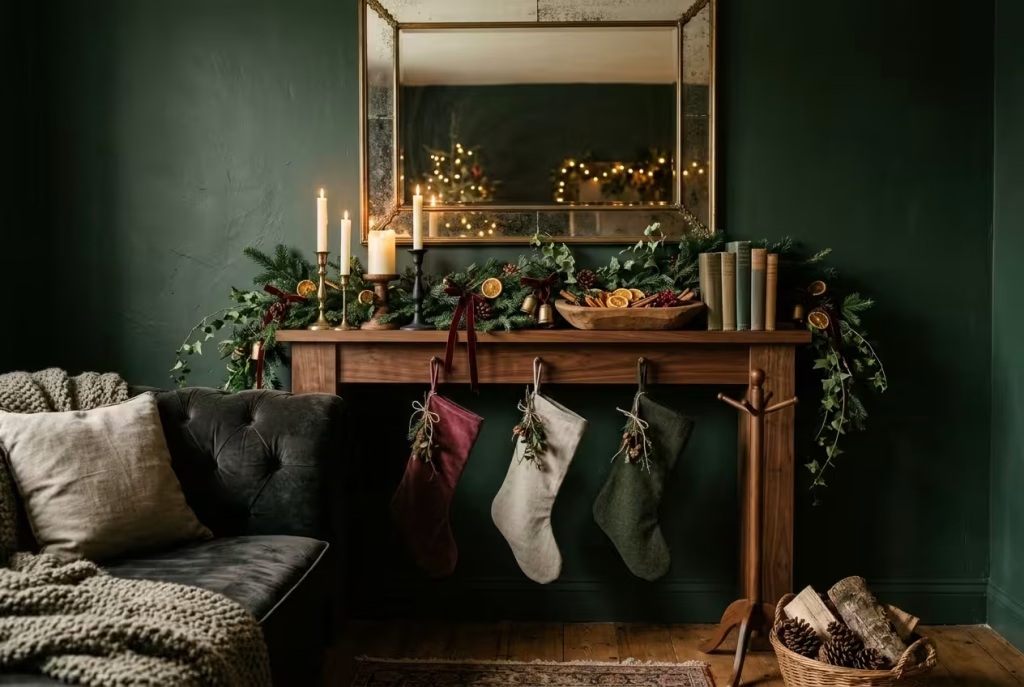
A chimney breast is a luxury, not a requirement, and its absence can work in your favour. Any horizontal surface at roughly shoulder height can do the work of a mantel.
- A console table behind the sofa, with a mirror above, reads as a hearth the moment you add a garland and a few candles.
- The top of a bookcase gives you a long, narrow ledge, ideal for a row of bottle-brush trees and a trailing garland.
- A deep windowsill puts the display in the light of the street, where it glows from outside.
- A sideboard carries heavier pieces, such as a lantern, a bowl of dried fruit or a cluster of tapers.
Hang stockings from a ladder leaned against the wall, from a coat rack, or from the edge of a shelf on cup hooks. Choose stockings in wool, linen or faded velvet in your palette rather than printed felt, and set a mirror behind the arrangement so the candlelight doubles. The result reads as a hearth, chimney or no chimney.
Lamplight: the part that makes or breaks the mood
14. Layer your lamps like a stage designer
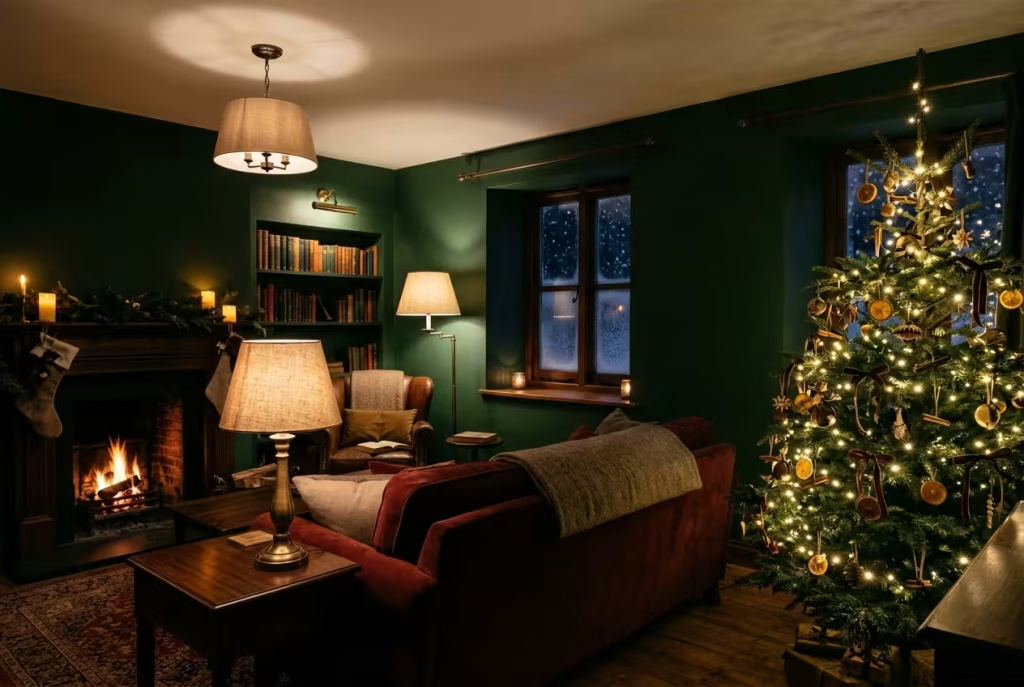
A dark room lit by a single overhead bulb feels like a waiting room, whereas the same room lit by five low sources feels like a secret. Specialists quoted by Livingetc recommend warm, dimmable LEDs at about 2700K for the ceiling fitting, then slightly warmer bulbs for table, floor and wall lamps, plus a colour rendering index of 90 or more so velvet and wool look rich rather than grey. Cool light of 4000K and above makes a deep room feel institutional, and mixing warm and cool bulbs in one space jars the eye.
| Layer | Colour temperature | The job it does |
| Ceiling light | About 2700K, on a dimmer | Rarely on; a low back-up for tidying and finding lost gloves |
| Table, floor and wall lamps | 2200 to 2700K | The real workhorses, at sofa, shelf and eye height |
| Accent and flame | 1800 to 2200K, or flameless candles | Pockets of amber on the mantel, sill and tree |
As a rough guide, a living room tends to need between 1,500 and 3,000 lumens in total. Spread that across lamps at three different heights, switch the ceiling light off, and let the corners settle into shadow. Dim-to-warm bulbs, which shift towards a candle-like tone as you lower them, are worth their weight in gold here.
Try this tonight. Turn off every light in the room, then switch the lamps on one at a time, starting with the one furthest from the door. Stop when the room feels like somewhere you would read aloud. Note that combination, because it becomes your base setting for every evening in December.
A bulb-buying checklist: check the Kelvin figure on the box (2200 to 2700K for lamps), the lumen figure (lower for lamps, higher only where you read), whether the bulb is dimmable and compatible with your dimmer, and whether the CRI is 90 or above.
15. Windowsills and mirrors that double the glow
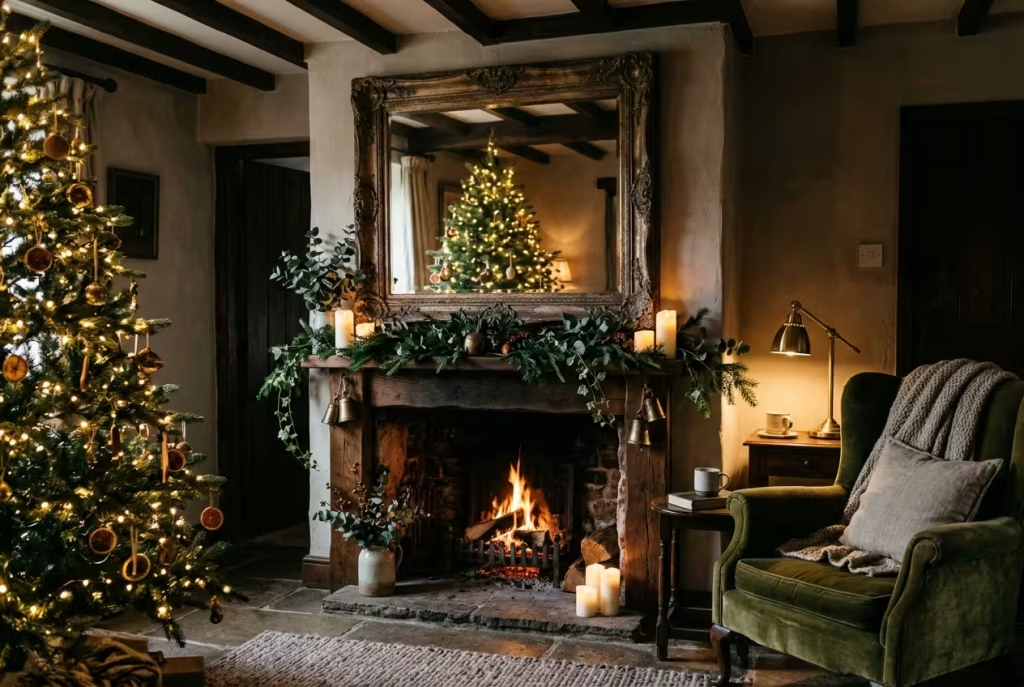
Dark palettes can read as merely dim if nothing bounces the light back. A mirror in a black or aged-bronze frame, hung opposite a lamp or a mantel of candles, will do the trick and double the glow without adding a single fitting. Position it where it also catches the tree, and you have, in effect, two trees.
A deep windowsill is the other unsung hero. Line it with lanterns or a row of small votives, and as dusk arrives the house looks as warm as a lit cottage window in a storybook, to anyone walking past and to you when you come home in the dark. Use flameless candles wherever a sill sits beside curtains, and avoid hanging a mirror directly opposite a bare window at night, where it will only show a black rectangle.
16. Fairy lights, used sparingly and hidden well

Fewer strands do more than you would think. Choose warm white LEDs and apply them with intent: wind them through the garland, push a strand into the heart of the tree, and slip another inside a glass jar or lantern for a lantern-in-the-woods effect. On a tree, wind from the inside out, so the glow comes from within the branches rather than sitting on the surface like tinsel.
Some safety points deserve to be taken seriously. Check that any lights carry a British Standard or CE mark, never use a lead with worn or frayed insulation, and avoid overloading sockets, since one plug per socket is the advice fire services give. Run cables behind furniture or along the skirting so the glow appears to come from nowhere. A plug-in timer on a lamp or a string saves the late-night walk round the room, and means the house greets you every evening already lit.
Seating, textiles and a corner for long nights
17. Velvet and wool, layered like sediment
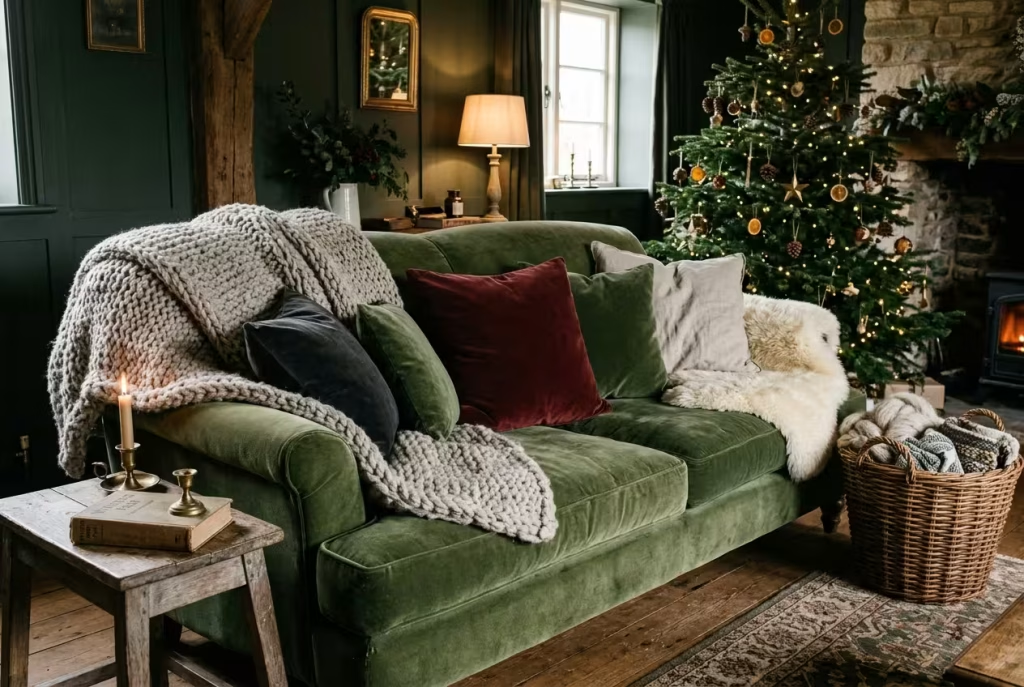
Texture is what turns a dark room from stark to snug, and the secret is to layer it the way sediment settles: heavy at the bottom, lighter on top. Start with a chunky wool throw across the back of the sofa. Add velvet cushions in oxblood, moss or charcoal in odd numbers and a mix of sizes. Finish with a linen or sheepskin layer for contrast, so your hands meet something different wherever they land.
Drape throws casually over an armchair rather than folding them into neat squares, so the room looks recently used and well loved. A basket of blankets beside the sofa is a small act of hospitality, since guests who spot it feel invited to sink in. If pets share the sofa, tightly woven fabrics shed hair more easily than velvet, chenille or corduroy, which tend to trap it, so keep a washable throw as the top layer.
18. Muted tartan and a rug with a past
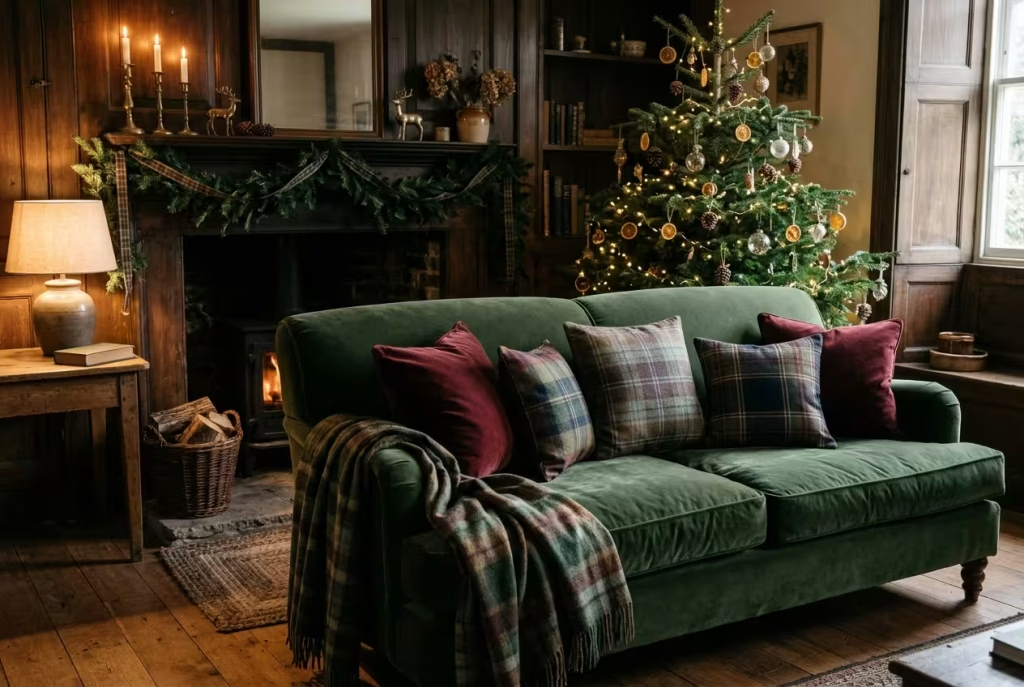
Plaid belongs here, but in whispers rather than shouts: deep green, brown and wine tartans in place of bright red and white. A tartan throw, a plaid ribbon on the garland or a few wool cushions bring in pattern without brightening the scheme, and a muted check pairs happily with velvet because the two textures argue politely.
Underfoot, an old rug in worn reds and browns, whether a charity-shop kilim or a faded Persian-style piece, grounds the whole room. A useful rule of thumb is to land at least the front legs of the sofa and armchairs on the rug, so seating and floor read as one arrangement. Faded patterns forgive wine, crumbs and muddy paw prints in a way a pristine rug never will.
19. A reading corner built for ghost stories
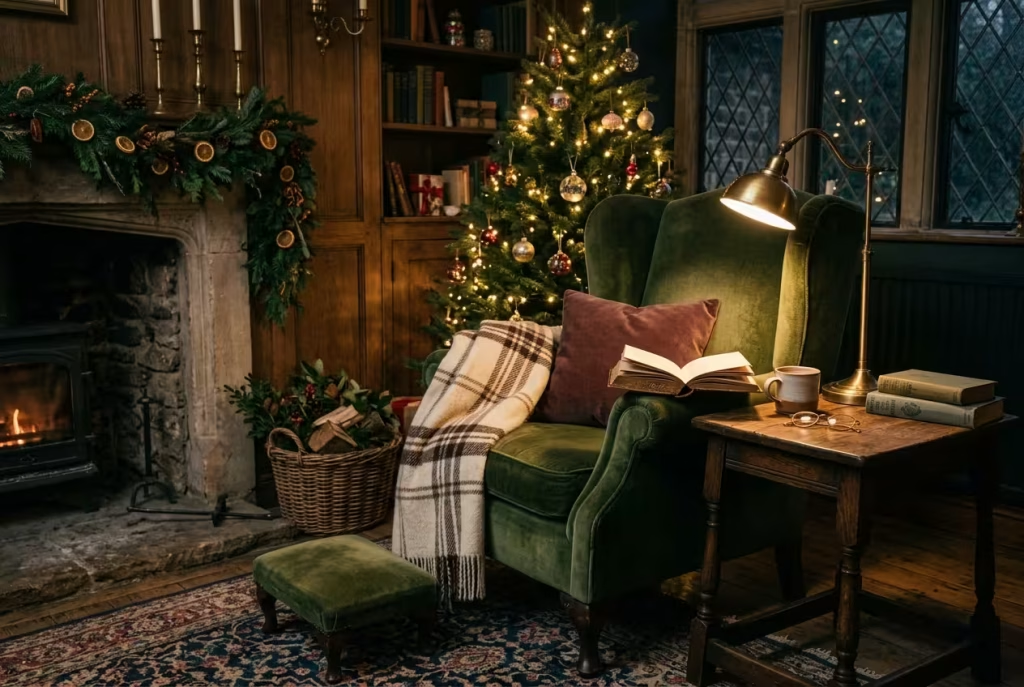
Christmas evenings are made for staying put. Pull an armchair close to the tree, add a lamp with a warm bulb positioned to light the page rather than the room, a stack of old books and a wool blanket, and you have the best seat in the house. Tell the household that nobody may disturb it for twenty minutes. That small, protected pause is often the most restful hour of a hectic month.
Fill the shelf with seasonal reading:
- A Christmas Carol by Charles Dickens, first published in 1843
- The ghost stories of M R James, such as Oh, Whistle, and I’ll Come to You, My Lad
- The Woman in Black by Susan Hill, which opens with a family telling ghost stories on Christmas Eve
- A battered book of folk tales or winter poems
Display one or two winter-themed titles cover-out, so the books become decorations in their own right, and read a story aloud one evening. The Victorians understood that a ghost story told by lamplight is half the magic of the season.
The collected, the folkloric and the quietly enchanted
20. Dried botanicals, kept at a safe distance
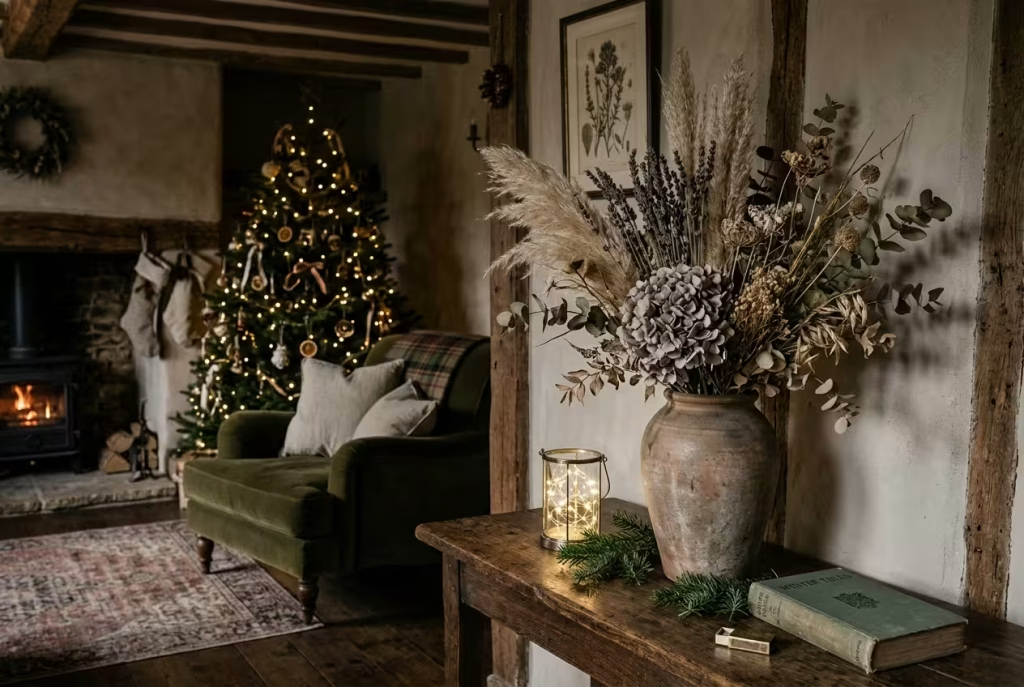
Pampas, lavender, hydrangea, eucalyptus and seed heads give a dark scheme its feathery, hedgerow softness, and they last the entire season at a fraction of the price of fresh flowers. They are also highly flammable, which deserves a clear-eyed look before you place them.
Official fire guidance in the US says to keep dried flowers, cornstalks and paper decorations at least three feet (about 90 cm) from open flames and heat sources, including light bulbs and heaters, and even a DIY pampas-garland tutorial warns against using it over an open fire. The solution is simple: put arrangements in a vase on the far side of the room from your candles, and let flameless lights glow near them instead.
A few practical notes:
- Dyed stems can transfer colour onto soft furnishings, so keep them in their vase.
- Shake pampas gently outdoors before bringing it in, to remove loose fluff.
- To dry your own, hang small bunches upside down in a cool, dark, airy spot for a few weeks.
- Avoid candles with dried flowers or herbs set into the wax, as the National Candle Association has flagged them as a fire hazard.
21. Botanical prints and books turned cover-out
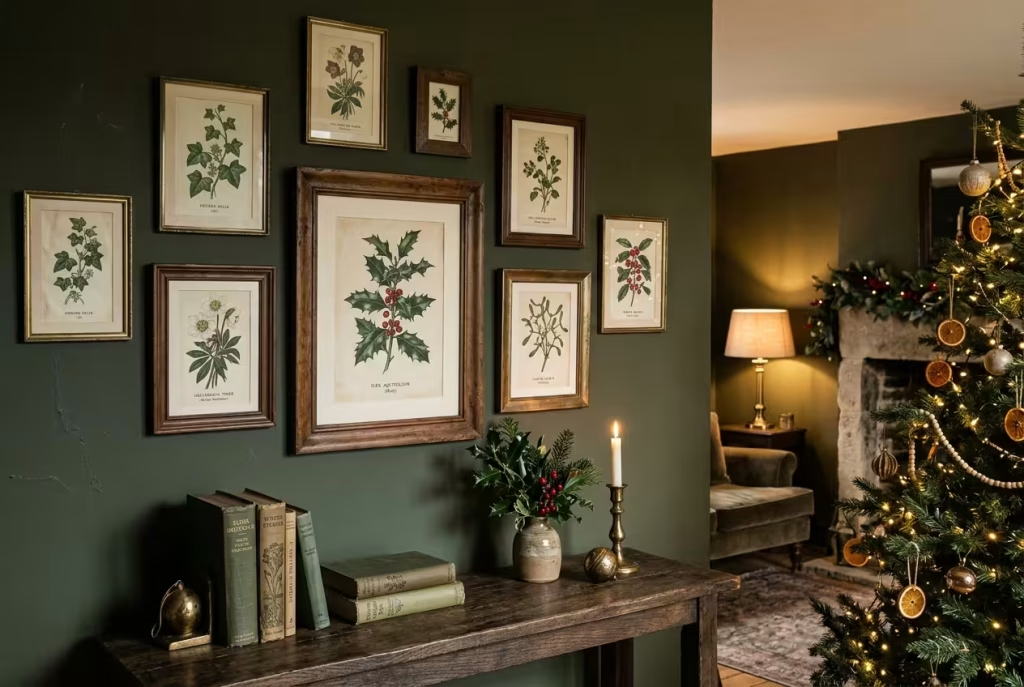
Prints of holly, ivy, mistletoe and hellebore carry the season onto the walls without anything that looks like a seasonal sign. Frame them in dark wood or tarnished brass, and they can stay up well into February, long after the baubles are boxed. Hang them at eye height, in a loose cluster rather than a rigid grid, with one larger piece anchoring the group.
Alongside them, turn a few antique or cloth-bound books so the covers face outwards, which gives the shelves the look of a small private library. Together, the prints and the books add depth and a quiet
, scholarly note that no shop-bought bauble can match. Charity shops, car boot sales and second-hand bookshops are the best hunting grounds, and the slightly battered finds are the ones that carry the most character.
22. A woodland scene that grows by one creature a day
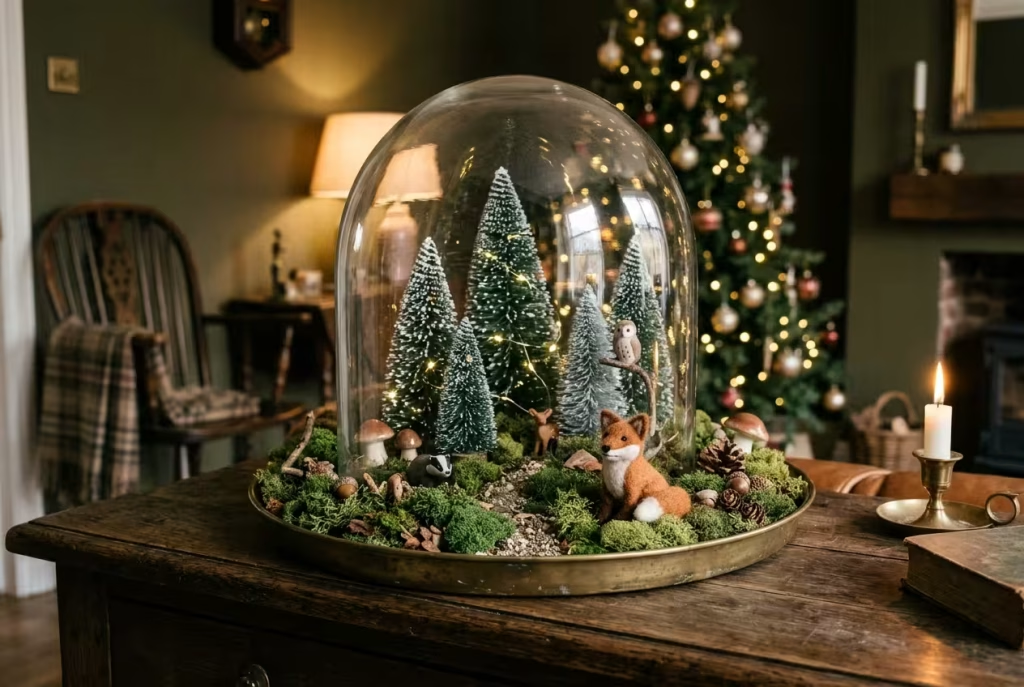
This is where the enchantment creeps in. Treat a small corner as a living scene rather than a display: a tray as the clearing, a layer of preserved moss as the forest floor, bottle-brush trees as the wood, and then the inhabitants, such as felt foxes, ceramic mushrooms, acorns and tiny wooden animals.
Add one new creature each day through December, and the scene becomes a daily ritual, a countdown with a story attached. Children love to decide where the fox goes this morning, and adults find themselves pausing to look as well. A glass cloche over a small tableau adds a fairy-tale hush, and the whole thing costs very little if you collect pieces over the years. Place it on a console, a deep sill or the bookcase top, somewhere at eye level, so the story can be read as you pass.
23. The winter afterlife what stays up after Christmas
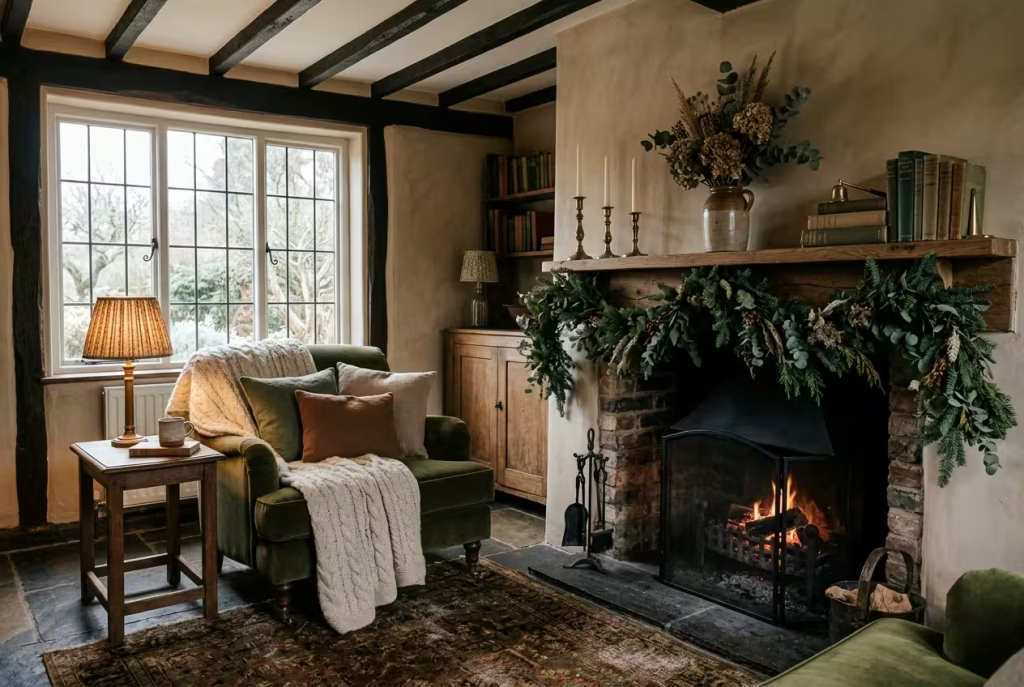
The day after the festivities need not bring a bare room. Plenty of keen decorators keep their scheme up through the twelve days of Christmas and then remove only the explicitly Christmassy pieces, such as red items, tinsel and stockings, leaving the garland, candles, dried botanicals and books in place. Red is the colour that stands out most and gives away the season, so once it goes, the room slips into a winter mood that can last until the end of January.
When the time comes to pack away:
- Store dried orange slices flat in an airtight tin, so they are ready for next year
- Wrap glass baubles in tissue and keep them in their dividers
- Hang the popcorn strings outside for the birds, and recycle a real tree through your council
- Jot a few lines in a notebook about what worked and what you would change, because you will have forgotten by next November
A scheme designed this way earns its keep for two months rather than one, and the farewell becomes a small ritual in itself rather than an anticlimax.
Keeping the magic and the house intact a safety cheat sheet

A room lit by flame and dressed in dry plant material is beautiful, and it is also one slip away from trouble. Run through this table before you light a single taper.
| Risk | What to do | Why it matters |
| Candles | Use a stable, non-flammable holder; keep at least one metre from anything flammable; never leave unattended; snuff out before they burn down to greenery | Fir greenery dries out over the season and ignites more easily |
| Dried botanicals | Keep at least three feet (about 90 cm) from flames, bulbs and heaters | Dried flowers, cornstalks and paper catch fire very easily |
| Botanical candles | Avoid candles with dried flowers or herbs embedded in the wax | The National Candle Association warns these can be a fire hazard |
| Real tree | Buy fresh, bounce the trunk to test for needle drop, keep the stand topped up with water, stand it away from radiators, fires and candles | A dry tree is extremely flammable |
| Artificial tree | Choose one with a fire-retardant label or genuine CE mark | Not all trees meet safety standards |
| Tree lights | LEDs with a British Standard or CE mark; no frayed leads; one plug per socket | Overloaded sockets and damaged cables can overheat |
| Open fireplace | Use a full metal spark guard; keep garlands, gifts and the tree well clear | Sparks and slipping decorations ignite quickly |
Pets and festive plants. Many traditional plants are a problem for dogs and cats, though the severity varies:
| Plant | Risk to cats and dogs | Notes |
| Holly | Toxic | Usually causes drooling, vomiting and an upset stomach; keep out of reach |
| Mistletoe | Toxic | Berries are the concern; choose a faux sprig |
| Ivy | Toxic | Can cause vomiting and skin irritation |
| Amaryllis and paperwhites | Toxic | The bulbs are the most poisonous part |
| Poinsettia | Mildly toxic | The ASPCA says its danger is often overstated |
| Christmas cactus | Non-toxic | A safe festive houseplant |
| Red and white roses | Pet-safe | A good substitute for holly and mistletoe |
If your pet may have eaten any of these, ring your vet straight away.
What will it cost, and what can you do for nothing?

Prices swing wildly depending on what you already own, so here is a guide to effort rather than pounds.
| Idea | Typical spend | The near-free route |
| Foraged tree decoration (4, 6, 7) | Low | Oranges from the fruit bowl, charity-shop paperbacks, a teabag, a bag of popcorn |
| Deep walls (2) | Medium | Heavy curtains and throws if you rent |
| Candles and lamps (10, 14) | Low to medium | Swap bulbs to warm white; rescue a lamp from a charity shop |
| Kissing bough (12) | Low | Two hoops and greenery from the garden |
| Stockings (13) | Low | Charity-shop wool, old jumpers cut and stitched |
| Reading corner (19) | Low | Your own chair, a lamp and a blanket |
A gentle timetable what to do and when
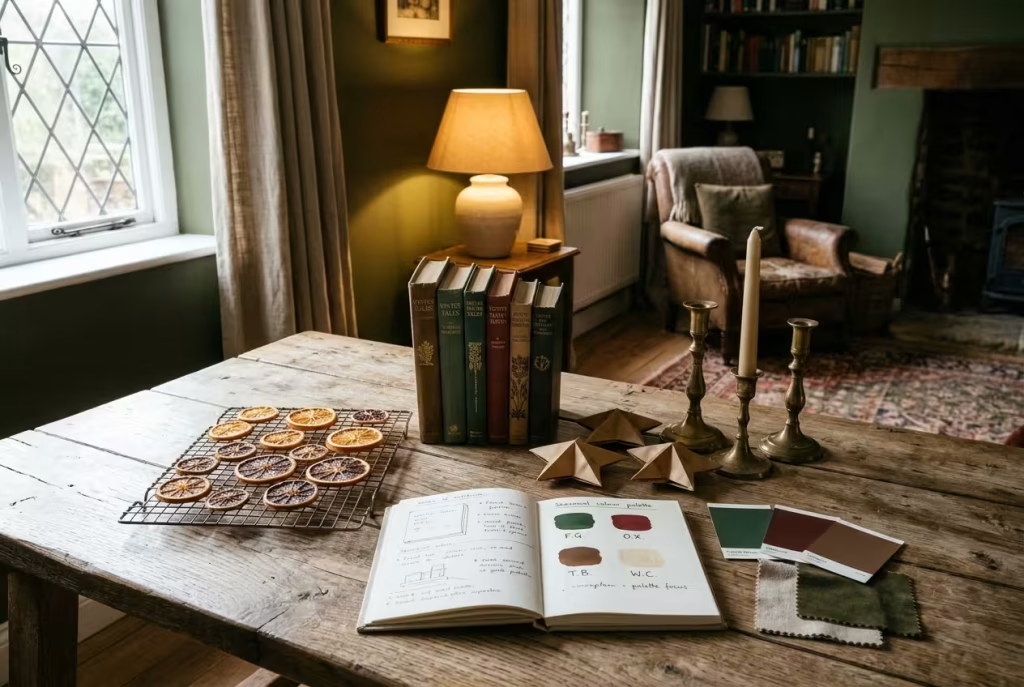
A scheme this layered is best built slowly. Spread the work across six weeks and it becomes a pleasure rather than a panic.
| When | What to do | Ideas |
| Early November | Settle your palette, switch lamp bulbs to warm white, dry the orange slices, start collecting charity-shop books and candlesticks | 1, 6, 14 |
| Mid to late November | Paint or hang curtains, frame the television, fold the paper stars, buy the tree | 2, 3, 5, 6 |
| First weekend of December | Dress the tree, hang the mantel garland, arrange candles and flameless lights, set up the woodland scene | 4, 9, 10, 11, 22 |
| Mid December | Wrap gifts in kraft, hang the kissing bough, string the popcorn, settle the reading corner | 7, 8, 12, 19 |
| After Christmas | Remove the red, keep the winter layer, pack away with care | 23 |
Six mistakes that flatten the mood
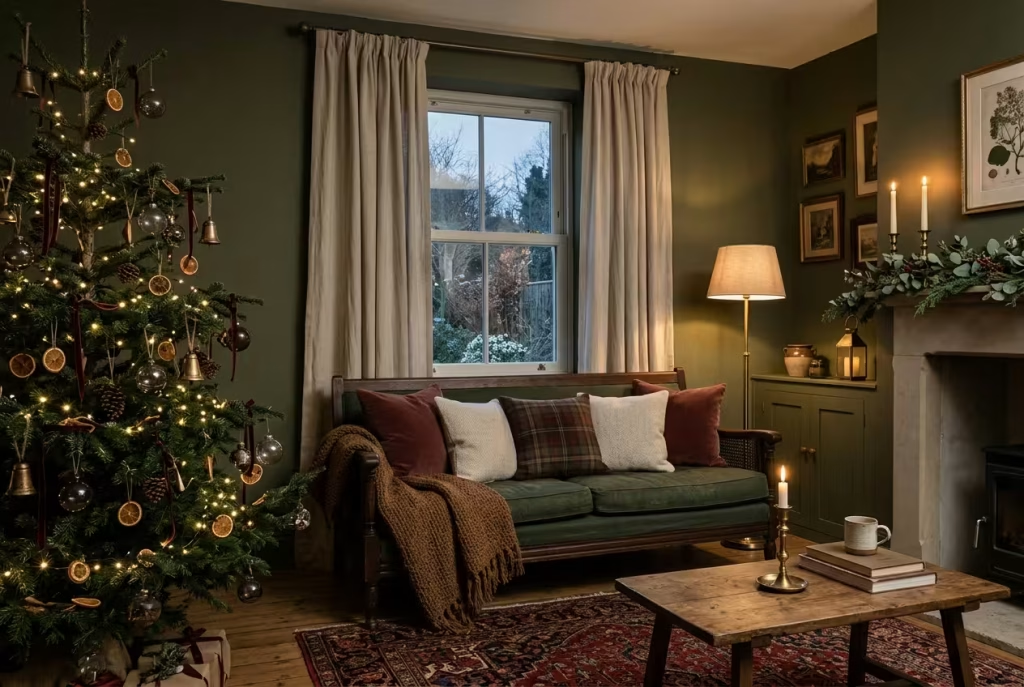
Most rooms that miss the mark fall into one of the same few traps. Spot them early and the fix is usually small.
- Cool-white bulbs. A single 4000K bulb can spoil an otherwise lovely room. Swap it for a warm one.
- Too much red. Bright red turns moody into merely festive. Keep your reds towards oxblood and brown.
- Everything matching. A boxed set of identical baubles looks bought. Mix textures, ages and finishes.
- Dried material near flame. Keep it at least three feet (about 90 cm) away, and use flameless candles nearby.
- Bare floors and bare windows. Rugs and curtains add the softness that makes a dark room feel held rather than shut in.
- No empty space. Bare surfaces let the eye rest, and they make the dressed ones look deliberate.
Where to find the pieces without spending a fortune
The best dark cottagecore rooms are built slowly and cheaply, from places with a story. Charity shops are the first stop for candlesticks, glass baubles, old books and knitwear. Car boot sales and antique fairs yield brass, tarnished mirrors and worn rugs. Friends and neighbours are often happy to share greenery if you ask, and Christmas tree sellers frequently have spare fir trimmings. Your own kitchen supplies the oranges, cinnamon and popcorn, and the garden and hedgerow offer seed heads, ivy and cones, provided you take only what you have permission to pick.
How do you know when the room is finished?
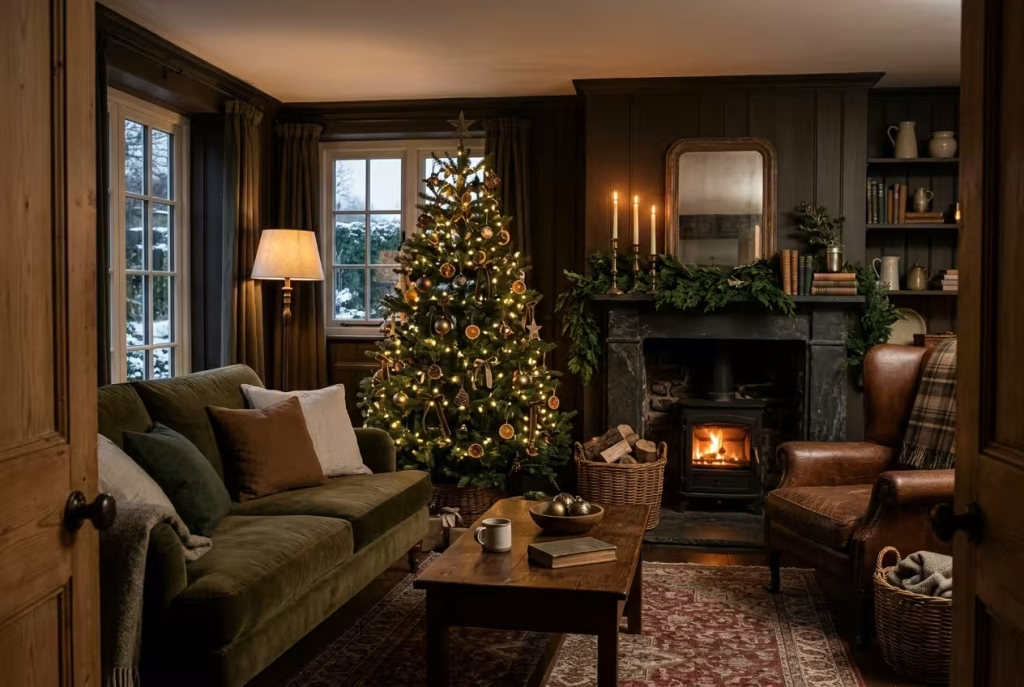
Reddit’s decorating threads are full of people asking what is missing from a room that “just doesn’t look finished”, or whether they have tipped into too much. A quick test settles it.
- The squint test. Half-close your eyes. If one area pulls your gaze and the rest fades into a warm blur, you are close.
- The three-heights test. Look for something tall, something mid-level and something low in each zone, grouped in odd numbers.
- The calm surface. Leave at least one table or shelf with plenty of bare wood. Rest is part of the design.
- The dusk test. Turn off the ceiling light, stand in the doorway, and see whether the room invites you in.
Let the dark do the talking
A moody dark cottagecore Christmas rewards patience and restraint. It asks you to pick your colours early, gather things slowly, and trust that a handful of candles, a tree dressed from the larder and a deep green wall can do more than any shop-bought set ever could. Start with the lamps and the palette, because everything else rests on them. Then add one or two ideas each weekend, and let the room gather its story as the nights draw in.
There is something quietly radical about it, too. In a season that can feel loud, hurried and expensive, a room that asks you to sit still, light a candle and read aloud is a rare gift, to yourself and to everyone who comes through the door. Years from now, nobody will remember the price of a single bauble. They will remember the smell of oranges drying in the oven, the paper stars you made together, and the way the room looked at dusk, lit like a lantern in the woods.
Save this guide to your Christmas board now, while there is still time to dry the oranges, hunt for mismatched candlesticks, and find the tea-stained paper that will turn into this year’s stars.
Frequently asked questions
What is a dark cottagecore Christmas, and how does it differ from dark academia?
Dark cottagecore is rooted in nature and handcraft: greenery, dried fruit, wool, candles and a woodland feel. Dark academia leans towards books, libraries and scholarly gloom. The two overlap in the palette and the love of old things, but cottagecore smells of orange peel and pine, while academia smells of paper.
How do I make a dark living room feel cosy rather than gloomy?
Use warm bulbs (about 2700K for the ceiling, 2200 to 2700K for lamps), layer light at several heights, add a mirror to bounce the glow, and soften the scheme with texture and a little cream. A matt finish on the walls helps too.
What colours suit a moody cottagecore Christmas?
Forest or moss green, oxblood or plum, walnut brown and aged brass, with cream used sparingly. Keep reds closer to brown than to bright postbox red.
Is it safe to use dried flowers and orange garlands near candles?
Not without precautions. Dried material is highly flammable, so keep it at least three feet (about 90 cm) from open flames and heat sources, and use flameless candles anywhere it sits nearby.
Which Christmas plants are unsafe around cats and dogs?
Holly, mistletoe, ivy, amaryllis and paperwhites are all toxic, with amaryllis and paperwhite bulbs the worst. Poinsettia is only mildly toxic, and Christmas cactus is safe. Call your vet at once if a pet has eaten any.
How do I decorate a dark cottagecore tree on a budget?
Dry your own orange slices, make paper stars from old books, thread popcorn and cranberries, and use ribbon you already own. Thrifted glass baubles in smoky tones add the old, collected feel for very little.
Can I do this look without a fireplace or in a rented room?
Yes. Use a console, bookcase or deep windowsill as a mantel, hang stockings from a ladder or shelf, and borrow depth from curtains, throws and a large framed print instead of paint.
How do I disguise the television in a moody living room?
Frame it with wood trim painted to match the wall, hang small prints alongside it, or tuck it into a cabinet with doors. Moving it off the main sightline also helps.
How long do dried orange slices last?
Stored flat in an airtight tin or a paper bag in a dry place, they often last several Decembers. Slices that feel sticky were not dried for long enough and need more time in the oven.
When should I put decorations up, and what can stay after Christmas?
There is no rule: some people begin before Halloween, others wait for December. Put things up when they bring you joy. Afterwards, remove the red and the explicitly festive pieces and keep the garland, candles, books and dried botanicals for a winter mood into January.
What wrapping paper suits the look?
Plain brown kraft paper, tied with cotton string and finished with a sprig of dried lavender, fir or eucalyptus and a handwritten cream tag.
How bright should a moody living room be?
Roughly 1,500 to 3,000 lumens in total, spread across several warm lamps rather than a single overhead light, with the ceiling fitting dimmed or switched off.
How do I keep a real tree fresh and safe?
Buy a fresh tree (one that sheds lots of needles when the trunk is bounced on the floor has been cut too long), top up the stand with water every day, and stand it away from radiators, fires and candles. Use LED lights with a British Standard or CE mark, and never put candles on the tree.
How do I make this look work in a small room?
Paint or drape one wall in deep colour, light the room with lamps at three heights instead of the ceiling fitting, add a mirror to bounce the glow, and choose a tabletop tree. Keep the floor clear and let a few well-chosen pieces carry the scheme.
What is the difference between moody and gothic?
Moody is warm: deep colour, candlelight and natural textures, with the comfort of a cottage. Gothic leans darker and more theatrical, with black, ornate metalwork and a sense of drama. This guide stays on the cosy, folk-tale side of the line.