




How Do You Decorate a Rented Living Room for a Japandi Christmas?
Updated 29 October 2026. Tenancy points apply to England, so check the rules separately if you rent in Scotland, Wales or Northern Ireland.
The short answer: Give the room one quiet focal point, such as a small or rented tree, a branch in a tall vase or a garland of paper stars. Stick to warm white, pale ash wood and a single deep green. Hang nothing that needs a drill, lean on freestanding pieces and cord, and keep lights, candles and cables firmly under control.
Quick answer at a glance
- Focal point: choose one only, so the eye has somewhere to rest.
- Palette: warm white, oatmeal and ash as the base, one green, one small accent.
- Walls: hang from curtain rails and furniture with thread, or use freestanding pieces. Avoid Blu-tack, tape and pins.
- Tree: a cut tree is relatively safe for about two weeks, according to London Fire Brigade, so a pot-grown, rented or tabletop tree often suits a short let better.
- Lights: warm white LEDs bearing a CE or UKCA mark, switched off at bedtime and whenever you go out.
- Budget: from next to nothing using what you own, to roughly £100 to £250 for a fully considered set.
- Before anything else: read your tenancy agreement and ask in writing if a point is unclear.
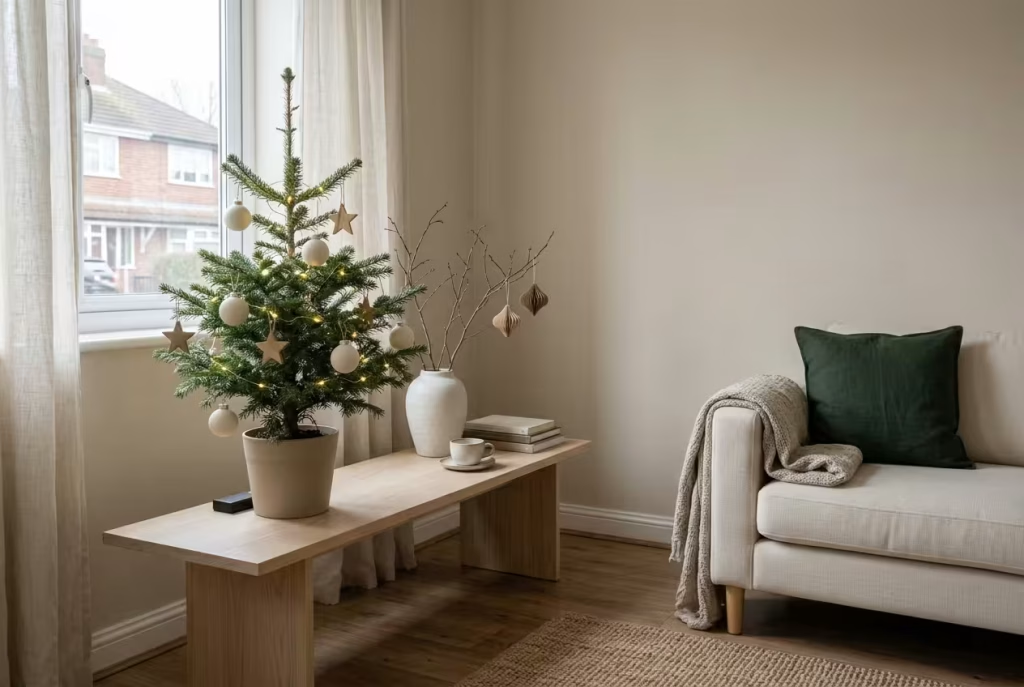
There is a particular December dread known only to renters. The tree you have your eye on is lovely, the carpet beneath it belongs to somebody else, and your deposit sits in a scheme somewhere like a hostage waiting for the inventory check. It is easy to talk yourself out of Christmas altogether, or to swing the other way and cover every surface until the room looks like a garden centre in a gale.
Japandi offers a third path. This blend of Japanese restraint and Scandinavian warmth rests on fewer objects, better chosen, with nothing forced into place. Those principles happen to sit comfortably alongside a tenancy agreement, which is why the style suits a rented lounge better than almost any other festive look.
The twelve steps below take you from an empty, slightly nervous room to a finished one, with the real numbers, the safety checks and the damage-free methods that most guides skip. You will also find the cost tiers, a pet and child safety table, and a takedown plan so January does not catch you out.
Who this guide is for. Flat-sharers with a communal lounge, couples on a twelve-month let, students on a short tenancy, and anyone whose landlord has strong views on candles. If you have ever stood in a shop with a box of tree lights in your hands, wondering whether you were even allowed to plug them in, you are in the right place. A realistic timetable sits near the end, so you can pace the work across several weeks instead of cramming it into one frantic Saturday.
What a Japandi Christmas actually looks like
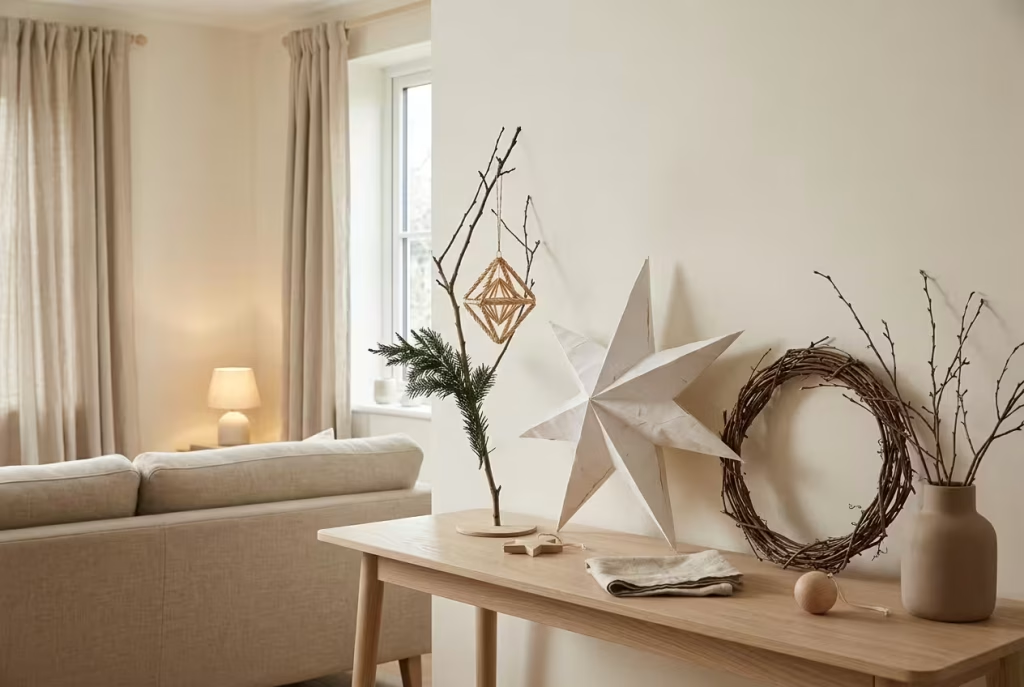
Strip the label away and you are left with three habits: natural materials (paper, wood, linen, felt, clay), a muted palette with one deliberate note of colour, and generous space around each object. Nothing glitters for the sake of it. A single well-placed star can say more than a hundred baubles.
The Scandinavian half of the blend brings genuine festive craft. Himmeli, for instance, is a traditional Finnish decoration made from straw, small enough to hang on a tree or large enough to float overhead as a mobile. Folded paper stars are another Nordic staple, as are simple twig wreaths and plain white candles.
The Japanese half deserves an honest footnote. Japan’s own seasonal decorations are tied to the New Year rather than Christmas. The pine-and-bamboo kadomatsu usually goes up after 25 December and stays until about 7 January, or 15 January in some regions. So a Japandi Christmas is a contemporary designer’s blend, not an ancient tradition, and that freedom works in your favour: you may borrow the calm without worrying about doing it by the book.
What lifts a Japandi Christmas above plain minimalism is a dash of wabi-sabi, the Japanese appreciation of things that are handmade, weathered or slightly off-true. That is why the style forgives a wonky paper star and often prizes it above a flawless factory bauble. Before any ornament earns a place, put it through three questions:
- Is it made of something natural, such as paper, wood, wool, clay or foliage?
- Does it have space around it, so the eye can take it in on its own?
- Would you be glad to unpack it again next December?
Three yeses make a keeper. Two out of three is a maybe. One out of three goes back on the shelf in the shop.
Read the tenancy before the tinsel
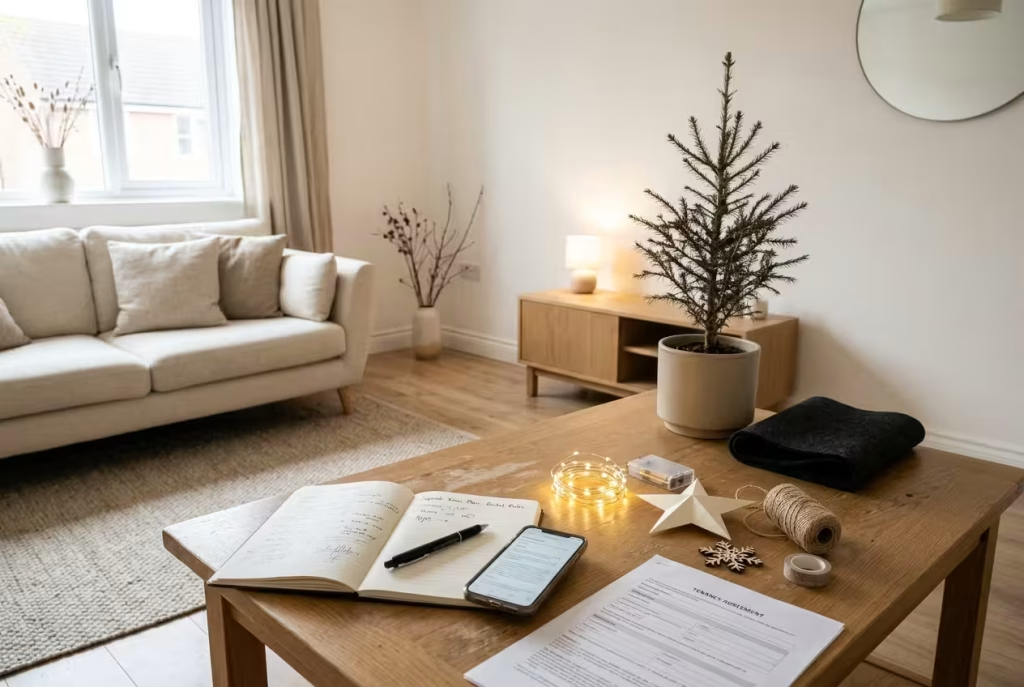
A few minutes with your agreement now will save an argument in the new year. Here is the legal backdrop for private renters in England.
- The main reforms under the Renters’ Rights Act took effect on 1 May 2026, and most private tenancies are now assured periodic rather than fixed-term.
- Deposits are capped at five weeks’ rent where annual rent is under £50,000, or six weeks’ at £50,000 and above.
- Your landlord must protect the deposit in an approved scheme and give you the details within 30 days.
None of that gives you a free hand with a hammer. Your agreement still governs alterations, and a landlord can usually claim for damage beyond ordinary wear. This is general information rather than legal advice, and Shelter and Citizens Advice are sound places to check your own position.
In practice, deposit disagreements over decorating usually trace back to a short list of culprits:
- paint lifted or marked when adhesive is pulled from a wall
- dents or stains in carpet from a heavy stand, tree sap or a water spill
- scratches on wood or laminate from dragging a tree or its stand
- scorch or wax marks from candles on sills and surfaces
- small holes left by pins, nails or hooks
Landlords generally accept ordinary wear and tear, but they can ask for the cost of putting right damage that goes beyond it. That is exactly why the before-and-after photographs carry so much weight.
| What to check | Why it matters | What to do |
| Clause on alterations or fixings | Many agreements ban nails, screws and sometimes adhesives | Ask in writing before you stick anything to a wall |
| Rules on open flames | Some landlords and insurers restrict candles | Use flameless candles and say so in your message |
| Real tree permission | Needles, sap and wet floors worry some landlords | Mention your floor-protection plan when you ask |
| Condition record | Photographs settle disputes quickly | Take date-stamped photos of walls, ceiling and floor before you start, and again after takedown |
| Existing fixtures | Picture rails, curtain poles and hooks are often fair game | Confirm that you may use them and their weight limit |
Keep every reply, even a one-line email. That thread is part of your evidence if the deposit is ever disputed.
A short message you can adapt:
Hi [name], I’d like to put up a few Christmas decorations in the living room this December. I’m planning a freestanding tree on a protective mat, LED or battery lights that I’ll switch off overnight, and some paper decorations hung from the curtain pole with thread. I won’t be drilling or using adhesives on the walls unless you’d prefer otherwise. Please let me know if there is anything in the tenancy I should avoid. I’ll take everything down by 6 January and leave the room as I found it. Thanks, [name]
Specific, cooperative messages tend to be answered quickly, and the reply doubles as written permission.
Twelve steps to a Japandi Christmas in a rented living room
1. Audit the room before you decorate it
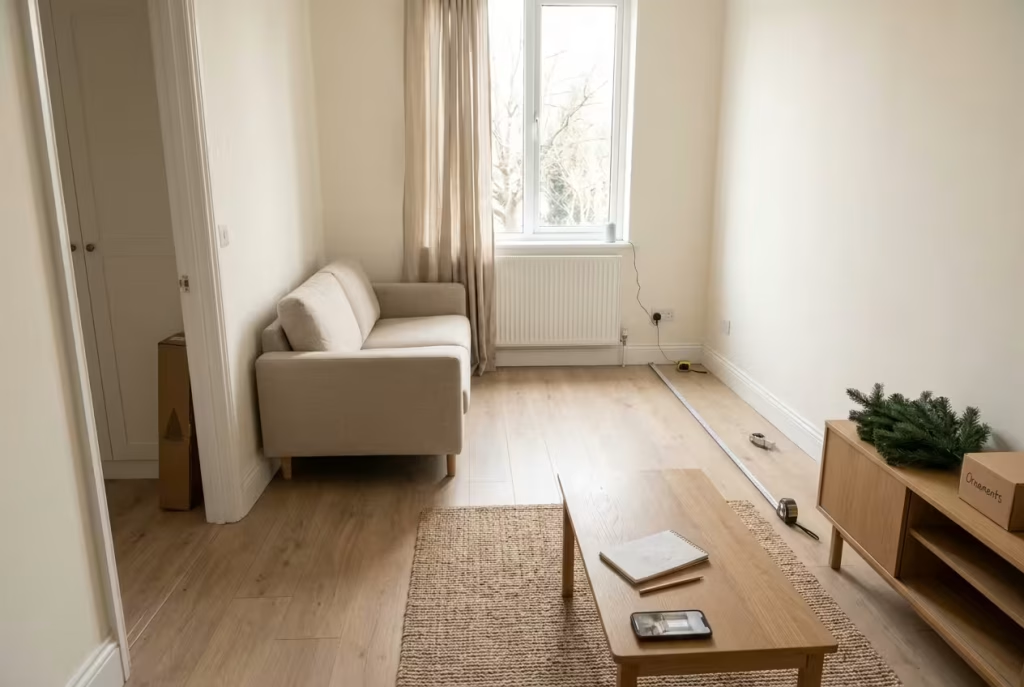
Start with a clear head and a camera. Photograph the room from the sofa, the doorway and the window, then identify the three things that must keep working: your main seat, the route from door to window, and the cupboard or curtain you use daily. Common planning guidance puts a comfortable main walkway at 30 to 36 inches, which is roughly 76 to 91cm. If a tree would squeeze that, it is the wrong tree or the wrong corner.
Decide now where the decorations will live in January as well. A display with no storage plan is a loan you will repay in tears. As the old saying goes, cut your coat according to your cloth: the room you actually have, not the one in the photograph, sets the budget for everything that follows.
Grab a tape measure and note down the following. Seven minutes now will answer half your shopping questions before you ask them.
- Ceiling height: leave roughly 30cm above a tree for the topper, a common rule of thumb.
- The corner you have in mind: a full 6ft tree is often 80 to 100cm across at the base, though slim varieties are narrower.
- Your front door and any tight turns on the stairs: a tree must travel in as well as sit down.
- Distance to the nearest socket and the nearest radiator: both shape where the tree can safely stand.
- The cupboard where the box will live: height, depth and the width of the opening.
- Floor type: carpet, laminate and wood each need different protection.
2. Choose one focal point and let the rest play support
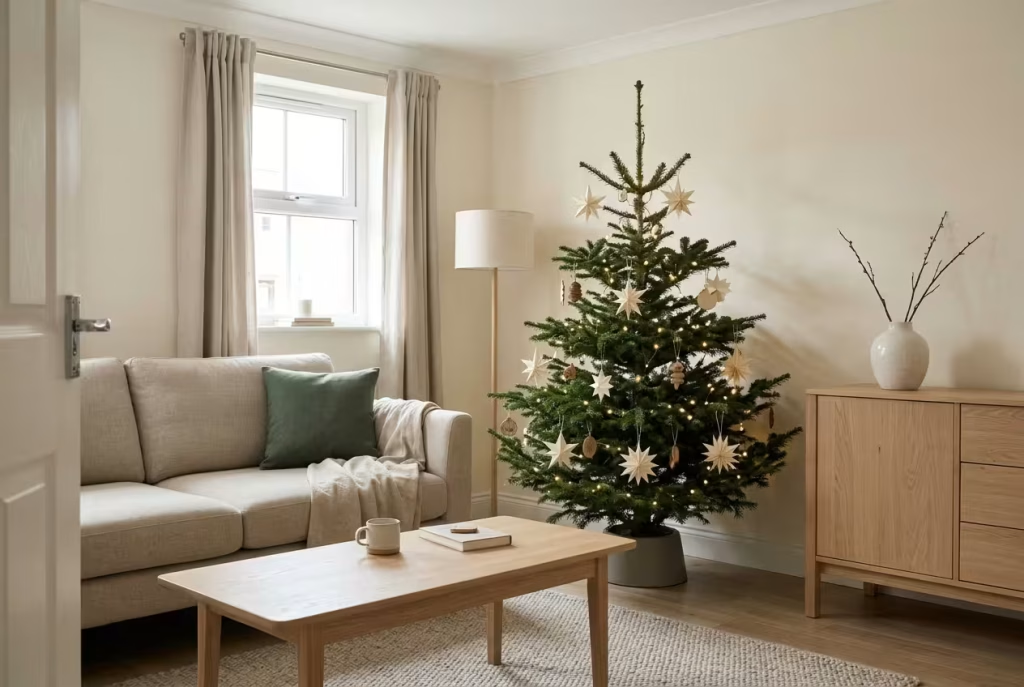
Japandi thrives on a single point of emphasis. From your usual seat, notice where your eye settles naturally. That spot, whether a clear corner, a sideboard top or a stretch of shelving, should carry most of the seasonal character.
You have three honest options:
- A floor tree: the strongest vertical statement, though it needs its own footprint and a stable base.
- A tabletop tree: saves floor space, but borrows surface space and needs a sturdy support.
- A tree-free arrangement: three tall branches in a heavy vase, hung with paper stars on thread. It costs little, stores flat and suits a cramped room with grace.
There is no prize for the biggest tree. Sometimes the bravest festive gesture is a single branch, bare and beautifully placed.
The three-seat test. Stand where the tree or branch will go, then look back at it from the sofa, the doorway and the spot where you usually make tea. A display that sings from one angle and vanishes behind an armchair from another needs shifting before you commit. Picture it, too, on an ordinary Tuesday evening rather than on Christmas morning: will it block the route to the window, the telly or the kettle? The best focal point is one you can live beside for three weeks without once muttering under your breath.
3. Pick the tree route that suits a short let
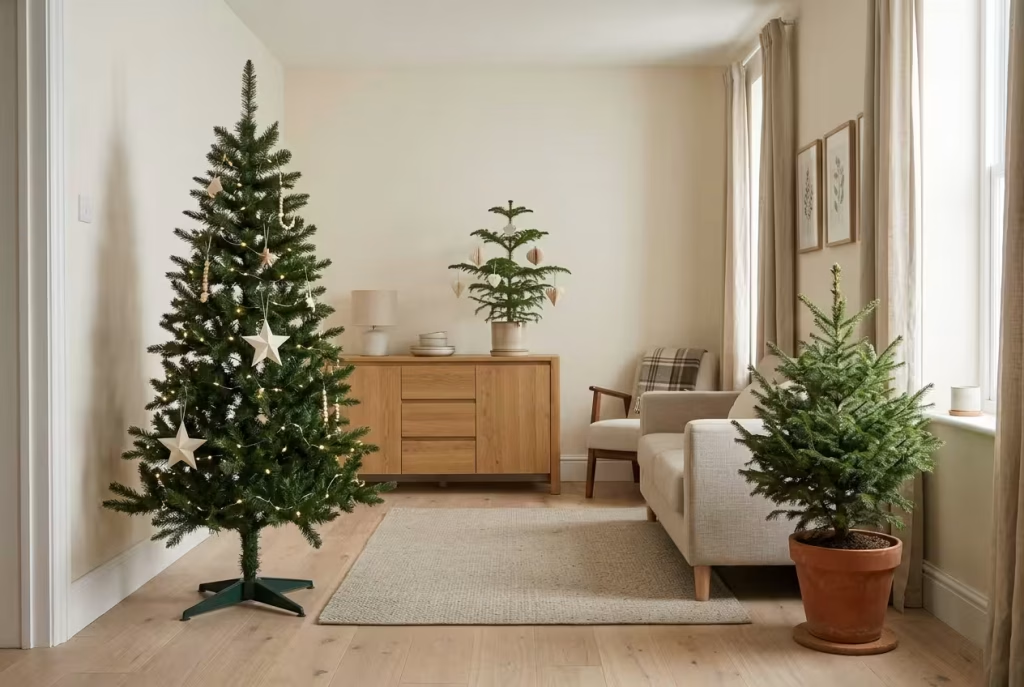
| Option | Typical UK cost (as reported, check current prices) | Why it works for renters | Watch out for |
| Artificial tree | Wide range | Reusable, no needles | A flame-retardant label does not mean fireproof, and the box needs a storage home |
| Cut Nordmann fir | Around £58 for 6ft in Newcastle, £80 for 7ft in London (Admiral survey) | Non-drop variety, strong scent | Relatively safe for about two weeks only, per London Fire Brigade |
| Pot-grown tree | From about £25 to £70 (Dobbies from £24.99, Patch £45 to £70) | Roots intact, so it sheds little | Keep indoors no longer than about 12 days, and you need a garden or balcony to return it to |
| Rented tree | About £55 for three weeks, plus £20 deposit and £20 delivery (reported) | Collected after Christmas, no disposal | Book early, and do not prune a tree that is not yours |
| Tabletop mini tree | Often around 70 to 80cm tall | Tiny footprint | Needs a sturdy surface and lighter ornaments |
If you want a real tree, the Nordmann is the name that keeps coming up for holding its needles. Whichever route you take, keep the tree away from radiators and heaters. UK fire services say to keep trees clear of heat sources without naming a distance, while New York’s fire department cites at least three feet, about 90cm. A metre is a sensible rule of thumb.
Choosing well at the tree seller
- Run a branch gently through your hand. On a fresh tree the needles are hard to pull off and do not snap.
- The base of the trunk should feel sticky with resin.
- Lift the tree a few centimetres and tap the trunk on the ground. A shower of needles means it has been cut too long.
- Ask for a fresh cut across the base, then stand it in water as soon as you are home.
Pot-grown or potted? The two are not the same thing. A pot-grown tree has lived in its container with its roots intact, so it settles better indoors. A potted tree has simply been dug up and put in a pot, which can damage the roots, so check that it is well rooted before you pay.
A word on artificial trees. Modern ones are usually flame retardant, but check the packaging and treat an elderly tree with suspicion. Fire safety guidance also advises against putting electric lights on metal artificial trees.
You May also Like: 21 Christmas Mountain Lodge Living Room Design Ideas
4. Protect the floor like it is a family heirloom
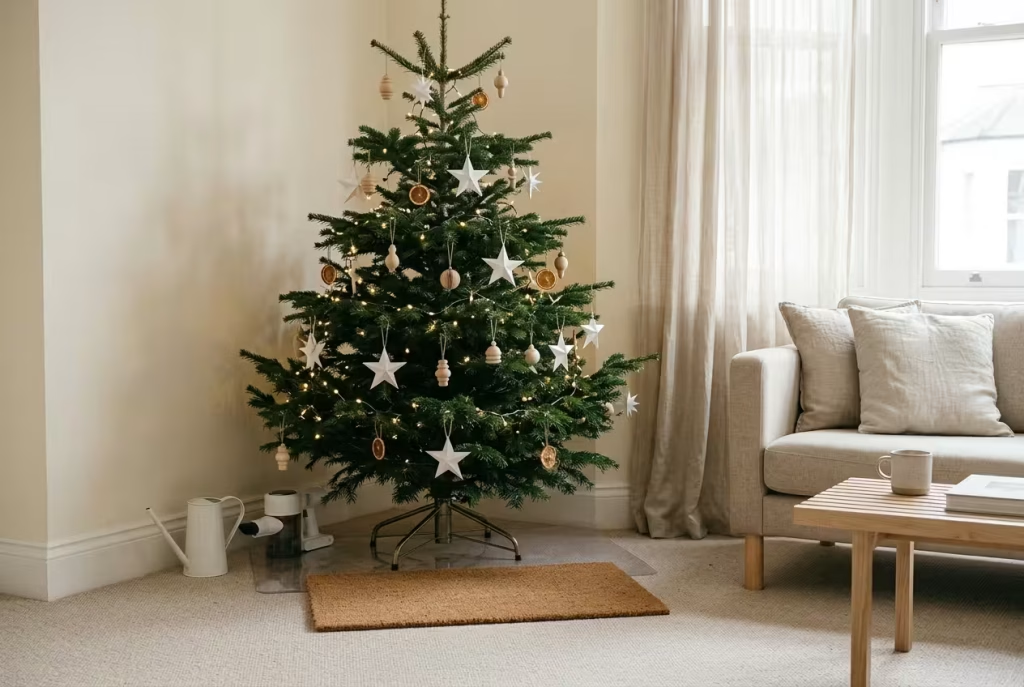
Carpets and hard floors are where deposits quietly drain away. Parents on Mumsnet swear by an old trick: keep a spare square of carpet, or a hard-wearing doormat, under the stand. Industrial-strength polythene sheeting under that makes the belt-and-braces version.
- Use a tray or a stand with a water reservoir, and check the water level daily.
- Hoover as you go rather than letting needles build up.
- Most of the mess arrives when the tree leaves, so wrap it in an old sheet or a tree bag before you carry it out.
- Never water from the top of the branches over presents or electrics.
A small, tidy routine is the difference between a lovely tree and a charge for cleaning.
Hard floors need a different plan. Wood and laminate fear water and scratches far more than they fear needles. Stand the tree in a waterproof tray with a felt or rubber layer underneath, lift it rather than dragging it, and check the stand’s feet for rough edges. Wipe any drips at once, because standing water is what leaves rings. A tree bag laid under the stand before you set up can be pulled up and around the tree in January, which takes the sting out of the least popular job of the season.
5. Set a palette that borrows from your room
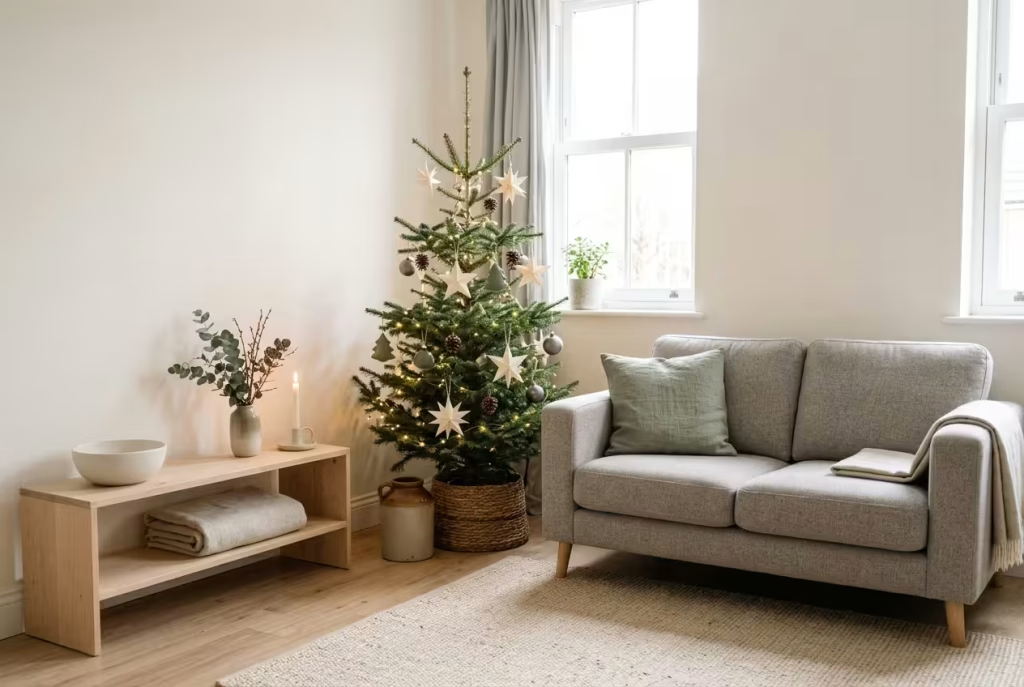
Begin with what you cannot change: the walls, the floor, the sofa. The Christmas layer should relate to them, not argue with them.
| Role | Colour or material | How much | Examples |
| Base | Warm white, oatmeal, soft grey | Already in the room | Walls, sofa, rug |
| Wood | Ash, oak, birch | A touch of warmth | Stand, bowl, tray, wooden shapes |
| Green | Fir, eucalyptus, olive | The headline act | Tree, branches, wreath sprig |
| Accent | Oxblood, ink black or terracotta | One only | Felt shapes, ribbon, a single ceramic |
| Texture | Paper, linen, felt, ceramic | Throughout | Stars, cushion covers, stockings |
If your sofa already has a strong colour, it may supply the accent for you. Repeating a second accent everywhere makes the seasonal layer look pasted on, rather than settled into the room.
Two ready-made colour recipes
| Recipe | Base | Wood | Green | Accent | Mood |
| Soft Nordic | White and pale grey | Birch | Sage and fir | Pewter | Light, frosty, airy |
| Warm Kyoto | Oatmeal and stone | Ash or oak | Olive and pine | Terracotta or ink black | Earthy, glowing, grounded |
Before you commit, hold your chosen colours up in daylight and again under the lamps you actually use. Warm bulbs can turn a cool sage muddy, and a shade that looked perfect on a screen may sulk in a north-facing flat. If your landlord’s walls are bright white or magnolia, lean on oatmeal and ash to soften them rather than fighting them with yet more white.
6. Make the ornaments earn their place

The trick is repetition with restraint. Choose one repeated shape, such as a folded paper star, and use it in two or three sizes, with the largest nearest the centre of the tree where the branches can bear them. Hang a few wooden shapes at different heights, add one slightly wonky handmade piece, and stop there.
- Paper stars and himmeli weigh almost nothing, so they suit a tabletop tree.
- Felt shapes soften the look and cost pennies.
- Dried orange slices add warmth, strung on thread.
- Fewer visible bulbs: let the lamps in the room carry some of the glow.
Leave pockets of green showing between ornaments. A Christmas tree that can breathe looks more luxurious than one dressed to the hilt.
Folding your own stars. A paper star is the most forgiving ornament going. Use 120 to 160 gsm card or heavy paper, which holds a crease without drooping, and cut your strips or squares accurately, because sloppy folds show. Hang each one from undyed cotton or linen thread. An evening in front of the telly will give you a dozen for pennies. For a tabletop tree about 70 to 80 cm high, 15 to 25 ornaments is a workable starting point rather than a rule. Hang heavier pieces low and near the trunk, and let the lightest ones dance at the tips.
7. Hang things without harming the walls
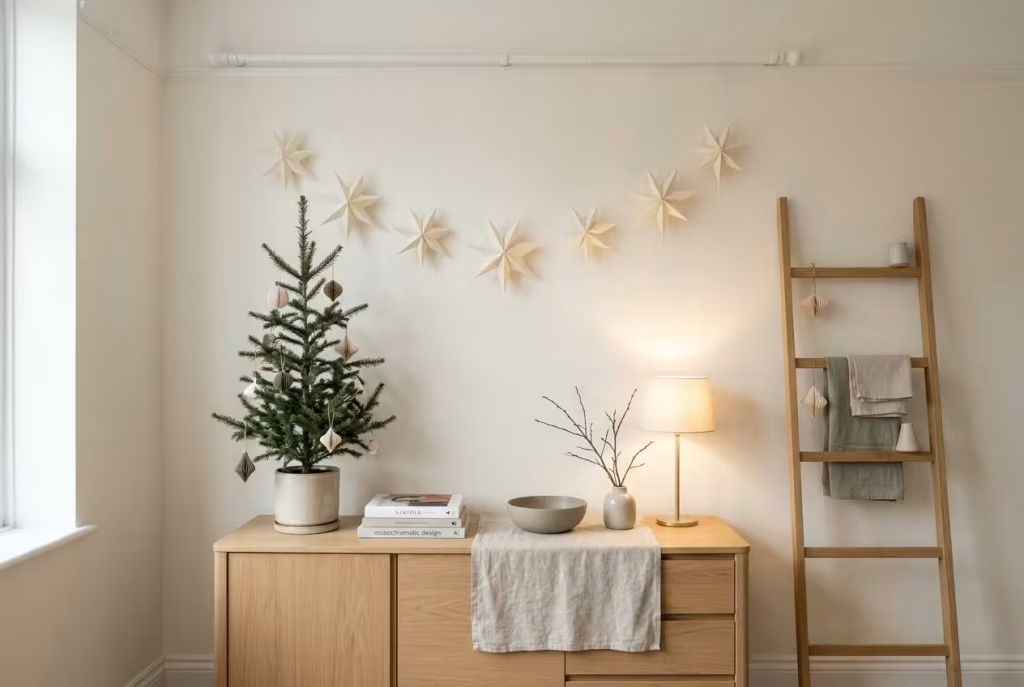
This is the step that keeps renters awake at night. Remember the golden rule that landlords and agents repeat: Blu-tack, sticky tape and drawing pins are out, and nothing should hang over a cooker or other heat source.
| Method | Suits | Limit | Notes |
| Command large picture strips | Smooth painted walls, tile, glass, finished wood | 1.8kg per pair, 7.2kg across a four-pair pack | Not for wallpaper or textured walls, wait 7 days after painting, wipe with rubbing alcohol, press for 30 seconds, then release by stretching each tab slowly down along the wall |
| Existing curtain rail or bannister plus thread | Paper stars, light garlands | Keep it light | Check the rail can take the load, and tie with thread you can snip |
| Existing picture rail | Light frames, garlands | Per the rail | Only if your agreement allows it |
| Window suction hooks | Glass | Very light items | Clean the glass first |
| Tension rod | A window reveal or recess | Light garland | Protect the ends with felt, and check the wall afterwards |
| Freestanding ladder shelf, stand or vase | Floor or surface | Any | No contact with the building at all |
Command’s own advice is that the packs are tested for suitable surfaces, so read the label on the pack you buy. When in doubt, a freestanding piece wins every time.
Test before you trust. Stick one strip in a hidden spot, such as inside a wardrobe or behind a door, and leave it for 48 hours before peeling it off. If the paint lifts, you have learned that lesson cheaply. Adhesive also struggles on cold glass, damp or steamy walls and freshly painted surfaces, so the proof of the pudding is always a trial run. As a sanity check, if an item weighs more than a mug of tea, give it a freestanding home instead. When release day arrives, pull slowly and parallel to the wall, never straight out.
8. Style surfaces so they still work
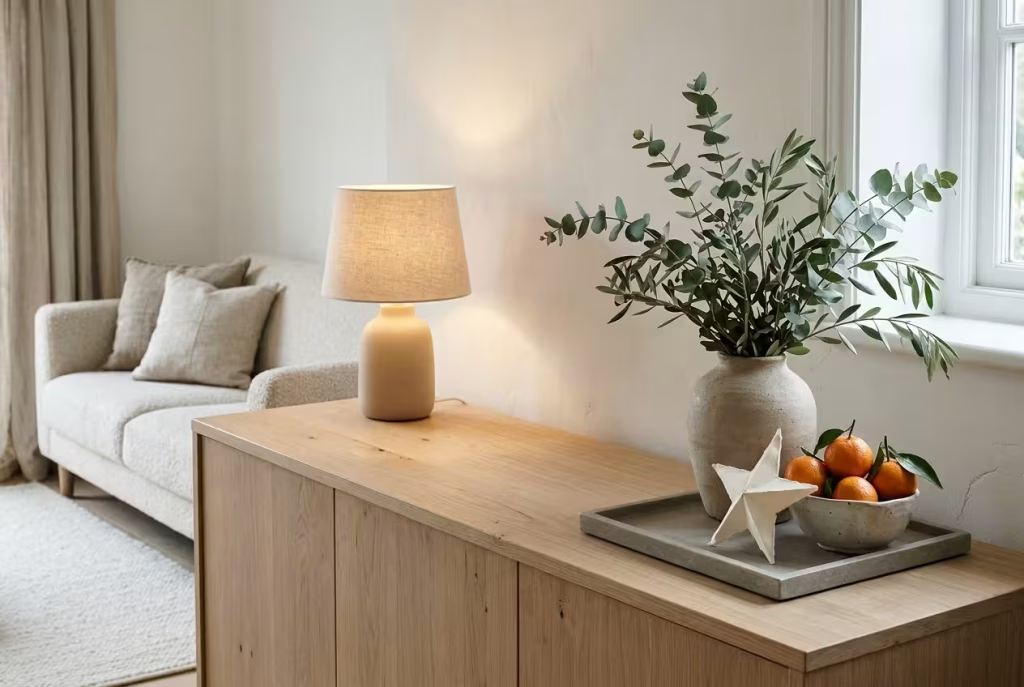
A sideboard that has to double as a place to put down a cup will not tolerate a crowded display. Set a tray on it, group items in threes, and leave a clear stretch for everyday use. A handy styling rule is to let a tray cover no more than about a third of a surface.
A handful of eucalyptus, olive or pine in a heavy ceramic vase makes a graceful centrepiece. Add a bowl of clementines and one paper star leaning against it. That is the whole composition, and it still leaves room for life to happen.
Three tabletop recipes to copy
| Surface | What goes on it | Leave clear |
| Sideboard | A tray holding a tall branch in a vase, a bowl of clementines and one paper star leaning against the bowl | About two thirds of the top |
| Coffee table | A low bowl of dried orange slices with a pine sprig | 30 to 50 per cent, for mugs and remotes |
| Shelf | Three objects only, one tall, one medium, one low, with a star hung by thread from the shelf edge | Everything else |
Change the vase water every few days so the greenery stays sweet-smelling, and remove any sprig that begins to shed or brown.
9. Light the room low and warm
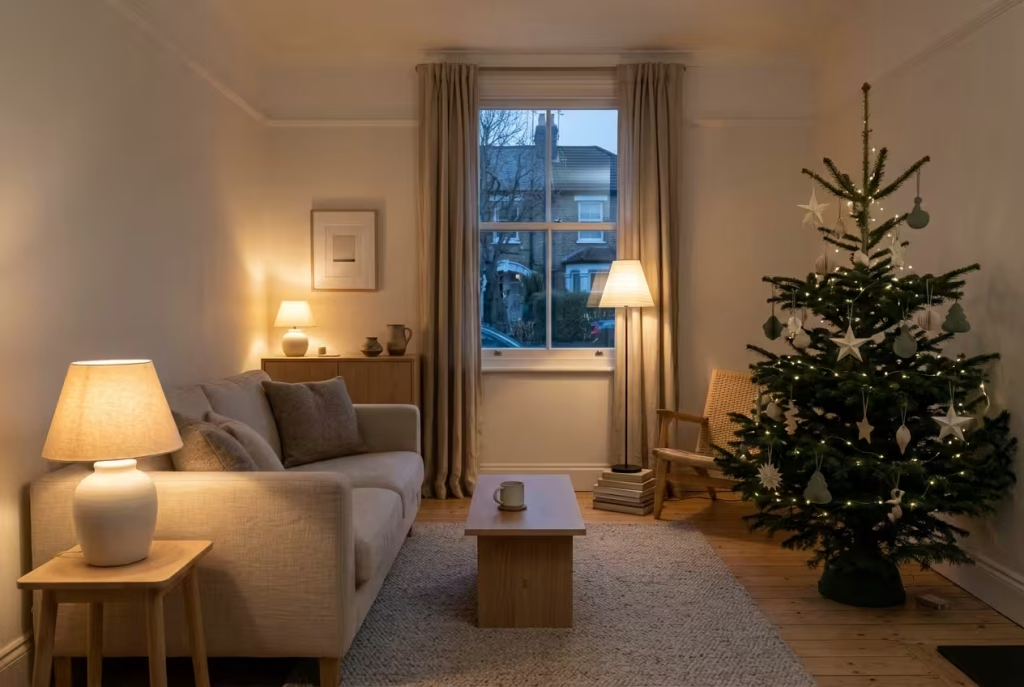
Japandi evenings glow rather than blaze. Choose warm white LEDs, around 2700K, and let your existing lamps do most of the work. Battery-powered fairy lights are an easy answer for shelves and branches where a plug would be awkward.
- Buy lights with a CE or UKCA mark, and prefer LED to older filament bulbs.
- Inspect last year’s lights for damage before using them.
- Avoid daisy-chaining extension leads. A typical four-way lead is rated at about 13 amps in total, around 3,000 watts, which a heater alone can nearly use up.
- Never attach decorations to lights or heaters.
- Switch lights off and unplug them at bedtime and when you go out. A plug timer can build the habit, though a last look at night is still wise.
How bright is bright enough? As a rough guide, a small lounge feels right with about 1,500 to 3,000 lumens in total, spread across two or three lamps rather than a single blazing overhead. Plug-in dimmer adaptors give many lamps a softer evening setting, though check that your bulbs are dimmable first. If you choose battery light packs, look for compartments that close with a screw, particularly in a home with young children.
You May also Like: 23 Modern Burgundy Christmas Living Room Ideas for a Cozy, Elegant Holiday
10. Layer in textiles and scent

Softness is where Scandinavian warmth lives. Swap a cushion cover for undyed linen, drape a wool throw over an arm, and hang a felt stocking from a freestanding stand or the back of a chair rather than the mantel. Each swap is reversible in seconds.
For scent, keep it simple: a fresh pine sprig, the citrus note of dried orange. If you love candles, choose flameless ones in a rental, or if you burn real ones, use a proper holder, keep it well away from anything flammable and never leave it unattended.
Reversible swaps worth making
- Undyed linen cushion covers over your existing cushions
- A wool blanket you already own, folded over the sofa arm
- A woven basket or folded linen sheet in place of a tree skirt, since it stores flat and hides the stand
- A tray to corral small objects, so nothing wanders across the surfaces
Diffusers and essential oils call for care in a household with pets, because some oils are harmful to cats and dogs. Check with your vet before using them.
11. Plan for pets, children and guests
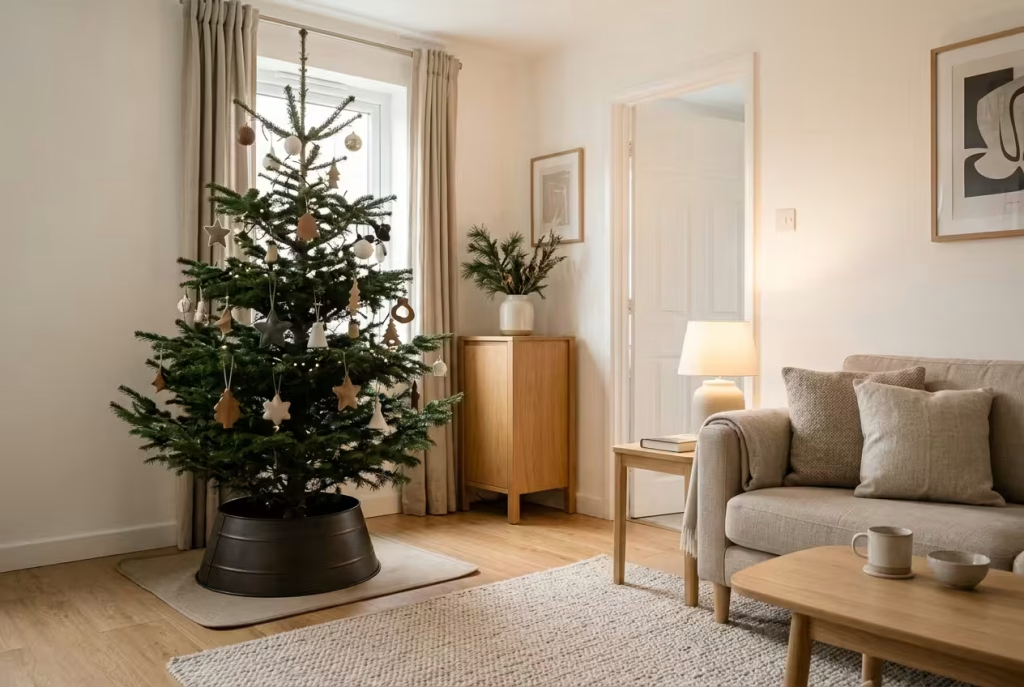
| Hazard | Why it matters | Fix |
| Pine needles | Blue Cross says serious injury is rare, but needles can irritate or injure | Choose a non-drop tree and sweep regularly |
| Tinsel, lametta, ribbon, string | Can cause intestinal blockage if swallowed | Skip tinsel, and keep twine and ribbon out of reach |
| Cables | Chewing can cause shock | Cover exposed wires and switch off at the mains when unsupervised |
| Tree water | Stagnant water and plant food can upset pets, and some fertilisers are toxic to cats | Cover the reservoir and avoid feeding a potted tree |
| Poinsettia, holly, mistletoe, ivy, lilies | Irritant or toxic to pets | Keep out of reach or choose a safe alternative |
| Low breakable baubles | Climbing and batting | Hang delicate pieces higher, and make sure the base is stable |
Note that twine and ribbon, so characteristic of Japandi, carry the same risk as tinsel. Hang them high and you lose nothing.
Children and guests add their own wrinkles:
- Button-cell batteries, found in many LED tealights and some light packs, are dangerous if swallowed. Keep spares out of reach, choose products with secure battery covers, and get emergency help at once if a child may have swallowed one.
- Glass baubles belong above toddler height, with wooden or felt pieces lower down.
- Doorways and escape routes must stay clear, even if the tree sits a step further from the door.
- Switches: tell guests where the tree lights switch off, so a late-night tidy-up does not end with them left on.
12. Plan the takedown before you start
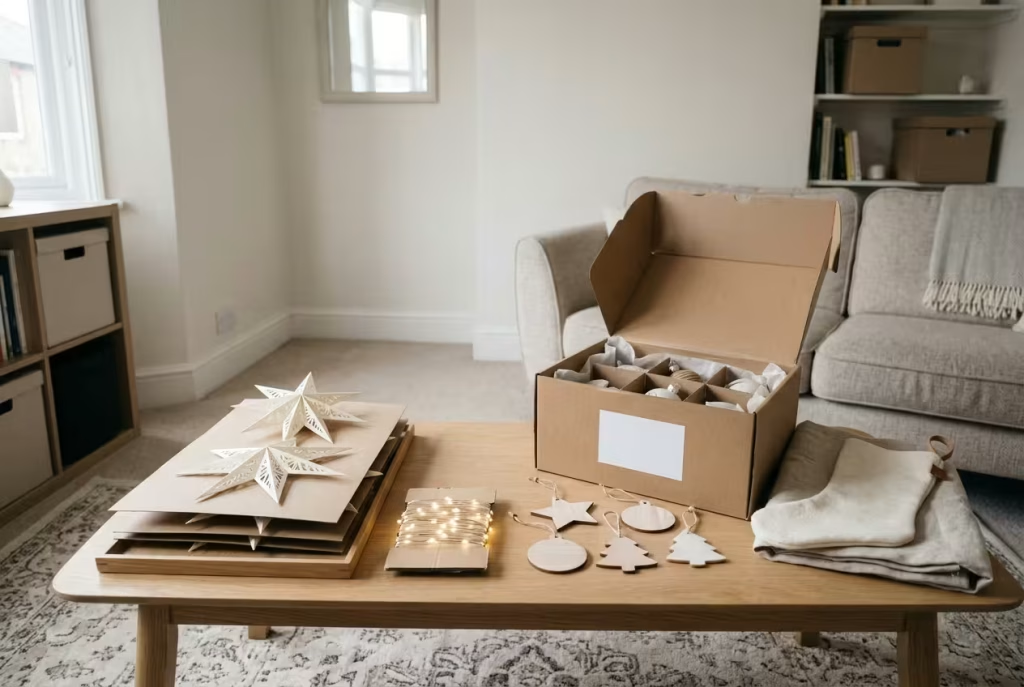
The best time to think about January is now. Set a take-down date, perhaps Twelfth Night on 5 or 6 January, and note it in your diary. A cut tree should not stay long, and a potted one no more than about 12 days indoors.
- Photograph the finished room, then compare it with your before photos once everything is down.
- Pack paper stars flat between sheets of card, and wind lights around a piece of cardboard.
- Label the box and give it a permanent home.
- Recycle a cut tree through your council, or return a rented one on schedule.
Storage is the quiet hero of a good Christmas. Pack it well and next year’s setup takes minutes.
A realistic timetable
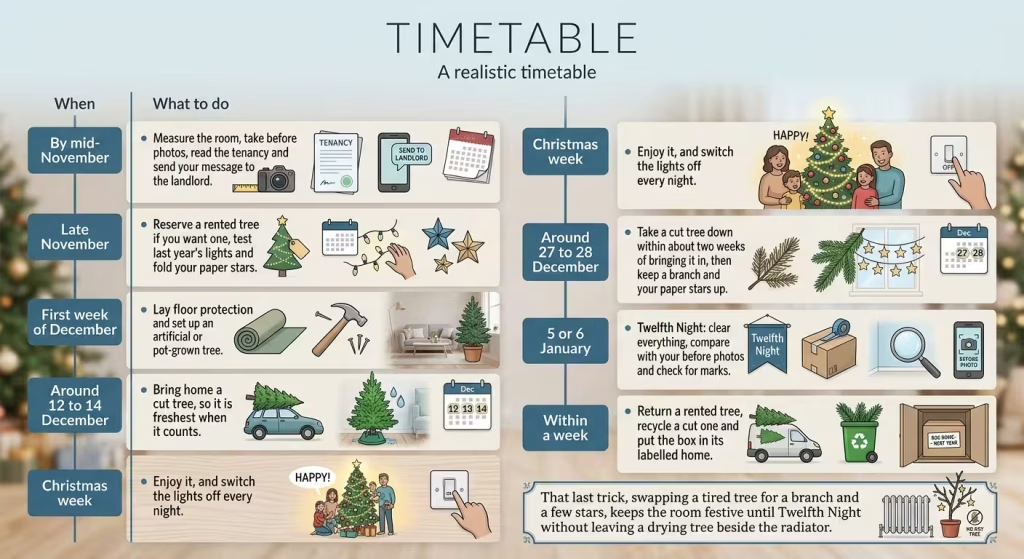
| When | What to do |
| By mid-November | Measure the room, take before photos, read the tenancy and send your message to the landlord |
| Late November | Reserve a rented tree if you want one, test last year’s lights and fold your paper stars |
| First week of December | Lay floor protection and set up an artificial or pot-grown tree |
| Around 12 to 14 December | Bring home a cut tree, so it is freshest when it counts |
| Christmas week | Enjoy it, and switch the lights off every night |
| Around 27 to 28 December | Take a cut tree down within about two weeks of bringing it in, then keep a branch and your paper stars up |
| 5 or 6 January | Twelfth Night: clear everything, compare with your before photos and check for marks |
| Within a week | Return a rented tree, recycle a cut one and put the box in its labelled home |
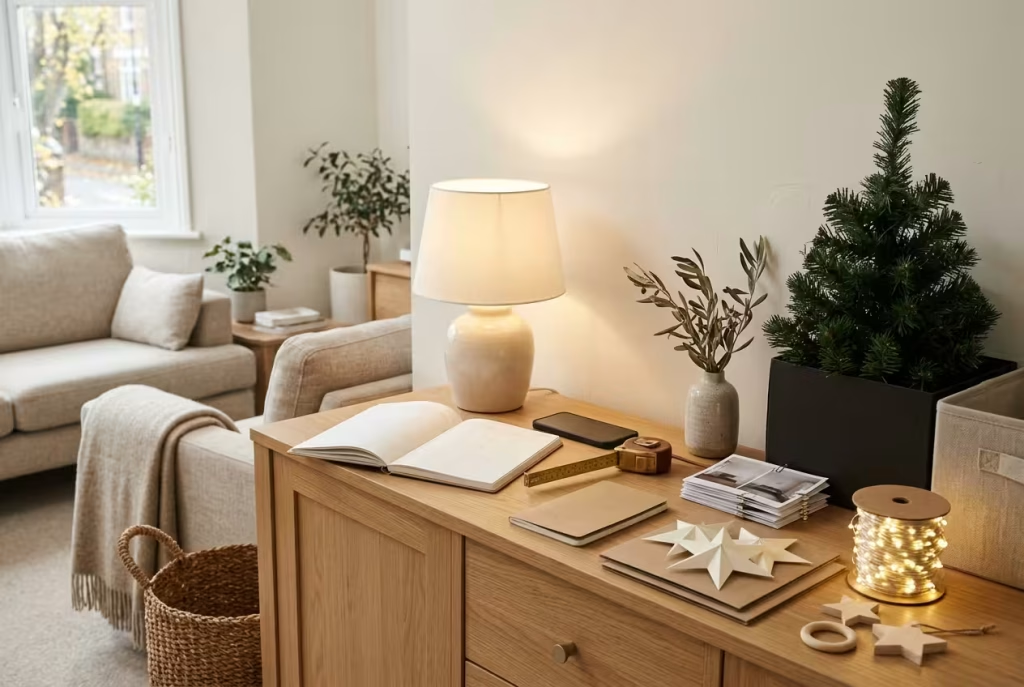
That last trick, swapping a tired tree for a branch and a few stars, keeps the room festive until Twelfth Night without leaving a drying tree beside the radiator.
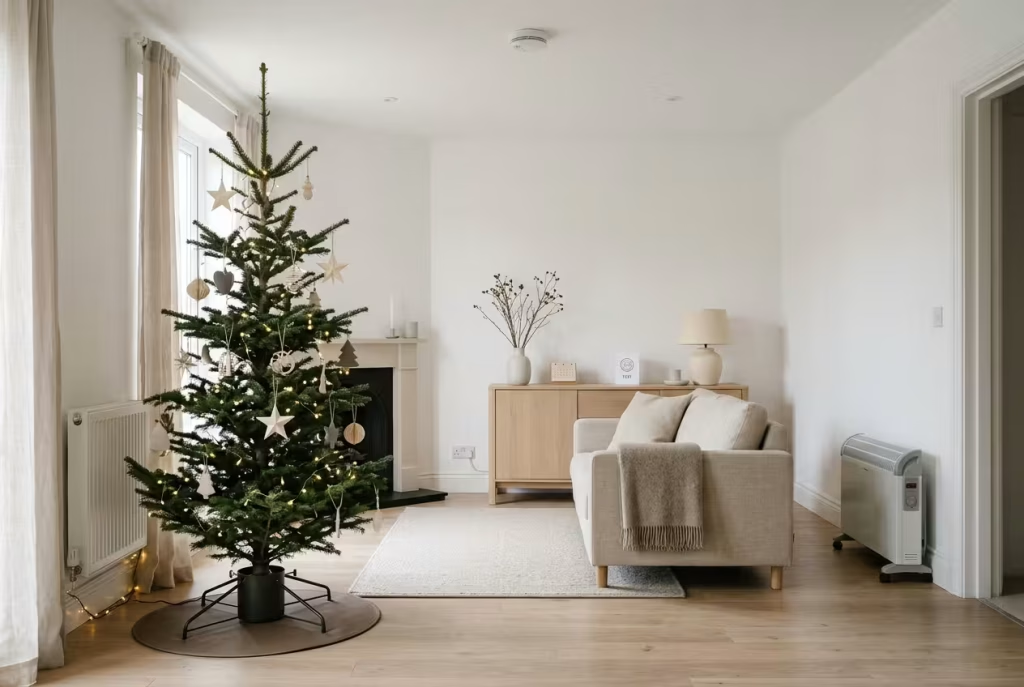
Fire and electrical safety at a glance
| Risk | What to do | Who says so |
| Tree near heat | Keep it clear of radiators, heaters and flames | London Fire Brigade |
| Lights left on | Switch off and unplug at bedtime and when out | London Fire Brigade, Electrical Safety First |
| Old or damaged lights | Check before use and replace if faulty | Electrical Safety First |
| Overloaded sockets | Avoid extension leads and adaptors where you can | Electrical Safety First |
| Decorations on lights | Never attach them to lights or heaters | London Fire Brigade |
| Paper and dried items | Keep away from bulbs, heaters and candles | Fire safety guidance |
| Candles near the tree | Keep them well away, never unattended | London Fire Brigade |
| Dry real tree | Choose a fresh tree whose needles are hard to pull off, and keep it watered | Fire safety guidance |
| Smoke alarms | Test weekly | Housing fire guidance |
If the worst does happen, the advice from UK fire services is simple: get out, stay out and call 999. Do not try to tackle a tree fire yourself, because a dry tree can engulf a room in seconds. Agree an escape route with everyone in the household, and test your smoke alarms weekly rather than waiting for the batteries to chirp.
What a Japandi Christmas costs, tier by tier
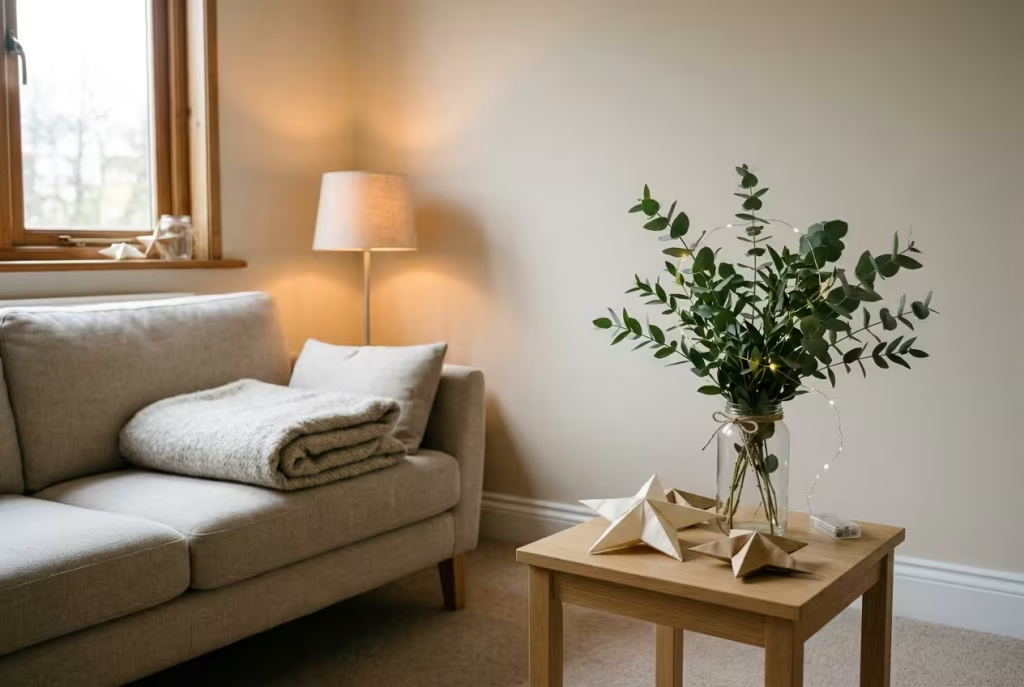
The figures below are ballpark ranges for the UK and they move from year to year, so check current prices before you buy. The deposit on a rented tree is refundable, but it still leaves your account for a while.
| Tier | Roughly | What you get | Where the money goes |
| Use what you own | Under £25 | Branches in a vase, paper stars made from paper you already have, existing lamps with warm bulbs | A pack of battery lights, a few sheets of good card |
| Smart borrowing | £25 to £100 | A pot-grown or small cut tree, LED lights, linen ribbon, felt shapes | The tree, which is the biggest single line |
| A considered set | £100 to £250 | A rented tree (about £75 once delivery and deposit are counted), a wool throw, ceramics, flameless candles | Textiles and one or two pieces you will use again next year |
The thriftiest route is almost always the one that comes with a storage plan. A tree you can return, or an ornament that folds flat, pays for itself by January. As the saying goes, a stitch in time saves nine, and a labelled box saves a lot more.
Where to spend and where to save
- Spend on a proper tray or stand, lights that carry a CE or UKCA mark, and one good linen or wool piece you will use for years.
- Save on ornaments, ribbon and vases, which paper, thread and a clean jam jar can replace.
| Instead of | Try | Why it helps |
| Boxed glass baubles | Folded paper stars | Lighter, kinder to pets and almost free |
| A set of scented candles | A pine sprig and a flameless candle | No flame, and no wax on the sills |
| A new throw | A wool blanket you already own | Costs nothing and suits the palette |
| A tree skirt | A woven basket or folded linen sheet | Stores flat and hides the stand |
| A mantel garland | A branch in a heavy vase | No fixings, no sag, no marks |
Why a quieter room feels better to live in
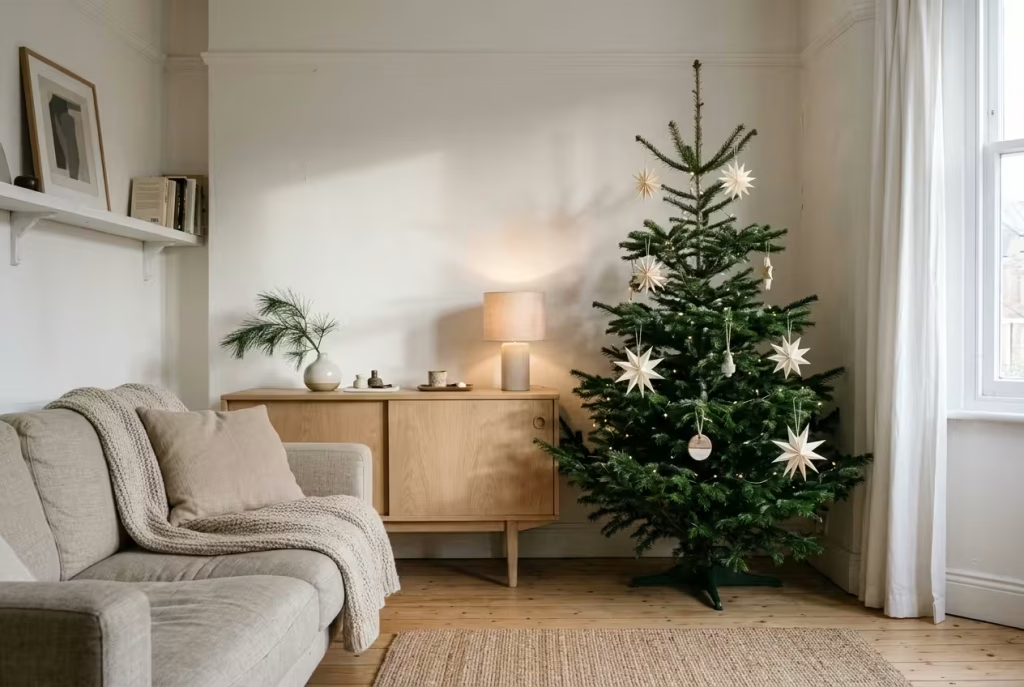
Christmas asks a great deal of us at once: shopping, cooking, travel, other people’s expectations. Your living room is where all of that is supposed to land softly. A crowded, glittering room can quietly undermine that, because every object is competing for a share of your attention.
Research from Princeton’s neuroscience institute found that competing visual stimuli jostle for limited processing capacity in the brain. In plain terms, clutter is not just untidy, it is tiring. A room with one clear point of focus lets the eye settle, which is much of what people mean by restful.
There is a human side too. Folding a paper star, tying a sprig to a branch or choosing three things instead of thirty is a small act of authorship. In a rented home, where so much is decided for you, that sense of making the room your own is worth more than any amount of sparkle.
For many of us, the pull of Christmas is memory far more than decoration: a particular smell of pine, a star that has hung from the same branch for twenty years. A Japandi scheme leaves room for those inheritances. One treasured, slightly battered ornament set among clean paper shapes tells a better story than a matching collection from a shop.
Renters often carry an extra feeling at this time of year, the sense of living in a space that is only provisional. Decorating thoughtfully, within the rules, is a way of saying that this room is home anyway, for as long as you are in it.
Common mistakes and how to sidestep them
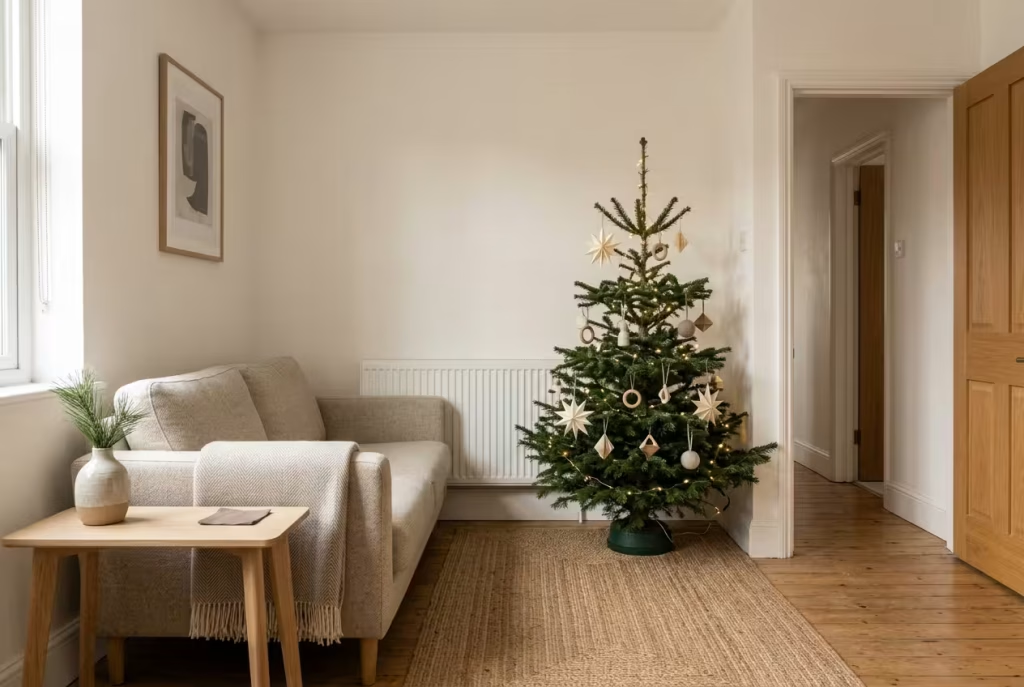
| Mistake | Why it backfires | Better move |
| Buying the tree before measuring | It blocks the walkway or the radiator | Mark the footprint and measure the doorway first |
| Using tinsel or fake snow | Clashes with natural materials and is risky for pets | Choose paper, wood and felt |
| Leaving lights on overnight | A fire and electrical risk | Switch off and unplug at bedtime |
| Too many colours | The room loses its hush | One green, one accent |
| Hanging heavy items from adhesive strips | They can fail and mark paint | Respect the weight limit or go freestanding |
| No storage plan | The box becomes January’s problem | Reserve its home before you buy |
| Over-scenting | Too many candles and sprays turn cosy into cloying | One gentle note is plenty |
If you only do three things: ask your landlord in writing before you stick, drill or light anything; protect the floor and keep every heat source, flame and cable well clear of the tree; and commit to a single focal point rather than a dozen small ones.
The final test
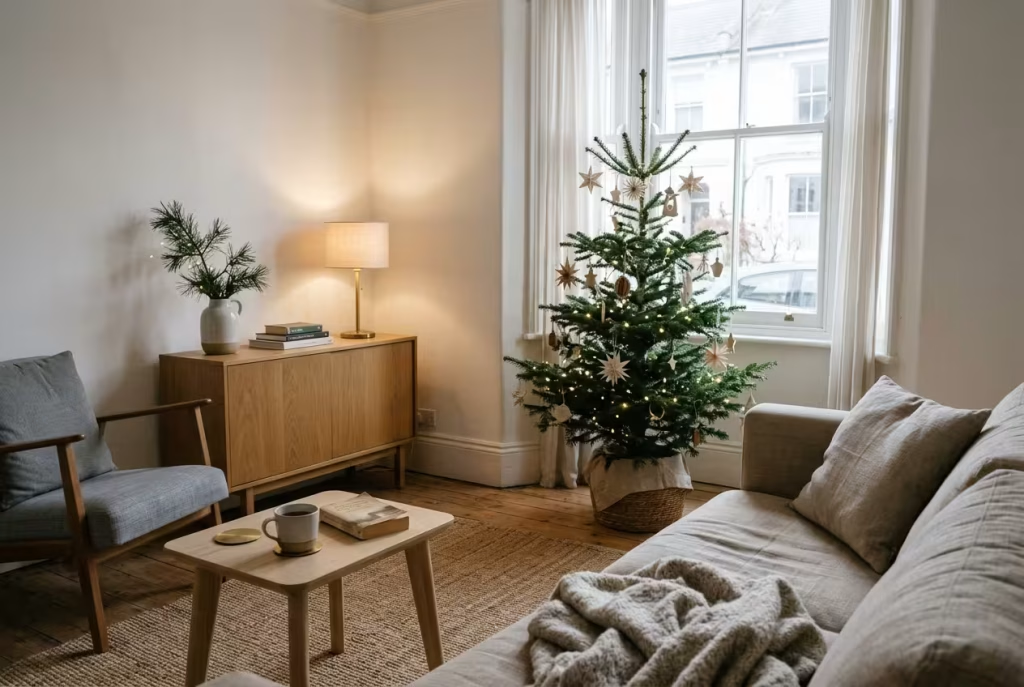
Once everything is up, do one last thing: sit down in your usual seat, open the curtains, set a cup on the table and breathe out. If you can do all of that without moving a single ornament, the room is finished. A rented Christmas, done well, is not a smaller version of the real thing. It is a quieter, more deliberate one, and it leaves the carpet, the walls and your deposit exactly as you found them.
Frequently asked questions
Can you put up a Christmas tree in a rented flat?
In most cases yes, but check your tenancy for any ban on real trees or open flames. Protect the floor with a tray and a spare mat, keep the tree clear of heaters, and ask your landlord in writing if you are unsure.
How do you hang Christmas decorations in a rental without damaging the walls?
Hang light pieces from existing curtain rails or bannisters using thread, or use freestanding stands and vases. Command strips can work on suitable smooth surfaces within their weight limits. Avoid Blu-tack, sticky tape and drawing pins.
How much weight can Command strips hold?
Large picture strips are rated at 1.8kg per pair, or 7.2kg for a four-pair pack. They are not intended for wallpaper or textured walls. Always follow the instructions on the pack you buy.
What is a Japandi Christmas?
It is a contemporary blend of Japanese restraint and Scandinavian warmth applied to the festive season. Expect natural materials, a muted palette, plenty of space and one deliberate accent, rather than an abundance of baubles.
What colours suit a Japandi Christmas?
Begin with warm white, oatmeal and soft grey, add pale ash or oak, then choose one green and one small accent such as oxblood, ink black or terracotta. Fewer colours make the room feel calmer.
How do you stop a real tree damaging carpet?
Put a tray under the stand, with a spare carpet square or hard-wearing mat beneath it, and consider polythene under that. Choose a non-drop tree such as a Nordmann, hoover regularly and wrap the tree before carrying it out.
Is renting a Christmas tree worth it?
It can be. One reported price is about £55 for three weeks, plus a £20 deposit and £20 delivery, with collection afterwards so there is nothing to dispose of. Prices change, so compare suppliers and book early.
Can you decorate without a tree?
Yes. Three tall branches in a heavy vase, hung with paper stars, make a graceful and inexpensive focal point. It also stores flat and suits a small living room well.
Are paper decorations and candles safe near a tree?
Keep paper and dried decorations away from bulbs, heaters and candles, and never attach decorations to lights. London Fire Brigade advises keeping candles away from the tree. Flameless candles are the simplest answer in a rental.
Is a Christmas tree safe around cats and dogs?
Generally yes with sensible care. Blue Cross says needle injuries are rare, so a non-drop tree helps. Avoid tinsel, ribbon and string within reach, cover wires, switch lights off at the mains when unsupervised, and keep poinsettia and holly out of reach.
What are my deposit rights in England?
Deposits are capped at five weeks’ rent where annual rent is under £50,000 (six weeks’ above that), and must be protected in an approved scheme with details given within 30 days. Photograph the room before and after. This is general information, so check your own position with Shelter or Citizens Advice.
When should I put decorations up and take them down?
Put up artificial decorations whenever you like. A cut real tree is relatively safe for about two weeks and a potted one should stay indoors no longer than about 12 days, so time your purchase accordingly. Twelfth Night, on 5 or 6 January, is the traditional take-down date.
How do I keep a real tree fresh for longer?
Buy it fresh, make a new cut across the base and stand it in water straight away. Check the water daily, keep the tree away from radiators and never spray it with hairspray, which is highly flammable. Even then, fire services consider a cut tree relatively safe for only about two weeks.
What if my landlord says no to a tree?
Switch to a tree-free focal point: three tall branches in a heavy vase, hung with paper stars, or a small artificial tabletop tree if they allow it. You can still use lamps, textiles and tabletop styling to build a warm, festive room without breaching the tenancy.
How do I make Japandi paper stars?
Use 120 to 160gsm card, fold accurately and thread each finished star with undyed cotton or linen. Keep them to one repeated shape in two or three sizes, and hang them from a curtain pole, a branch or a freestanding stand rather than from the wall.
Can I put Christmas lights on a timer?
A plug timer can help you build the habit of switching lights off at bedtime. Fire services still advise switching off and unplugging at night and when out, so check the lights and plug manually, and use only lights that carry a CE or UKCA mark.
Sources consulted
These pages informed the figures and advice above. Prices and rules change, so check each source for the latest position before relying on a number.
- London Fire Brigade: Christmas trees
- Admiral: Christmas tree cost survey
- Havering Council: Renters’ Rights Act
- Chichester District Council: Renters’ Rights Act
- Command (3M): Large Picture Hanging Strips (a US listing, so check the label on UK packs)
- Ideal Home: decorating a rental property
- Mumsnet: real tree with carpet
- Remodelista: Scandi Christmas decorations