



23 Japandi Christmas Tree Ideas for Small Rental Living Rooms
A small rented living room has a knack for turning Christmas into a negotiation. The sofa wants its patch of floor, the landlord wants the deposit left alone, and the tree, bless it, wants a corner roughly the size of a wardrobe. Japandi offers a way out of the stand-off. Born of Japanese restraint and Scandinavian warmth, it asks for fewer things, chosen with care and given room to breathe. In a flat where every square metre is already spoken for, that is less a style statement than a lifeline.
If you are reading this with a half-empty box of last year’s baubles at your feet, or with no box at all because this is your first Christmas in a place that is not quite yours, you are in good company. Renting changes the rules in ways nobody warns you about. You cannot drill, you often cannot paint, and the picture of a tree standing proudly in a bay window can feel like something that happens in other people’s homes. Yet a small room can hold a more memorable Christmas than a large one, precisely because it forces you to choose.
What follows are 23 ideas, sorted by the decisions you will actually face, from picking the tree to packing it away in January. Every one can go up without a drill, a nail or an awkward email to the agent, and most cost less than a weekend takeaway for two.
The best way to use this guide is to skim the short answer, run through the rental checklist, choose a tree type, and then dip into whichever zones match your room. You do not need all 23. Two or three well-chosen ideas, done properly, will beat a dozen done in a hurry.
You May also Like: How to Decorate a Rented Living Room for a Japandi Christmas Complete Guide
The short answer
The best Japandi Christmas tree for a small rental is a slim, open-branched tree dressed with paper, wood, felt and unglazed ceramic in two or three natural tones, lit with warm white lights and stood on a tray that protects the floor.
- Choose height over width. A tall, narrow tree still reads as a proper Christmas tree while taking only a sliver of floor.
- Keep real trees on a short stay. The London Fire Brigade says a cut tree stays reasonably safe for about two weeks.
- Hold every tree at least 1 metre from radiators and heaters.
- Leave sticky tape, Blu Tack and nails in the drawer. Reach for damage-free fixings or free-standing solutions.
- With no floor to spare, go vertical: branches in a vase, a tree on a shelf, or one traced on the wall in lights.
What actually makes a tree Japandi
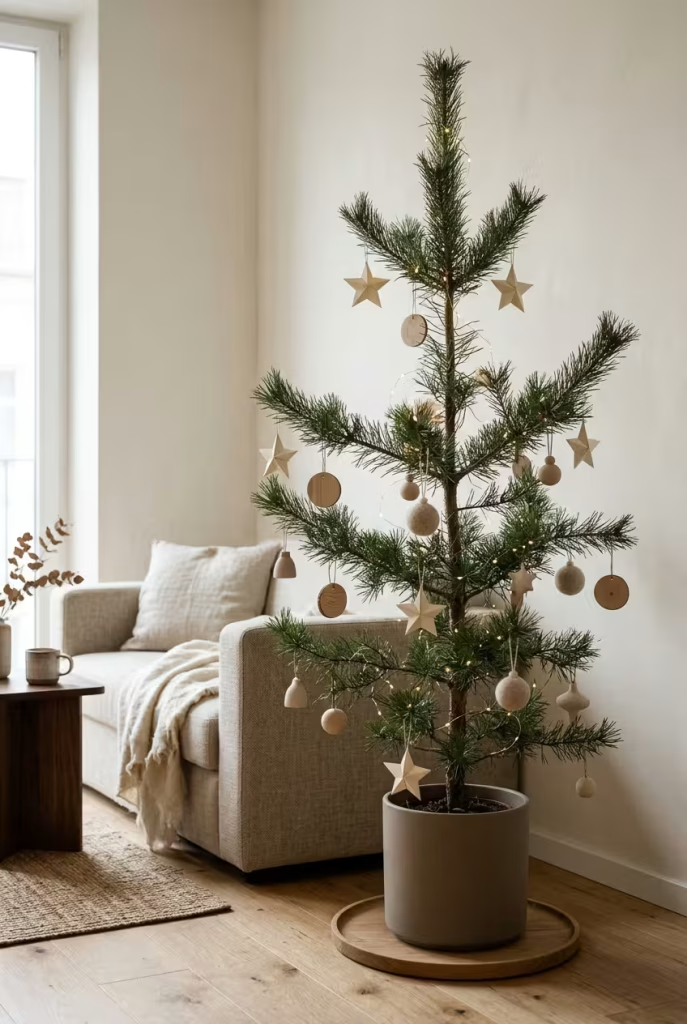
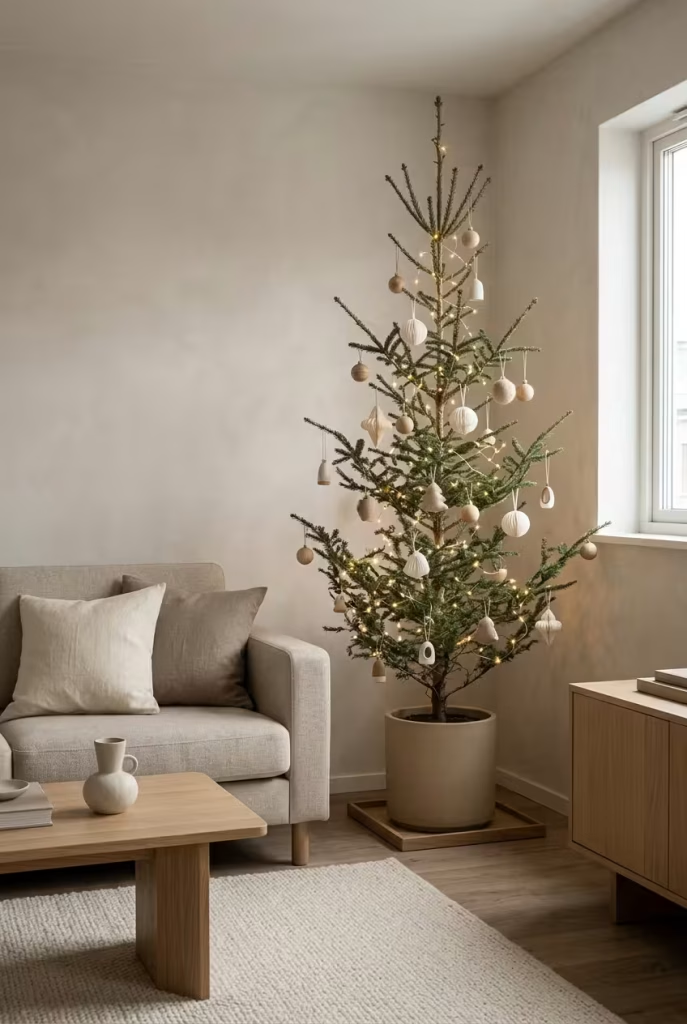
The style borrows the cosiness of Scandinavian hygge and the discipline of Japanese wabi-sabi, the habit of finding beauty in things handmade, weathered and slightly off-true. Strip away the jargon and it is a simple bargain: fewer objects, better materials, more space between them. On a tree, that bargain shows up in surprisingly concrete ways.
Hygge supplies the warmth: wool, lamps lit low, candlelight (swapped for LED here, for reasons we reach in the fire safety section). Wabi-sabi supplies the honesty: a paper star with a wonky fold, a ceramic bauble with a thumbprint in the glaze, a branch that bends the wrong way. That is why Japandi forgives the beginner. Imperfection is not a flaw to be hidden, it is half the charm.
| Feature | Scandinavian tree | Japandi tree |
| Shape | Full and lush | Sparse, with branches you can see |
| Palette | White, red and green | Oat, cream, sage, plus one deep accent such as rust or charcoal |
| Ornaments | Glass, metal, mixed | Paper, wood, felt, unglazed ceramic |
| Finish | Shiny is welcome | Matt and tactile; no high gloss, no metallics |
| Light | Bright and cheerful | Low, warm and steady |
| Guiding idea | Hygge | Wabi-sabi and negative space |
That last row is the one that rescues most trees. Stop earlier than you think you should. In Japandi, the gaps are not a failure to finish, they are the whole design. A tidy way to hold yourself back is the three-tone rule: choose two natural tones for the ornaments, say oat and pale wood, then add one deep accent. Anything that fails to fit one of the three goes back in the box.
One caution while we are here. A few popular guides push gold seams, bright lanterns and glossy metal baubles under the Japandi banner. They are lovely things, but they belong to a different look, so treat them as seasoning rather than the main course.
Before you buy the rental checklist
A tree that looks right in a photograph but fails on the doorstep is an expensive lesson, and in a rental the bill can arrive months later, when the deposit comes back a little lighter than expected. Run through these first.
- Read the tenancy agreement. Look for clauses on real trees, naked flames and fixings. One letting agency takes the view that landlords cannot reasonably ban decorations that are temporary, cause no damage and break no term, but your agreement has the final word.
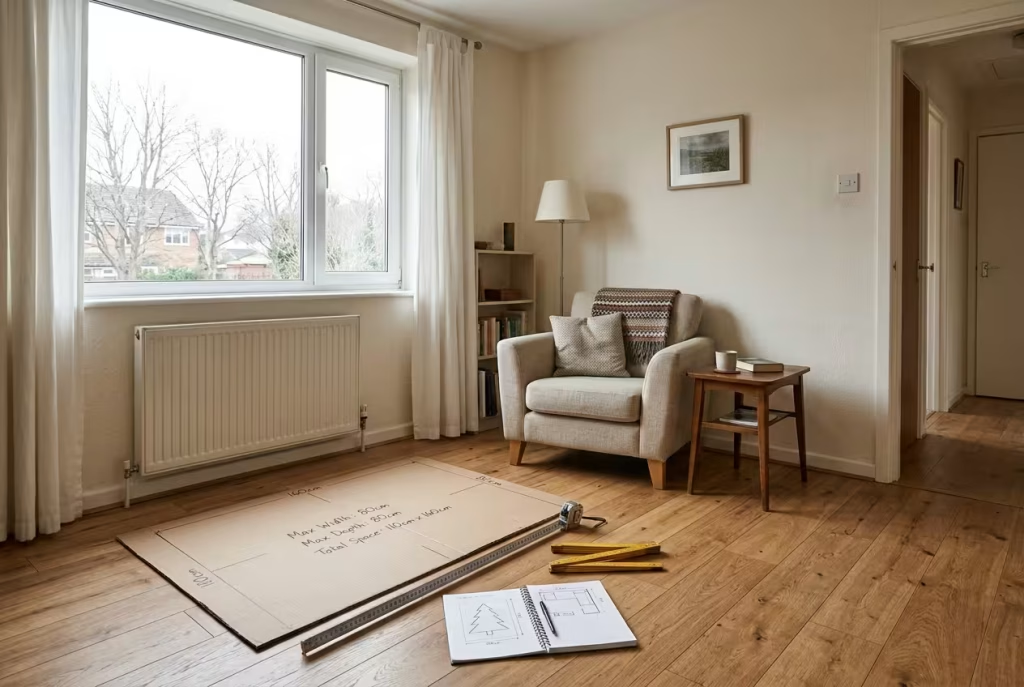
- Measure three things. The floor footprint plus 30cm for branches and elbows, the height to the nearest ceiling light, and the route from front door to corner. Squeezing a tree through a narrow hall is how walls and floorboards get scratched.
- Check what is on the wall. Blu Tack and sticky tape can lift paint or plaster, and the repair often comes out of the deposit.
- Respect the weight. A living 5ft tree in its pot can weigh around 68kg, according to a US university extension service. That matters on stairs and in upper-floor flats.
- Keep exits clear. A tree should never narrow a doorway or sit beside a fire escape route.
- Plan the January exit now. Where the box lives, or how a real tree leaves, decides whether this is a joy or a chore.
Then try a trick that costs nothing. Cut a piece of cardboard to the tree’s footprint, the width plus your 30cm margin, and leave it on the floor for a day. Walk past it with a cup of tea. Reach for the lamp. Open the cupboard. If you trip over the cardboard, you would have tripped over the tree, and it is far cheaper to learn that from a cereal box.
Which kind of tree suits a rental?
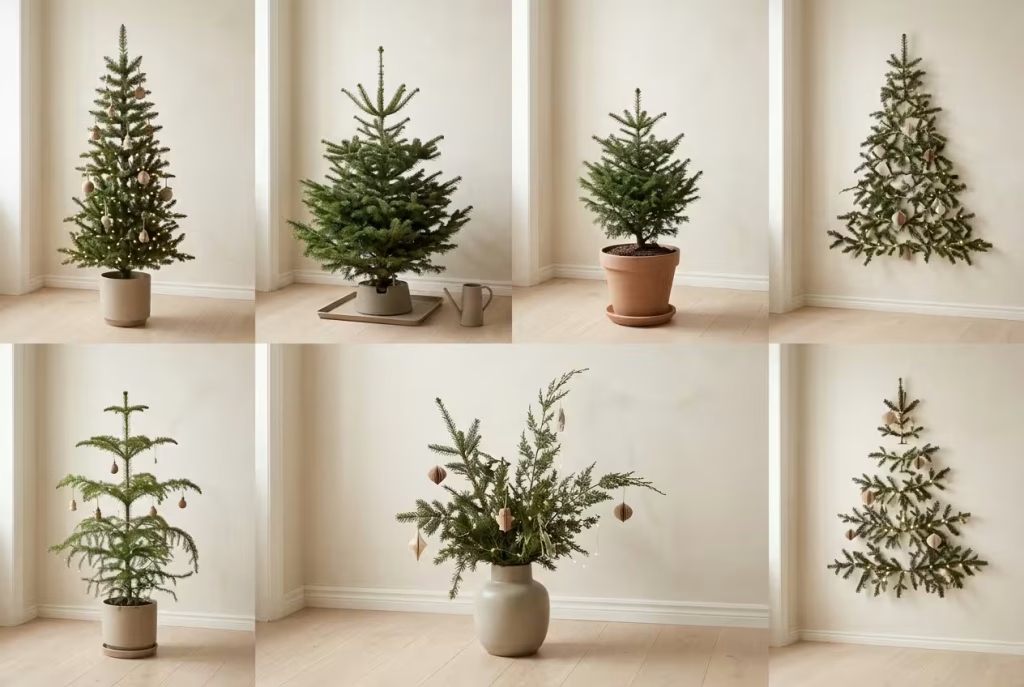
| Type | Best for | Watch out for | Time indoors |
| Slim artificial | Anyone wanting no mess and a reusable tree | The word slim has no fixed meaning, so check the listed diameter | The whole season |
| Cut real tree | Scent and a short, sweet display | Needle drop, daily watering, fire risk as it dries | About two weeks at most |
| Potted living tree | Gardeners with a spot to return it to | Soil spills, heat from radiators | Ideally 3 to 4 days, up to a week; some growers allow nearer two |
| Norfolk pine | Small flats wanting a year-round tree | Delicate branches, so only light ornaments | Year round |
| Branches in a vase | Tiny rooms, pet owners | Needs a heavy vase and fresh water | Several weeks |
| Wall tree | Rooms with no floor space at all | Fixings, so test them first | The whole season |
The environmental sums are worth a moment. The Carbon Trust puts a 2m artificial tree at around 40kg of emissions, against roughly 16kg for a real tree sent to landfill and about 3.5kg if it is burnt. That means an artificial tree needs reusing for about ten Christmases to come out ahead, though estimates elsewhere run from seven to twenty depending on the assumptions. The practical lesson is the same either way: buy one good tree and keep it for the long haul, or choose a real one and dispose of it well.
If you are still torn, ask yourself which sentence sounds most like you:
- I want no fuss and I plan to stay put. A slim artificial tree.
- I cannot live without the smell of resin. A compact cut tree, bought late.
- I have a garden, balcony or kind friend with one. A potted tree on a short stay.
- I want it all year, and I hate packing things away. A Norfolk pine.
- The floor is gone. Branches, a shelf tree or a wall tree.
You May also Like: 25 Christmas Room Decor Ideas That Bring Comfort, Charm, and Holiday Cheer
Choosing the shape six ways to start
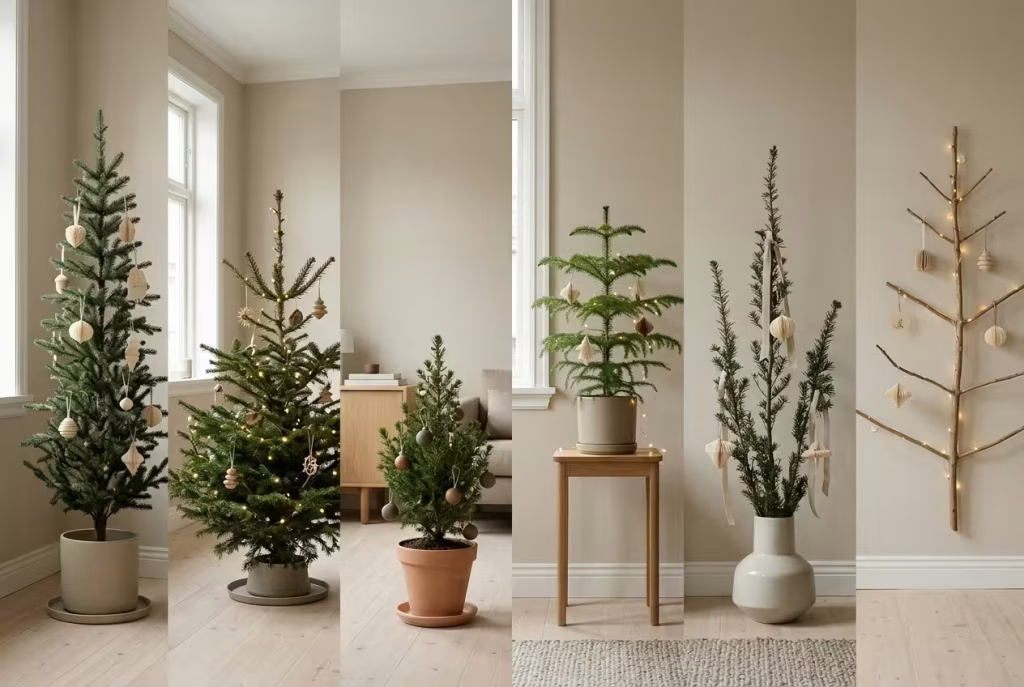
A tree begins with a decision, and in a rented room that decision carries more weight than anywhere else. These six options run from the cheerfully reusable to the deliciously temporary. None is better than the others, only better suited to your floor space, your landlord and your heart.
1. A slim artificial tree you plan to keep
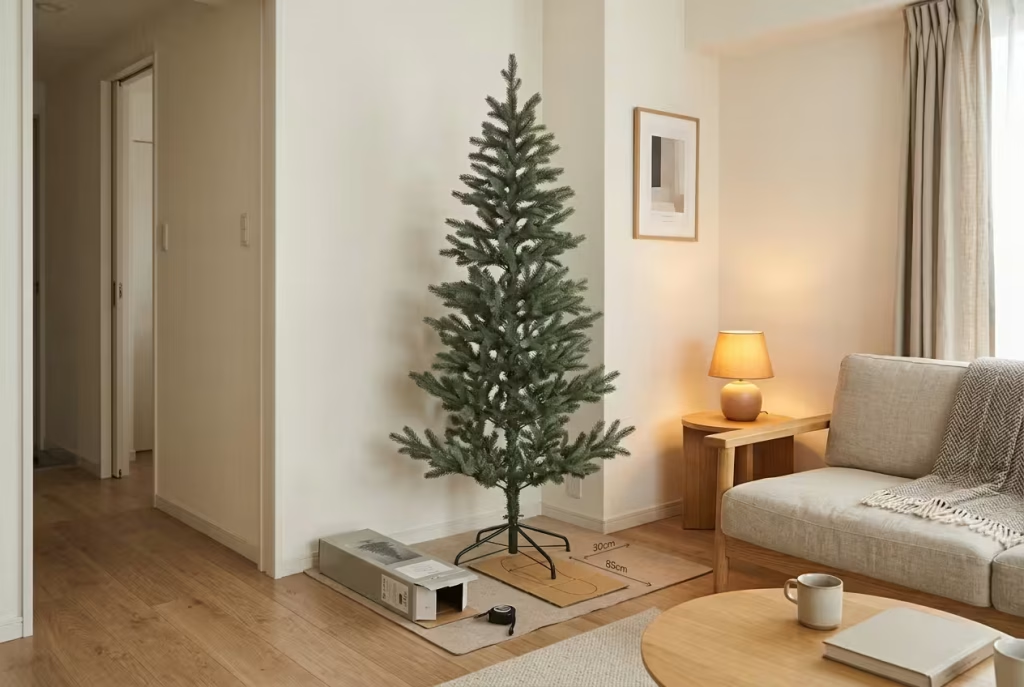
There is nothing romantic about the sensible choice, and yet a slim artificial tree is the one that lets you enjoy December rather than manage it. No needles to hoover from the floorboards, no water bowl to top up, nothing leaking onto a landlord’s laminate.
Before you click buy, run three quick checks:
- Diameter, not adjectives. Slim has no fixed meaning, so read the listed width at its widest point, then add your 30cm margin.
- Branch tips and finish. Open, uneven tips in a matt green look far more convincing than a glossy, perfectly symmetrical cone.
- The label. Look for a fire-resistant mark on the packaging before it comes home.
Designers often point out that a tall, narrow tree can fill a room visually without eating the floor, which is exactly the trick a small living room needs. Then do the one thing that makes the purchase worthwhile: keep it. At around 40kg of emissions for a 2m artificial tree, it only redeems itself over about ten Christmases, so think of it as furniture that sparkles in December and hides in a wardrobe the other eleven months.
2. A tabletop tree on the sideboard
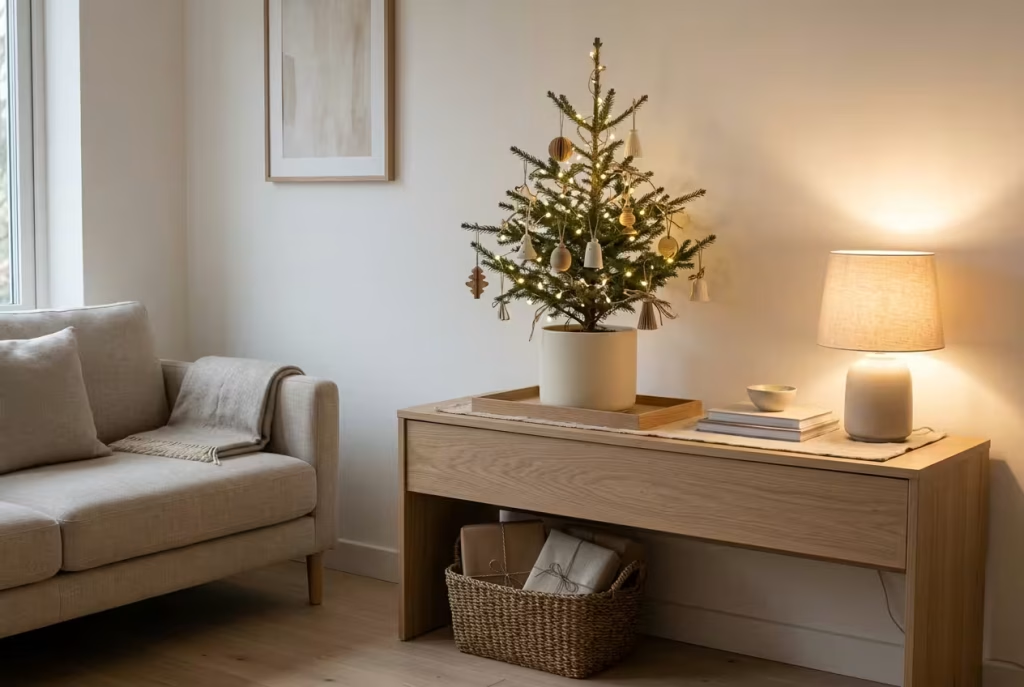
Picture the sideboard on Christmas Eve. The lamp is low, a small tree stands at eye level, and the sofa still has all its legroom. That is the quiet charm of a tabletop tree: it lifts the display to where you actually look, and it gives the floor back.
A few practical details separate a polished arrangement from a precarious one:
- Weigh up the surface. It needs to be stable, away from heat and wide enough for the stand, with a runner or tray beneath.
- Leave air above. Keep a hand’s width between the highest branch and any lamp shade, shelf or wall light.
- Keep sockets clear, so nobody has to unplug the tree to charge a phone.
- Hide the presents. A woven basket of wrapped gifts under the sideboard stops them spreading across the carpet like a slow tide.
The scale suits Japandi particularly well. A small tree forces restraint, and restraint is half the style.
3. A compact cut tree, bought late
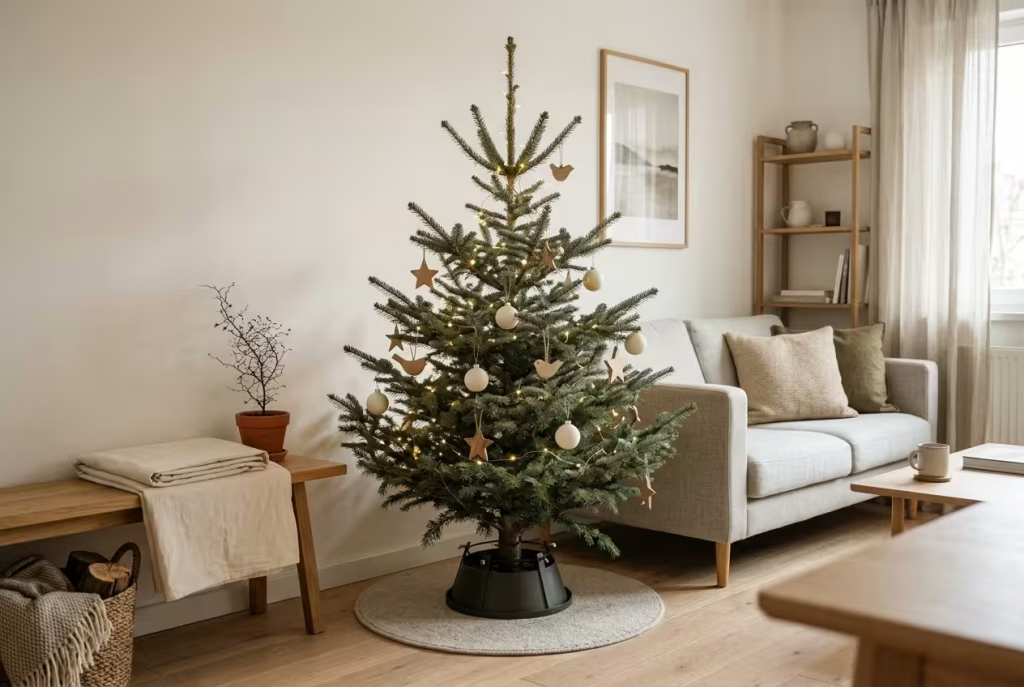
Nothing announces Christmas quite like the first breath of cut spruce in a warm room, and if that scent is non-negotiable, go small and go late. The London Fire Brigade treats a real tree as a two-week guest, and says it can drink up to two pints of water a day, so the longer it sits indoors, the more it asks of you.
Shopping day goes smoothest with a short routine:
- Buy as close to the day as you can, ideally a tree that has been outdoors until you collect it.
- Test it at the stall. Needles should resist a firm tug, the cut end should feel sticky with resin, and a thump on the ground should leave the branches unbothered.
- Wrap it for the trip. An old bed sheet protects the hallway walls on the way in.
- Water it every morning. Check the stand before the kettle goes on, and top up.
Place it away from radiators, and remember the aftermath. A real tree is a lovely thing to share a room with, provided you have already decided how it will leave.
4. A potted tree on a short lease
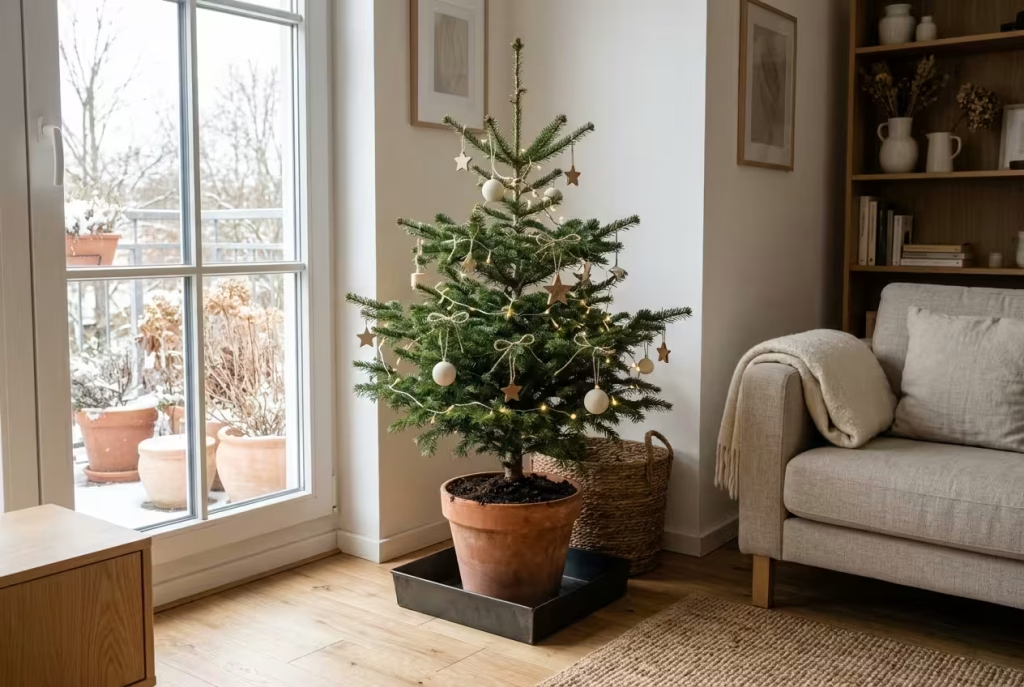
There is a gentle honesty in a potted tree. You are borrowing a living thing for a few days, with every intention of handing it back. Growers disagree on how long it can stay in the warm, with advice running from three or four days, through a week, to nearer two, so choose the cautious end of that range.
The kindest sequence is a slow one:
- Start outdoors. Let it acclimatise on a balcony, porch or doorstep for a few days first.
- Bring it in for the shortest stay you can manage, well away from radiators, on a deep tray.
- Water sparingly. Check the soil with a finger rather than pouring on a timetable.
- Return it outdoors promptly rather than letting it linger.
If you have no garden, ask a friend, a relative or a local community garden whether it can have a home afterwards. Settle that conversation before you buy, because a tree with nowhere to go is a lovely idea that quietly turns into a problem.
You May also Like: 24 Christmas Pathway Lighting Ideas That’ll Make Your Home Glow Easy, Dazzling & Cozy
5. A Norfolk pine as a year-round tree
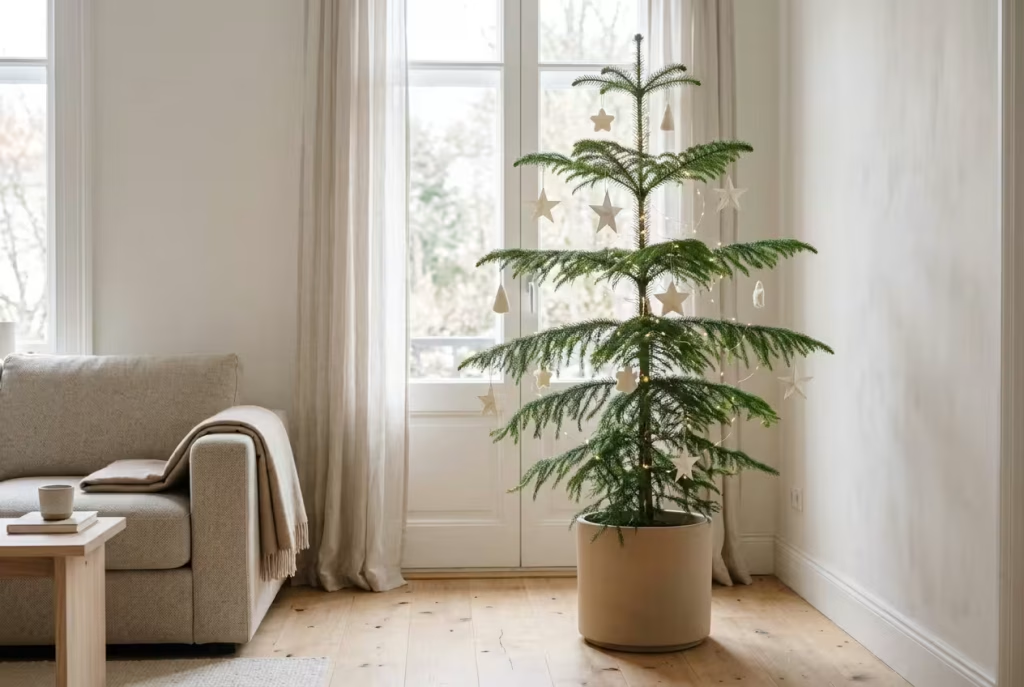
Most Christmas trees are a short love affair. A Norfolk pine is a long marriage. It is a houseplant that happens to look like a small, tidy conifer, and in a bright spot it can live in the same pot for years. For a tenant who dreads the January ritual of dismantling and dumping, that is quietly revolutionary.
Dress it as you would a spring branch, with restraint:
- Hang no more than a handful of paper stars or felt shapes, because its branches are delicate and cannot carry weight.
- Use a thin thread of cool LED lights rather than a heavy string.
- Keep it where it gets good light all year, not stuck in a dim corner.
In January you simply take the decorations off, and it goes back to being a plant. In a rental, where you never quite know where you will be next December, a living thing that travels with you becomes part of how a place starts to feel like home.
6. Bare branches in a heavy ceramic vase
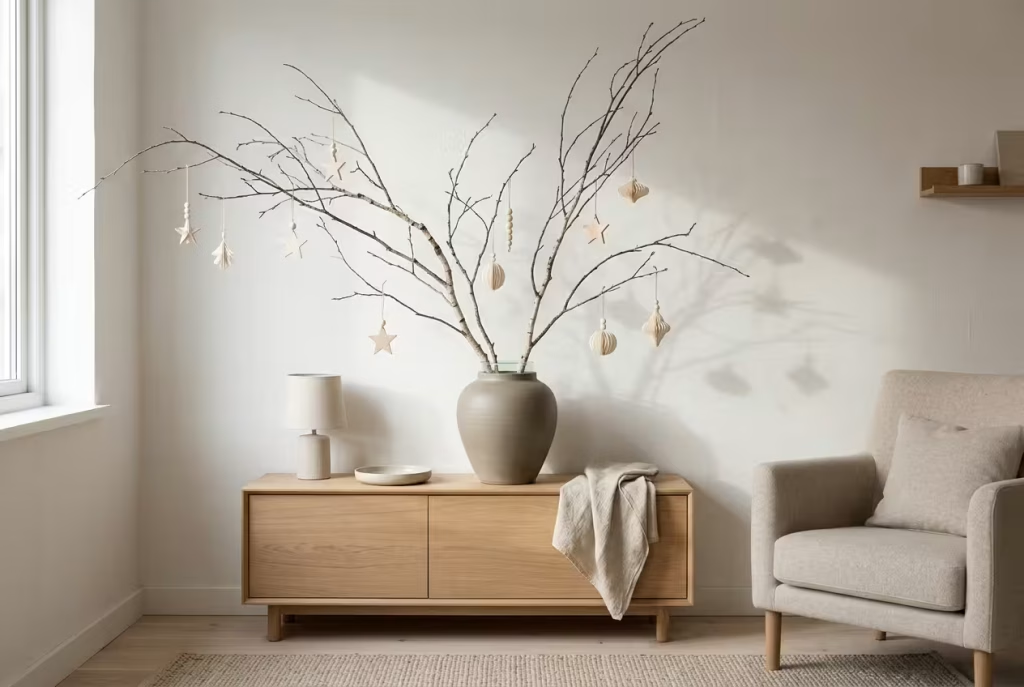
Japandi at its purest borrows from ikebana, the Japanese art of arranging branches so that the empty space around them matters as much as the wood itself. Applied to Christmas, it is disarmingly simple, and it asks very little of a small room.
Here is how to build one that looks designed rather than dropped in:
- Gather bare birch, pine or cedar branches from your own garden or a florist, cut to different lengths.
- Choose a heavy ceramic vase, one that will not topple if a sleeve brushes it.
- Hang six to eight paper or wooden ornaments, spacing them so bare twig shows between each.
- Keep fresh water in the vase for cut branches, and top it up as it drops.
Nothing tips over, no needles fall, and when the baubles come off in January the arrangement is still sculpture. It is also the tonic for the flat so small that even a pencil tree would feel like a crowd.
Finding the right spot four placements that work
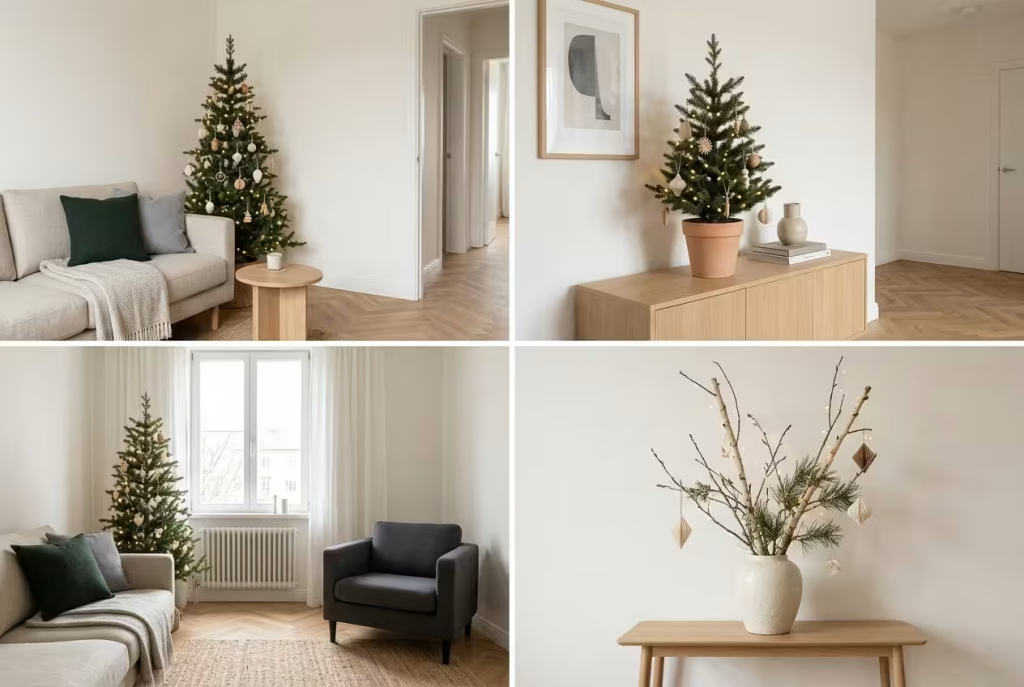
Where a tree stands matters almost as much as which tree it is. A grand one in the wrong spot becomes a daily obstacle, while a modest one in the right spot looks as if it was always meant to be there. Four placements earn their keep in a small room.
7. Wedged into a corner
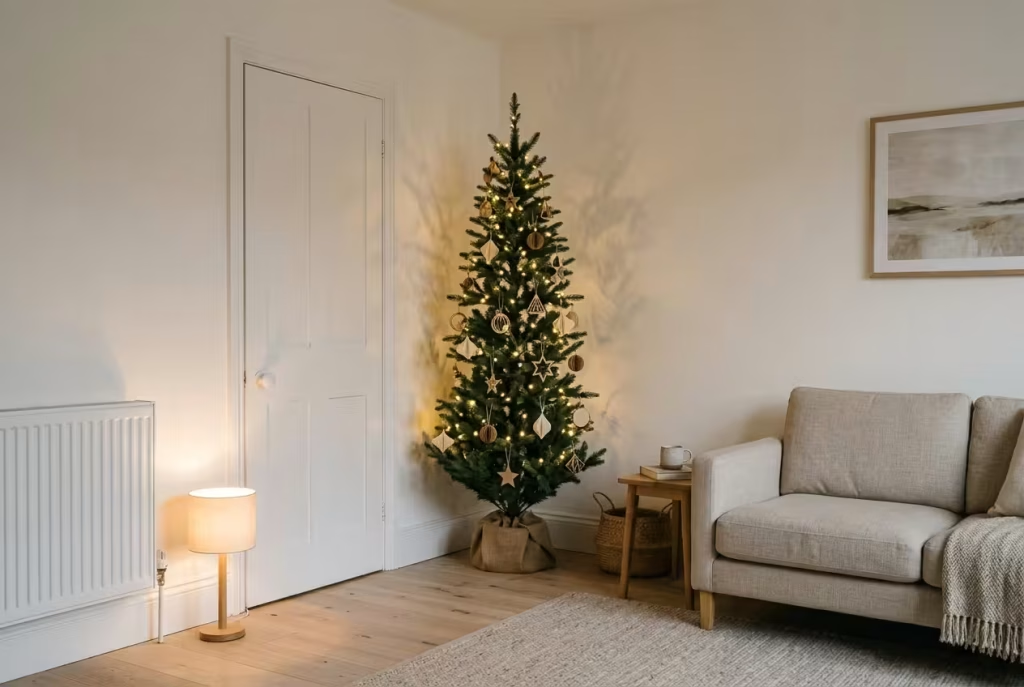
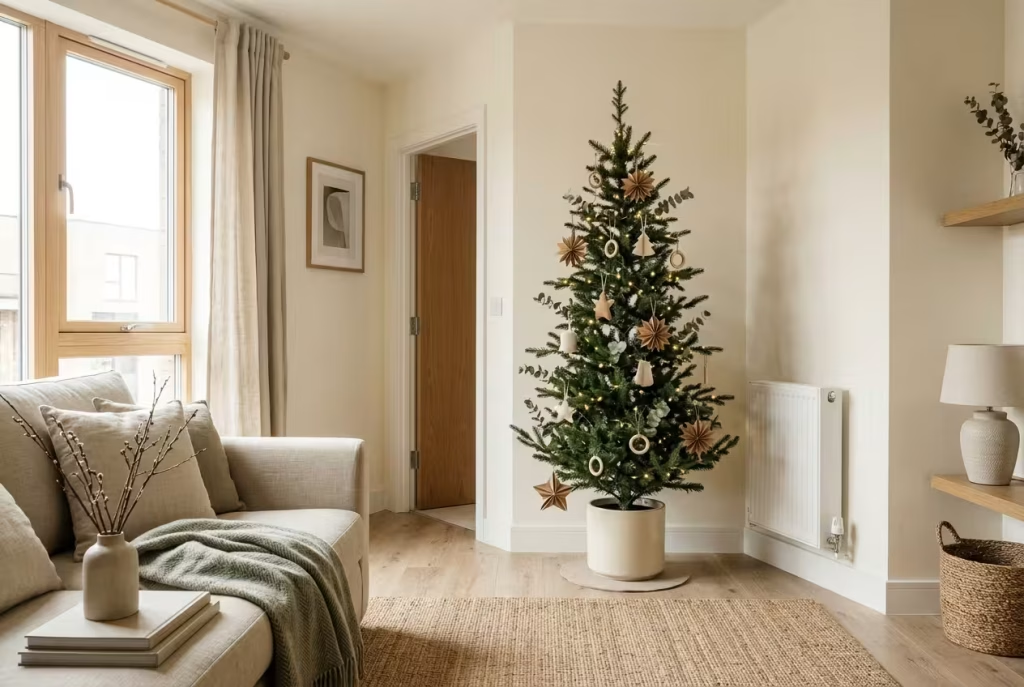
A corner is the most underused real estate in a small living room, and it happens to be the natural home for a tree. Two walls steady it, the footprint is tucked out of the traffic, and the room loses almost nothing.
Three checks before you commit:
- Swing the door fully open and shut. A branch snagged on the handle gets old very quickly.
- Hold a full metre back from any radiator, since heat dries a real tree and can spoil an artificial one.
- Angle the best side towards the sofa. The back can stay sparse, and nobody will ever know.
A tree in a corner also changes how the room feels. The eye travels along the walls, settles on the glow, and the whole space seems a little deeper than it did the week before.
8. Beside the window
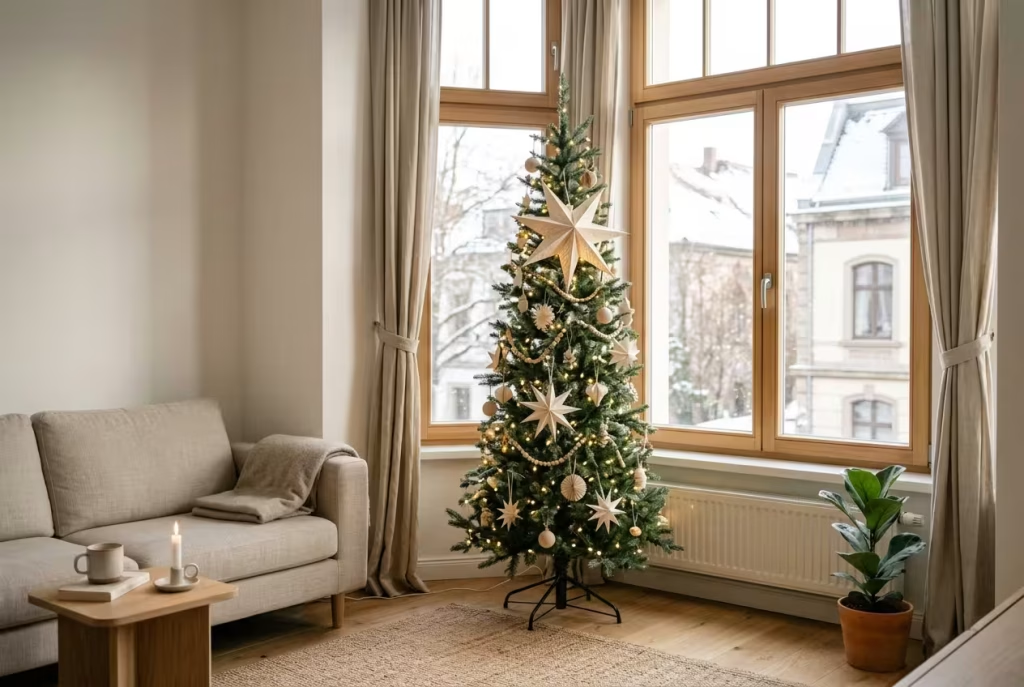
There is a particular kind of magic in a tree glowing in the window, on duty for you indoors and for everyone walking past outside. It is a small, generous gesture, and it costs the neighbours nothing.
To keep it safe and tidy:
- Draw the curtains well back, so fabric never touches branches or bulbs.
- Check there is no radiator beneath the sill, since a hot windowsill is the wrong place for any tree.
- Run the cable along the skirting board, away from doorways and feet.
- Leave the window itself easy to open, in case you need air.
Daylight helps too, because natural light shows off the texture of paper and wood far better than lamps do. A pale paper star in morning sun is one of the prettiest things a small flat can produce.
9. A shelf of its own
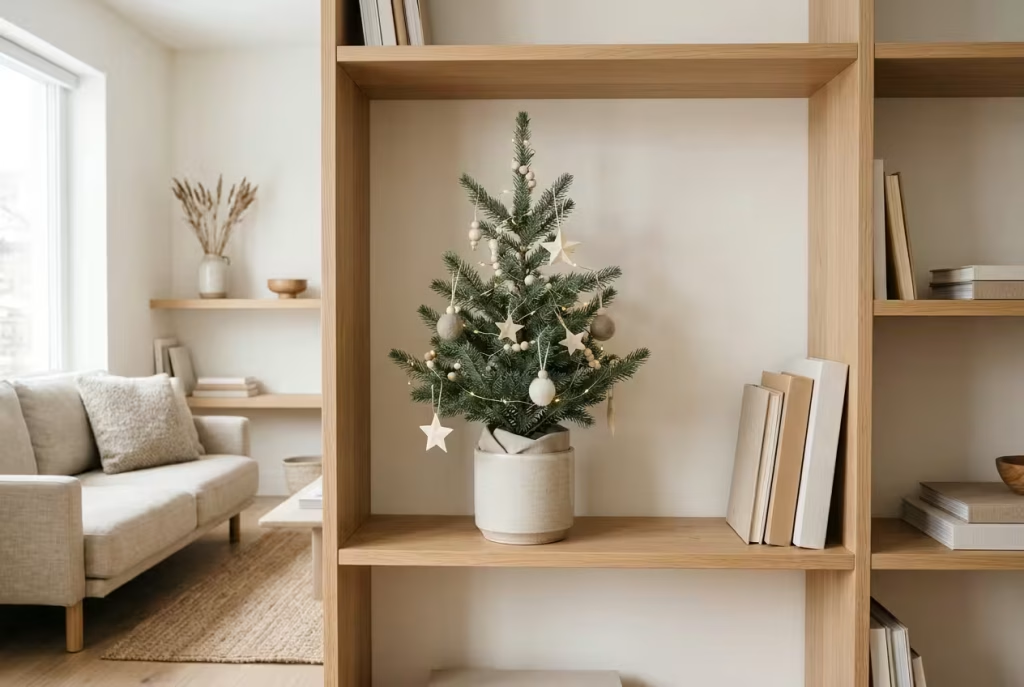
When floor and surface are both spoken for, borrow a shelf. Clear one level of the bookcase, lean a few books spine-in to form a calm backdrop, and set a small tree in the gap. It reads as deliberate rather than squeezed in.
A few details make it work:
- Choose the right shelf. Eye level or just below, so ornaments are seen rather than craned at.
- Clear the clutter. Take away everything except a single stack of books, so the tree has air around it.
- Mind the cable. Battery lights save a lead trailing down the shelving.
There is a library-like warmth to a tree among books. It suggests a household where reading comes first and Christmas arrives quietly, which may be exactly the mood you are after.
10. Paired with a lamp by the sofa
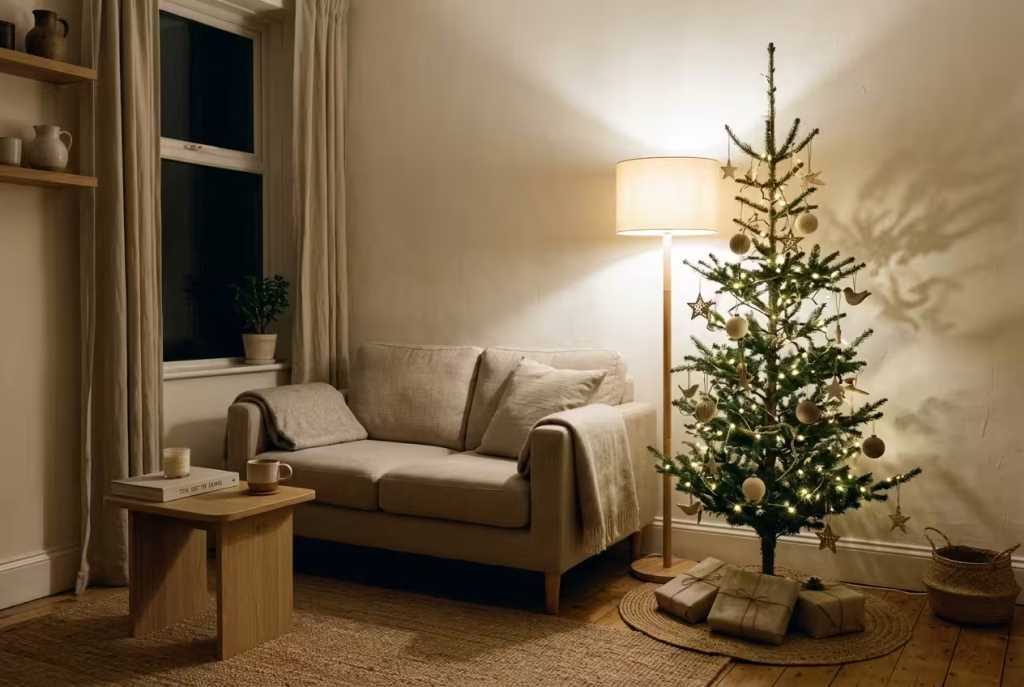
Stand a tree beside a floor lamp of similar height and the pair reads as one composed picture, rather than a tree plus clutter. The lamp’s glow washes the branches, so you need fewer lights on the tree itself, and the shadows on the wall do some of the decorating for free.
Some pairing pointers:
- Match the heights roughly, within a hand’s span or so.
- Choose a lamp with a soft, warm shade, ideally paper or linen.
- Leave the arm of the sofa clear for a mug and a book, because a tree you cannot sit beside is a tree you will resent.
On a dark December evening, with the ceiling light off and this pair glowing in the corner, a rented room can look as though it has been loved for years.
Dressing the tree five Japandi touches
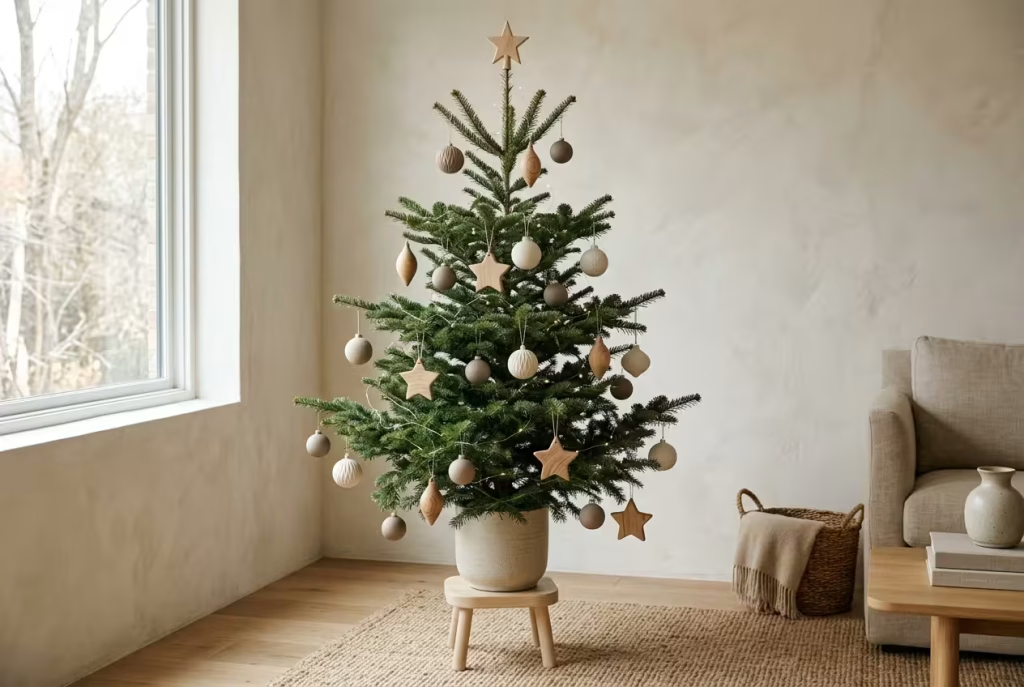
This is where Japandi earns its keep. The ornaments you choose, and the ones you leave in the box, do most of the work of making a small tree feel considered. Keep to two or three natural tones, leave green showing around each piece, and remember that oversized baubles swamp a small tree while tiny ones vanish into it.
You May also Like: Vintage Christmas Decor Ideas Create a Cozy, Nostalgic Home This Festive Season
11. Folded paper stars
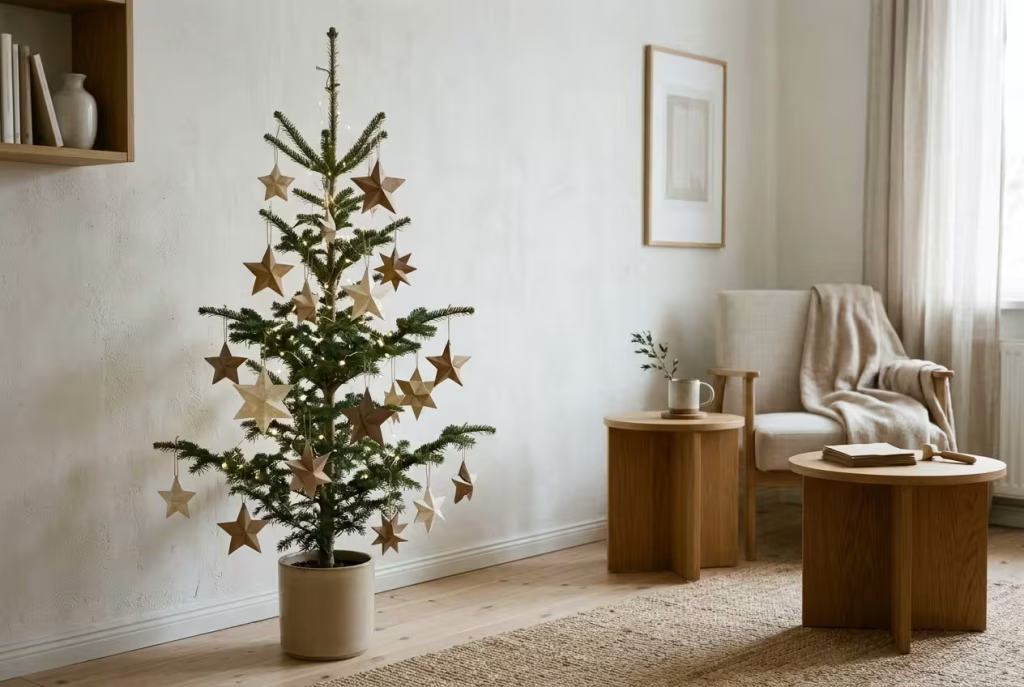
Folding a paper star is one of those small domestic rituals that gives a whole afternoon a point. A pile of kraft or washi squares, a mug of something warm, and by teatime there is a constellation. Because paper weighs next to nothing, even the most delicate branch will carry it without complaint.
Make them part of the season rather than a chore:
- Fold a mixed batch in two or three sizes, so the tree has rhythm.
- Hang them at different depths, some close to the trunk and others near the tips.
- Leave visible green around each one.
If there are children in the house, or a friend who insists they are hopeless at crafts, hand them the squares. The wonkiest fold is the most wabi-sabi of the lot.
12. Wooden bead garlands
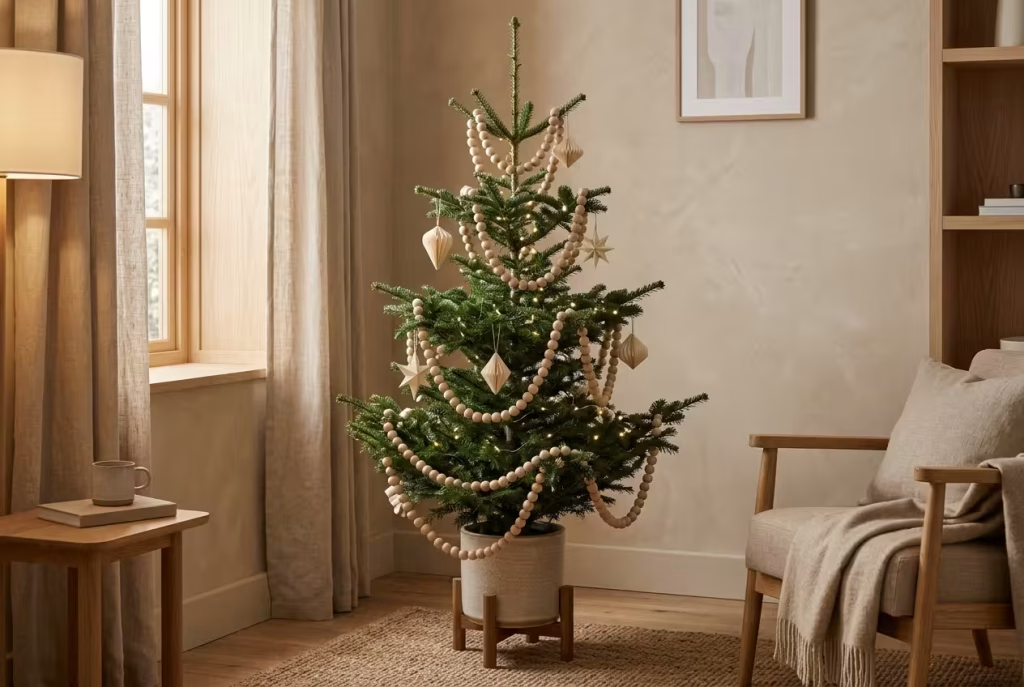
A strand of natural wood beads drapes in soft, irregular curves that glossy tinsel can only dream of. It is also one of the simplest ways to carry the grain of pale oak or ash onto a tree.
Hang it with a light hand:
- Start at the top and let the strand fall loosely, rather than winding it tight.
- Keep the loops uneven, since perfect spirals look machine-made.
- Stop while you can still see branches.
Pair the beads with oat-coloured walls and linen, and the whole corner takes on a warm, quiet glow. It is the sort of detail guests notice without being able to say why.
13. Felt and wool shapes
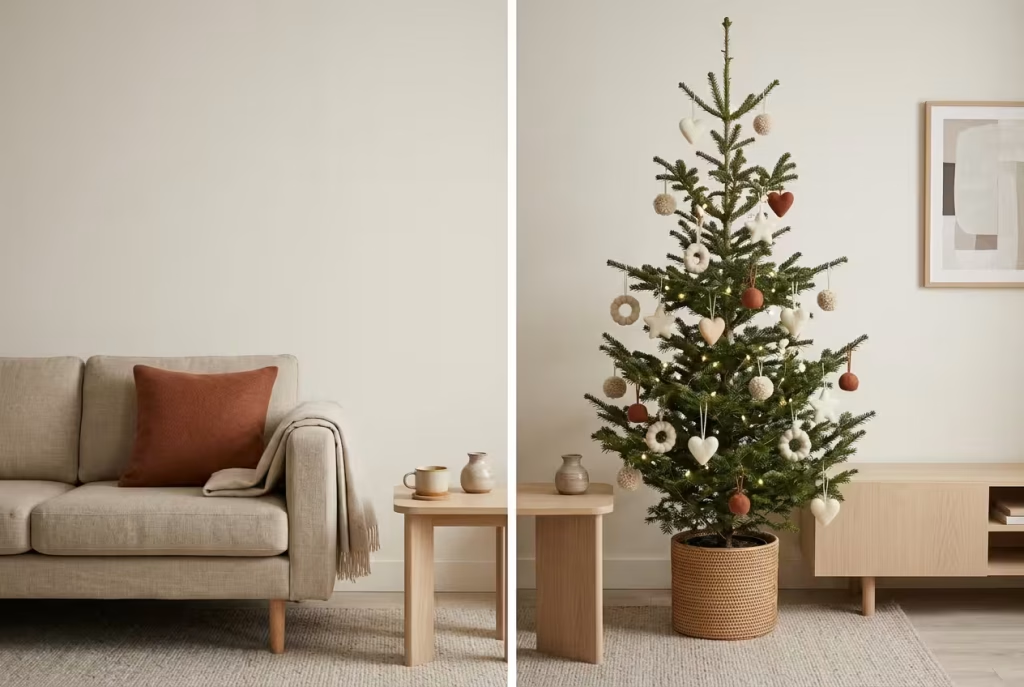
Soft things soften a room. Simple felt hearts, stars and mini wreaths add tactile warmth without weight, and they bounce rather than shatter if a cat takes an interest or a sleeve catches a branch.
This is also the place for your one deep accent. Choose rust, burgundy or charcoal, and use it in a handful of pieces rather than scattering it across every branch. The restraint is what makes it look expensive.
Cream wool pom-poms tuck neatly between the green, and a few felt shapes in the accent colour can echo a cushion or throw elsewhere in the room, tying the tree into the wider scheme.
14. A few unglazed ceramic pieces
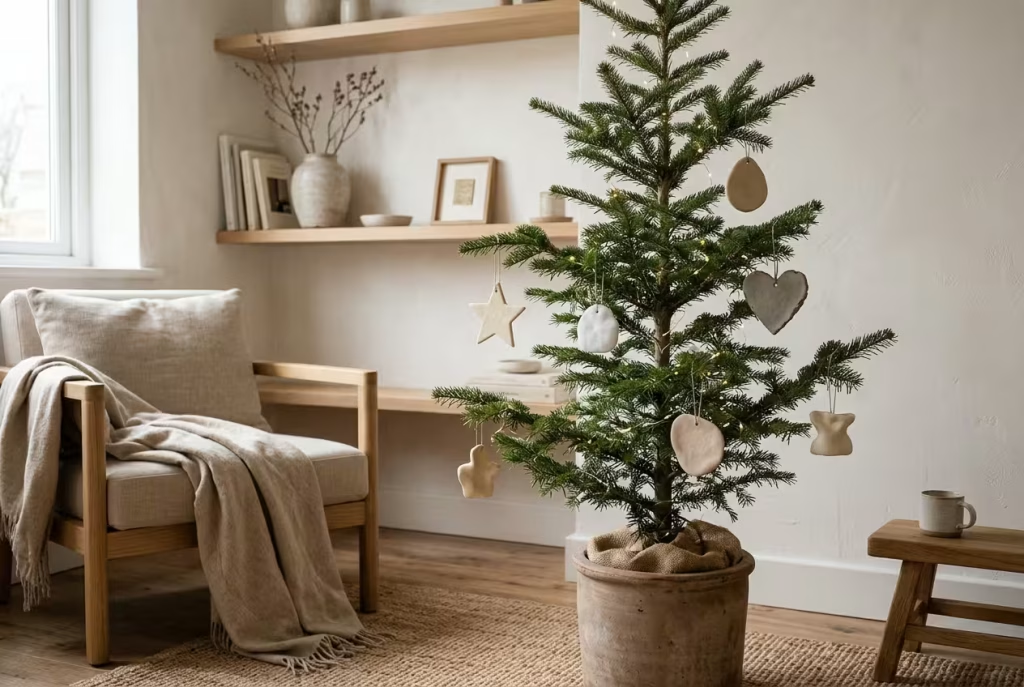
Three to five handmade ceramic ornaments are plenty. Any more and the tree starts to feel like a shop display, and the whole point of ceramic is that each piece should be noticed.
What to look for:
- Unglazed or matt surfaces, which feel good in the hand and sit quietly among the green.
- A slightly uneven edge or thumbprint, the wabi-sabi signature that mass-produced copies rarely capture.
- A light weight, because ceramic is heavier than paper or felt.
Hang them low and close to the trunk, where branches are sturdiest. Handmade pieces often come with a story, a potter’s name or a market stall in the rain, and those stories become part of the tree. In a rented home where little else is yours to alter, a few well-chosen handmade things carry a surprising amount of meaning.
15. Linen ribbon and twine bows
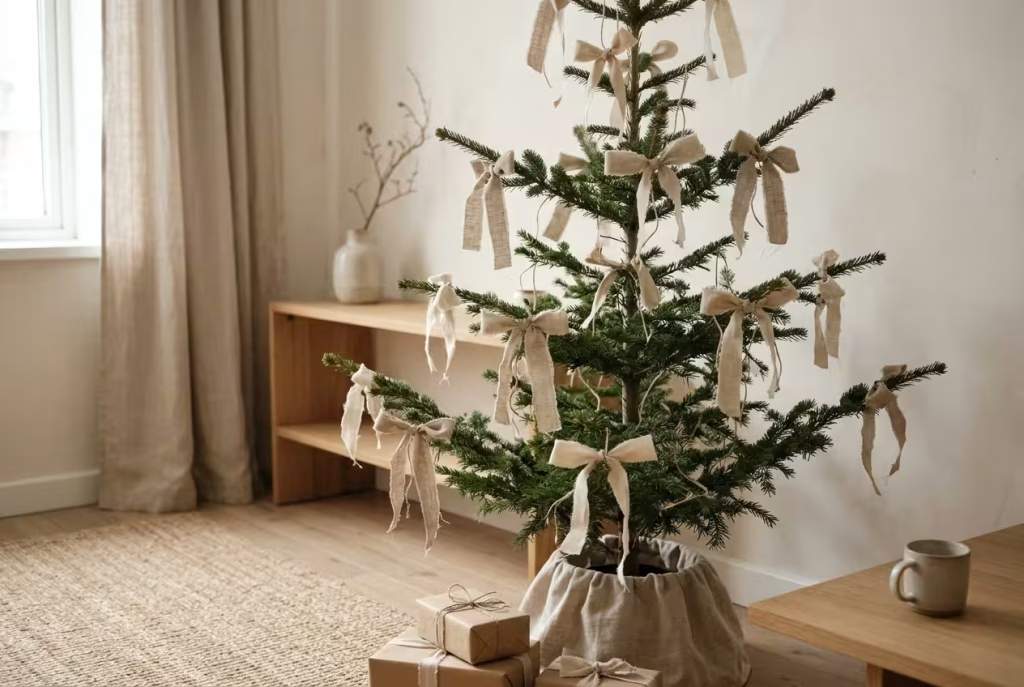
Some of the loveliest decorations cost almost nothing. Tear strips from an old linen napkin, or take a ball of plain twine, and tie small bows at the tips of the branches. It takes ten minutes, it echoes the linen collar around the base, and it gives the whole tree a softly bundled look.
Keep within your palette of two or three tones, and hold gloss and metallic finishes at arm’s length. A shiny gold bow will shout across a room where a linen one merely whispers.
If you want to stretch the idea, wrap presents in plain kraft paper and tie them with the same twine. The tree and the gifts then belong to one family, and the room looks composed before anyone has opened a thing.
Lighting the tree three warm approaches
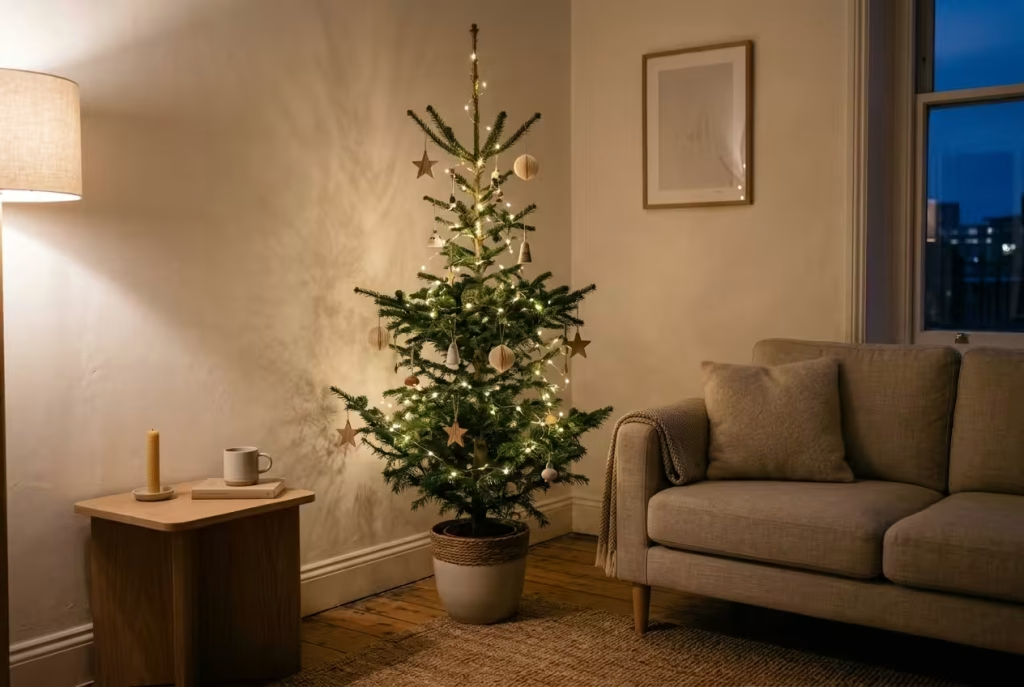
Light does more for a minimalist Christmas than any ornament, which makes this the cheapest place to get things right. The aim is a glow, not a glare.
16. Warm white lights, tucked deep
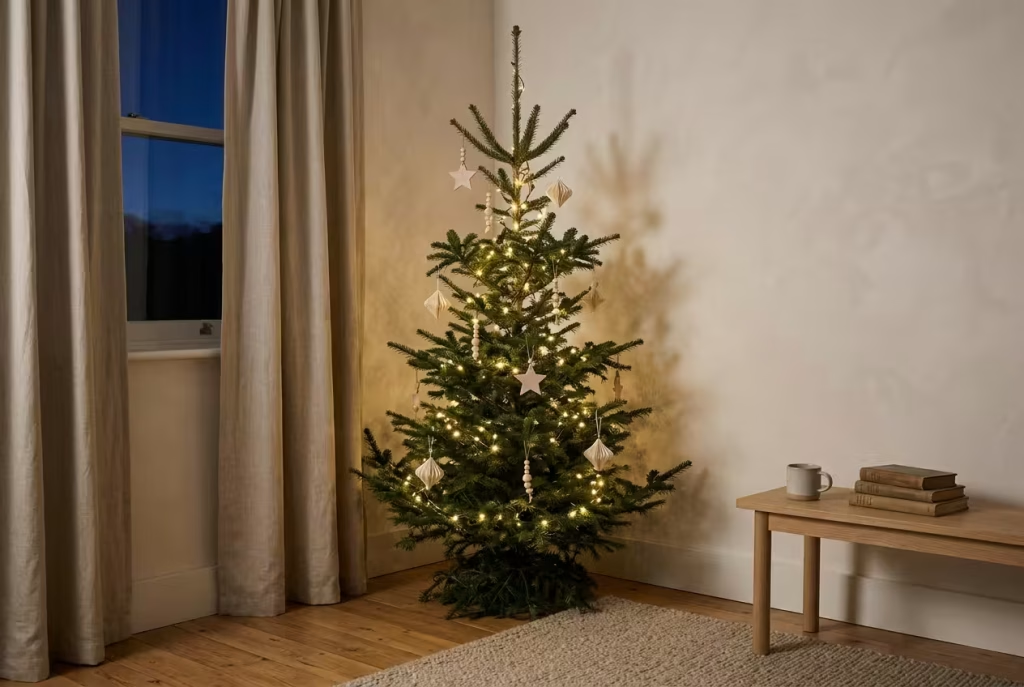
Aim for warm white at about 2700K and run the lights on steady rather than flashing. Flashing is exciting for about nine seconds and tiring for the rest of the evening, whereas a constant warm glow lets the eye relax.
Fit them well:
- Weave the strand deep inside the branches, so you see a glow rather than a row of bulbs.
- Work from the trunk outwards, then upwards, so the light seems to come from within.
- Buy from a reputable seller and check for a CE or UKCA mark.
- Switch them off at bedtime and whenever you leave the flat.
- Avoid electric lights on trees with metallic branches.
Done well, warm white turns wood from grey to honey, and it makes a small room feel gently lit rather than brightly staged.
You May also Like: 21 Christmas Mountain Lodge Living Room Design Ideas
17. Battery lights on a timer
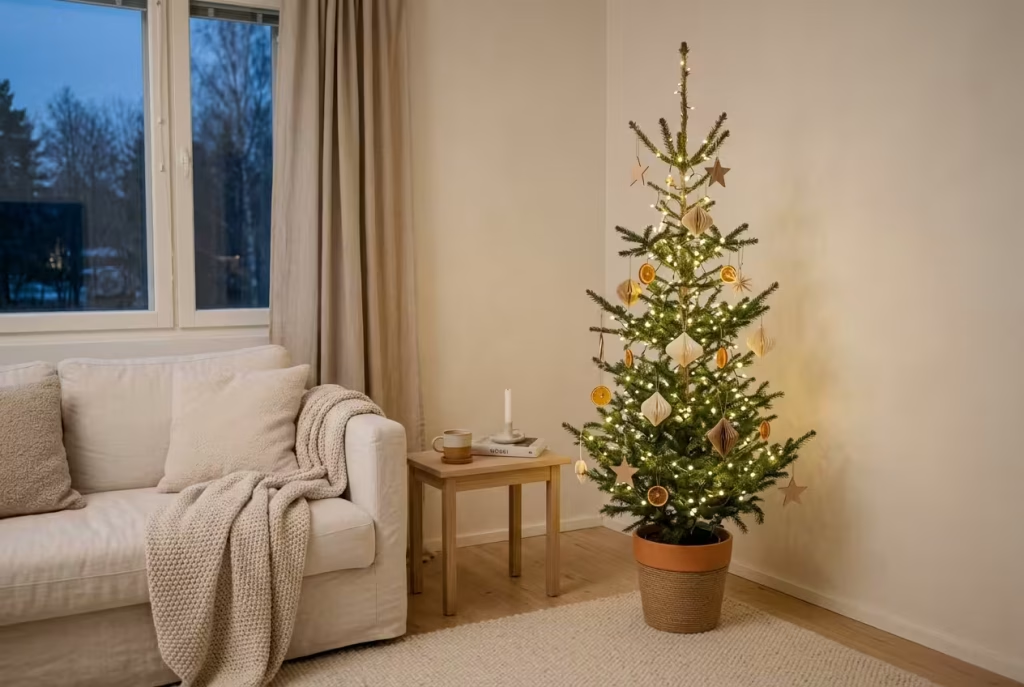
In a small flat, sockets are precious real estate, and an extension lead snaking across the floor is no part of the Japandi look. Battery-powered micro lights solve both problems at a stroke. They free you from leads, and a built-in timer takes the nightly switching on and off out of your hands.
Many timers run six hours on and eighteen off, so the tree glows at dusk and rests overnight without any effort from you. Check how the battery pack sits, and tuck it among the branches or behind the stand so it does not spoil the picture.
It is a small thing, but there is real pleasure in coming home on a dark evening to a tree that has already switched itself on, as though the room had been waiting for you.
18. Let a lamp do the heavy lifting
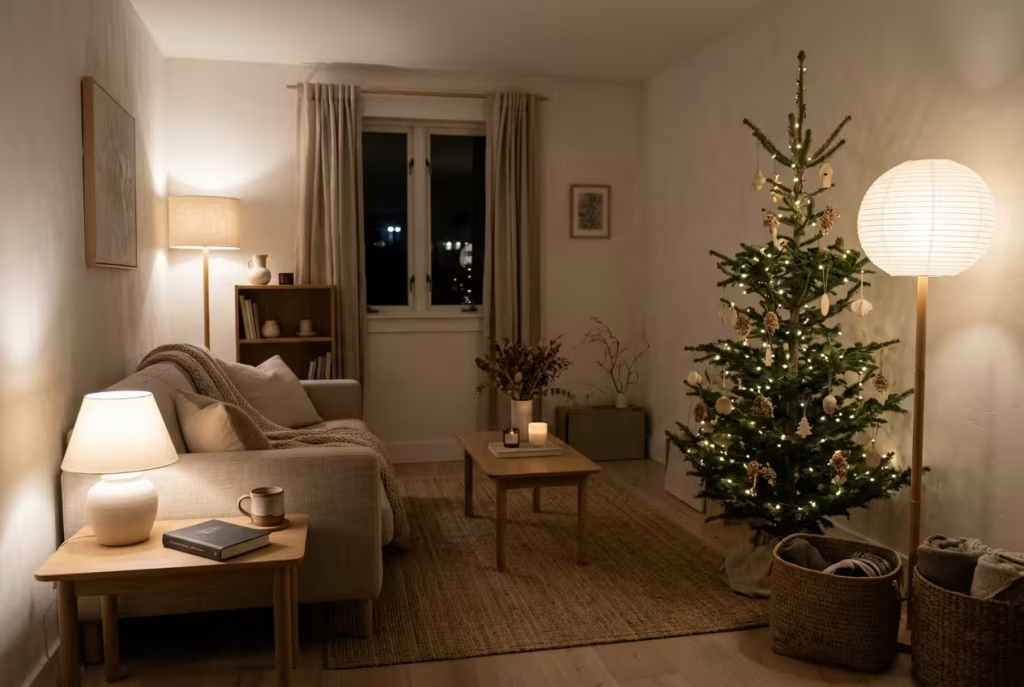
Switch off the harsh ceiling light and build the room from small pools of low light instead. A paper-shaded lamp near the tree softens the whole corner, and you can dim the tree’s own lights to a whisper.
Try layering the room from the furthest light to the nearest:
- A lamp in the opposite corner, for balance.
- The tree, lit gently, as the focal glow.
- A small table lamp at sofa height, for reading and a mug of tea.
The effect feels less like a display and more like a hearth. It also does something kind for tired eyes at the end of a long day, because the room stops demanding attention and starts offering rest.
Protecting the deposit three renter-proof moves
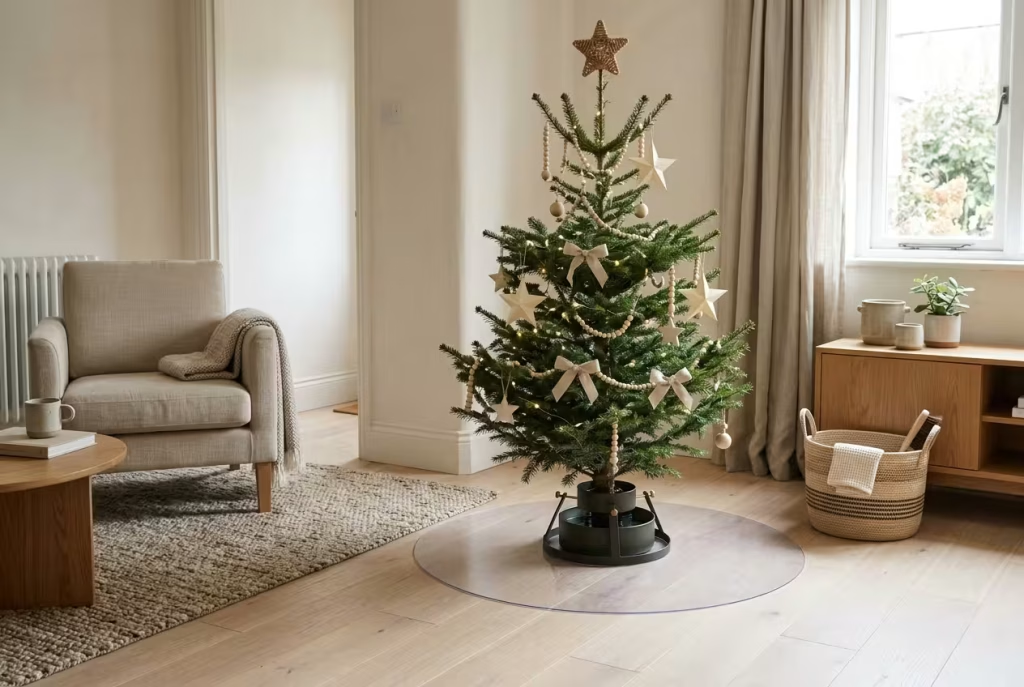
This is the zone that protects your money. A rental asks you to leave the place as you found it, and a tree, with its stand, water and needles, is the biggest test of that promise. A few small precautions turn it from a risk into a non-event.
19. A tray and a felt pad under the stand
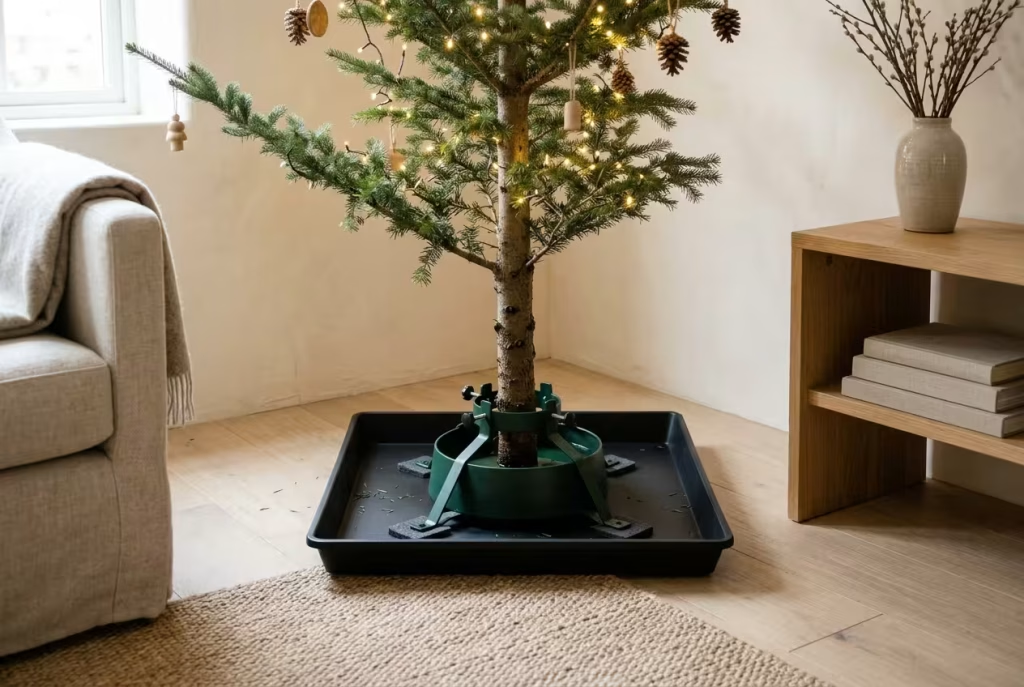
Stands scratch, and watered trees leak. Between them they account for most of the damage a Christmas tree does to a rented floor, and both are cheap to prevent.
A simple protection set-up:
- A felt pad under each foot of the stand, to stop scratching.
- A shallow tray beneath the whole base, deep enough to catch spills.
- A cloth or small rug under the lot, to catch needles for easy sweeping.
A real tree needs a tray with real depth, not a decorative saucer that only looks the part. Done properly, the floor emerges none the worse for wear in January, and the day the deposit comes back is a quietly satisfying one.
You May also Like: How to Style a Dining Room for Holiday Gatherings: Expert Tips, Décor Ideas & Lighting
20. A linen collar instead of a skirt
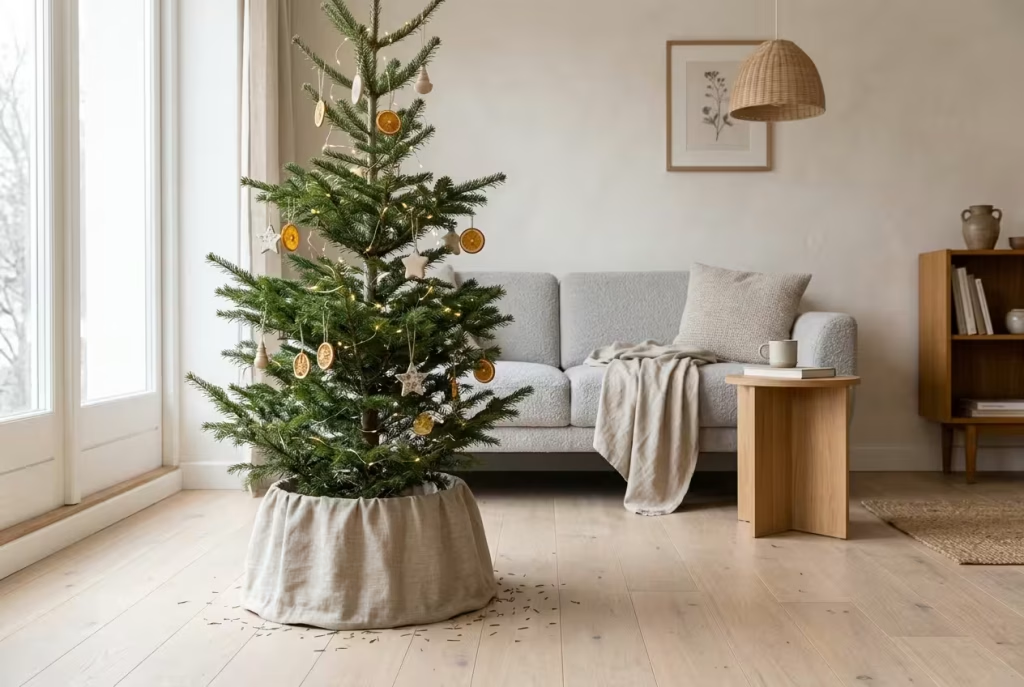
Bulky tree skirts swallow floor space and snag on the vacuum, which is why a neat linen collar or a small natural jute mat is the better answer in a small room. It hides the stand without crowding anything, and it keeps needles and the odd drip in a single place for easy cleaning.
The collar earns its place beyond December. Once the tree goes, it can become a cushion cover, a table runner or a wrap for a plant pot, so it never turns into one more thing in the cupboard.
Choose natural fibres in an oat or sand tone, and resist the urge to add pattern. Plain linen under a plain tree is a small act of confidence.
21. A wall tree that leaves no trace
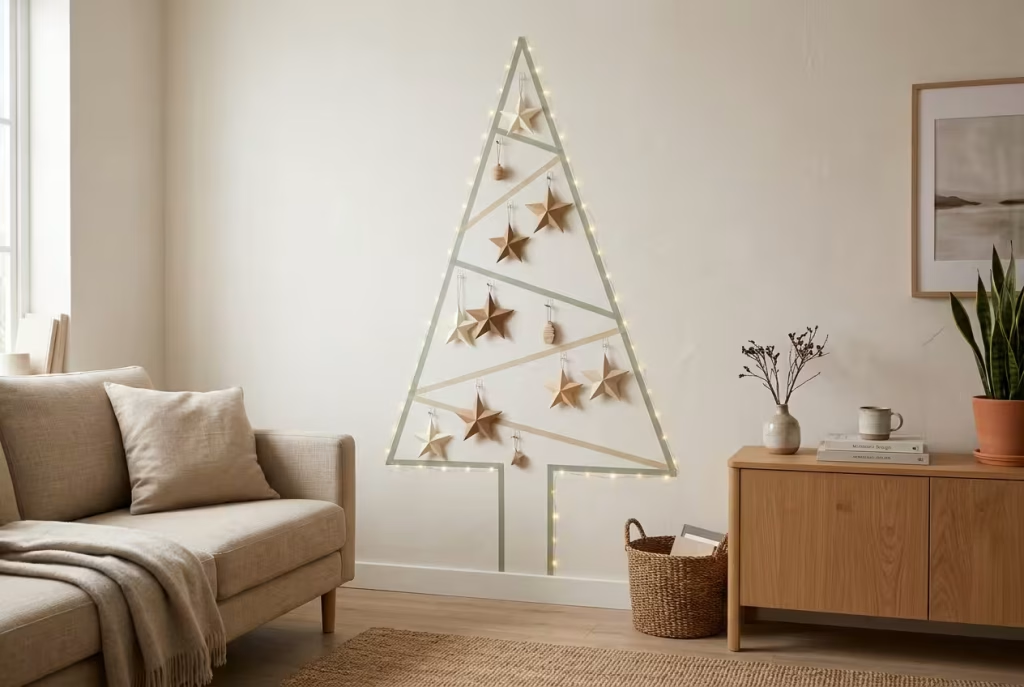
When there is no floor at all, the wall becomes the tree. Trace a tree shape with warm white lights held on damage-free clips, or outline one in washi tape, and hang a few paper stars from small hooks that peel away cleanly.
Doing it without leaving a mark:
- Test first. Try the tape or clip on a hidden patch for a day, and check it lifts without taking paint with it.
- Sketch the shape on paper and hold it up, to judge height and width before anything touches the wall.
- Use the full height the wall allows, because a tall, thin tree reads as grand in a small room.
- Remove it slowly in January, warming the tape with a hairdryer if it resists.
It takes up zero floor, it costs next to nothing, and it peels away cleanly when the season ends.
Packing away two ideas for January
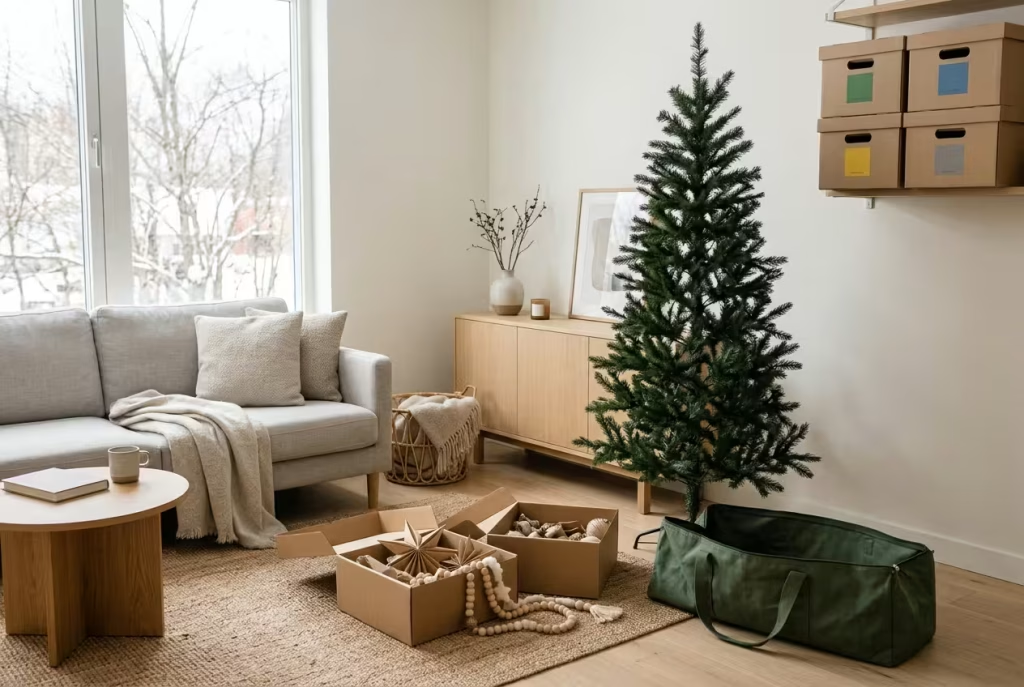
Christmas does not end on Boxing Day, at least not in a small flat. What you do in January decides whether next year’s tree feels like a welcome guest or a returning problem.
22. A flat-pack storage plan
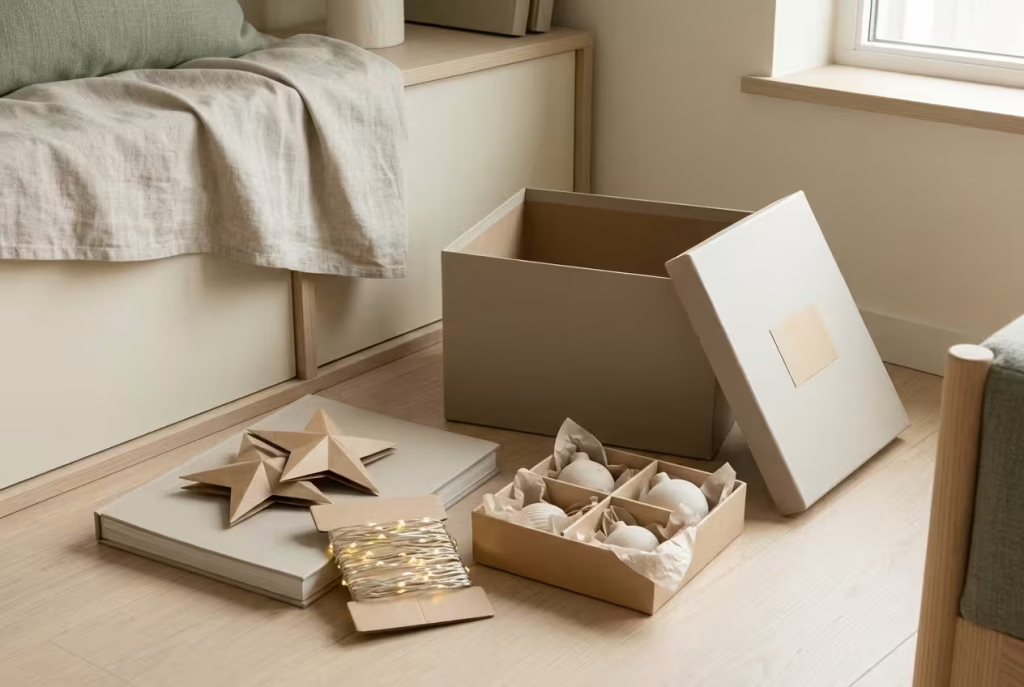
Storage is the problem nobody photographs, and in a small flat it decides whether next year’s tree is welcome. A little planning now spares you the sinking feeling of a box that will not fit anywhere.
Pack it like this:
- Keep paper stars flat inside a large book or folder.
- Wind lights around a piece of card, so they do not tangle.
- House fragile ceramics in a divided box, with tissue between.
- Label the box with its contents and the year.
Choose its home before you buy anything. If the whole kit will not fit in one box, the tree is too big for your life. And if you are someone who finds January bleak, a well-packed box is a small promise to your future self that next Christmas will be easier.
23. A clean exit for a real tree
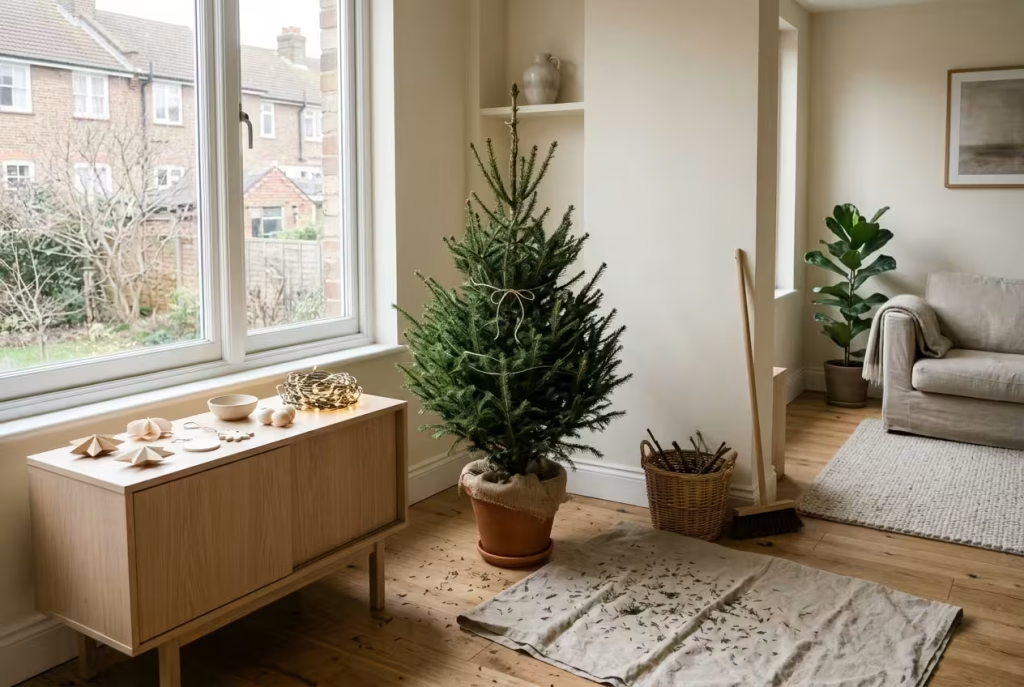
A real tree that has given you a fortnight of resin and light deserves a tidy goodbye. The Carbon Trust says chipping, planting or burning a real tree can cut its footprint by up to about 80 per cent compared with landfill, which makes disposal the part that matters most to the planet.
A good exit plan has three steps:
- Check your council’s collection dates, or its drop-off sites, before the tree comes in rather than after.
- Strip every ornament, tie and light, then wrap the tree in an old sheet to carry it out without scattering needles.
- Keep it off the log burner, as dry needles flare fiercely.
If you rented or potted a tree, book its return in advance so it does not linger in the hallway. Then sweep up the last needles, put the kettle on, and enjoy a room that feels a little too empty. It will fill again next December.
Fire safety at a glance
| Risk | What to do |
| Heat sources | Keep trees at least 1 metre from radiators, fires and heaters; some authorities quote 3ft, about 90cm |
| Drying real tree | Water daily, as it can drink up to two pints, and treat two weeks as the limit |
| Lights | Buy with a CE or UKCA mark; switch off overnight and when out |
| Candles | Never place real candles on or near a tree; use LED candles instead |
| Artificial trees | Check the packaging for a fire-resistant label |
| Metallic foliage | Avoid electric lights on trees with metallic branches |
| Exits | Never block a doorway or escape route |
What it costs three tiers
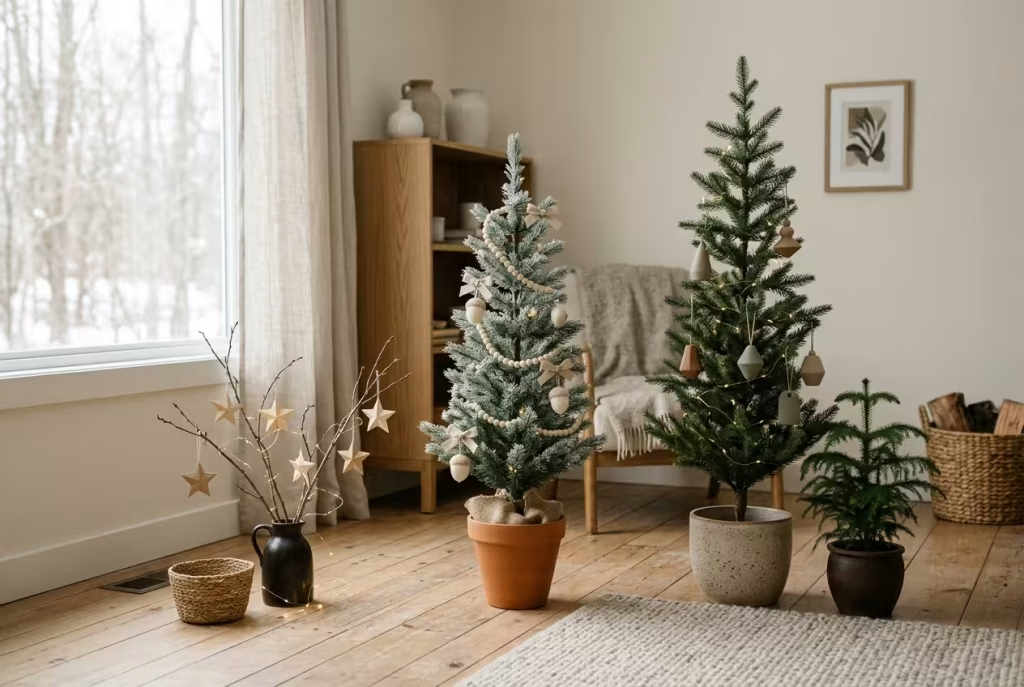
These are indicative bands only, as prices shift with retailer and year, so check current listings before you buy.
| Tier | Roughly | What you get |
| Pared back | Under £40 | Branches from your own garden or a florist, DIY paper stars, battery lights, a kitchen tray |
| Middle ground | £60 to £150 | A good slim artificial tree, wood beads, felt pieces, timed LED lights |
| Invest once | £150 and up | A realistic slim tree built to last, handmade ceramics, a Norfolk pine in a quality pot |
Why a small tree can feel bigger than it is
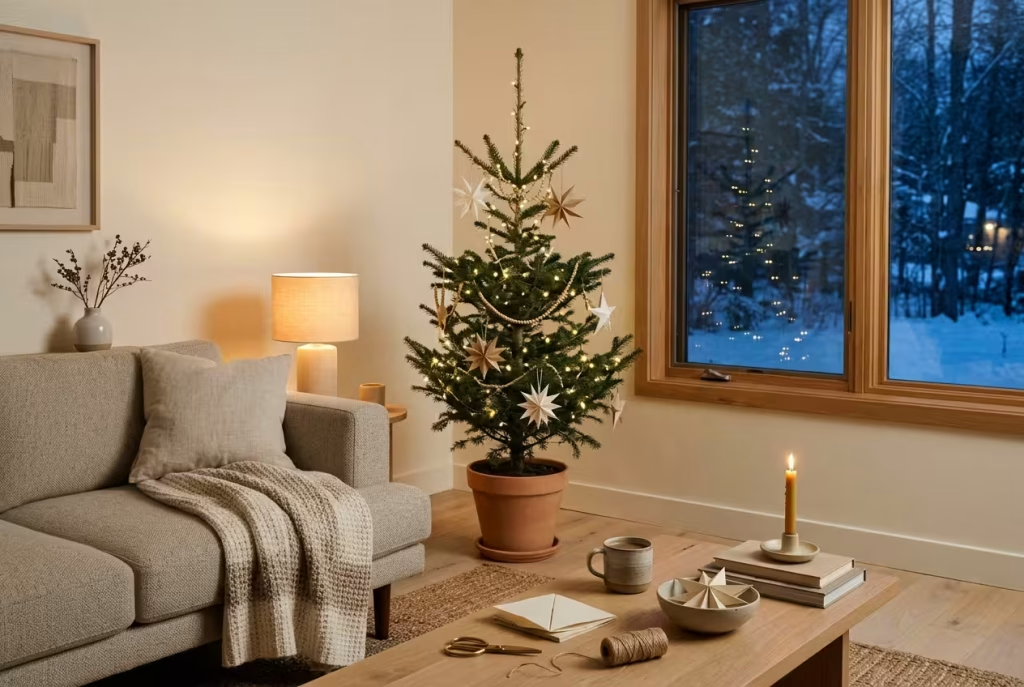
There is real science behind the calm. Psychologist Deborah Serani says Christmas decorating can trigger a dopamine lift, helped along by twinkling lights and colour. The scent of pine can summon childhood memories, and research from the University of Southampton links that nostalgia with a more optimistic outlook. Work in the Journal of Environmental Psychology suggests people see decorated homes as belonging to friendlier, more approachable residents.
Negative space adds its own quiet benefit. Princeton University Neuroscience Institute research found that competing visual stimuli mutually suppress each other in the visual cortex, so clutter literally competes for your brain’s attention. A sparse Japandi tree gives the eye somewhere to rest. And if your own Christmas memories are patchy, a new small tradition builds a new association, one paper star at a time.
Ritual matters more than size here. The afternoon spent folding paper stars, the evening you choose the lamp, the first night the tree glows on its own: these small acts are what turn a rented room into somewhere you belong, and they cost almost nothing.
A rental is temporary, but the feeling does not have to be. That is the heart of Japandi: choose a few things that mean something, and let them carry the season.
Common mistakes to avoid
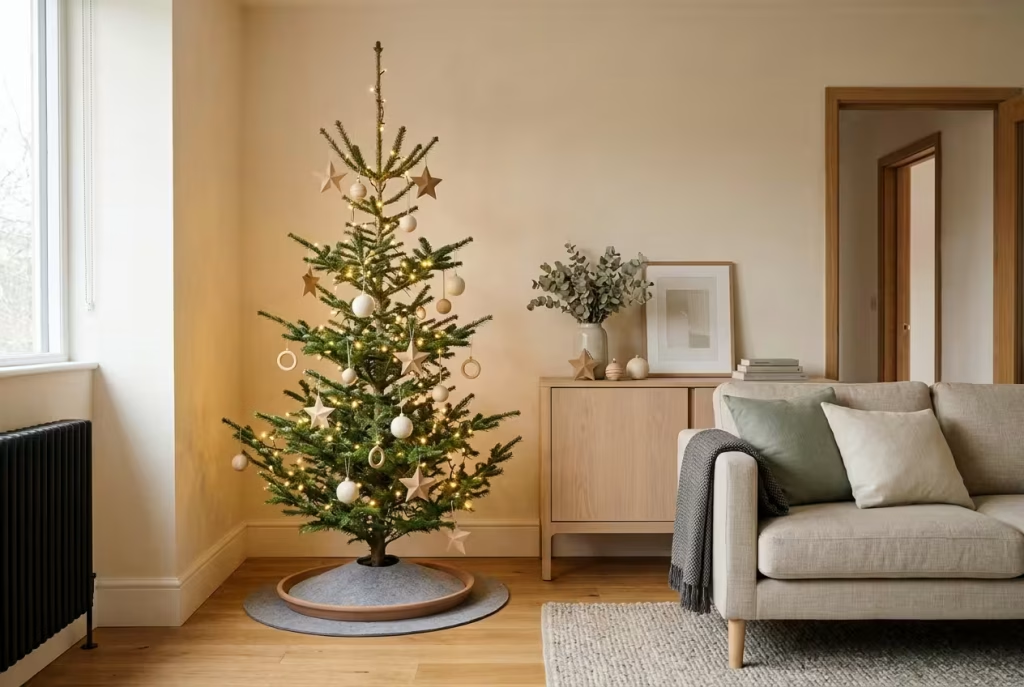
- Buying for the photo, not the room. Measure first, then shop, and leave the cardboard template on the floor for a day before you commit.
- Overdressing. If every branch carries something, nothing stands out. Take three ornaments off when you think you are done.
- Mixing cold and warm light. Blue-white strings turn wood grey. Keep every source warm.
- Hiding a bad stand in a basket. Disguising a wobbly base only conceals the problem, and a wobbly base is the one thing you should never conceal.
- Forgetting the exit. A tree with no storage or disposal plan becomes January’s headache.
- Going all white. White on white reads as a showroom, so add wood, green and one dark note.
- Ignoring the heat. A tree within a metre of a radiator dries out faster and looks tired within days.
One last thought
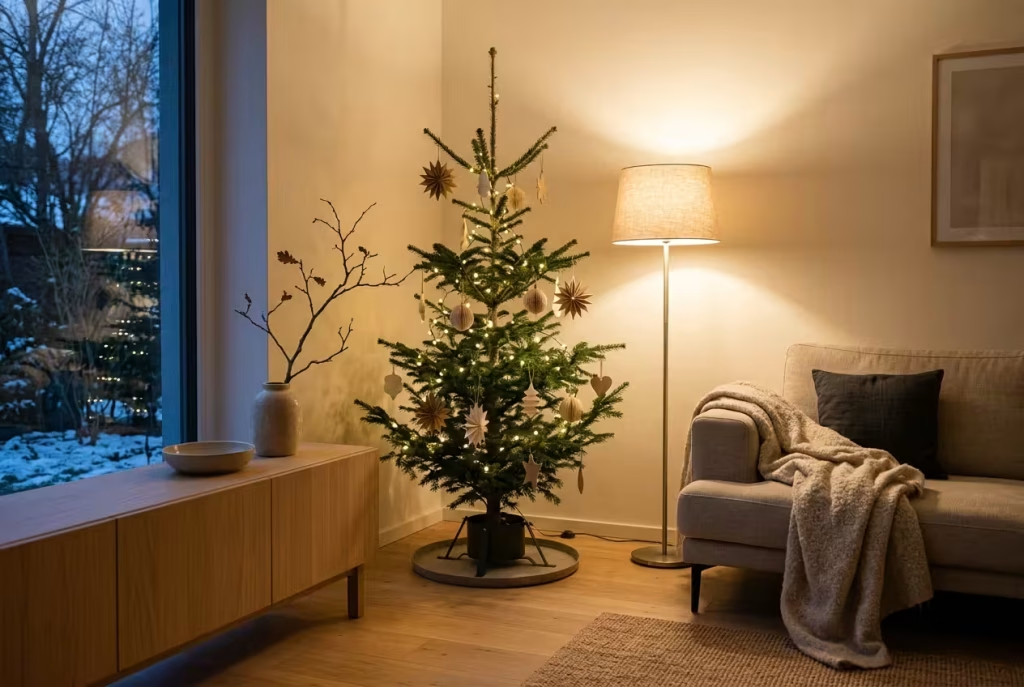
A Japandi tree in a small rental is not about doing without. It is about choosing a handful of natural things, giving them space, and letting warm light do the rest. Start with the tree and a single lamp, add one branch in a ceramic vase, and stop a little sooner than feels natural.
Then sit down, switch off the big light, and look at what you have made in a room that was never quite yours. The room will thank you, and so will your deposit.
Frequently asked questions
What is a Japandi Christmas tree?
A Japandi Christmas tree is a sparse, natural-looking tree dressed with paper, wood, felt and unglazed ceramic in muted tones, lit with warm light. It blends Scandinavian cosiness with Japanese restraint, so you should still see the branches.
How is a Japandi tree different from a Scandi tree?
Scandi trees tend to be full and bright, with white, red and glass or metal ornaments. Japandi trees are sparser, matt and earthier, often adding a deep accent such as rust or charcoal and avoiding gloss and metallics.
What is the best Christmas tree for a small rental living room?
A slim artificial tree or a tabletop tree is the simplest choice, because neither drops needles nor needs watering. If you want something living, a Norfolk pine works year round, and branches in a vase suit the tiniest rooms.
Can my landlord stop me having a real Christmas tree?
It depends on your tenancy agreement. One letting agency says landlords cannot reasonably ban temporary decorations that cause no damage and break no term, but you should read your own contract and ask if in doubt.
How do I protect rental floors from a tree stand and needles?
Put a felt pad under the stand’s feet and a deep tray beneath the whole base, then add a linen collar or small jute mat. Carry a real tree in wrapped in a sheet to avoid scratching walls and floorboards.
How close can a Christmas tree go to a radiator?
At least 1 metre is the common guidance, and some authorities quote 3ft, roughly 90cm. Follow whichever your local fire service recommends, and never stand a tree against a heat source.
Are real or artificial trees safer in a small flat?
Modern artificial trees are usually fire resistant, though you should check the packaging. A real tree is safe for around two weeks if watered daily, but it burns fast once dry, so it needs more care.
Is a real or artificial tree better for the environment?
The Carbon Trust puts a 2m artificial tree at about 40kg of emissions, so it needs roughly ten Christmases of reuse to beat a real tree. A real tree is greener if you chip, plant or burn it rather than landfill it.
Can I keep a potted tree indoors, and for how long?
Advice varies, from three or four days up to about two weeks. The cautious approach is to acclimatise it outdoors, keep it indoors for no more than a week, and stand it well away from radiators.
How do I put up a tree with no floor space?
Go vertical. Use branches in a heavy vase, a small tree on a shelf or sideboard, or trace a tree shape on the wall with warm white lights or washi tape.
What colours and ornaments suit a Japandi tree?
Stick to warm white, cream, oat and muted sage with one deep accent such as rust or charcoal. Choose paper, wood, felt and unglazed ceramic, and skip high gloss and metallics.
How do I hang decorations without damaging walls?
Use damage-free clips or a washi tape outline, tested first on a hidden patch. Avoid Blu Tack and sticky tape, which can lift paint or plaster.