


How to Style a Dining Room for Holiday Gatherings: Expert Tips, Décor Ideas & Lighting
Think back to the dining table of your childhood. Not the food, necessarily, but the table itself: the cloth that only appeared at Christmas, the candle somebody always insisted on lighting before anyone could sit, the chair that belonged to the same person year after year. The menu has probably faded. The feeling has not. Somebody built that feeling, quietly, by caring how the room would hold you.
Now the job has landed on you. If that prospect brings a flicker of dread, with a diary full of deadlines and a dining room currently buried under parcels, take heart. Styling a room for holiday gatherings has far less to do with money than with a short run of decisions made in the right order: how many people the space can honestly seat, how the table is laid, what goes in the middle, and, above all, how everything is lit.
This guide walks through each of those decisions with real measurements (metric first, imperial in brackets), designer advice, the hard-won lessons of hosts who feed twenty or more every December, and the safety figures that glossy galleries tend to leave out. Follow it from the first declutter to the final candle, or dip in wherever your own evening threatens to wobble.
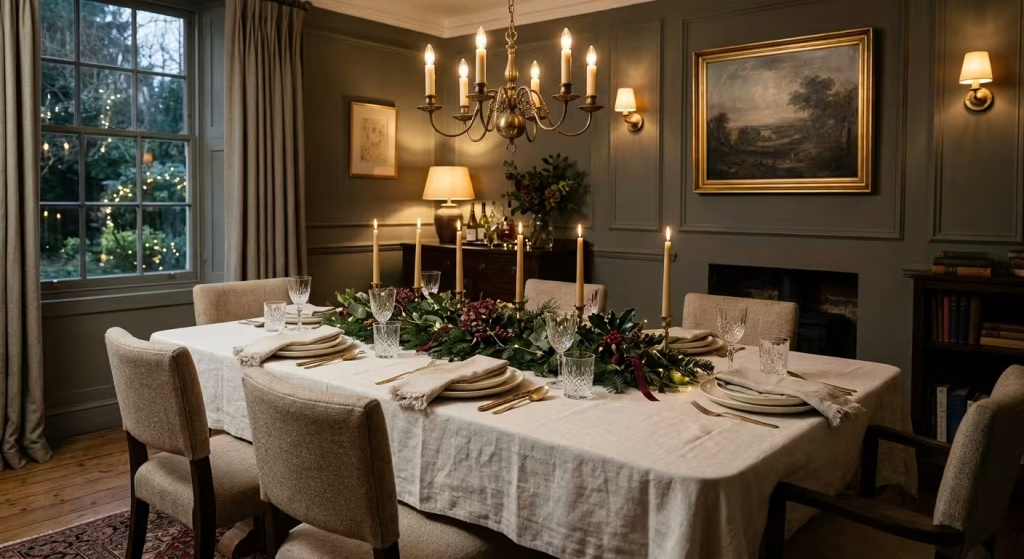
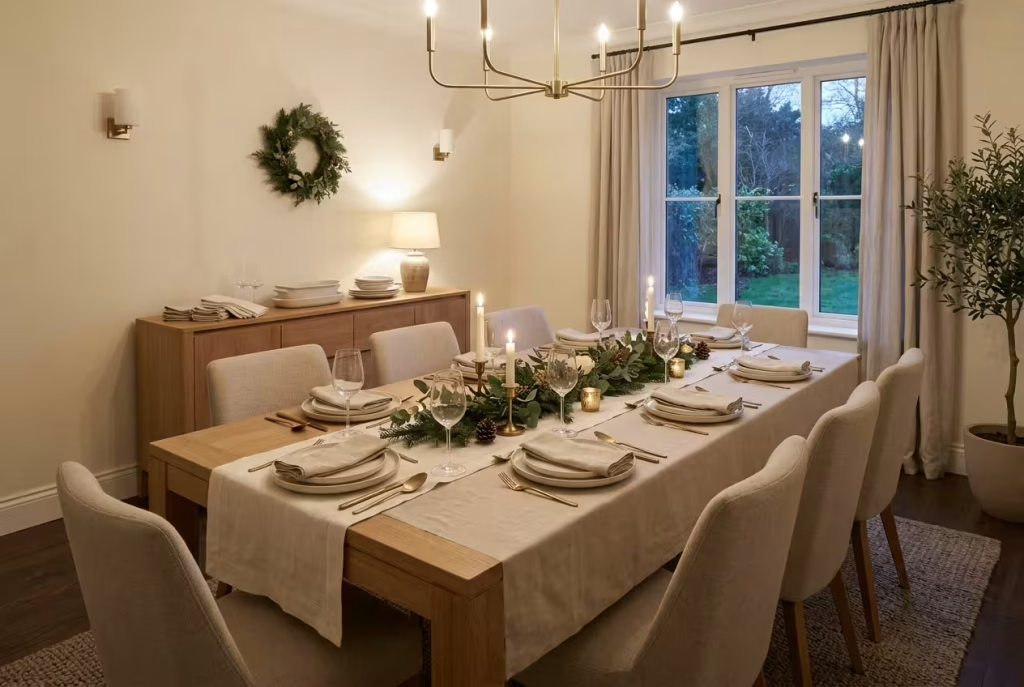
Quick answer: how do you style a dining room for holiday gatherings? Clear the room first, then size the table at roughly 60 cm (24 in) of edge per guest. Layer linens, plates and napkins in two or three colours, keep the centrepiece low and wide or tall and slender, and hang the chandelier 75 to 90 cm (30 to 36 in) above the table under a standard 2.4 m ceiling. Fit 2700K bulbs with a CRI of 90 or more, dim the overhead light to between a third and a half of full power, add lamps and candles, and keep every flame at least 30 cm (12 in) from anything that can burn. Set the whole table the day before.
You May also Like: How Do You Decorate a Rented Living Room for a Japandi Christmas?
Seven Decisions That Make or Break the Evening
| Decision | The rule worth remembering |
| The room | Clear it, then leave about 90 cm (36 in) of walking space around the table |
| Table size | 60 cm (24 in) of table edge per guest, as a bare minimum |
| Place settings | Everything within easy reach, nothing crowding the glass |
| Linens and colour | Two or three colours, with one clearly in charge |
| Centrepiece | Low and wide, or tall and slender, never tall and wide |
| Lighting | Warm 2700K light in layers, dimmed, with candles added last |
| Logistics | Set the table the day before and plan how food will reach it |
Why the Room Does the Heavy Lifting
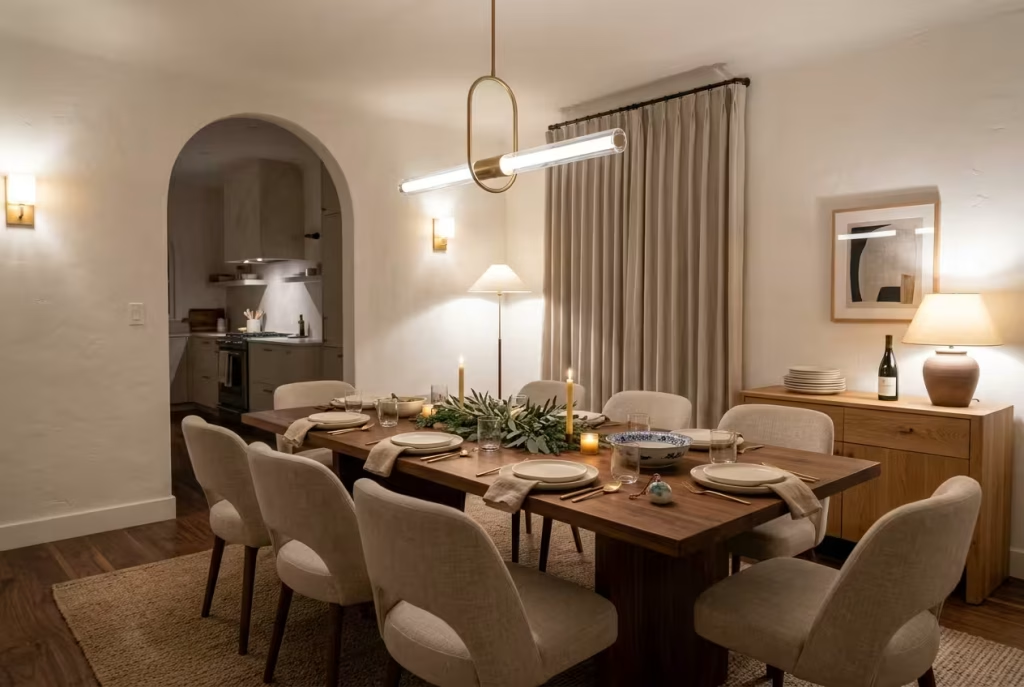
Food feeds people for an evening. Atmosphere feeds them for years. Ask anyone about a favourite family Christmas and the gravy rarely features. The year the candles burned low and the talk carried on past midnight almost always does.
Designers are picking up on the same hunger. ELLE Decor’s 2026 trend report describes homeowners asking for proper dining rooms again, with a door, a purpose and a table that sees real use. Designer Olga Doykhen sums up the mood: minimalism had its moment, but today’s dining rooms are meant for connection. Ethan Greenfeld goes further, arguing that a dedicated room gives hosts and guests a better experience than a kitchen peninsula ever could, because a room with a door concentrates the occasion.
There is research that nods in the same direction, though it deserves a measured reading. Cornell and Georgia Tech researchers, writing in Psychological Reports, transformed half of a fast-food restaurant with softer light and gentle music. Diners in the calmer half stayed about 41 minutes rather than 32, ate fewer calories (775 against 949) and judged the food tastier. It was a small study of roughly 60 people, run in a burger restaurant and not a family dining room, so treat it as a hint rather than a law. Even so, it explains something every host has felt: when the glare drops and the pace slows, the very same dinner tastes better.
So think of the room as an ingredient. Three levers do most of the work:
- Light, which decides whether people look rested or interrogated.
- Pace, set by comfortable chairs, music turned low and a table that does not need constant rearranging.
- Memory, carried by the objects people recognise: the heirloom plates, the child’s clay robin, the carving knife that has done the rounds for forty years. One Houzz forum regular described getting her ornaments out each year as worth the bother precisely because every single one held a person.
Decorate with those three levers in mind and the room will quietly make everyone feel expected.
Make Space Before You Make It Pretty
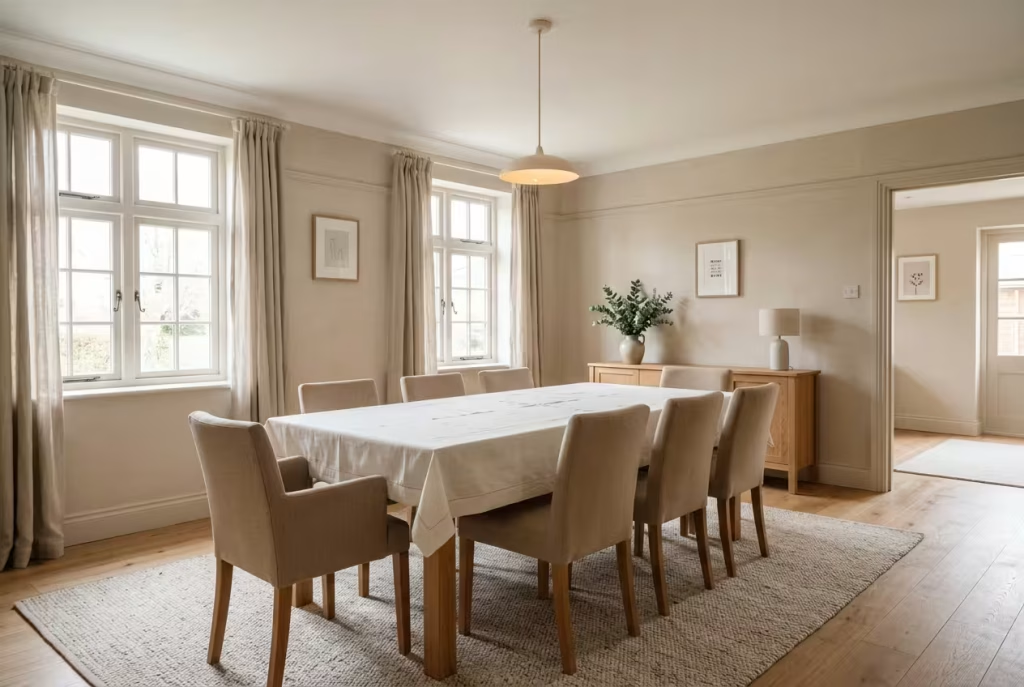
Styling lands badly on a room that is still moonlighting as a dumping ground. HGTV designer Mimi Meacham is unsentimental about it: whatever has drifted in over the year needs a permanent home or a place at the charity shop. Give yourself one focused weekend and work through the room in this order.
- Empty the surfaces. Sideboard, window sills, the end of the table: if it is not part of the evening, it leaves. A single laundry basket carried from room to room keeps the sweep brisk.
- Tackle the invisible dirt. Meacham’s list covers fresh bulbs, hoovering, dusting, and cleaning upholstery, rugs and curtains, because the room will be scrutinised for hours by people with nothing to look at but their surroundings.
- Protect the table. A felt or flannel-backed pad under the cloth guards against hot dishes and wine rings. If you want bare wood on show, heat-proof mats are non-negotiable.
- Test every chair. Loose joints and wobbly legs reveal themselves at the worst moment, usually when a large relative sits down. Tighten them now.
- Walk the route. Carry a loaded tray from the kitchen to the table, then from the table to the sofa. Anywhere you turn sideways is a spot to fix.
How Much Elbow Room Does the Table Need Around It?
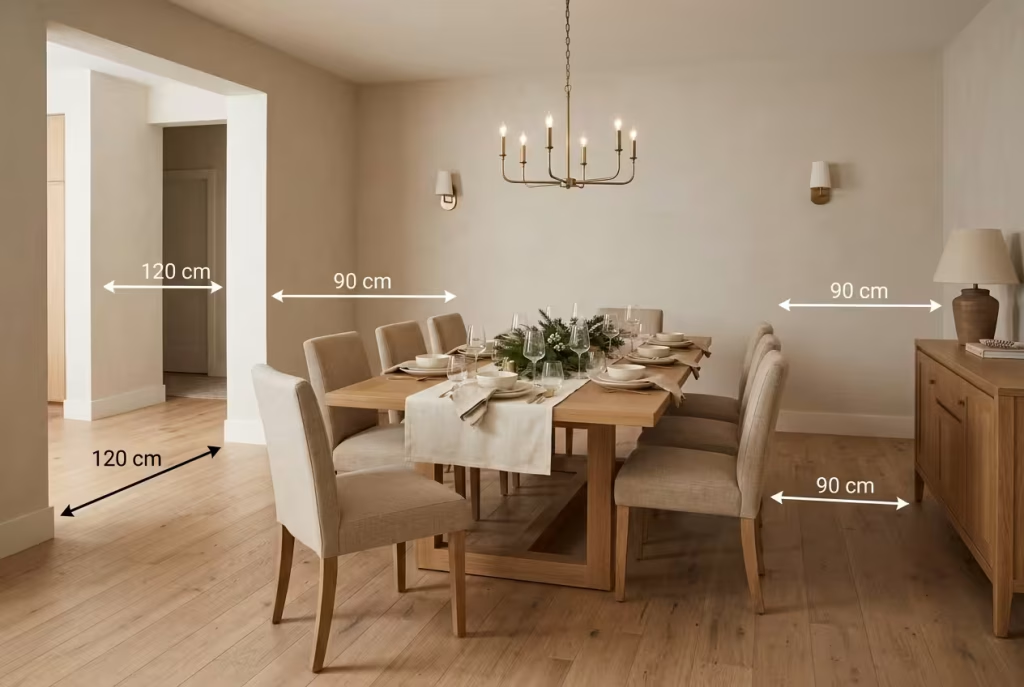
Allow about 90 cm (36 in) between the table edge and any wall or furniture, rising to 105 to 120 cm (42 to 48 in) wherever someone must edge behind a seated diner. Hosts on a long-running Houzz discussion confessed to bending those figures for the odd big occasion, nudging the table off-centre or shifting a sideboard out for the day. One said her table forced anyone entering through the garage door into a wide U-shaped detour, and the family simply learned to live with it. A tight squeeze is forgivable for one night. Just keep a single clear lane open for whoever is carrying the hot dish.
If the room is truly cramped, borrow a trick from the best small-space designers: pull the table away from the wall on one side only, and tuck a bench or banquette against the wall on the other. The small-room section below returns to that idea.
Table Maths for Real Life
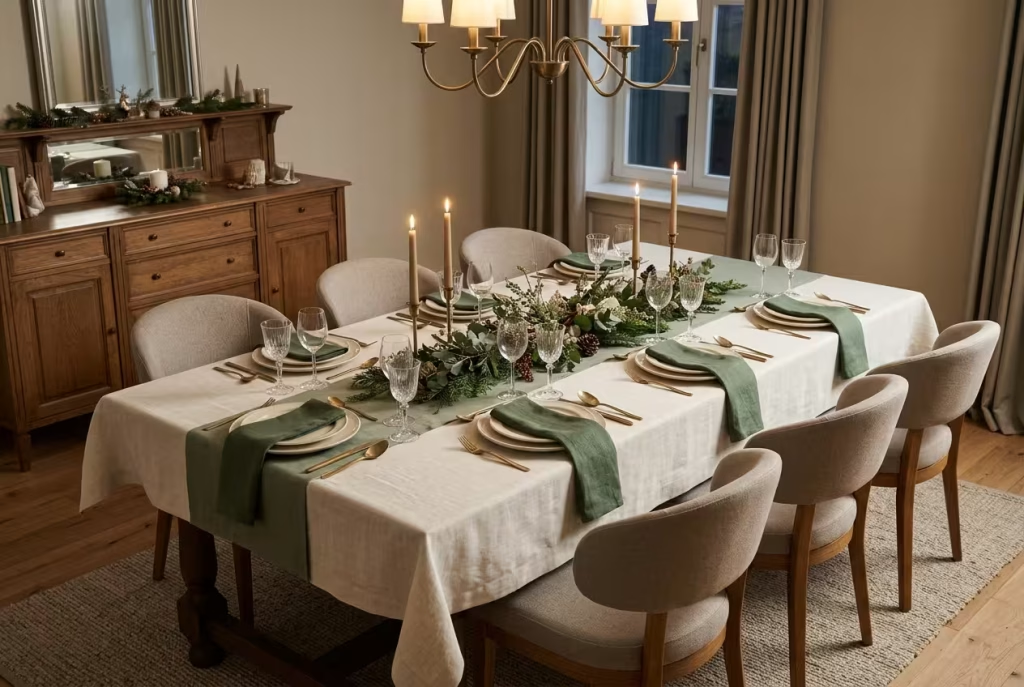
The trade rule is 60 cm (24 in) of table edge per person. Think of it as a floor and not a luxury allowance. Many designers prefer 75 cm (30 in) when the meal runs long, the chairs have arms or the guests are generously built. Subtract the table legs before you count, because a place setting wedged around a leg is no place at all.
| Guests | Rectangular table (seats on the long sides only) | Rectangular with a chair at each head* | Round table diameter |
| 4 | 120 cm (48 in) | Not needed | About 105 cm (42 in) |
| 6 | 180 cm (72 in) | 120 cm (48 in) | 135 to 150 cm (54 to 60 in) |
| 8 | 240 cm (96 in) | 180 cm (72 in) | About 150 cm (60 in), snug |
| 10 | 300 cm (120 in) | 240 cm (96 in) | Better as a rectangle or two tables |
| 12 | 360 cm (144 in) | 300 cm (120 in) | Two tables |
*Needs a table at least 90 cm (36 in) wide. These are minimums at 60 cm per place; add 15 to 30 cm if you want elbow room.
Round, Rectangular or Something in Between?
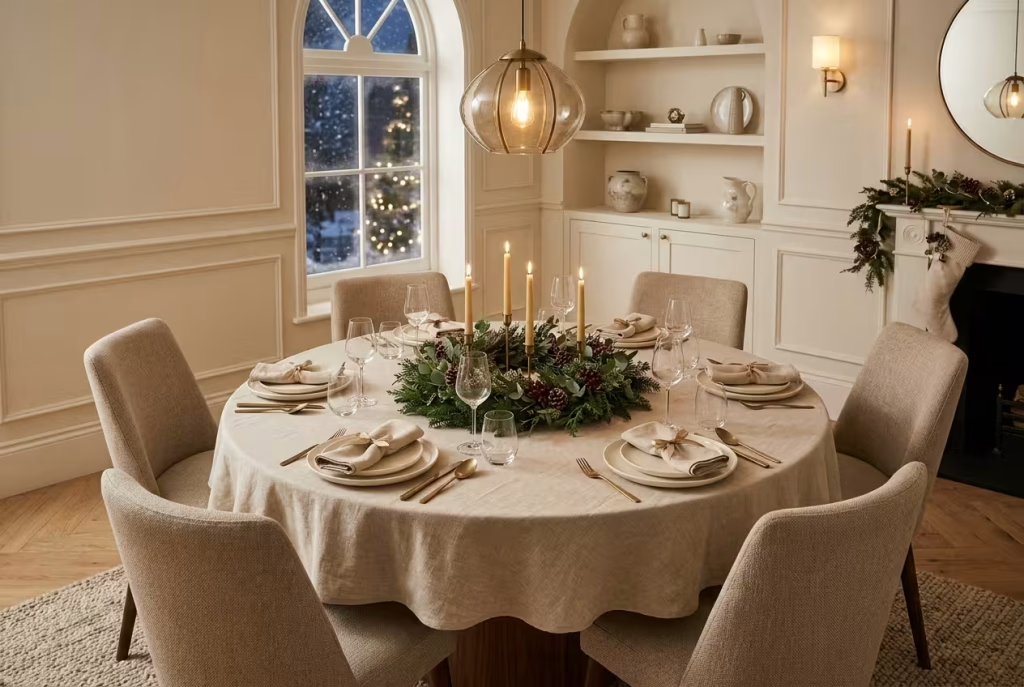
A round table removes hierarchy and pulls everyone into one conversation, which is why Homes & Gardens lists the return of the round table among its 2026 trends. Designer Miranda Cullen says it eliminates edges and rank and subtly changes how people gather. The trade-off is reach: once a round table grows beyond about 150 cm (60 in), the middle sits too far away to pass a dish, and talk splinters into pairs. Rectangles seat more people for the floor space and suit long, narrow rooms, but the two ends can feel like separate countries.
For the long haul, an extending table is the sensible compromise. One Houzz host owns a 54 in (137 cm) round with six 18 in (45 cm) leaves. It grows from a snug family table to one that can seat up to twenty, then shrinks back when the crowd goes home.
When the Guest List Outgrows the Table
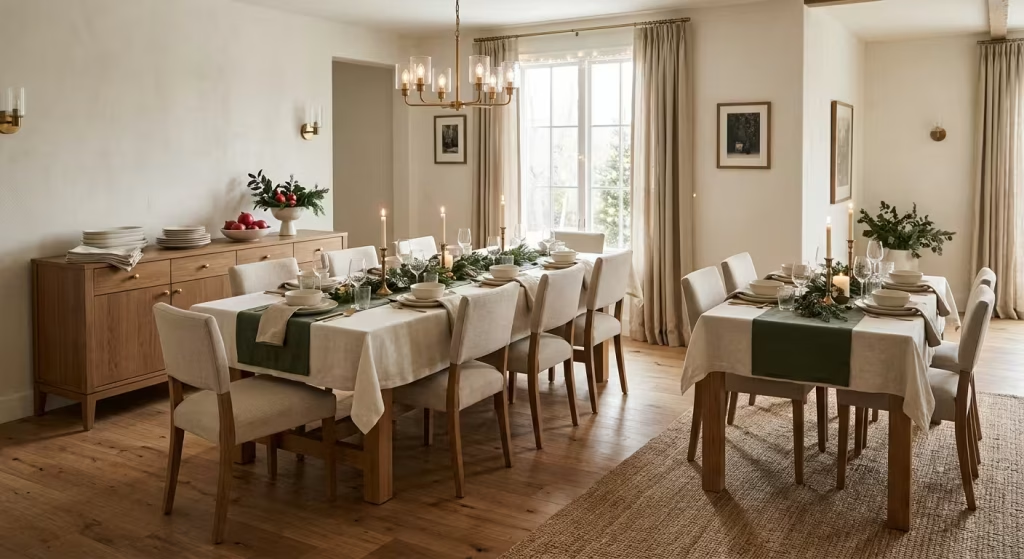
It nearly always does, and the most relaxed hosts treat the overflow as a design opportunity, not an apology.
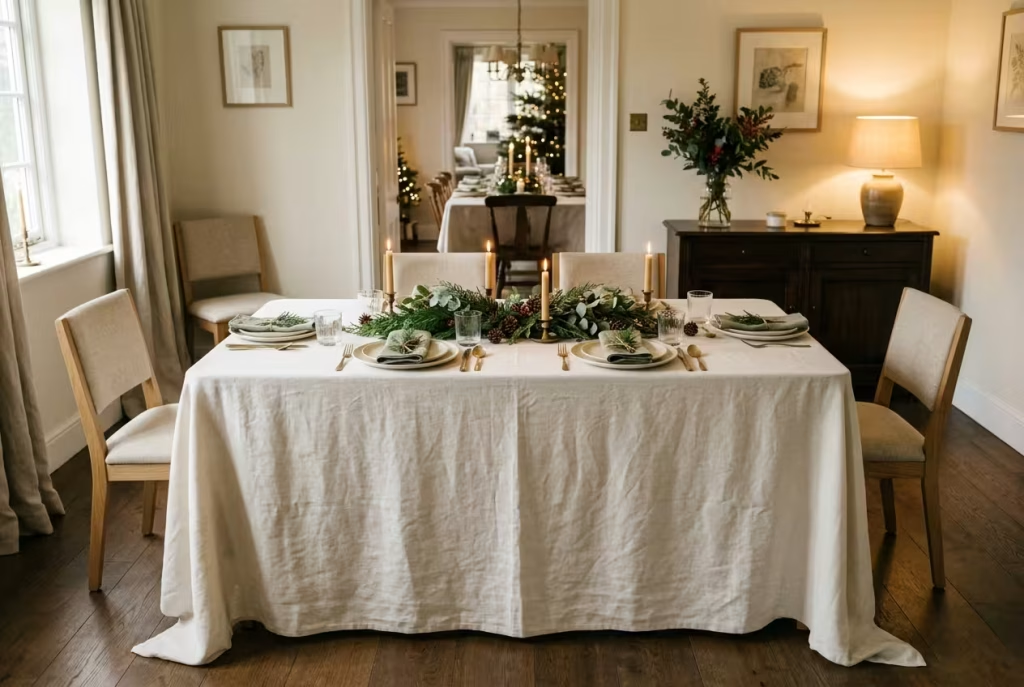
A second table in the next room. One advice guide makes the case bluntly: an extra table elsewhere beats cramming an oversized one into a room that cannot carry it. A folding table in a floor-length cloth passes for furniture.
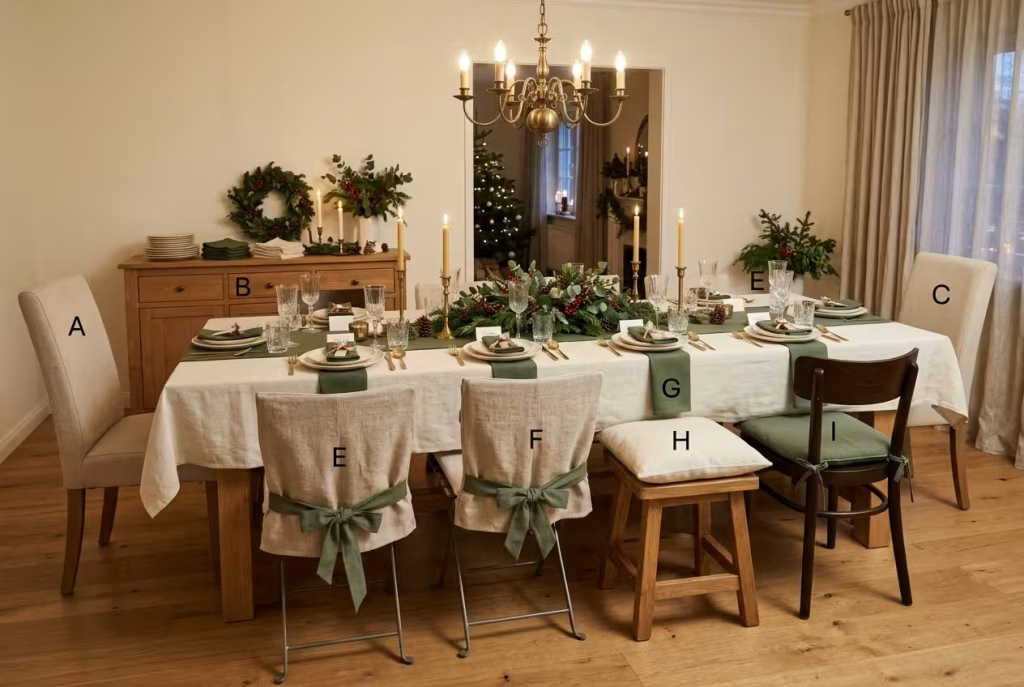
Disguise the mismatch. Folding chairs, borrowed stools and cushioned garden seats all disappear under festive cloths and matching napkins. One forum regular keeps collapsed folding tables in a cupboard with their covers on a tray, so two cousins can set up an extra table while everyone queues for plates. Guests, she says, think Santa’s elves did it.
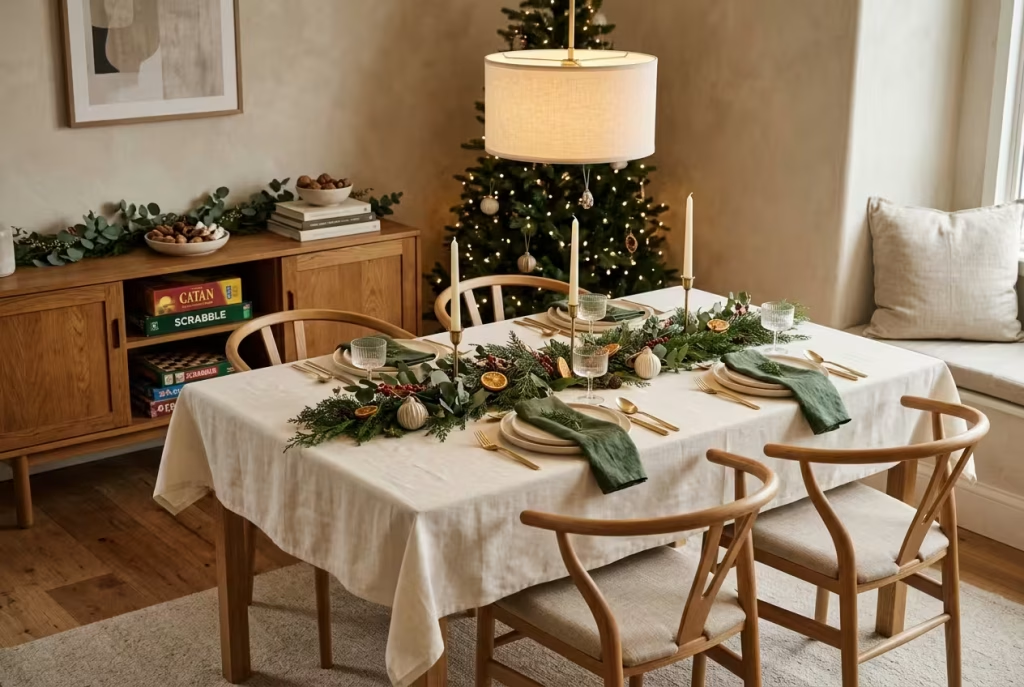
Rename the children’s table. A recurring trick on Houzz is calling it the ‘young adult table’, which instantly turns it into the most coveted corner of the house.
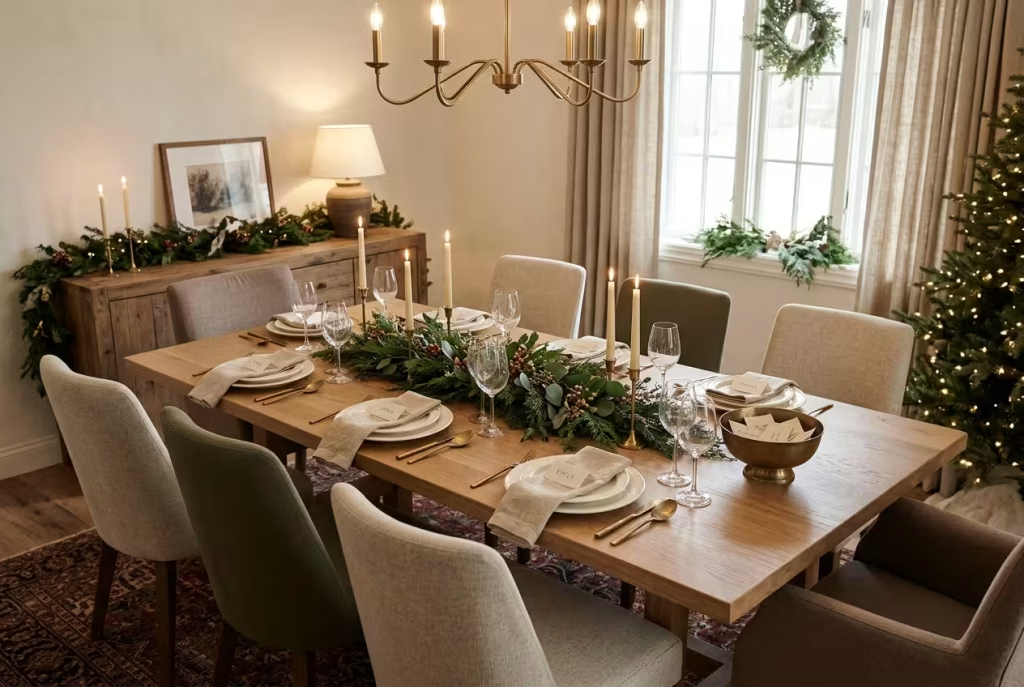
Shuffle the seating on purpose. Drawing numbers from a bowl pulls everyone away from their usual neighbours, although one host noted that every married couple somehow landed side by side.
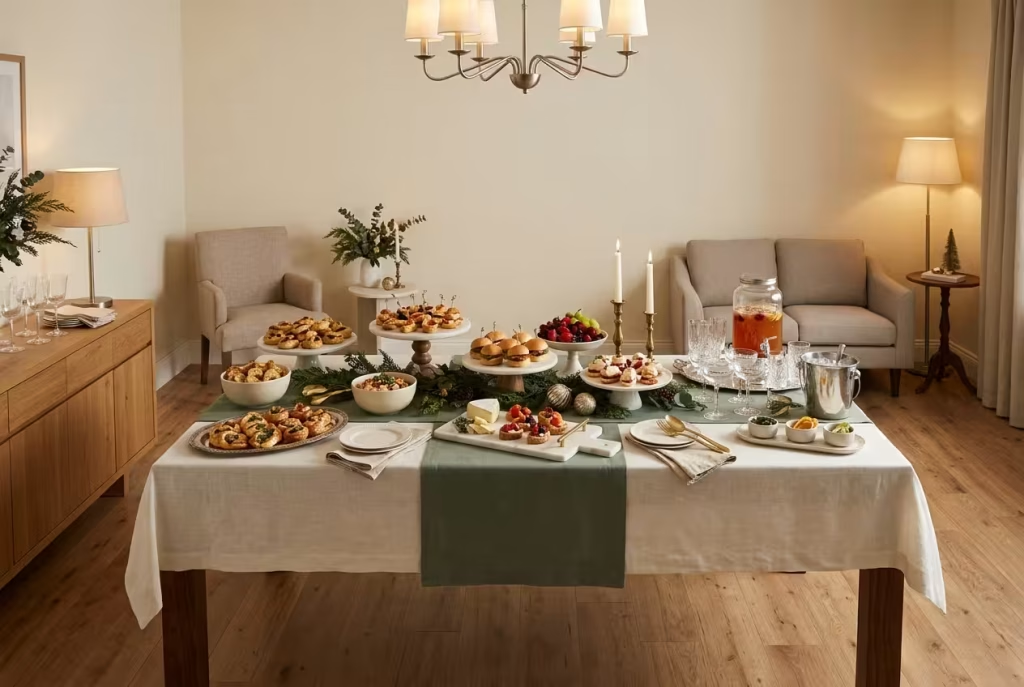
Try a cocktail buffet. AD PRO’s entertaining report highlights event planner Rebecca Gardner’s case for it: dress the dining table with beautiful dishes, station help nearby and let guests perch around the house. It suits smaller homes particularly well.
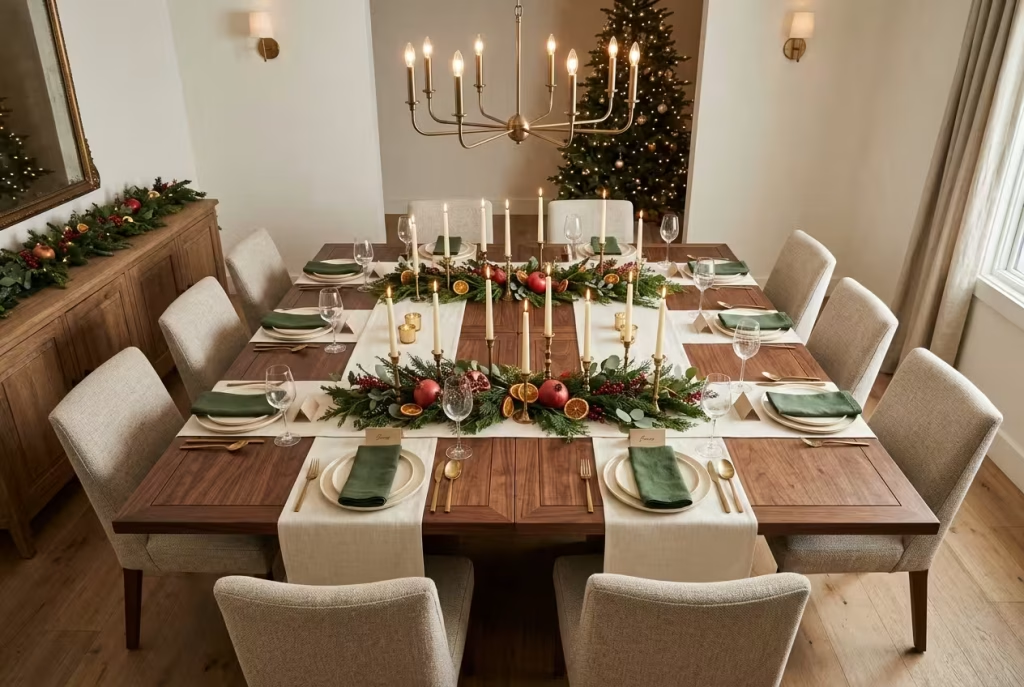
Use twin tables. Designer Starrett Ringbom favours a pair of identical square tables that push together for crowds and split apart for quieter days.
The Anatomy of a Place Setting
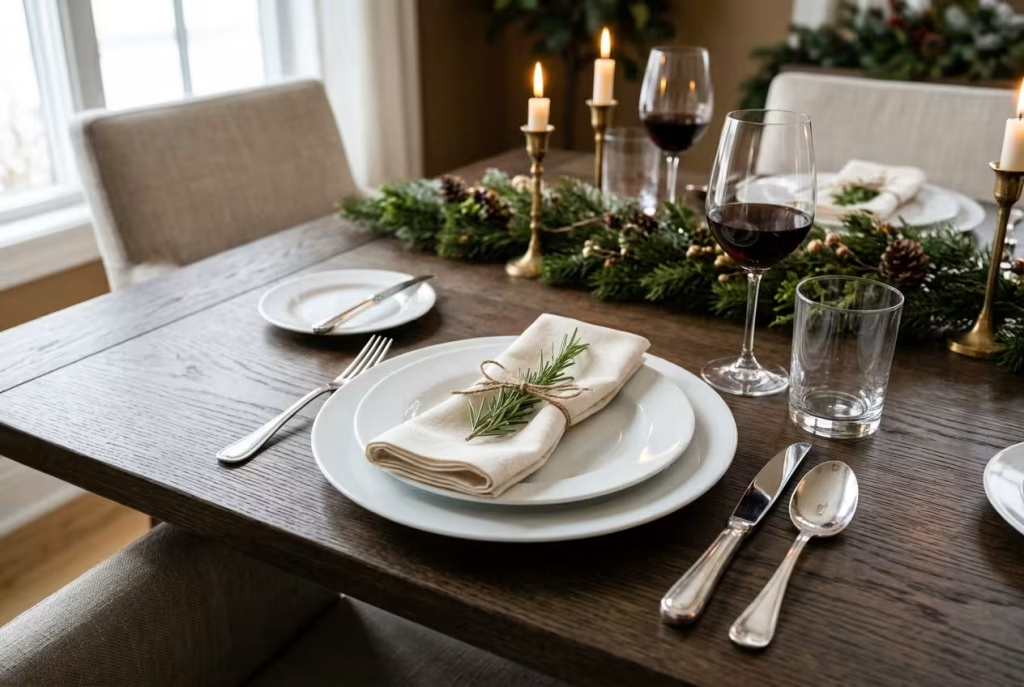
Before any flourish, the foundations. A well-ordered place setting tells guests where everything lives without a word being spoken, sparing nervous diners the agony of the wrong fork.
- Dinner plate in the middle, roughly 2.5 cm (1 in) in from the table edge.
- Fork to the left of the plate. Knife to the right with the blade turned inward, and the spoon beside it.
- Water glass at the top right, directly above the knife, with a wine glass keeping it company.
- Napkin on the plate or tucked under the fork. Iron it first, because a crease draws the eye faster than any centrepiece.
- Side plate at the top left, for bread rolls.
When the meal has several courses, cutlery is laid in order of use, working from the outside in. That one habit rescues more dinners than any amount of ribbon.
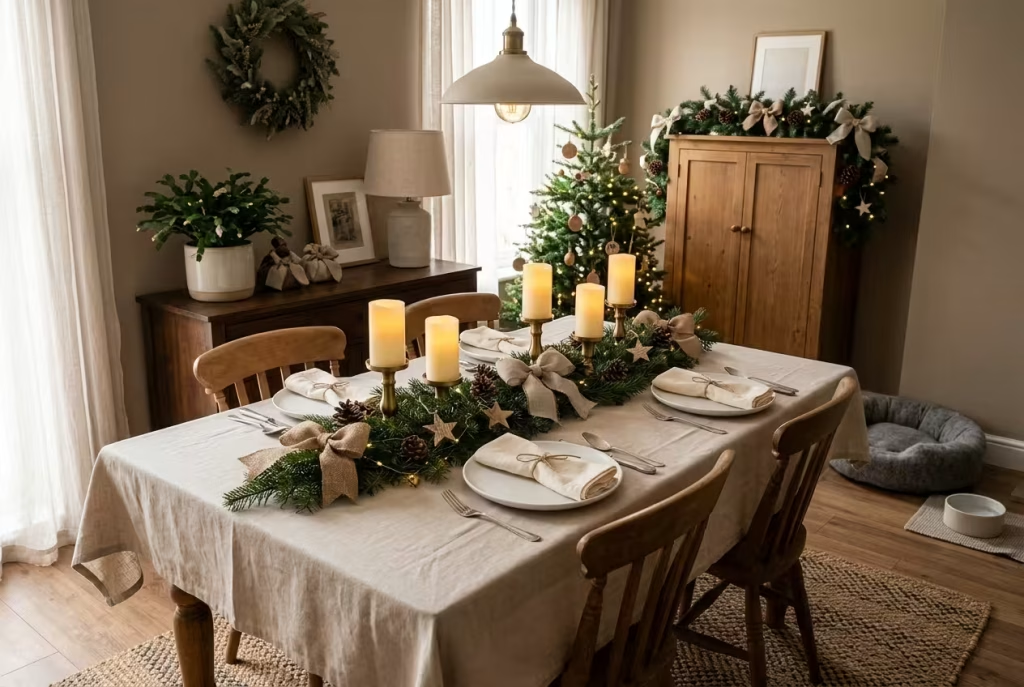
Once the basics sit square, dress them. Fenwick’s Christmas buyer Emma Coleman suggests layering: stack plates, add a folded napkin, then crown the pile with a sprig of foliage or a tiny tree decoration. Three napkin treatments look expensive and take seconds:
- Roll it, then tie it with twine and slip in a sprig of rosemary.
- Fold it flat beneath the fork and lay a single leaf across it.
- Fold a pocket and tuck a handwritten name card inside.
Name cards deserve a moment of strategy. Placed with care, they turn seating into a gift: the chatty neighbour beside the shy one, the grandparent away from the draughty door, the teenager next to the cousin they actually like. One host on Houzz made hers from leftover gingerbread-house cookies, and, by all accounts, they vanished before the pudding.
You May also Like: How to Create a Zen Japandi Utility Room: 15 Calm & Functional Design Ideas
Linens Cloth, Runner and Napkins Without the Guesswork
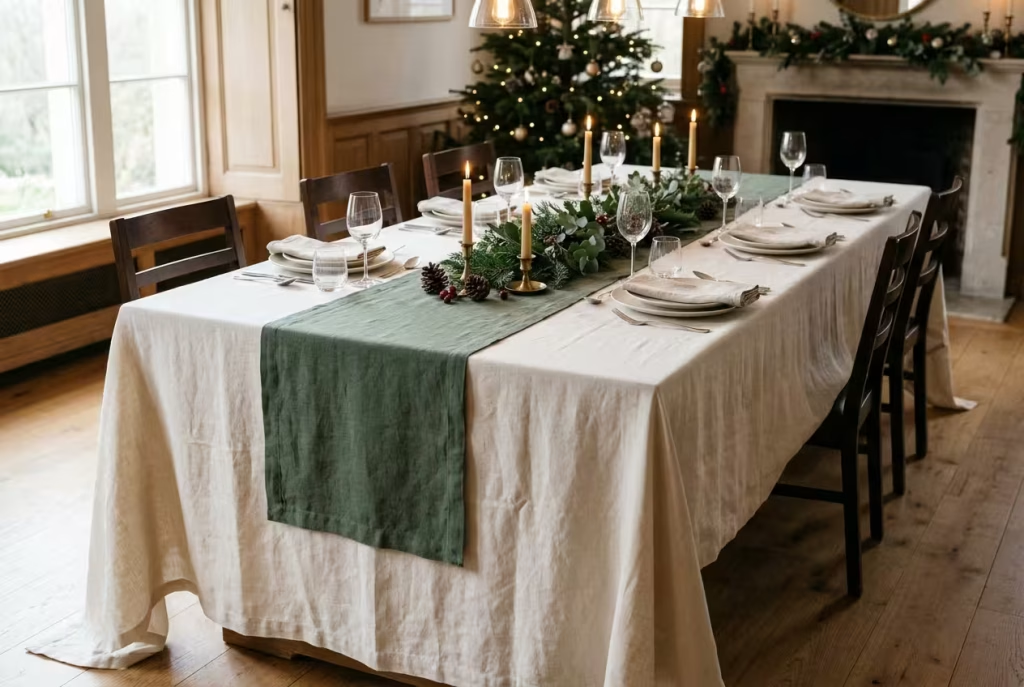
A cloth that is too short looks apologetic. One that is too long ends up in the gravy. Treat the figures below as your safety net.
| Item | Rule | Why it works |
| Casual cloth drop | About 20 cm (8 in) each side | Tidy, and keeps knees free |
| Formal cloth drop | About 38 cm (15 in) each side | Reads as dressed for the occasion |
| Cloth size | Table length and width plus twice the drop | Even overhang on every side |
| Floor-length cloth | Add double the table height to length and width | Hides folding legs and a multitude of sins |
| Runner width | One third of the table width, usually 30 to 45 cm (12 to 18 in) | Leaves room for plates either side |
| Runner overhang | 15 to 30 cm (6 to 12 in) each end | Looks deliberate, not accidental |
| Runner length | Always shorter than the cloth beneath it | Avoids a messy hem collision |
Fabric matters as much as size. Linen has a lived-in elegance but creases readily. A cotton-linen blend irons faster and forgives a rushed hand, and a stain-resistant weave is worth considering if small children will be seated nearby.
Full-price linens for a long, awkward table can cost a small fortune, so hosts have become inventive. Forum regulars report using window panels picked up for a few pounds, plain white sheets, fabric bought by the metre and a pristine linen cloth snapped up at a charity shop. Spills are a given, and a thrifted cloth removes the dread.
Colour Stories That Look Intentional
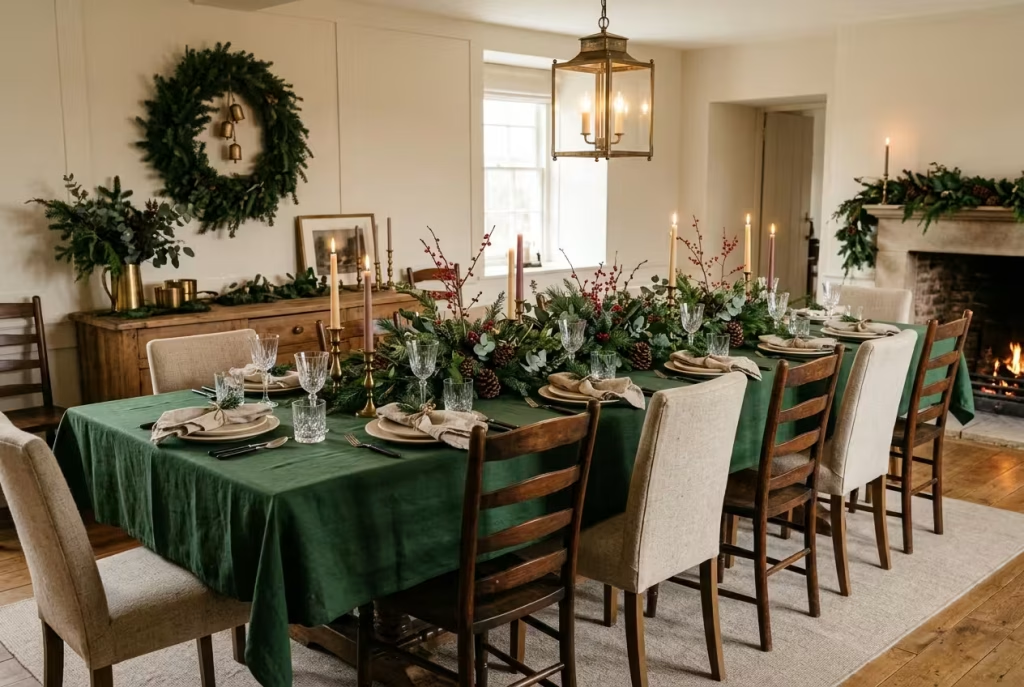
Designer Mimi Meacham advises choosing one palette and holding your nerve. Let the dishware and serving pieces be the quiet classics, then bring in colour through whatever is cheapest to swap: placemats, runners, napkins and place cards. Stylist Claire Douglas, speaking to Woman & Home, adds a practical twist, suggesting you avoid obviously festive patterns such as snowmen or puddings. Plain green, cream or neutral linen earns its keep all year, which is kinder to your purse and your airing cupboard.
A reliable shortcut is the old 60-30-10 rule from interior design. Let one colour dominate about 60 percent of what the eye sees (the cloth and walls), a second take roughly 30 percent (plates and napkins), and an accent shine in the final 10 (candles, baubles, a sprig of berries).
| Palette | Core colours | The mood it creates | Watch out for |
| Deep and moody | Chocolate brown, soft charcoal, muted green, aged brass | Enveloping and intimate, as the 2026 trend reports describe | Needs warm bulbs and candles, or it turns gloomy |
| Woodland classic | Forest green, cream, burgundy, copper | Familiar and generous | Too much red tips into theme-park territory |
| Scandinavian natural | White linen, oatmeal, bare oak, pinecones | Calm and airy | Can feel cold without textured fabrics |
| Jewel and metallic | Emerald or plum with gold or brass | Glamorous and celebratory | Keep metallics to one or two finishes |
| Collected and mixed | Vintage glass, mismatched chairs, one repeated colour | Personal and relaxed | Needs one unifying thread so it looks chosen |
Designer Tess Canfield, quoted by Houzz, deliberately avoids matching dining sets and prefers a collected feel even in formal rooms. Alternating two different chair designs along the table can look more considered than eight identical ones, which is encouraging news for anyone borrowing chairs from the neighbours.
Centrepieces Seven Ways to Make the Middle Matter
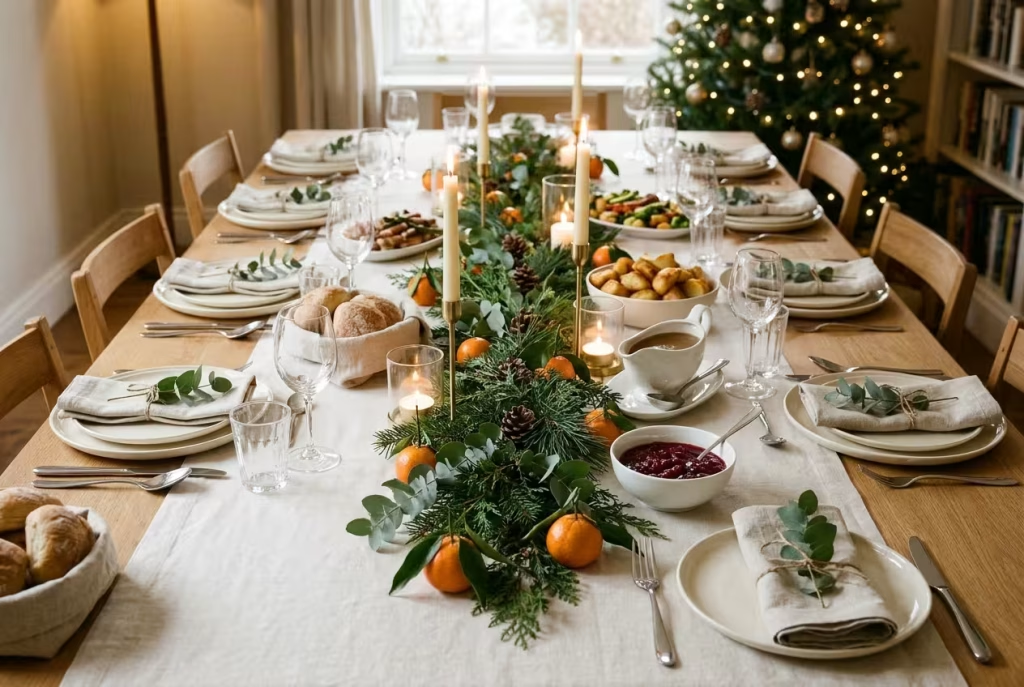
If one mistake sinks more festive tables than any other, it is the over-tall centrepiece. Stylist Claire Douglas warns that guests must be able to see and talk to the person opposite without standing or peering round a thicket of foliage and candelabra. John Lewis makes the same point with a more practical edge: a centrepiece that is too tall or too wide stops anyone passing the cranberry sauce.
There is a geometry problem hiding here. A place setting normally takes 30 to 38 cm (12 to 15 in) of depth from the table edge, so on a standard 90 cm table you are left with a central strip only 15 to 30 cm wide. Anything bulky simply will not fit alongside the gravy boat and the sprouts.
The seated eye-level test. Sit in a chair at one end, then at the middle of a long side. If you must lean sideways to see the person opposite, trim the arrangement. As a rule of thumb, go low and wide, or tall and slender with the stems above eye line. Never go tall and wide.
| Formula | What you need | Height | Best for |
| Garland trail | Foraged foliage with glass-shielded tea lights or flameless candles | Low | Long rectangular tables |
| Candles at mixed heights | Slim holders in varied sizes, as HGTV’s Cecilia Casagrande suggests | Low and slender | Any shape, especially narrow tables |
| Oversized fruit bowl | A wide bowl of clementines, pears, pomegranates and rosemary | Low | Budget tables, round tables |
| Flat wreath | A wreath with a lantern in the middle, as Emma Coleman suggests | Low | Round or square tables |
| Overhead cloud | A flower cloud or clip-on frame above the table | Above the table | Small tables that need every inch |
| Sideboard star | One dramatic arrangement on the sideboard, clean table | Any | Family-style meals |
| Mini vases in a row | Small bud vases, one every 30 to 40 cm | Low | Long tables with mixed guests |
If you hang something overhead, keep it light. Claire Douglas cautions that heavy decorations can strain the fixing and cable of a pendant.
Leave Space for the Feast Itself
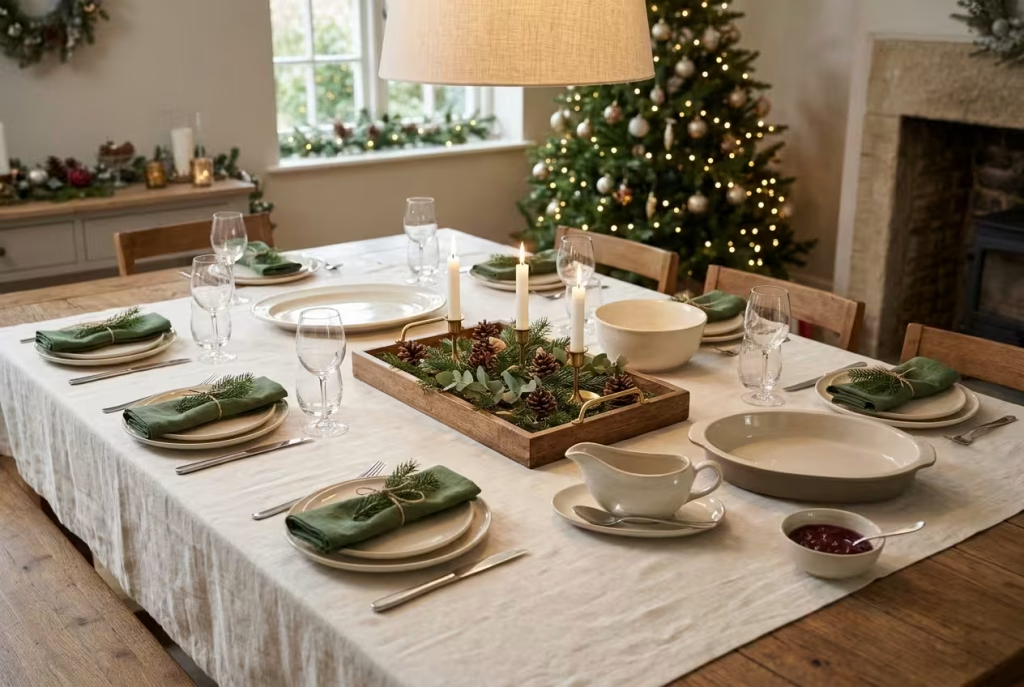
Christmas dinner needs far more dishes on the table than a Tuesday supper, a point Douglas stresses. A trick from the Houzz threads is to build the centrepiece on a tray or wooden board, so it lifts away in one go when the platters arrive. Houzz’s editors also recommend a dry run with dinnerware, decorations and serving dishes before the day, so surprises surface while there is still time to move things. Lay out the empty serving dishes on the cloth, step back and ask yourself a simple question: can I still spot the table underneath?
Lighting Where Holiday Dining Rooms Are Won or Lost
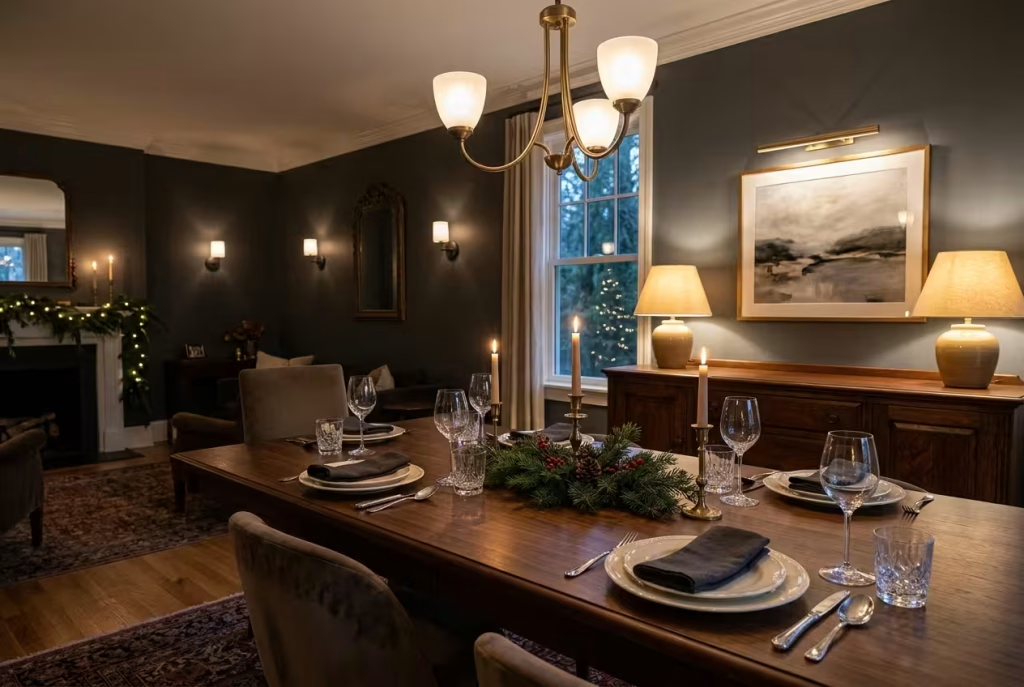
Picture two identical dinners. In the first, the overhead light blazes at full strength, bouncing off the glasses and flattening every face. In the second, the chandelier glows low, the sideboard lamps wash the walls in amber and candle flames shiver on the table. Same food, same guests, utterly different evening. ELLE Decor’s designers call a dimmable statement pendant one of the most transformative investments in the room, and Yazmin Gutierrez of Sentinium Design puts it plainly: no bright lights, just warm, moody light that creates ambience.
Think in four layers, each on its own switch if you can manage it.
| Layer | Its job | Suggested dinner setting |
| Chandelier or pendant | Ambient glow over the table | Dimmed to roughly a third to a half of full power |
| Sideboard or table lamps | Warm light at eye level, plus a lit serving area | On, or slightly dimmed |
| Picture light or wall sconces | Lifts the walls and makes the room feel finished | Low accent |
| Candles | The flattering finishing layer | Lit once guests are seated |
Getting the Chandelier Height Right
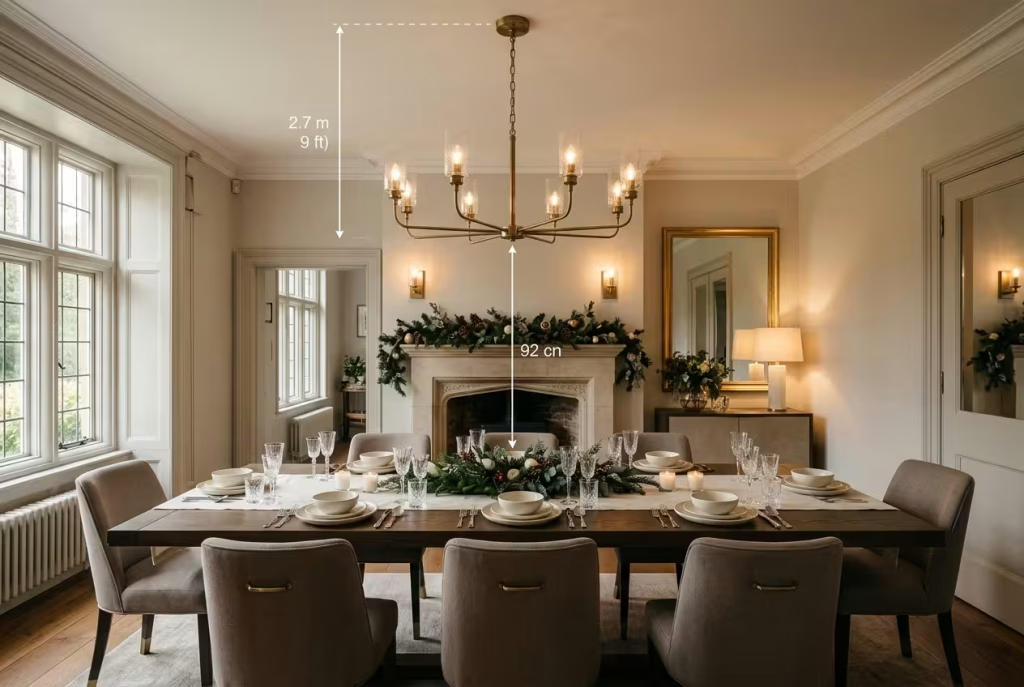
Lighting specialists and Williams-Sonoma agree on the baseline: hang the bottom of the fixture 75 to 90 cm (30 to 36 in) above the tabletop for a 2.4 m (8 ft) ceiling, then add about 7.5 cm (3 in) for each extra 30 cm (1 ft) of ceiling height.
| Ceiling height | Bottom of the chandelier above the table |
| 2.4 m (8 ft) | 75 to 90 cm (30 to 36 in) |
| 2.7 m (9 ft) | 85 to 100 cm (33 to 39 in) |
| 3.0 m (10 ft) | 90 to 105 cm (36 to 42 in) |
| 3.3 m (11 ft) or more | 100 to 115 cm (39 to 45 in) |
As for width, a fixture between half and two thirds the width of the table is a reliable range. Keep it at least 15 cm (6 in) inside the table edge on every side, so a standing guest never clips their head.
Bulbs, Dimmers and the Magic Number
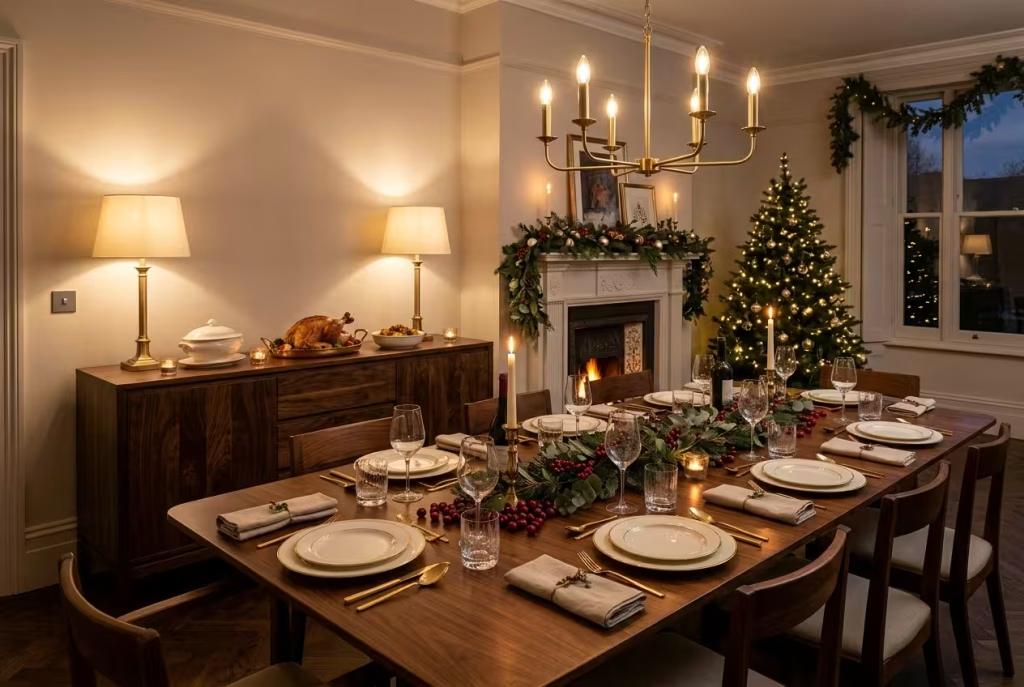
- Choose 2700K bulbs. That warm white sits close to candlelight and flatters gold, brass and red. Avoid mixing colour temperatures in the same room, because a cooler lamp beside a warm chandelier looks like a mistake.
- Pick a CRI of 90 or above. Bulbs with strong colour rendering keep the roast, the cranberries and the greenery rich instead of dull.
- Fit a dimmer. It is the single most useful upgrade, since the same room must be bright for laying the table and low for dinner. Check that the dimmer suits your LED bulbs, because a mismatch causes buzzing and flicker.
- Mind the lamps. On a sideboard, a pair of table lamps between 70 and 85 cm (28 to 34 in) tall puts warm light at the right height, and opaque shades push it down onto the food and up the wall.
- Light the art. A picture light roughly half to two thirds the width of the frame turns a painting into a focal point, and wall sconces centred at about 150 to 165 cm (60 to 66 in) flatter faces.
You May also Like: How to Create a Stunning Coastal Home: The Ultimate Design Guide
When the Light Goes Wrong
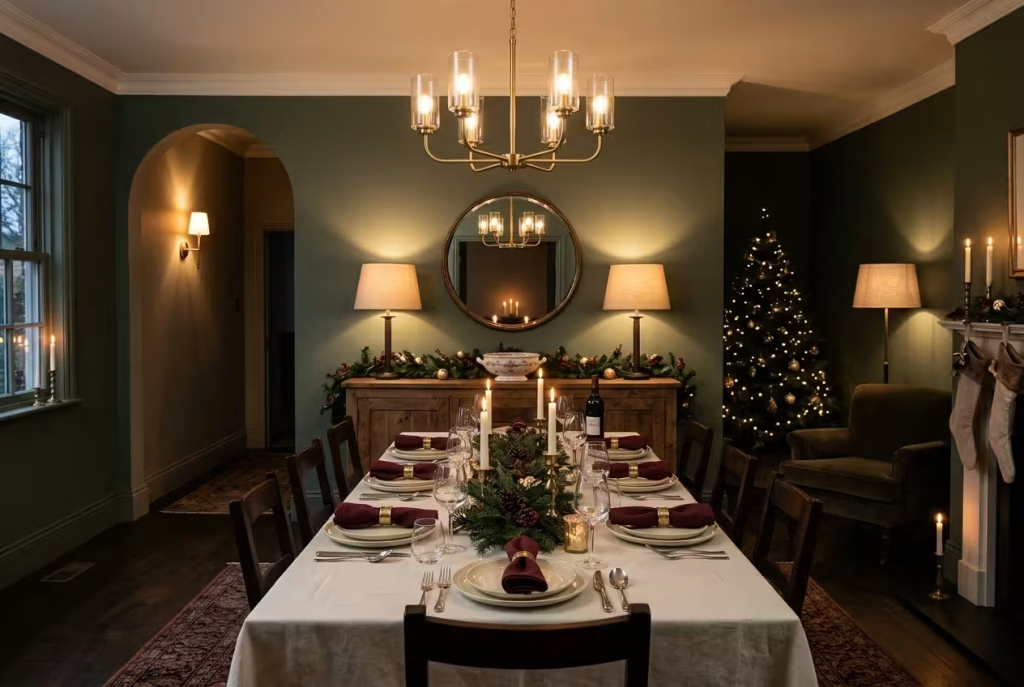
| What you notice | The likely cause | The fix |
| Faces look flat or washed out | Overhead light at full power | Dim to a third or half, add lamps |
| Food looks dull and grey | Bulbs with a low CRI | Swap to CRI 90 or above |
| The room feels cold and clinical | Bulbs above 3000K, or mixed temperatures | Standardise on 2700K |
| The dimmer hums or flickers | Bulbs and dimmer not compatible | Fit a dimmer made for LEDs |
| Glare in guests’ eyes | Chandelier hung too low | Raise it toward the top of the 75 to 90 cm range |
| Dark corners make the room feel small | No light below eye level | Add a lamp or two on the sideboard or floor |
A few finishing touches go a long way. Dim the room about fifteen minutes before the doorbell rings, so the space feels welcoming the instant the door opens. Keep the adjoining hallway or kitchen at a low glow, so the dining room reads as a destination. Hang a mirror or glass-fronted cabinet opposite the chandelier to double the sparkle without adding a fitting. Candlelight burns at around 1800 to 2000K, even warmer than your bulbs, which is why it flatters so shamelessly. And keep greenery clear of bulbs and sockets, never letting dried foliage touch a hot surface.
Tenants, take heart. Plug-in wall lights, a pair of lamps on a console and a handful of candles deliver most of the effect without touching the ceiling rose.
Beyond the Table Sideboard, Chairs and the Rooms Around You
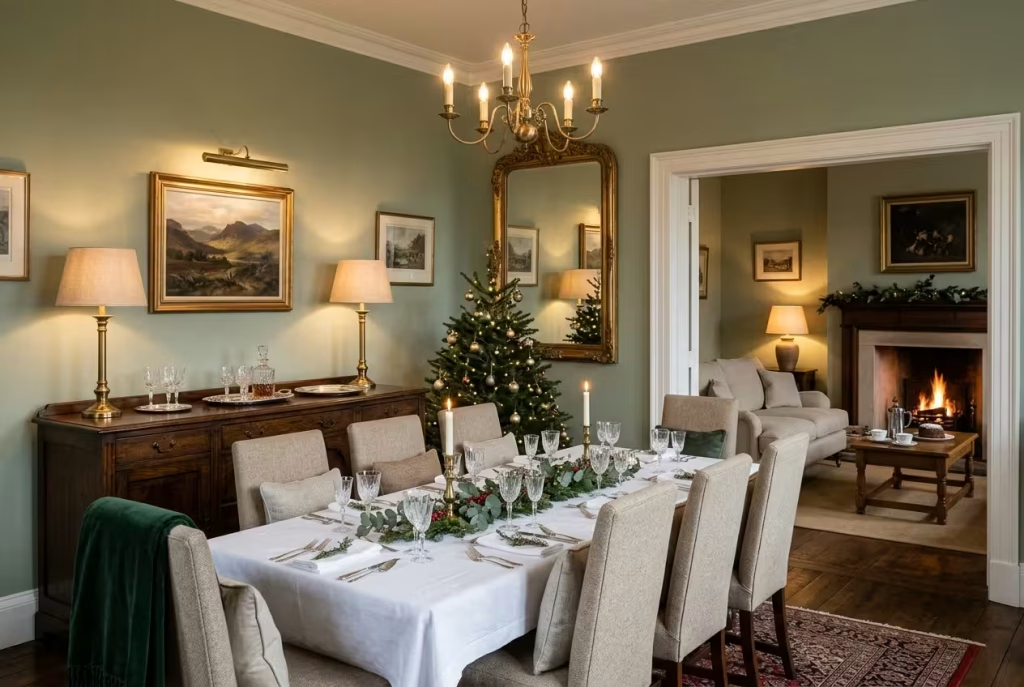
A table rarely stands alone. The furniture and walls around it decide whether the evening glides or jars.
Give the sideboard a job. It is the natural landing strip for hot dishes, spare serving spoons and the bottle that needs breathing space. Put a pair of lamps on it, a tray of glasses at one end, and leave a clear stretch for platters. A Houzz host who serves drinks from the end of her island lets guests pick up a glass just before sitting down, which spares the cook a dozen requests.
Think about the chairs, not only the table. Designer Tonia Coleman, working with a Texas family who adored long meals, was asked for chairs that felt more like lounge seating than traditional dining chairs, so guests could linger for hours without feeling confined. Seat pads in a wool or velvet blend, a cushion for the stiffest chair and a throw over the back of the host’s seat all say the same thing: stay as long as you like.
Plan a second act. Rebecca Gardner, the event planner behind Houses & Parties, likes to host across several connected rooms, so that you can open a door on the next stage of the evening. Parties last hours, she observes, and nobody wants to stay in one room all night. A pudding course in the lounge, coffee by the fire, a game laid out on a side table: each is an excuse to stretch legs and swap seats.
Let the walls work. A mirror opposite the chandelier doubles the light. A picture light turns a favourite painting into the room’s quiet host. Designers also report that every room now leads a double life, so a library can become a cocktail lounge and a dining room can double as a gallery.
Scent, Sound and Touch
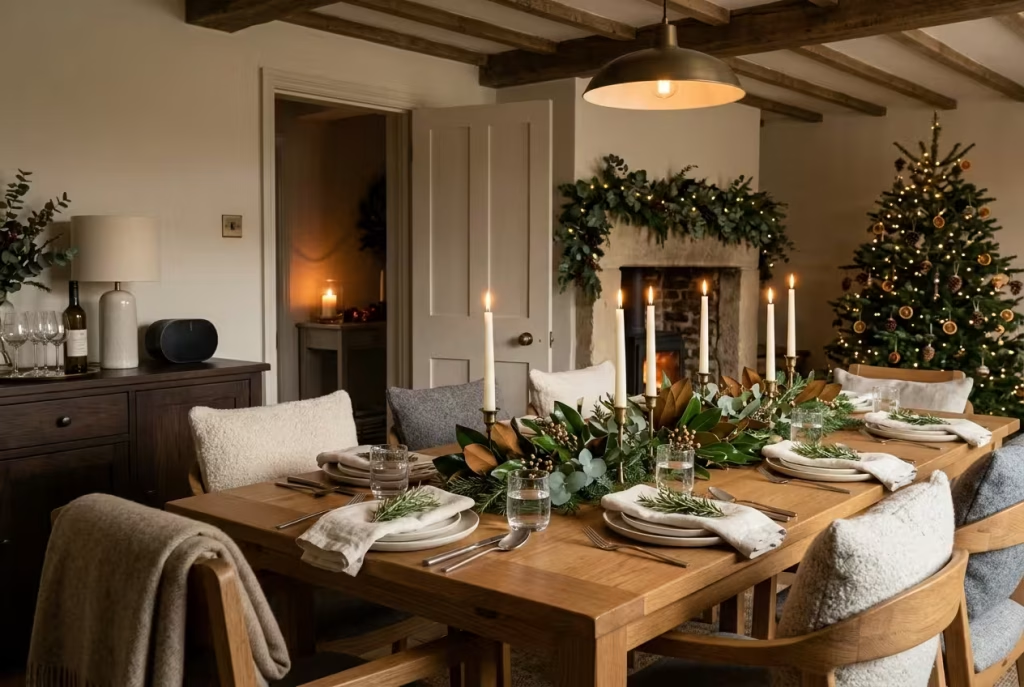
Guests read a room with every sense, and the ones hosts forget are often the ones remembered longest.
- Greenery: foraged branches, magnolia, eucalyptus and rosemary look generous and cost almost nothing. Crush the ends of woody stems and stand them in water overnight so they drink well, and keep every stem clear of flame.
- Scent: keep fragrant candles in the hall or lounge and use unscented ones at the table, because scent competes with the food and nobody wants a vanilla-tinged turkey.
- Sound: a low playlist is a quiet star. Aim for volume that fills the silences without elbowing into conversation, and test it from the far end of the table.
- Touch: soft napkins, heavy cutlery and cushioned seats tell people that nobody is in a hurry.
- Warmth: ovens, bodies and candles heat a dining room quickly, so keep it slightly cooler than feels right when you start. Guests will thank you by the main course.
How the Food Reaches the Table
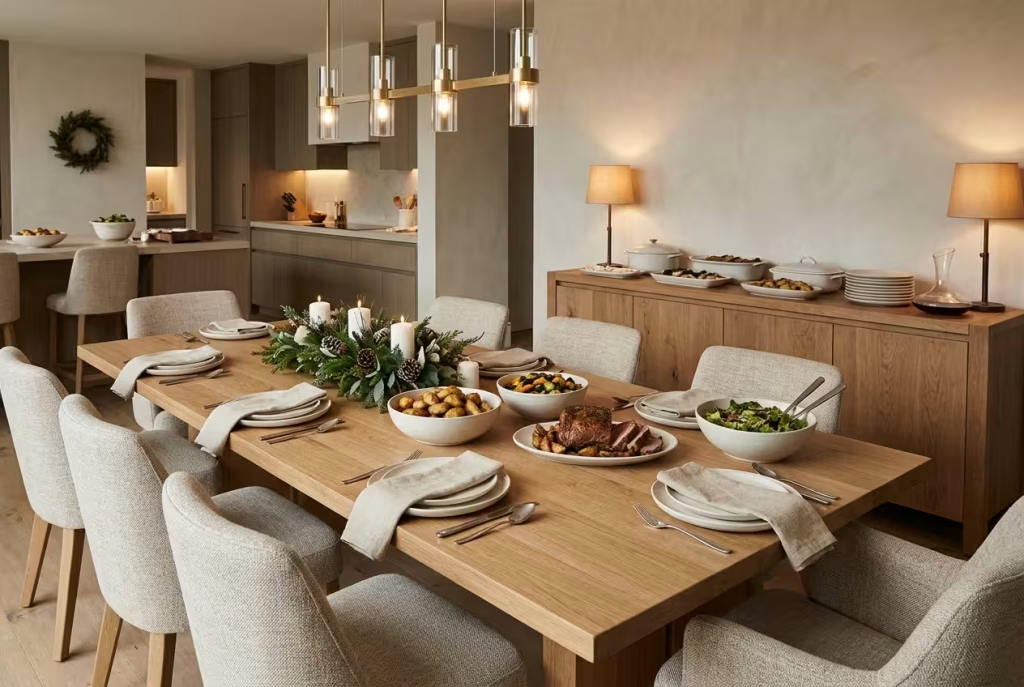
The way dishes travel decides how much space you can spare for decoration. Choose the style first, then dress the table to suit.
| Serving style | Works best for | Pressure on the table | Watch out for |
| Plated | Formal dinners of six to eight | Light, since plates arrive ready | Needs someone free to serve |
| Family style | Warm, talkative groups | Heavy, because every dish lands in the middle | Keep the centrepiece minimal or removable |
| Buffet | Larger numbers, mixed ages | None, since food stays on a side surface | Guests need somewhere comfortable to eat |
| Cocktail buffet | Crowds and small homes | None, as guests roam | Plenty of perching spots and napkins |
A recurring complaint on the Houzz threads is the kitchen crush, with guests wedged around the dishwasher while the cook tries to carve. Moving the buffet to an island or dining sideboard, and setting drinks elsewhere, draws the crowd out of the engine room.
One Room, Many Celebrations
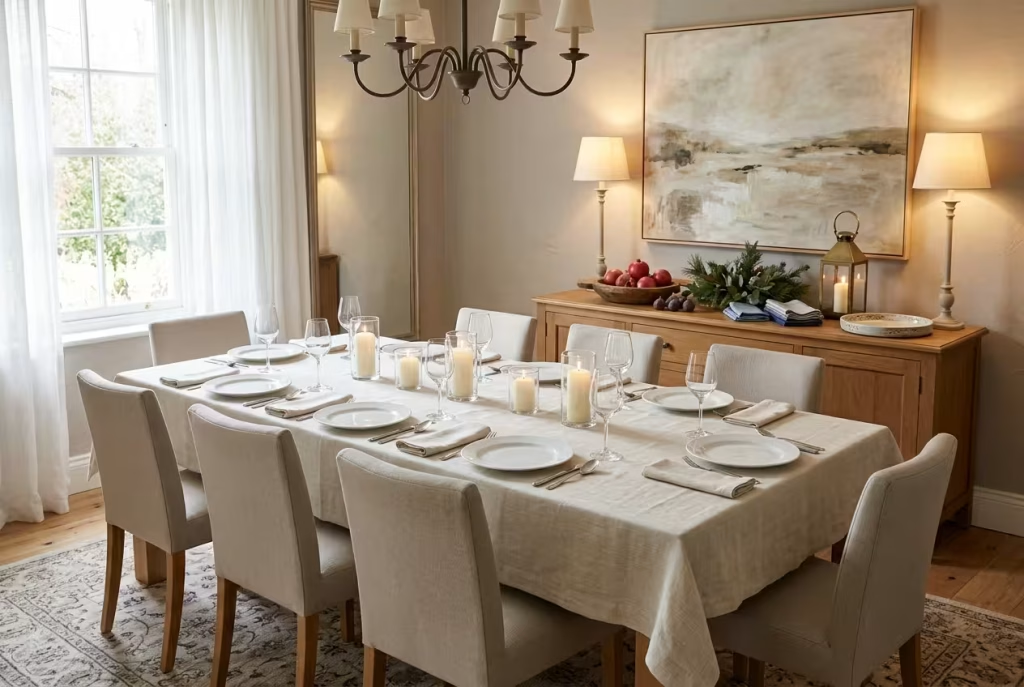
A holiday dining room does not have to mean one holiday. Many households juggle several traditions in a single season, and a flexible base serves them all.
| If you celebrate | Styling thread | A practical note |
| Christmas | Greenery, candles, crackers beside each plate | Keep foliage clear of flames and bulbs |
| Hanukkah | Blue, white and silver linens; the menorah as a centrepiece | Stand it on a heat-proof tray, away from curtains and napkins |
| Diwali | Diyas, marigolds and warm gold accents | Place lamps on ceramic or metal trays and keep fabrics well back |
| Eid | Dates, sweets and lanterns on a generous table | Gatherings often run through the day, so use sheer curtains and natural light |
| Thanksgiving or Friendsgiving | A big bowl of seasonal fruit and layered metallics | Keep the table clear for platters |
| New Year’s Eve | Candlelight, metallics, a cocktail buffet | Plan how guests will move between rooms |
Neutral linens, plain white plates and a stock of unscented candles carry you through all of them, with a change of accessories doing the festive work.
The Hosting Plan A Countdown, Then the Last Ten Minutes
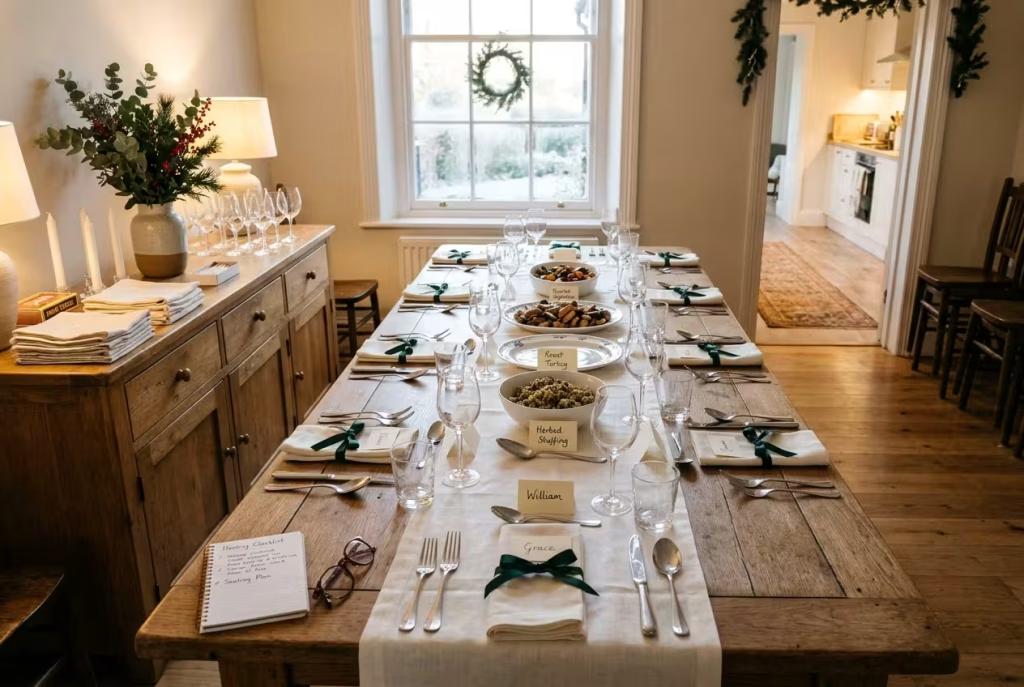
Styling rarely fails on looks. It fails on logistics: the crowded kitchen, the missing chairs, the table that needs resetting between Christmas Eve cocktails and Christmas morning brunch. Learn from the hosts who have been there.
- Plan the turnaround. One Houzz regular, hosting a Christmas Eve party followed by a brunch, tested the brunch table the night before. Same china and placemats, smaller cutlery, everything ready to go.
- Delegate with a purpose. A host who passed table-setting to her niece found that the niece chose dishwasher-safe plates and glasses, saving a whole evening of washing up.
- Keep the cook out of the traffic. Make a clear route from the oven to the table that avoids the drinks station.
- Let the memories lead. Heirloom plates, handmade ornaments and borrowed linens are the reason the effort feels worthwhile, so give them pride of place.
Woman & Home’s hosting advice is to set the table the day before, leaving one fewer job on the day. This timeline builds on that.
| When | What to do |
| Two weeks before | Declutter and deep clean the room. Replace bulbs and test the dimmer. Do a dry run with plates, serving dishes and decorations. |
| One week before | Wash and press linens. Polish glasses and cutlery. Count chairs and borrow what is missing. Choose seated or buffet. |
| Two or three days before | Buy greenery and fruit. Stock unscented candles and spare matches. Write name cards and sketch the seating plan. |
| The day before | Lay the whole table. Label serving dishes with sticky notes. Set the dimmer levels you like. |
| Morning of | Top up greenery and flowers. Clear the hallway. Check chairs and any overflow table. |
| Thirty minutes before | Light the candles, dim the lights, start the music and pour yourself something. |
The Last Ten Minutes
- Stand at the door and look in as a guest would, then fix the first thing your eye snags on.
- Check that every candle is secure and clear of foliage.
- Walk the dimmer to its dinner setting and put the lamps on.
- Open the window for a minute to freshen the air, then close it.
- Put one small, kind thing at each seat, even if it is only a name card in your own handwriting.
- Take one breath. The room is ready, and so are you.
Small Rooms, Rentals and Tight Budgets
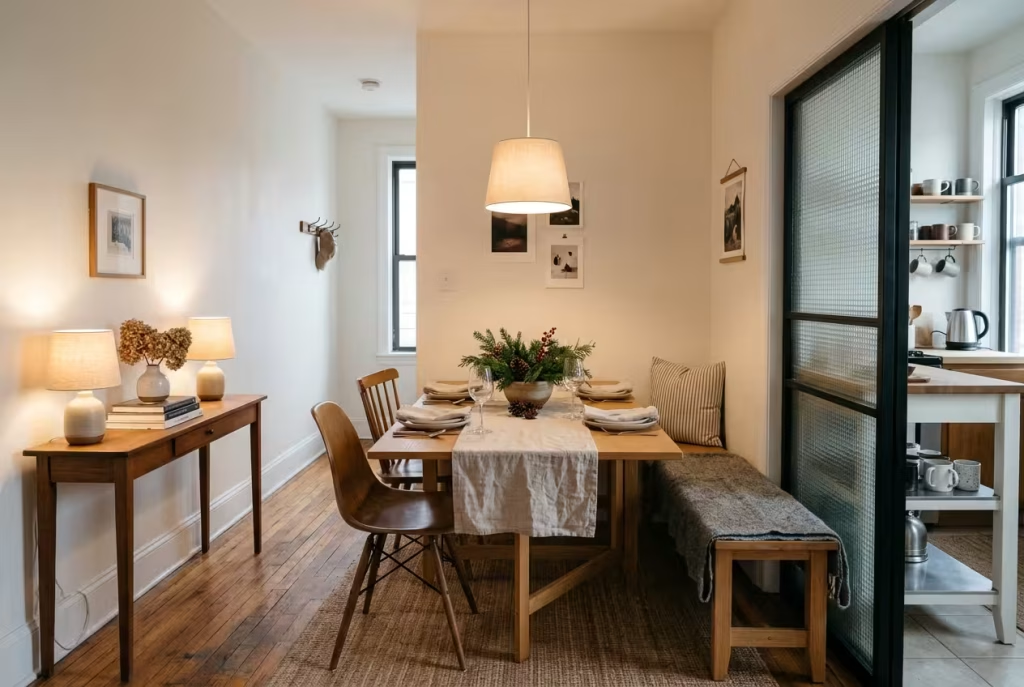
Nobody needs a ballroom. Some of the most memorable tables belong to people with a corner of a flat and a borrowed trestle. Rebecca Gardner herself, as she writes in her book, sometimes hosts eight for dinner in her bedroom, on a folding table pulled up to her canopy bed.
Squeezing in More Seats
- Add a bench or banquette. Designer Karen Asprea, quoted by Good Housekeeping, explains that a banquette sits against the wall without needing clearance, while a backless bench tucks fully under the table when not in use.
- Think round. Round tables remove corners and hierarchy, so conversation flows more freely.
- Borrow a hallway. Designer Octavia Dickinson champions the hall dining room, where a table in a generous entrance becomes the host’s favourite place to entertain, lit by candles and with the kitchen close by.
- Blend functions. Several designers expect dining spaces to double as libraries, desks or games areas. A fold-away table keeps those options open.
- Use glass to divide. Designer Paris Forino likes glass pocket doors to separate kitchen and dining space, letting light through while hiding the mess.
Where to Spend and Where to Save
| Spend on | Save on |
| A dimmer and warm, high-quality bulbs | Themed, single-season tableware |
| Good napkins and a neutral cloth that lasts for years | Elaborate floral centrepieces, when foraged foliage will do |
| Sturdy, safe candle holders | Expensive scented candles, since scent is best kept away from the table |
| A pair of sideboard lamps | Matching chairs, because a collected look is on trend anyway |
Budget hosts have more allies than they think. Woman & Home’s stylist advice, to buy tableware that works all year, saves money in the long run, and thrifted linens, foraged branches and a bowl of seasonal fruit cost very little yet look entirely intentional.
Fire and Pet Safety Keeping the Evening Merry
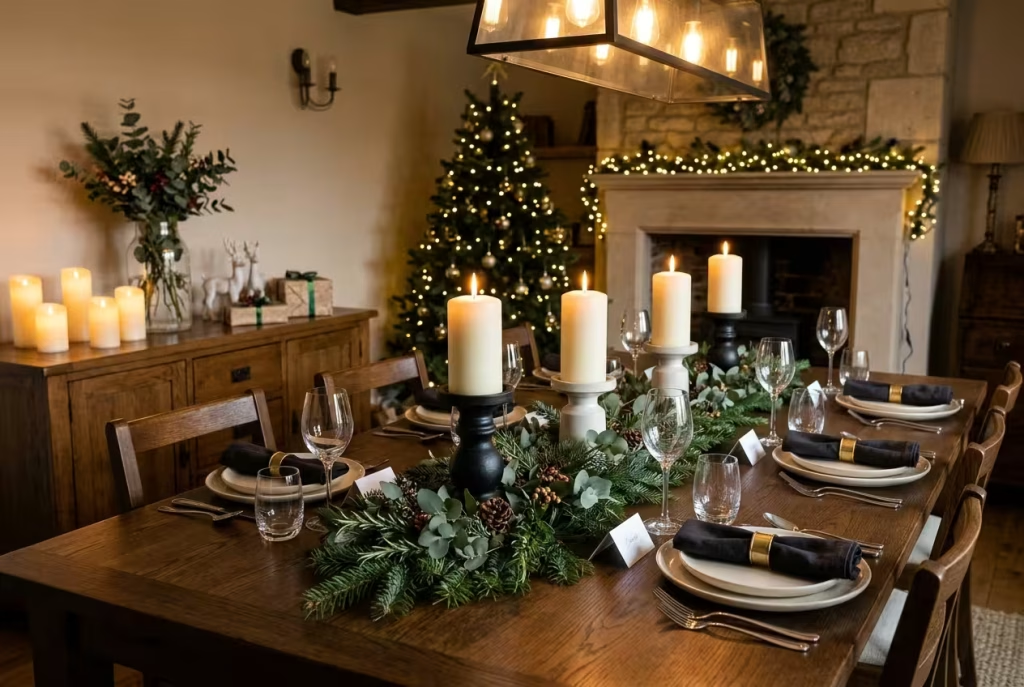
Most of the risk comes down to two things: flames and curious paws. The figures below come from US fire statistics, but the physics of a candle near a curtain does not change at the border.
Candles and Decorations
| What the data says (NFPA, US) | What to do |
| Candles start 35% of home decoration fires through the year, rising to 45% in December | Choose stable holders, and swap in flameless candles for risky spots |
| In 44% of decoration fires, the item was too close to a heat source | Keep flames at least 30 cm (12 in) from foliage, paper, napkins and curtains |
| In three of every five candle fires, the candle sat too close to something flammable | Use shorter, wider candles that cannot topple, and keep tapers clear of greenery |
| In the US, 8% of December candle fires began in dining rooms, against 3% over the rest of the year | Never leave a lit candle unattended, and blow them out before bed |
| Christmas Eve and Christmas Day are the top two days for home candle fires | Give one person the job of checking the table before everyone drifts to the sofa |
One more caution: strings of lights and heavy garlands hung over the table should never overload a pendant cable. If in doubt, choose something lighter, and test your smoke alarm before the cooking starts.
Pets and Festive Plants
| Plant or item | Risk to pets |
| Poinsettia | Only mildly irritating, so the ‘deadly poinsettia’ story is a myth |
| Holly | Toxic, causing stomach upset |
| Mistletoe | Toxic, with rare heart effects reported |
| Lilies | Extremely dangerous to cats, even in small amounts, with a risk of kidney failure |
| Amaryllis and paperwhite narcissus | Toxic to cats and dogs |
| Christmas cactus and roses | Non-toxic |
| Tinsel, ribbon and loose wires | Choking and obstruction risks |
The ASPCA suggests non-toxic decor such as wood, fabric or pinecones. Cats may also swat at flames, so consider LED candles for any table within a pet’s reach, and keep a quiet room ready for animals that find crowds stressful.
Bringing It All Together
The best holiday dining rooms rarely shout. They hold you gently, with soft light, enough elbow room, a table that lets everyone see everyone else, and a few well-chosen touches that look as if they have always lived there. You do not need all of it. Begin with the dimmer and the tape measure, add one decent centrepiece, and set the table the day before.
Then, when the doorbell finally rings, stand still for a moment and look at what you have made. Somewhere in the years ahead, a guest will recall this room without remembering a single dish. They will remember how it felt to be welcomed into it, and that, as every host eventually discovers, is the whole point.
Frequently Asked Questions
How do I style a dining room for a holiday gathering?
Clear the clutter, size the table to 60 cm per guest, layer linens and plates in two or three colours, keep the centrepiece low or slender, and light the room with a dimmed chandelier, lamps and candles. Set the table the day before.
How tall should a holiday centrepiece be?
Keep it low and wide, or tall and slender with the stems above eye line. If guests must lean to see across the table, it is too tall. A standard table leaves a central strip only 15 to 30 cm wide once place settings are down.
How much space does each guest need at the table?
Allow about 60 cm (24 in) of edge per person as a minimum, and 75 cm (30 in) for comfort. Keep roughly 90 cm clear between the table and walls, and 105 to 120 cm where people walk behind chairs.
What size table seats 6, 8, 10 or 12 people?
At 60 cm per place, a rectangular table with seats on both long sides needs 180 cm for six, 240 cm for eight, 300 cm for ten and 360 cm for twelve. A chair at each head lets you trim about 60 cm from those lengths.
How high should the chandelier hang over the dining table?
Hang it 75 to 90 cm (30 to 36 in) above the table for a 2.4 m ceiling. Add about 7.5 cm for every extra 30 cm of ceiling height, so a 3 m ceiling suits roughly 90 to 105 cm.
What colour temperature and bulbs suit a holiday dining room?
Choose 2700K warm white bulbs with a CRI of 90 or higher. They match candlelight, flatter food and faces, and harmonise with gold, brass and red. Avoid mixing different colour temperatures in the same room.
How do I seat more guests than my table holds?
Set a second table in an adjoining room, dress folding tables in floor-length cloths, and try a cocktail buffet. Hosts also swap in benches or banquettes and rename the extra table the ‘young adult table’.
What size tablecloth and runner do I need?
Cloth size is table length and width plus twice the drop: about 20 cm for casual, 38 cm for formal. A runner should be about a third of the table width, hang 15 to 30 cm over each end, and sit shorter than the cloth.
Where does each piece go in a place setting?
Place the fork on the left, the knife on the right with its blade turned inward, and the spoon beside the knife. The water glass sits above the knife, and the napkin goes on the plate or beneath the fork.
Are holiday candles and greenery a fire risk?
Yes. US data show candles start 45% of decoration fires in December. Keep flames at least 30 cm from anything flammable, use stable holders, never leave candles unattended, and keep greenery away from bulbs.
Which holiday plants are unsafe for pets?
Holly, mistletoe, amaryllis and paperwhite narcissus are toxic, and lilies can cause kidney failure in cats. Poinsettia is only mildly irritating. Christmas cactus and roses are non-toxic.
How far ahead can I set the table?
A full day ahead works well. Lay cloths, plates, glasses and napkins the night before, then add fresh greenery and light candles on the day. Keep tea towels over the settings if you have pets.
How do I decorate a small dining room without it feeling cluttered?
Keep the centrepiece to one low arrangement, move statement pieces to the sideboard, use a banquette or bench to save space, and draw drama upward with lighting or hanging foliage. Fewer, better pieces feel calmer.
Can one dining room suit several holidays?
Yes. Start with neutral linens, plain white plates and unscented candles, then change only the accessories: greenery for Christmas, a menorah for Hanukkah, diyas and marigolds for Diwali, dates and lanterns for Eid.