
How to Design a Sophisticated Victorian Home Office: The Definitive Guide
Quick answer: A sophisticated Victorian home office pairs one substantial anchor piece (a mahogany or walnut desk, real or reproduction) with a deep jewel-toned palette, layered brass or Tiffany-style lighting, and floor-to-ceiling storage, then deliberately loosens the whole thing up with one or two contemporary pieces so the room reads as lived-in rather than roped off like an exhibit. Budget realistically: a genuine antique desk runs anywhere from £425 to £5,000+, a roll of proper Morris & Co wallpaper sits around £86 to £150, and any vintage-style lighting should be checked by an electrician before it goes anywhere near a stack of papers.
There’s a particular kind of quiet that settles over a room lined with books and lit by a single warm lamp. It’s the quiet that makes you want to sit down, pour something into a decent glass, and actually think for a while rather than skim another fifteen browser tabs. Psychologists have a name for part of what’s happening in a room like this: environments with rich texture, warm light and a sense of enclosure quietly cue the nervous system to settle, the same mechanism that makes a candlelit dinner feel different from one under strip lighting. That’s the promise of a Victorian home office done properly, and it’s exactly why the style has refused to go out of fashion since the reign it’s named after.
The trouble is that most people who chase this look end up with something closer to a stage set for a costume drama than a room they actually want to work in. Heavy, dark, a bit airless, and about as inviting as a solicitor’s waiting room in 1889. You know the room the moment you walk into it. Nothing has been touched in years, the chair looks like it might report you to the authorities for slouching, and there’s a faint sense that you ought to be wearing gloves.
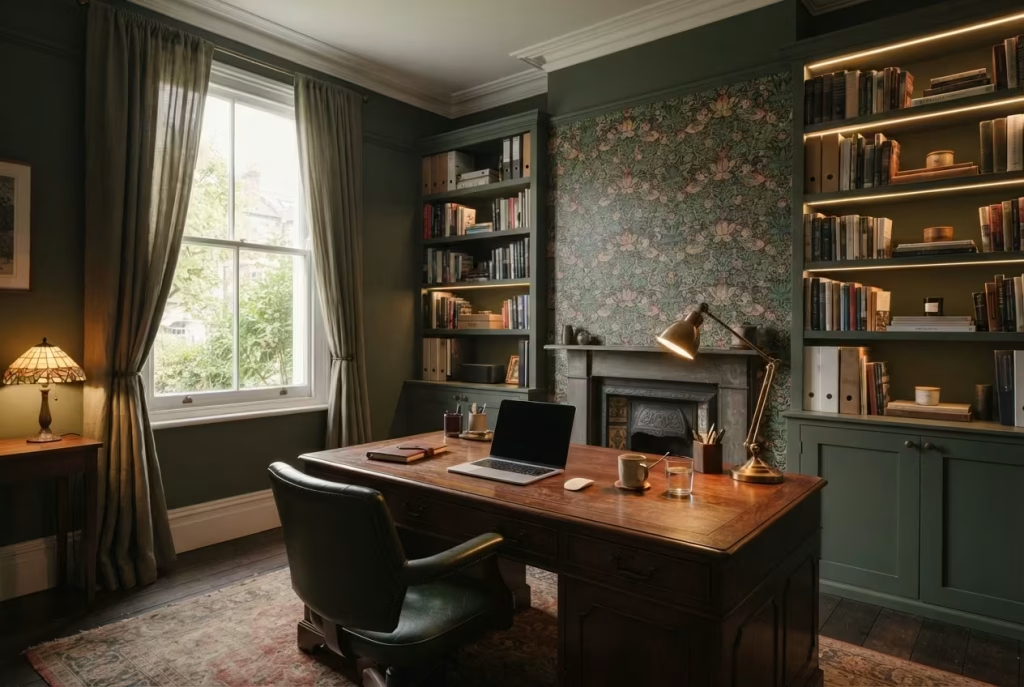
This guide exists to close that gap, properly, with numbers behind every claim rather than the vague gestures towards “rich colours” and “ornate furnishings” you’ll find on most sites chasing this exact keyword. We’ll walk through the anchor furniture, the palette, the lighting, the storage, the window dressing, and the finishing touches, zone by zone, with real prices, real measurements, and the kind of practical honesty about wiring, ergonomics and budget that the competing guides on this topic simply don’t offer. Along the way we’ll answer the two questions almost everyone actually asks once they start planning this for real: how do I stop it looking like a museum, and how much is this genuinely going to cost me.
Why “Sophisticated” Isn’t the Same as “Authentic”
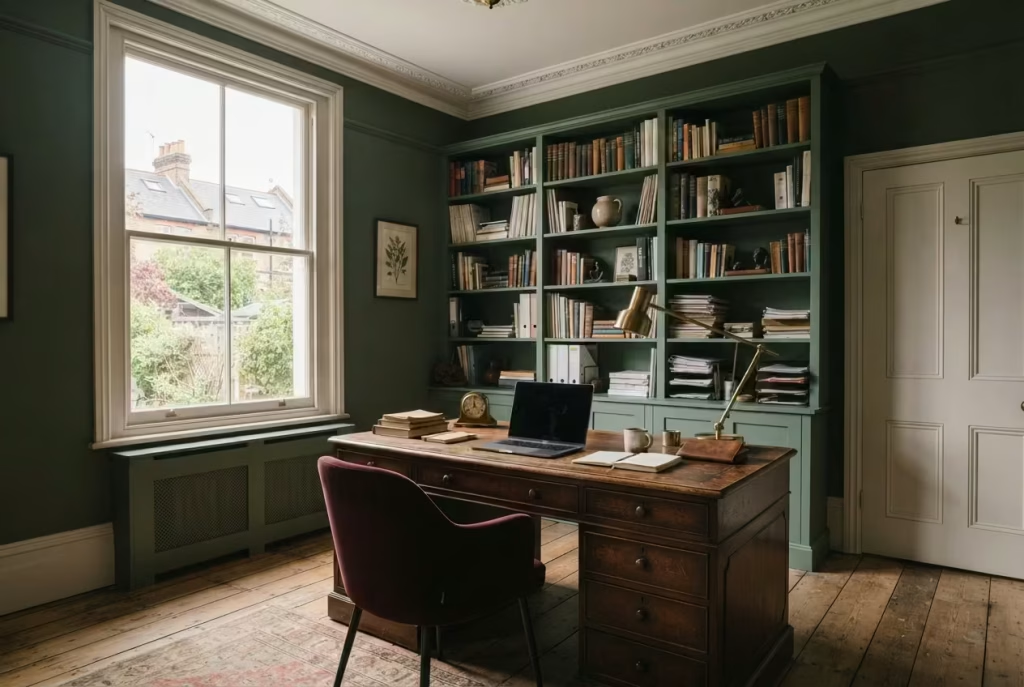
Here’s a distinction worth sitting with before you spend a penny, because getting it wrong is the single biggest reason these projects go sideways. Museum-accurate Victorian design and sophisticated Victorian design are not the same brief, and chasing the first will actively sabotage the second. A room decorated to the strict letter of 1875, every surface patterned, every chair upholstered in unforgiving horsehair, tends to feel stiff and slightly accusatory rather than storied and warm. There’s a reason so many stately home tours leave you relieved to get back outside.
Real Victorian interiors, incidentally, were never even that uniform in the first place, so there’s no single “correct” version to be faithful to. The era ran from 1837 to 1901, a full sixty-four years, long enough for tastes to swing from the fussy excess of the mid-century High Victorian mood right through to the pared-back handcraft ethos of the Arts and Crafts movement that closed it out. Treating “Victorian” as one fixed look is a bit like treating the last sixty years of British music as a single genre. It flattens something that was actually restless and evolving the whole way through.
The fix that keeps surfacing among people who actually live with these rooms, rather than just photograph them for a feed, is tension. A genuinely instructive real-world case comes from a 2026 Houzz feature on a Victorian semi in West Dulwich, south-east London. The couple who bought it inherited an interior where, in the owner’s own words, “everything was kind of moss green” with “tons of wood stained really dark.” Their instinct wasn’t to strip the character out and start again with white walls and flat-pack furniture, which is the mistake most people make when a dark period room starts to feel oppressive. Instead they kept what gave the house its bones (the restored sash windows, the reinstated ceiling roses, the high ceilings) and layered in genuine jewel-bright colour while working harder to pull natural light into the space. The gloom lifted. The character didn’t. That’s the throughline running underneath everything in this guide: protect whatever gives the room its gravitas, and ruthlessly cut whatever’s making it feel like nobody’s actually allowed to sit down in it.
There’s also a psychological dimension worth naming honestly, because it explains why this style keeps calling people back even in an era of minimalist beige everything. A room with visible history, real wood grain, worn leather, a desk that’s outlived several owners, offers something a brand-new flat-pack setup simply can’t: a sense of continuity. Sitting at a desk that’s a hundred and fifty years old and has already survived several wars, a handful of owners and at least one house move connects your working day to something larger than the next deadline. That’s not sentimentality. It’s one of the genuine, quiet reasons people report feeling calmer in a well-executed period room than in a sterile modern one.
Choosing Your Victorian Sub-Style First
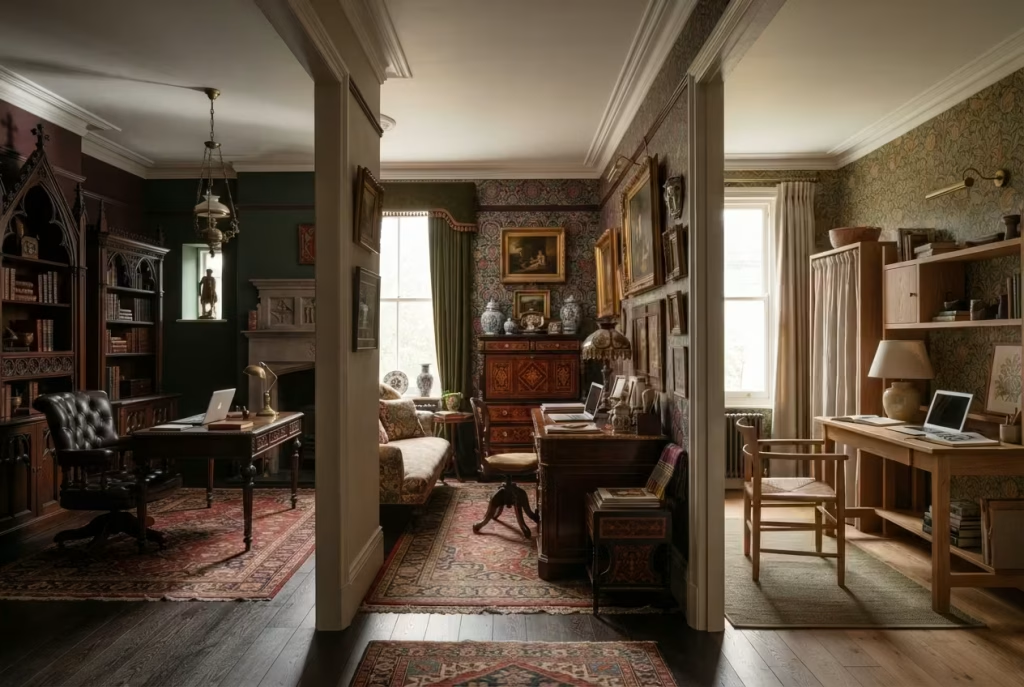
Before you buy a single thing, decide which flavour of Victorian you’re actually chasing, because “Victorian” alone is far too broad a brief to shop against with any confidence. Walk into a furniture showroom or start browsing an auction site without narrowing this down first and you’ll end up with a room that looks like three different decades had an argument. Three sub-styles cover most of what people actually mean when they say the word, and each one comes with a distinctly different price ceiling, a different mood, and a different set of practical demands on your space.
| Sub-style | Character | Typical cost tier | Best suited to |
| Gothic Revival | Pointed arches, dark carved wood, medieval-romance detailing, burgundy and forest green | Mid to high (carved antique pieces command a real premium) | Larger rooms with high ceilings and strong original architectural bones |
| High Victorian | Ornate, eclectic, layered pattern-on-pattern, gilt and marquetry | High (the most furniture- and fabric-heavy of the three, by some distance) | Those genuinely willing to invest and with the square footage to layer without the room feeling crowded |
| Arts and Crafts | Clean joinery, visible craftsmanship, nature motifs, simpler honest forms | Low to mid (closer in spirit and cost to well-made contemporary furniture) | Smaller rooms, renters, or anyone nervous about committing to full ornamentation |
Gothic Revival carries a certain brooding romance to it, all pointed arches and the sense of a room that takes itself seriously. It suits a proper study with a fireplace and decent proportions far better than a boxroom, because the drama needs somewhere to breathe. High Victorian is the maximalist’s answer, layered, eclectic, unapologetically much, and it genuinely does need the space to support it or the eye has nowhere to rest. Arts and Crafts is the quieter, more forgiving option, and honestly the one most people should start with if they’re at all unsure. Its clean joinery and visible craftsmanship photograph beautifully and, crucially, don’t punish a smaller room the way the other two can.
Think of it less as picking a decorating theme and more as choosing which decade of a very long reign you actually want to live inside. Get this decision right before you shop and everything downstream, the desk, the wallpaper, the lighting, becomes a much easier, far less expensive series of choices.
You May also Like: 25 Relaxing Coastal Home Office Ideas Inspired by Capri Living
Zone One: The Desk, or Getting Your Anchor Piece Right
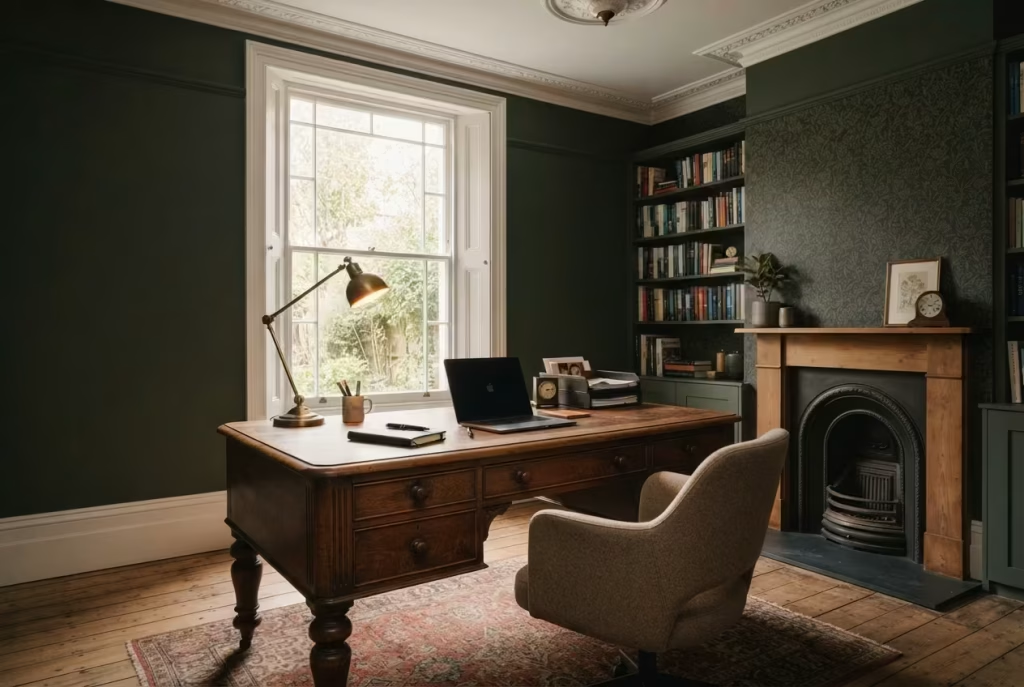
The desk is doing more work than any other single object in this room. It’s the first thing your eye lands on, the piece that sets the tone for a video call, and, frankly, the one item that will either make the whole room sing or quietly undermine everything else you’ve spent money on. Get it wrong and nothing else quite lands, however carefully you’ve chosen the wallpaper.
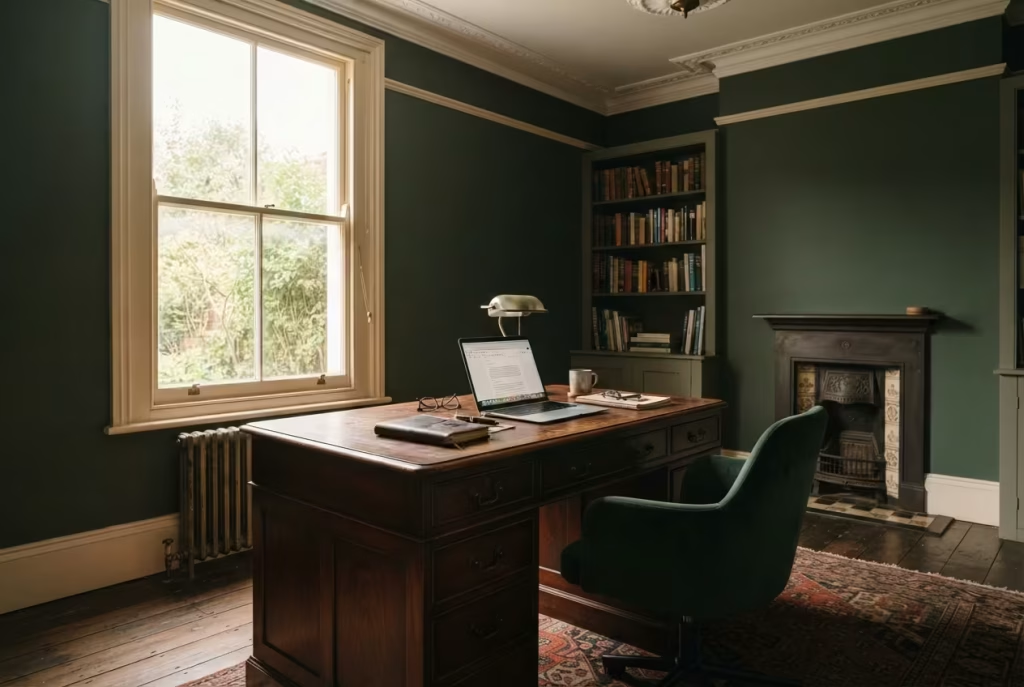
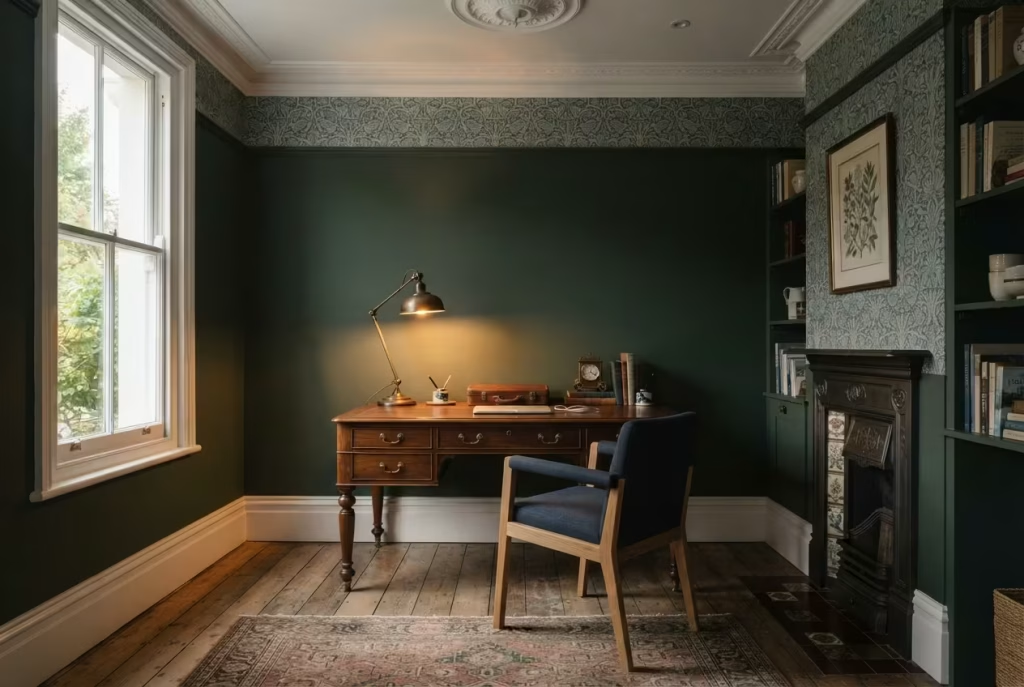
1. Go antique if your budget and door frames allow it. Real Victorian desks aren’t the unobtainable luxury they’re sometimes made out to be, and there’s a genuine emotional payoff in owning a piece with actual history rather than something that arrived flat-packed last Tuesday. Entry-level pieces, small writing tables and kneehole desks, sit around £425 to £600. Mid-range mahogany pedestal or partners desks run £600 to £1,500. Named makers such as Gillows, Maple & Co. or Howard & Sons push into £1,500 to £5,000, and rare museum-quality pieces can reach £9,500 upward, occasionally climbing into the tens of thousands for exceptional examples. One price-guide survey covering 442 sold Victorian desks found the full spread ran from as little as £84 right up to nearly £14,900, so there’s genuinely something at most budgets if you’re patient enough to work auction listings rather than fixating on the first showroom you visit. Patience, in this particular corner of furniture buying, is very literally worth money.
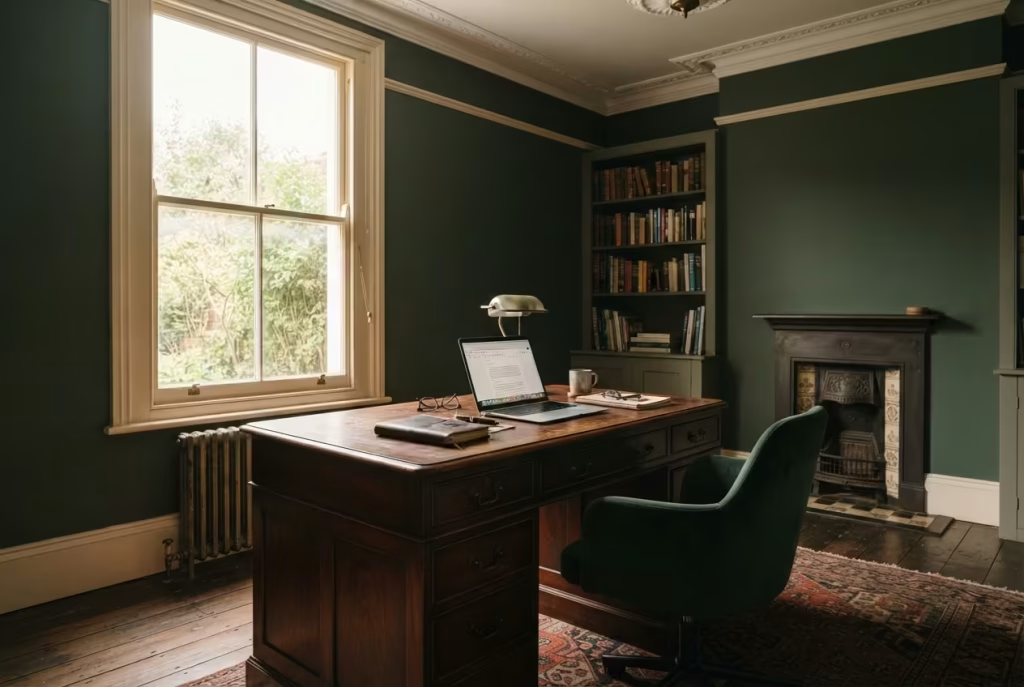
2. Measure the doorway before you fall in love with anything. This isn’t a throwaway tip, and ignoring it can turn a joyful purchase into a genuinely stressful afternoon. One furniture writer recounted sourcing a spectacular 300-pound solid walnut Eastlake cylinder desk for a client, only to discover on delivery day that it wouldn’t clear a standard 32-inch interior door frame, forcing the removal of the entire door casing just to get it into the room. Imagine that moment: the desk arrives, the excitement peaks, and then it simply will not go through the gap. Measure twice, buy once, and if the desk is coming up a staircase rather than through a ground-floor door, get exact dimensions of every turn, landing and bannister first, not just the final doorway.
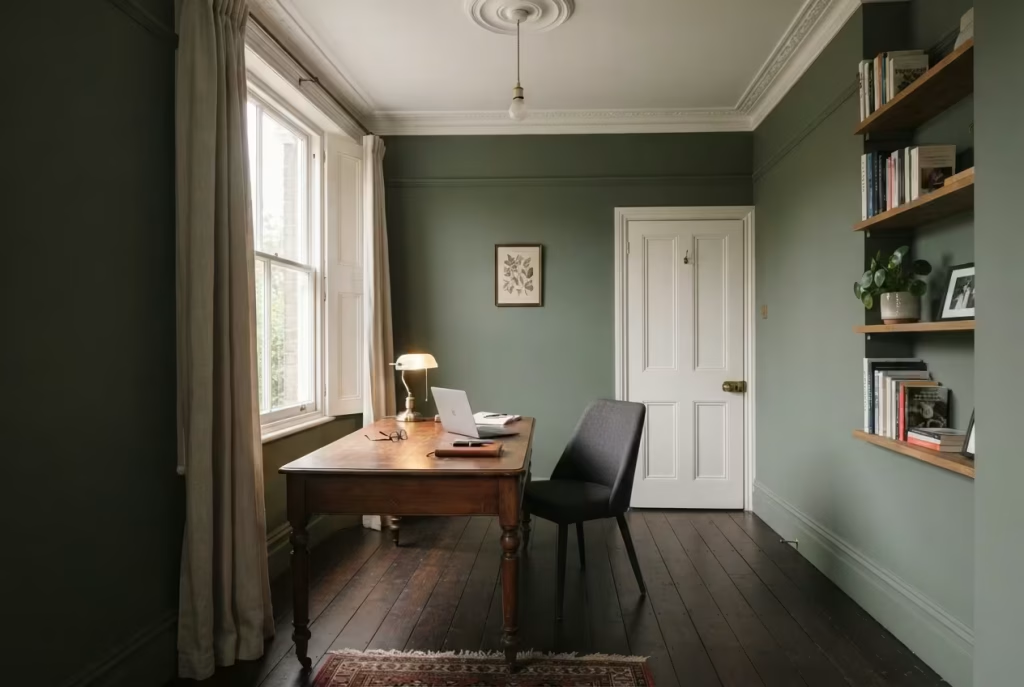
3. Choose a writing table over a solid pedestal desk in a smaller room. A double-pedestal desk looks magnificent in a photograph and swallows a 10x12ft room whole, leaving you feeling boxed in rather than settled. A Victorian writing table with turned legs leaves negative space beneath it, letting light pass through underneath and making the room read larger and airier than it actually is. There’s a real psychological effect here too. Rooms where you can see floor beneath the furniture consistently feel less claustrophobic than rooms where every piece sits solidly on the ground, which matters enormously if you’re working in this room for hours at a stretch.
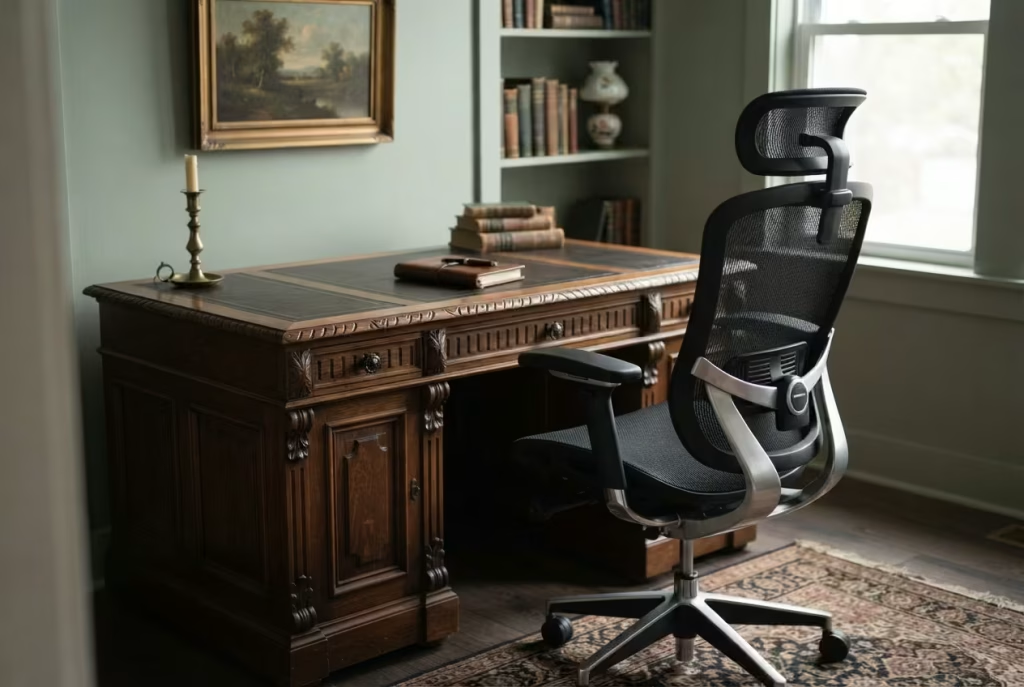
4. Buy the antique desk, but don’t sit on the antique chair. This is the single most repeated piece of genuine, hard-won wisdom on this whole topic, and it comes from bitter first-hand experience rather than a marketing brief. One designer who paired an authentic Eastlake desk with an equally authentic tufted velvet parlour chair reported that within three days, the client’s back was in genuine agony. The chair was built for twenty minutes of correspondence by candlelight, not eight hours of back-to-back video calls. Buy the antique desk. Buy a proper, modern, ergonomically sound chair to go with it, and don’t feel even slightly guilty about the mismatch in period accuracy. Your spine, quite literally, does not care whether the chair has provenance.
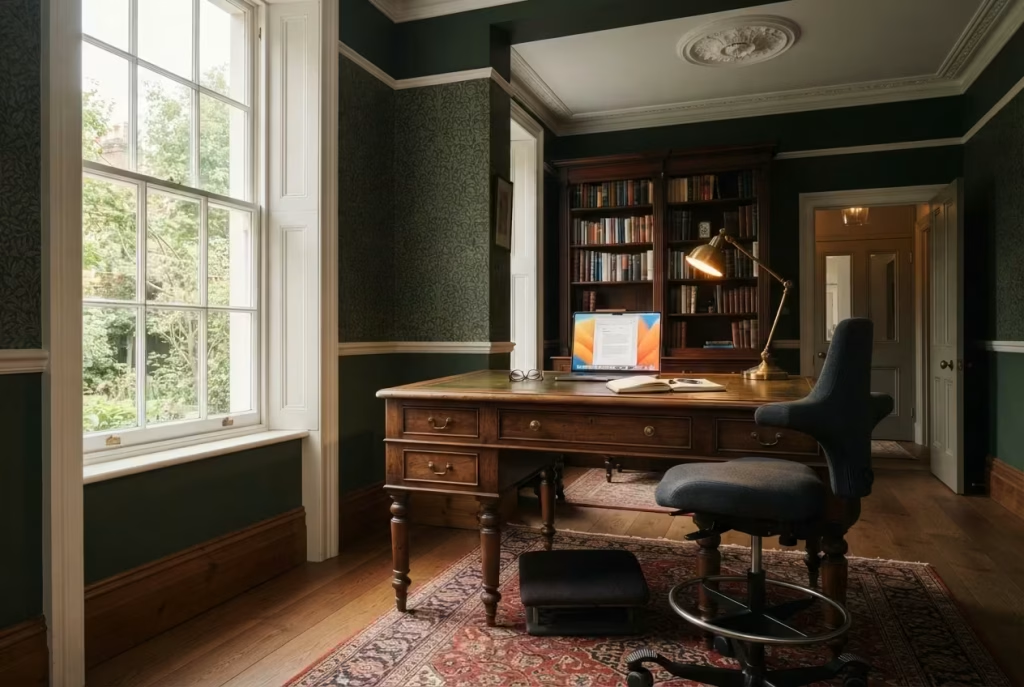
5. Mind the desk height if you’re set on something original. Standard desk height sits between 28 and 30 inches (71 to 76cm), suited to users roughly 5’8″ to 5’10” once paired with a properly adjustable chair. Real antique slope-top and ladies’ writing desks were often built taller, some auction listings run close to 40 inches, or 101.6cm, because they were designed for a more upright, formal Victorian writing posture rather than the hunched-forward angle of modern keyboard work. If a desk you’ve fallen for falls outside the standard range, a height-adjustable modern chair and a decent footrest will do far more for your daily comfort than trying to alter the desk itself, which risks damaging a genuinely old piece for very little gain.
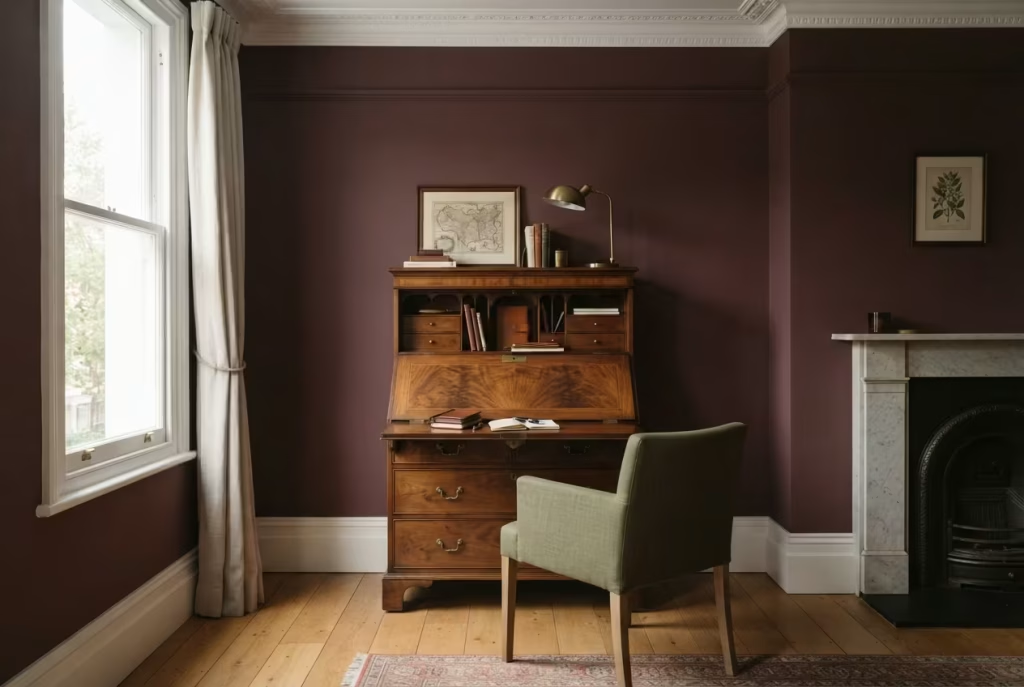
6. Consider a secretary or roll-top for a smaller footprint. Both offer hidden compartments and organisational nooks that close away entirely when the working day is done, which matters enormously if this room doubles as a guest bedroom or a dining room after five o’clock. There’s something quietly satisfying, too, about the ritual of closing a roll-top at the end of the day. It draws a physical line under your work in a way that simply clicking a laptop shut never quite manages.
Zone Two: Colour and Wallpaper Without the Gloom
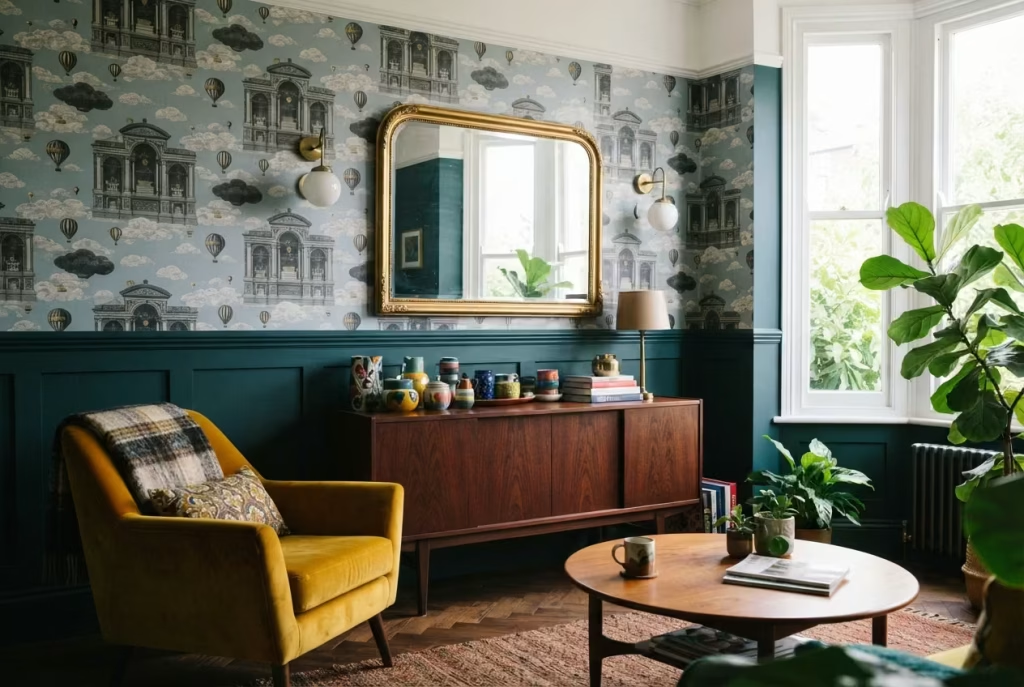
Colour is where most attempts at this style go badly wrong, either by drowning the room in darkness until it feels like working inside a coal cellar, or by going so pale and cautious that all the character drains straight out of it along with the gloom.
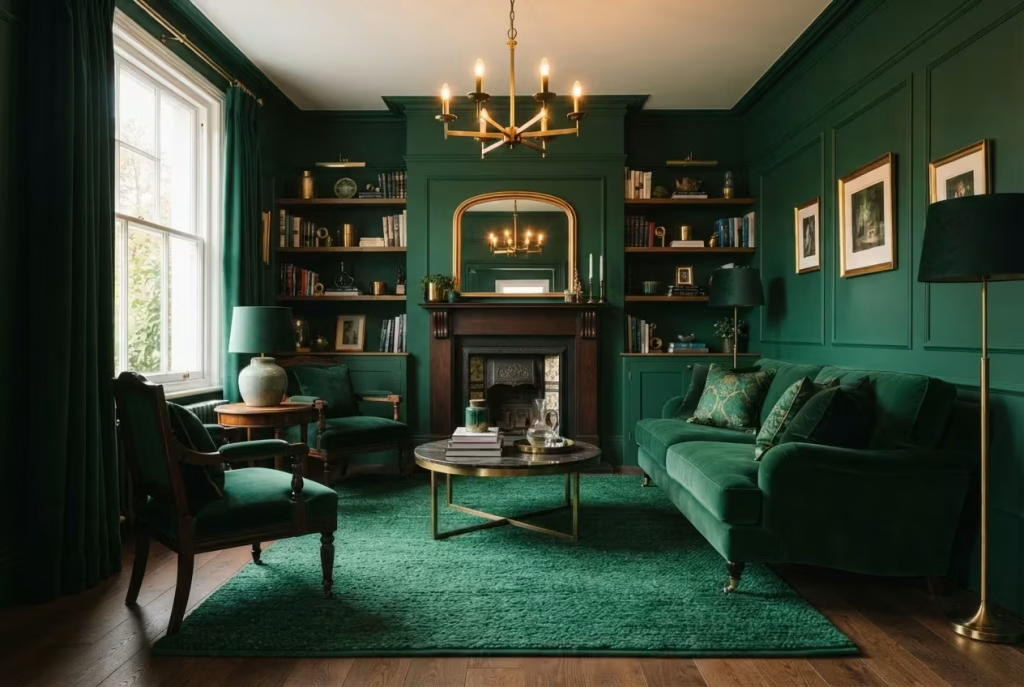
7. Anchor the room in one deep hue rather than several fighting for attention. Burgundy, emerald, sapphire, hunter green, deep plum. Pick one as your dominant note and let everything else, the wood tones, the metals, the fabric, support and echo it, rather than trying to cram the whole jewel box in at once. A room built around a single confident colour reads as intentional. A room with five competing jewel tones reads as indecisive, however expensive each individual choice was.
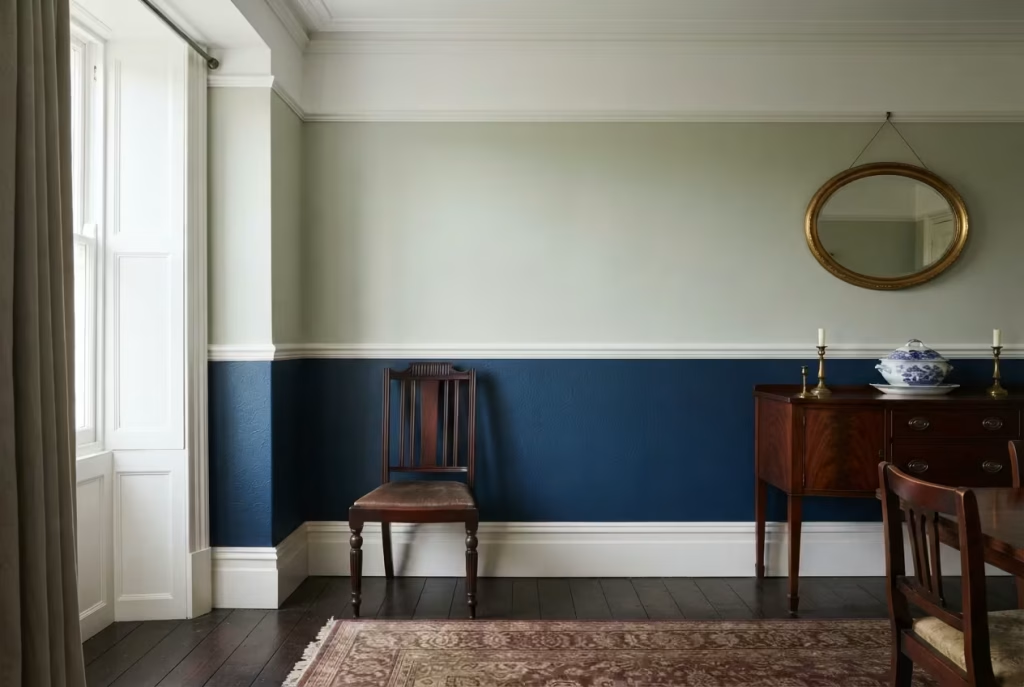
8. Split the wall with a dado rail, properly proportioned rather than eyeballed. The traditional Victorian convention put the darkest tone below the rail and a paler shade above it, with the lightest colour of all reserved for the woodwork itself, a layering that draws the eye gently upward and makes even a low-ceilinged room feel taller. Get the height right: 900mm to 1,000mm from the floor for a standard 2.4m ceiling, rising to 1,000mm to 1,100mm for the taller 2.7m to 3m ceilings more typical of a genuinely original Victorian room. The rail was historically set to exactly where the back of a dining chair struck the wall, which is why it’s also known as a chair rail, a small piece of everyday practicality hiding inside what looks like pure decoration. Get this height wrong and even beautiful paint colours will look somehow off, without most people being able to say exactly why.
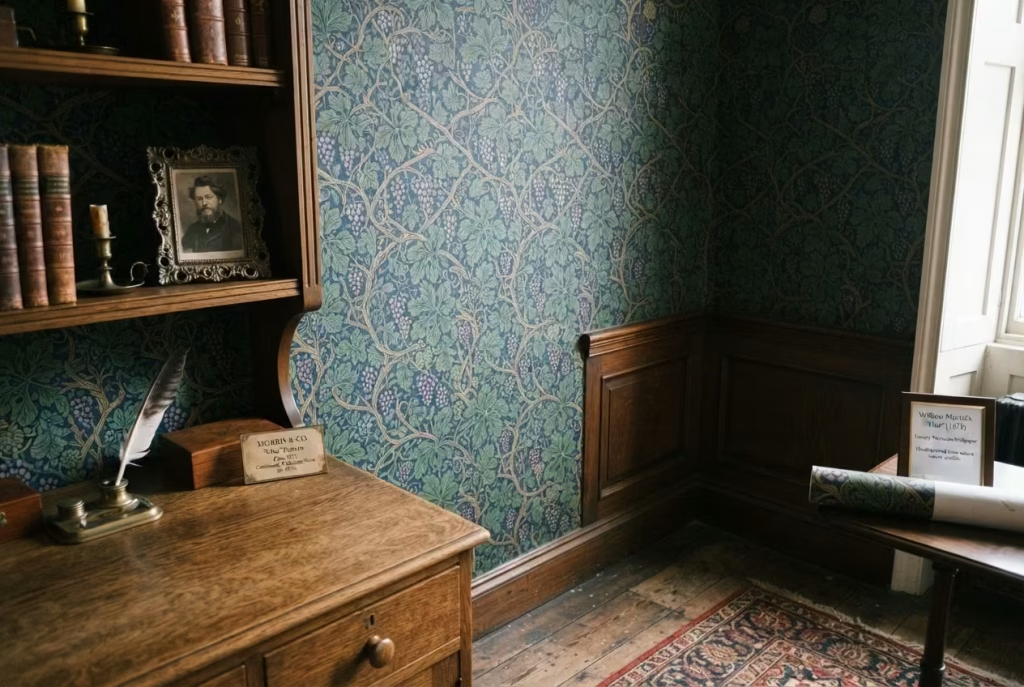
9. Choose real Morris & Co wallpaper if the budget stretches, and understand what you’re actually paying for. There’s a lovely piece of history worth knowing before you shop, because it reframes the cost entirely. By 1890, William Morris himself was charging just 40 to 50 pence a roll for his “Vine” pattern, and his priciest design of the era, “Wreath,” topped out at 80 pence, which placed it firmly in the top price bracket of its day, a genuine luxury item for Victorian households. Today, genuine Morris & Co wallpaper runs roughly £86 to £150 a roll. It isn’t cheap by any measure, but it’s a remarkably fair reflection of a pattern that’s been in continuous production since the 1870s, hand-derived from Morris’s own nature studies, rather than a modern mark-up invented to cash in on nostalgia. There’s a quiet pleasure in knowing the pattern on your wall has genuinely outlived several monarchs.
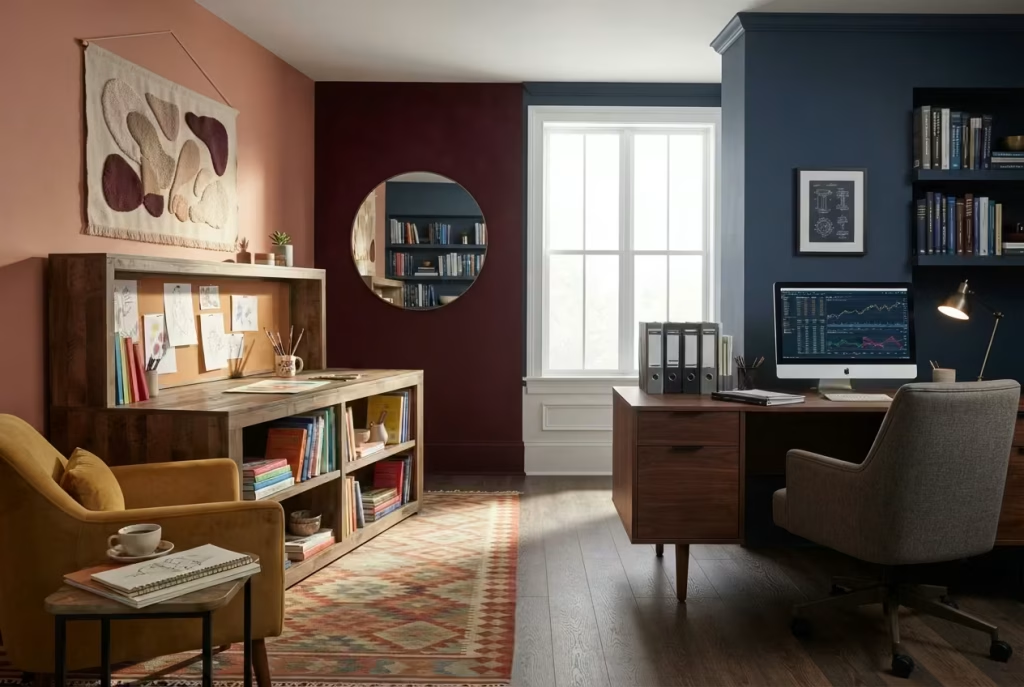
10. Use warm tones for the parts of the room where you think creatively, and cooler tones where you need to concentrate. This isn’t just decorating folklore dressed up to sound scientific. Colour psychologists consistently link darker blues to sustained concentration and analytical thinking, the kind of headspace you need for a detailed report or a difficult decision, while lighter blues lean toward creativity and looser, more associative thinking. Deep burgundy reads as formal and traditional in a way that genuinely suits a client-facing study, lending a sense of gravitas the moment someone walks in or joins a call. A consumer survey by heating manufacturer Stelrad and workplace psychologist Lee Chambers, covering 4,325 respondents, found that only 6% of people currently have a blue or red home office, despite blue’s well-documented calming, focus-supporting effect. That’s a genuinely striking gap between what actually helps people work well and what people are actually choosing, and it’s worth sitting with for a moment before you default to the safe neutral you’d pick for a hallway.
You May also Like: 25 Productive Japanese Home Office Designs for a Soulful Workspace
Zone Three: Lighting, and the Safety Talk Nobody Else Is Having
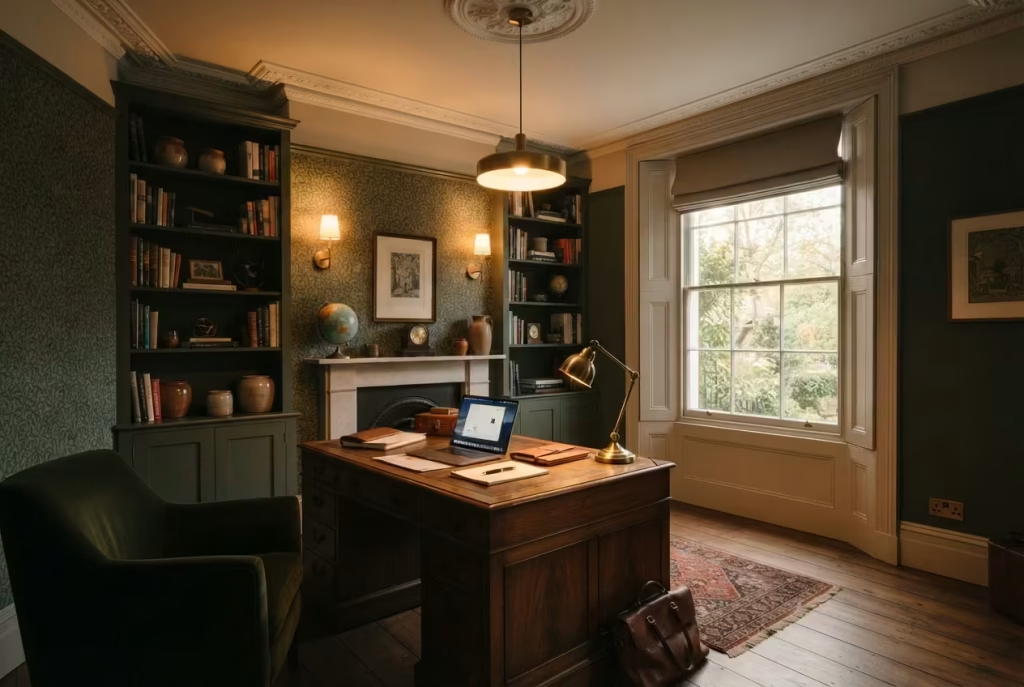
This is the section every other guide chasing this exact keyword skips entirely, and it’s arguably the one that matters most if your house is old enough to have genuine period wiring hiding behind the plaster. It’s also, not coincidentally, the section that turns a pretty room into a genuinely liveable one.
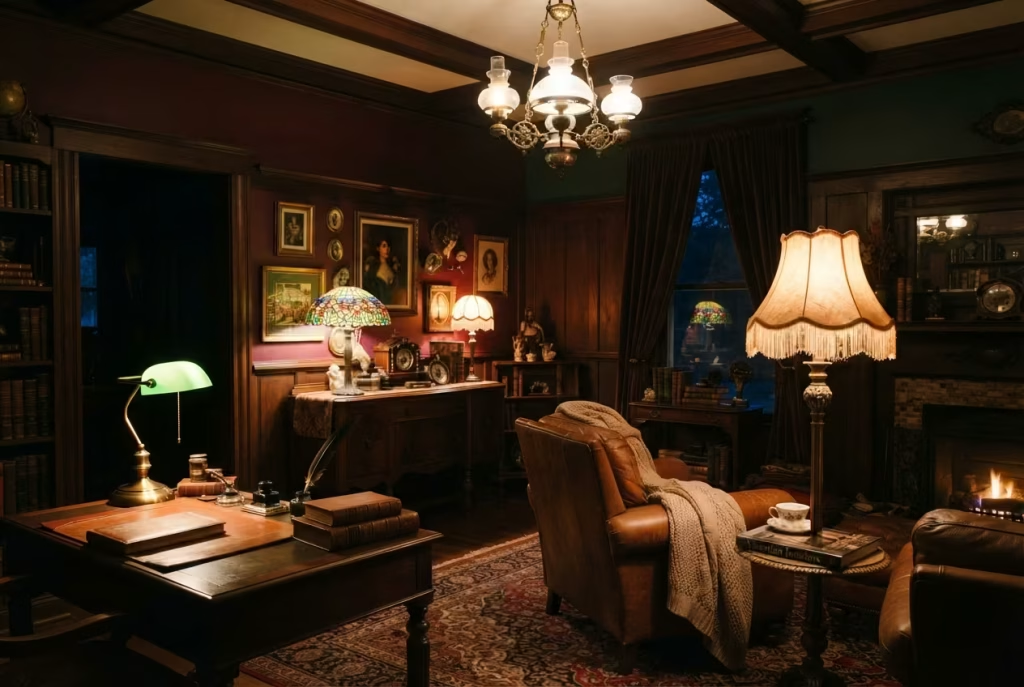
11. Layer your light sources rather than relying on a single overhead fixture. A lone ceiling light in a Victorian-style room reads flat, slightly institutional, and works directly against everything the rest of the decorating has achieved. Combine a desk lamp for close task work, a floor lamp or standing light near a reading chair for evening downtime, and one genuine statement piece, whether that’s a chandelier or a Tiffany-style shade, so the room has pools of warm light dotted through it rather than one even, shadowless wash. The difference this makes to how the room actually feels at seven in the evening, rather than how it photographs at noon, is enormous.
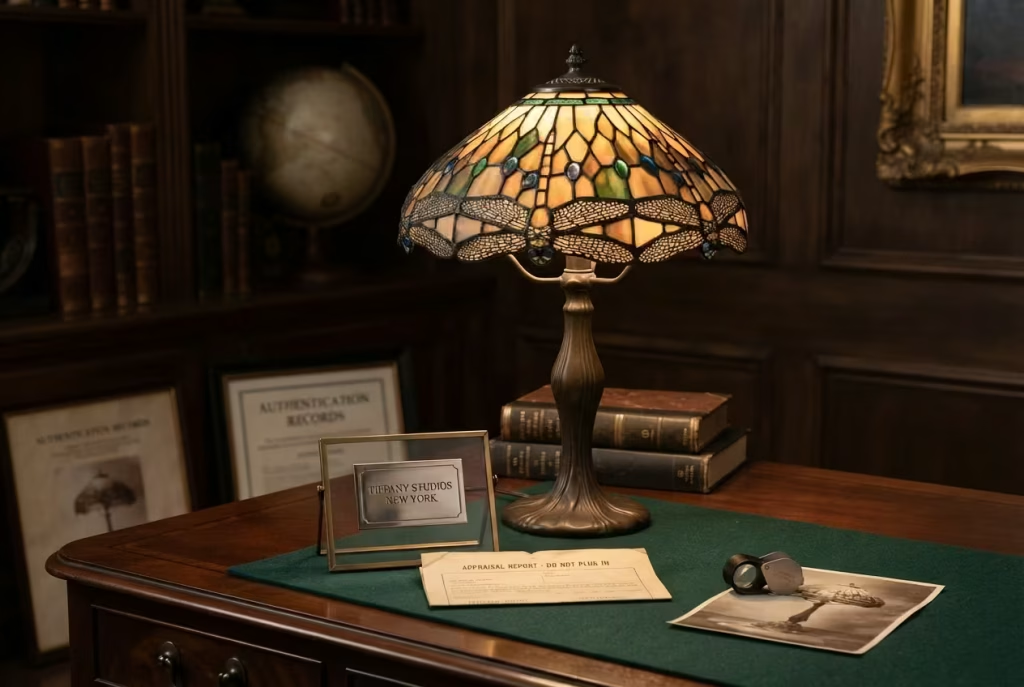
12. Understand what you’re actually buying before you commit to a Tiffany-style lamp. Prices here vary so enormously that it’s worth knowing the tiers properly, both so you don’t overpay for a reproduction and so you don’t accidentally underpay for, and then mistreat, something genuinely valuable. Small mass-produced reproductions run $150 to $600. Mid-size, better-made reproductions with more refined glasswork run $350 to $1,800. Larger designer reproductions with genuinely complex shade patterns run $800 to $3,000. Authentic Tiffany Studios pieces start around $2,000 and climb steadily into five and six figures for rare examples, with the record auction sale hitting an astonishing $3.37 million in 2018. If you’ve inherited, or think you’ve spotted a bargain on, something you suspect might be genuine, get it appraised properly before it goes anywhere near a plug socket.
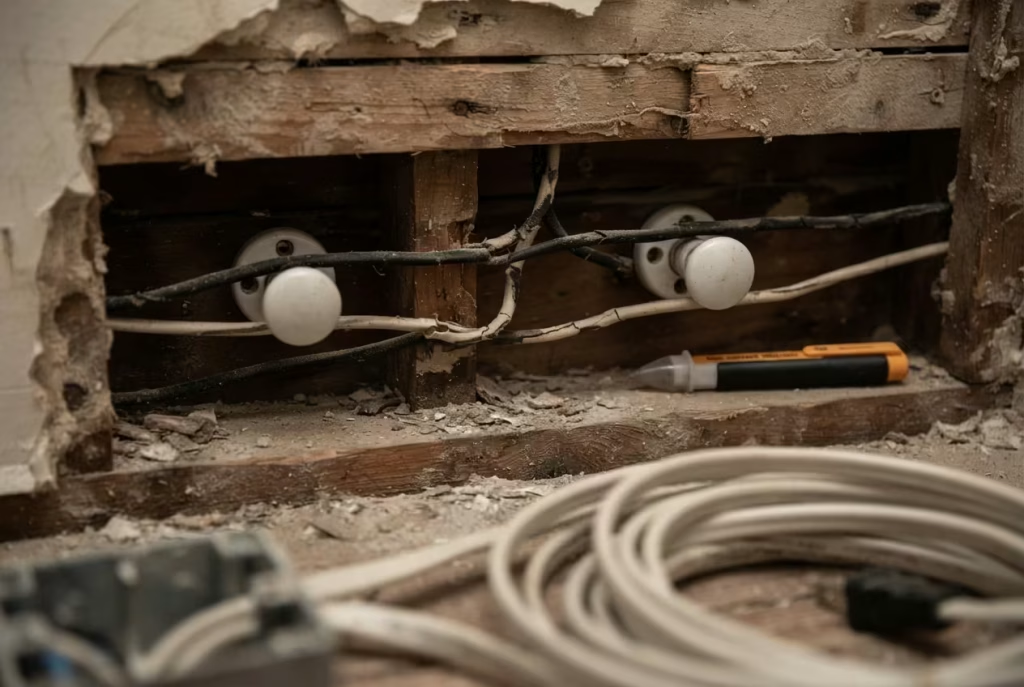
13. Never assume a period-look fixture is period-safe wiring. This is the caveat that separates a genuinely useful guide from one that’s purely decorative, and it deserves your full attention rather than a skim. If your house predates the 1950s, there’s a real, non-trivial chance it still has knob-and-tube wiring somewhere behind the walls, a system with no ground wire at all, insulation that grows brittle and cracks with nothing more than ordinary age, and a design that was never remotely meant to handle a modern desktop setup, a monitor, a phone charger and a desk lamp all drawing power at once. It cannot safely be covered with modern loft insulation, and many insurers now either charge a premium for it or refuse cover outright. A full rewire runs roughly $12,000 to $36,600 for a whole house, or a far more targeted partial rewire of just the room in question at $1,500 to $5,000. If you’re restoring or rewiring an antique lamp specifically rather than the house wiring itself, budget $300 to $3,000 depending on how much of the original fitting you’re keeping versus replacing. None of this needs to frighten you away from the style entirely. It simply needs one phone call to a qualified electrician before the heavy curtains and the antique furniture go anywhere near an old fixture. Peace of mind, in a room you’re going to spend thousands of hours in, is not an optional extra.
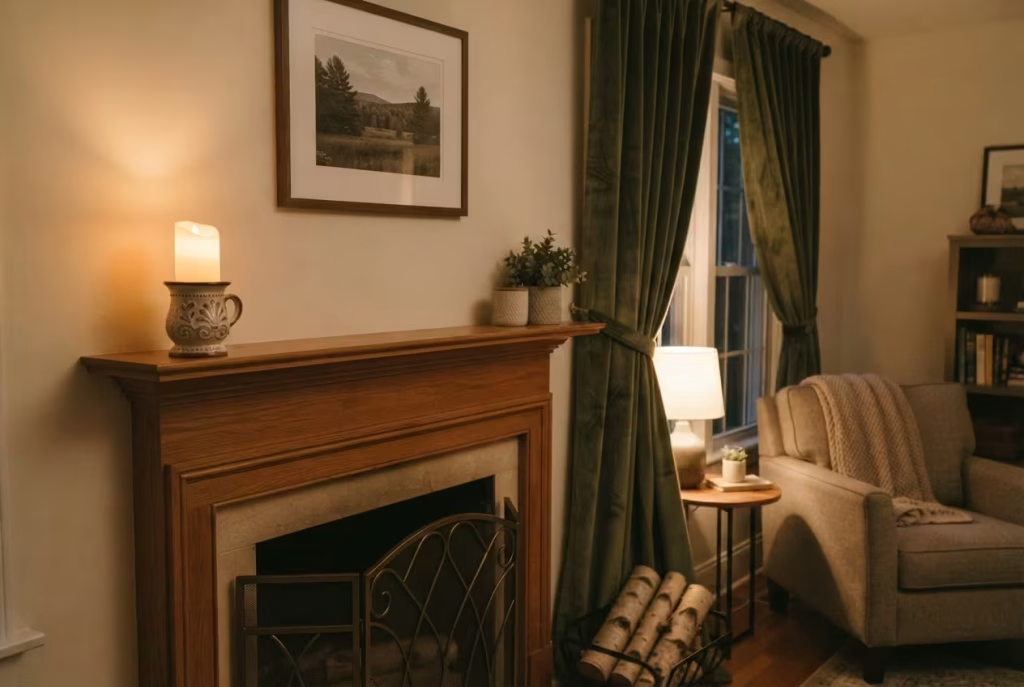
14. Keep candles and heavy drapery at a proper, deliberate distance from each other. Layered curtains and dense fabric are absolutely part of the aesthetic, giving the room its sense of weight and warmth, but they’re also exactly the sort of combustible material fire services routinely warn about. A large share of home candle fires trace back to the candle simply being placed too close to something flammable, and the overwhelming majority come down to plain, avoidable misuse: left unattended for a moment too long, or balanced somewhere it really shouldn’t be. If you want the flicker of candlelight in the room without the risk, a flameless LED version gives you the same warm, moving glow with none of the danger sitting a few inches from a curtain hem, and modern versions have come a long way from the slightly naff flickering bulbs of a decade ago.
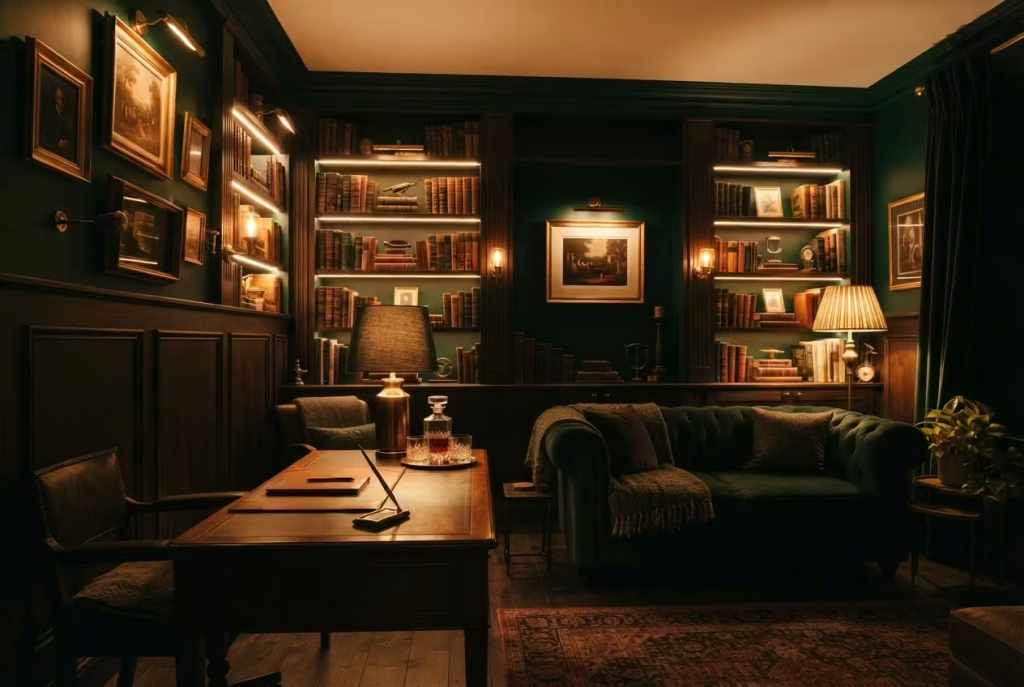
15. Choose warm-toned bulbs over cool white for absolutely anything in this room. Anything above roughly 3300K starts to feel clinical and slightly hostile against dark wood and jewel-toned walls, undoing hours of careful colour selection in one trip to the lighting aisle. Stay warm, and layer brightness through several smaller sources rather than one harsh downlight doing all the work alone.
Zone Four: Storage That Earns Its Keep
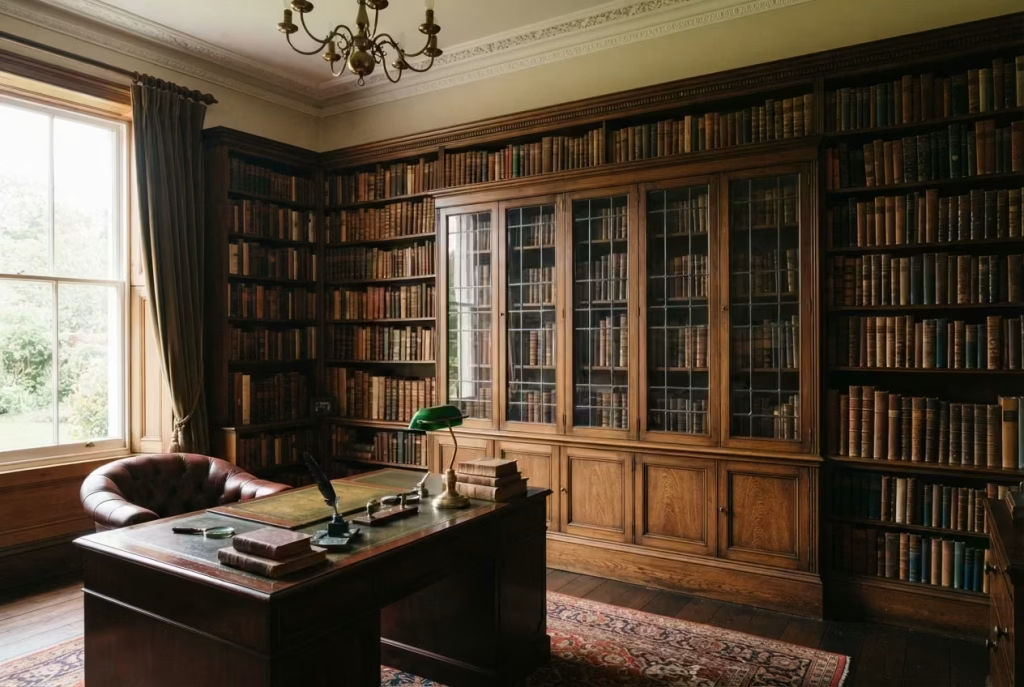
16. Build up rather than out with floor-to-ceiling shelving. Nothing evokes a genuine Victorian study quite like a wall of books running unbroken from skirting to cornice, and there’s a real emotional weight to being surrounded by a lifetime’s reading while you work rather than staring at a bare wall. If a full built-in isn’t in the budget just yet, tall freestanding bookcases with glass-fronted doors do a thoroughly convincing job and protect the books from dust into the bargain, which matters more than people expect once a collection has been sitting on open shelves for a decade.
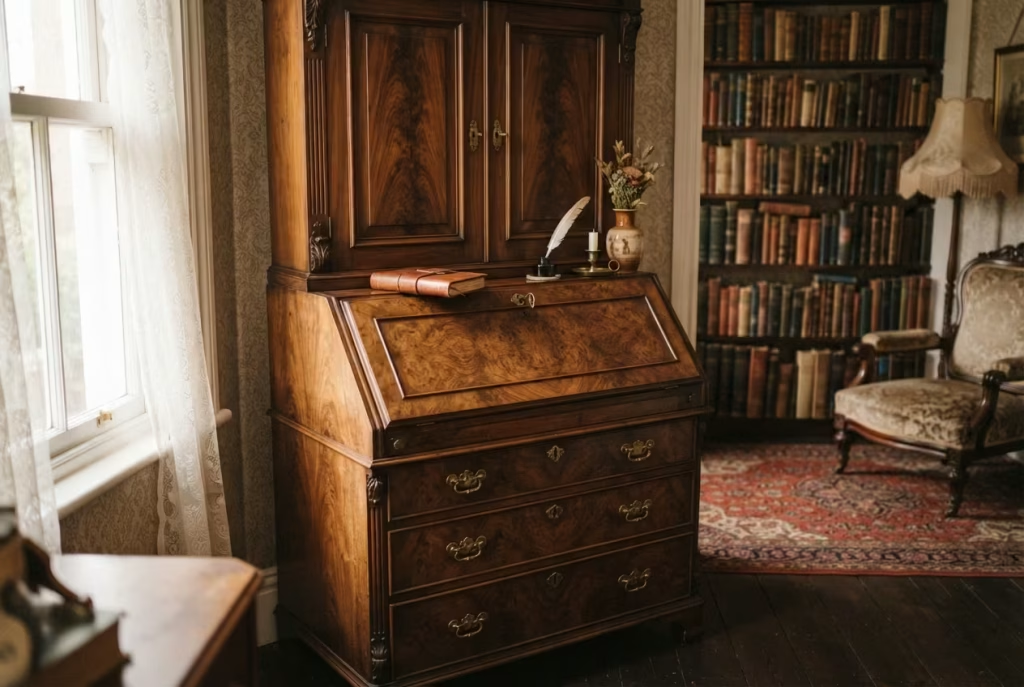
17. Look for a secretary desk or cabinet with genuinely hidden storage. Victorian furniture-makers were rather brilliant at concealment, tucking away supplies, papers or even a fold-down bed behind an unassuming panel that gives nothing away when closed. It’s a period-accurate way to keep the room tidy without resorting to modern plastic storage boxes that will fight the whole aesthetic and undo the atmosphere you’ve worked to build.
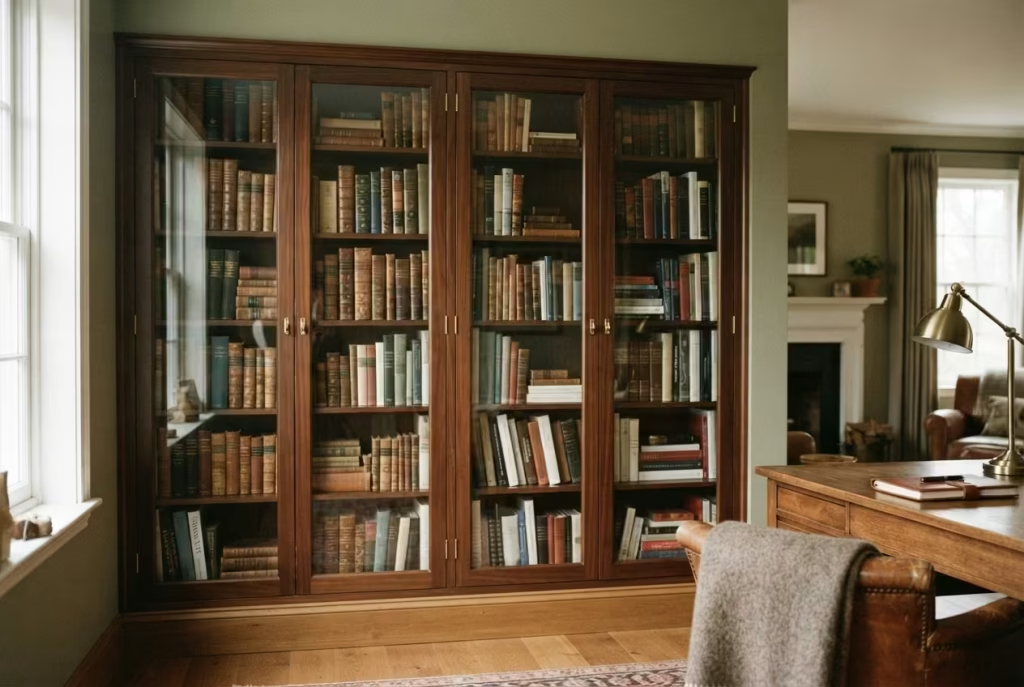
18. Choose glass-fronted over open shelving if you’re precious about your books. Beyond the visual polish, which is considerable, it genuinely protects paper and leather bindings from the dust and light exposure that a busy working room generates over years of daily use, extending the life of anything you actually care about keeping.
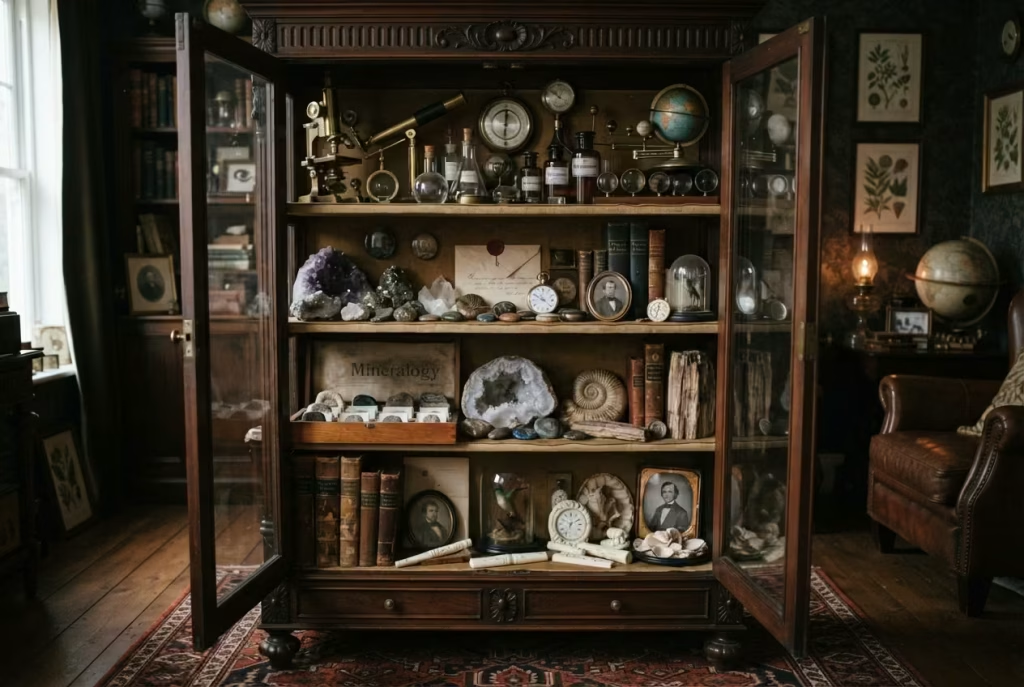
19. Add one curio cabinet for the things that don’t have another home. Victorians were prolific and rather eccentric collectors, and a cabinet of scientific instruments, geological specimens, or simply a well-edited set of your own personal treasures gives the room a sense of a life actually being lived in it, rather than a showroom dressed and staged purely for sale.
You May also Like: 25 Clean & Modern Minimalist Basement Designs That Feel So Spacious, They Don’t Even Feel Like Basements
Zone Five: Window Treatments That Do More Than Decorate
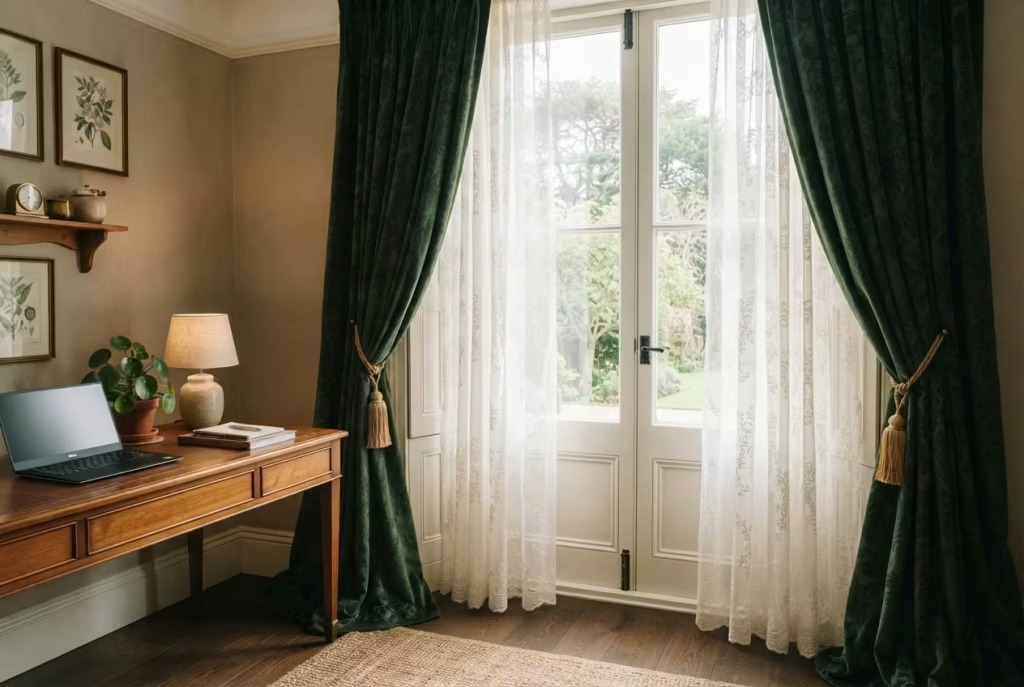
20. Layer heavy drapes with a sheer underneath. Rich fabric such as velvet or damask in a deep tone gives you the drama and the light control the style demands, while a lace or sheer panel underneath softens the effect during daylight hours and keeps a measure of privacy without blocking the room out entirely, which matters if you’re on camera for calls through the working day.
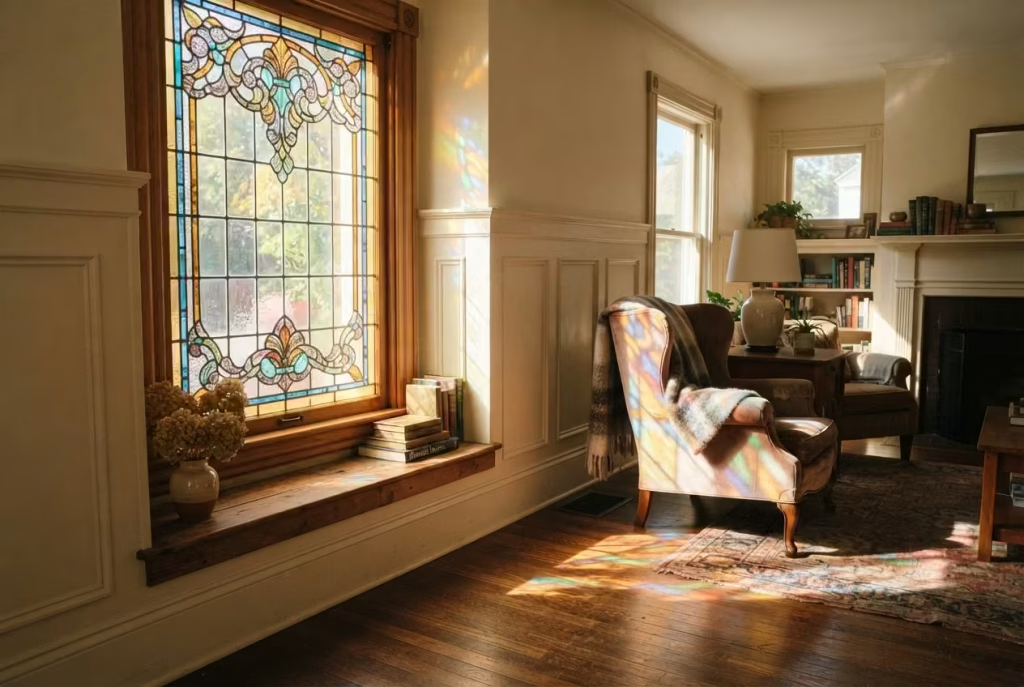
21. Consider stained glass, real or otherwise, for a genuinely period touch that transforms how the room feels at different times of day. Real leaded glass can now be set into modern toughened double-glazed units, so you get the security and insulation of contemporary glazing without sacrificing a single scrap of the coloured, dappled light that makes stained glass so beloved in the first place. If that’s out of reach financially, static-cling window film from around £9 replicates the effect surprisingly convincingly, adds daytime privacy, cuts UV fade to your furnishings, and is fully removable, which makes it the honest, sensible choice for renters or anyone not ready to commit permanently. It won’t give you the real depth and texture of hand-leaded glass, and it offers none of the security benefit real glazing does, but as a budget stand-in it earns its place.
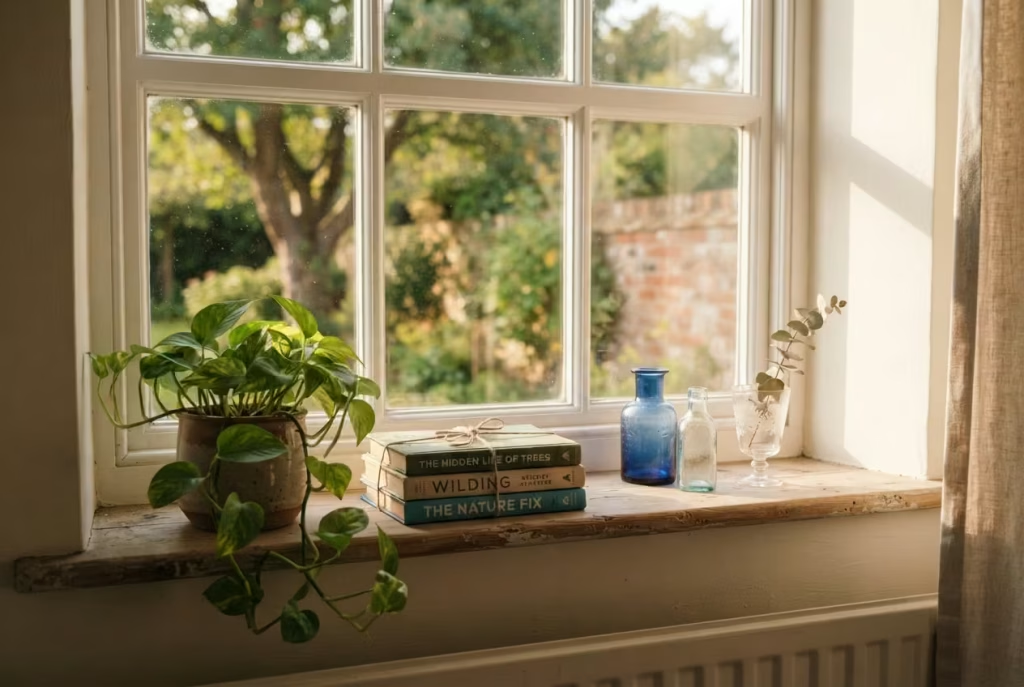
22. Don’t neglect the windowsill itself. A small collection of glassware catching the afternoon light, a trailing plant, or a stack of well-chosen books turns an often-overlooked ledge into one more spot where the room’s character can genuinely breathe, rather than sitting empty and forgotten.
Zone Six: Accessories and the Finishing Layer
23. Invest in one proper desk set rather than scattering small trinkets around. An inkwell, pen holder, letter opener and blotter in brass, silver or carved wood does more for the room’s authenticity than a dozen smaller decorative objects ever could, and there’s a genuine, quiet satisfaction in using well-made functional objects every single day rather than admiring purely ornamental ones.
24. Build a gallery wall with matching frames, whatever’s inside them. Whether you’re hanging botanical prints, architectural sketches, or your own family photographs, keeping the frames consistent, either all gilded or all ebonised, brings order to what would otherwise read as clutter, and gives even a mismatched collection of images a sense of having been curated rather than accumulated.
25. Bring in a globe, a map, or a genuine scientific instrument. The Victorians were fascinated to the point of obsession with exploration and discovery, and a floor-standing globe or a framed antique map does a great deal of visual heavy lifting as a single striking object, doing more work than a shelf full of smaller pieces all competing for the same attention.
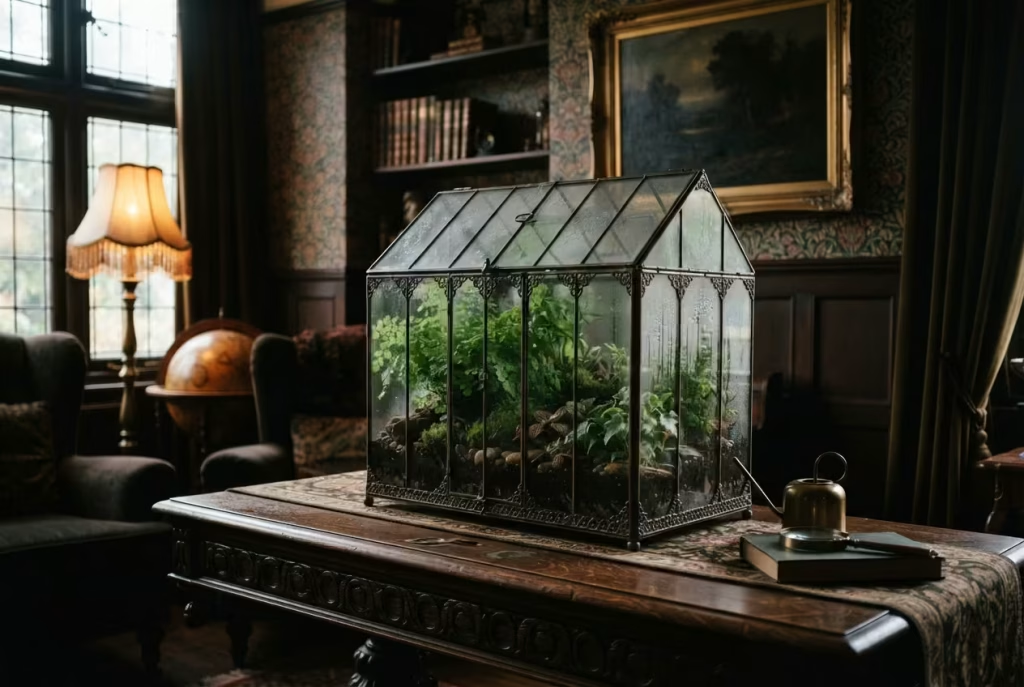
26. Add a plant, or better yet, a proper terrarium. Victorian households had a genuine, well-documented fondness for botany, and terrariums specifically were popularised during the era, becoming a genuine domestic craze. A fern or a palm suited to lower light does the same job today while quietly nodding at that history, and living greenery against dark wood and deep colour has a way of stopping the room from ever feeling static or museum-like, however carefully everything else has been arranged.
Zone Seven: Making It Work in a Small Space or a Rented Room
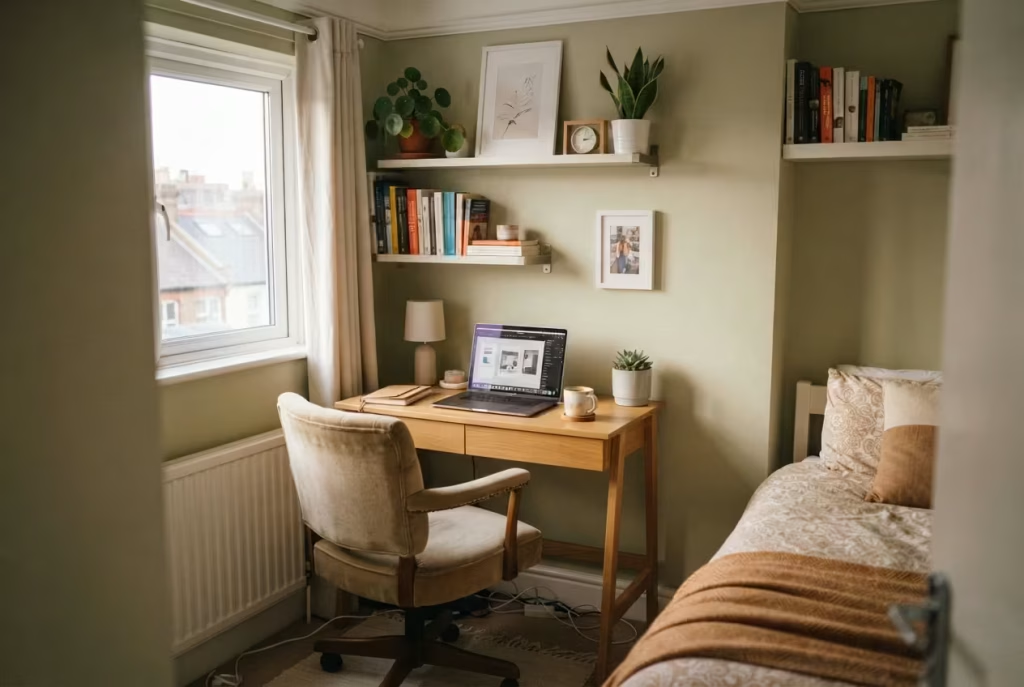
This is the segment every one of the three main competitors on this exact keyword either skips entirely or mentions in a single throwaway line, despite it being one of the most common real constraints people are actually working within. Not everyone chasing this look has a dedicated study with a fireplace and original cornicing, and pretending otherwise leaves a huge number of readers with nothing genuinely useful.
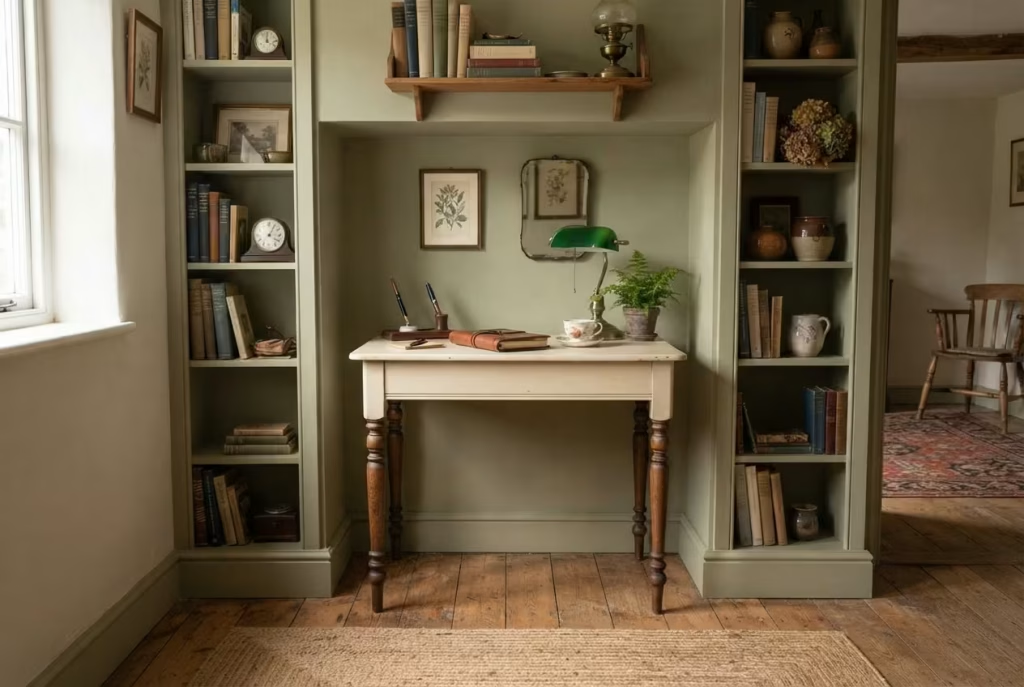
27. Swap the pedestal desk for a slim writing table with turned legs. As covered above, the open space beneath a writing table reads far larger in a boxroom or an awkward alcove than a solid-fronted desk ever will, and in a small space that visual breathing room matters far more than it might sound.
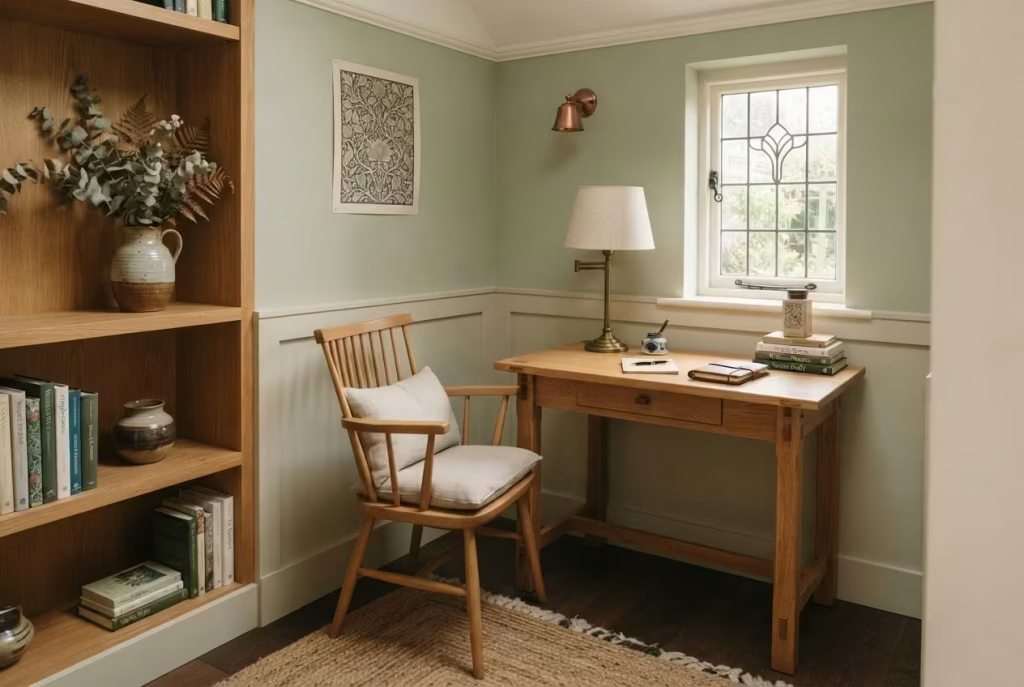
28. Lean on Arts and Crafts rather than High Victorian in a compact room. Its simpler forms and cleaner joinery avoid the visual density that a smaller space simply cannot absorb without starting to feel cramped and slightly claustrophobic by the end of a working day.
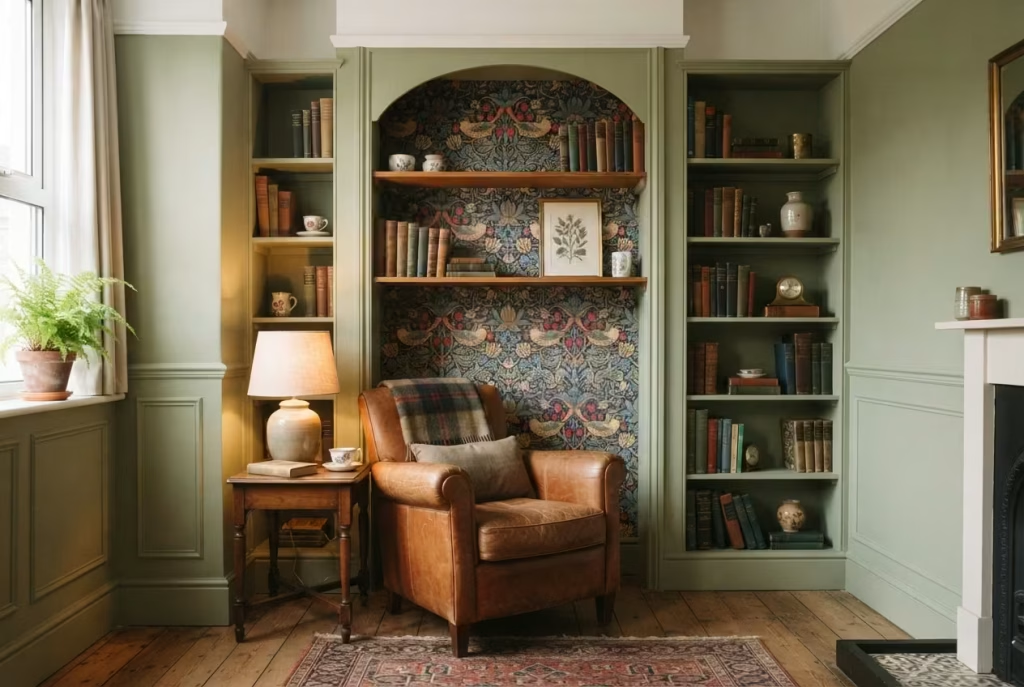
29. Use wallpaper on one wall only, or even just inside a bookcase or alcove. You get the full-strength pattern and the genuine period feel in a contained, deliberate dose, without either the cost or the closed-in effect of papering all four walls of a small room, which can tip a compact space from cosy into oppressive surprisingly quickly.
Zone Eight: Blending In the Modern Without Ruining the Look
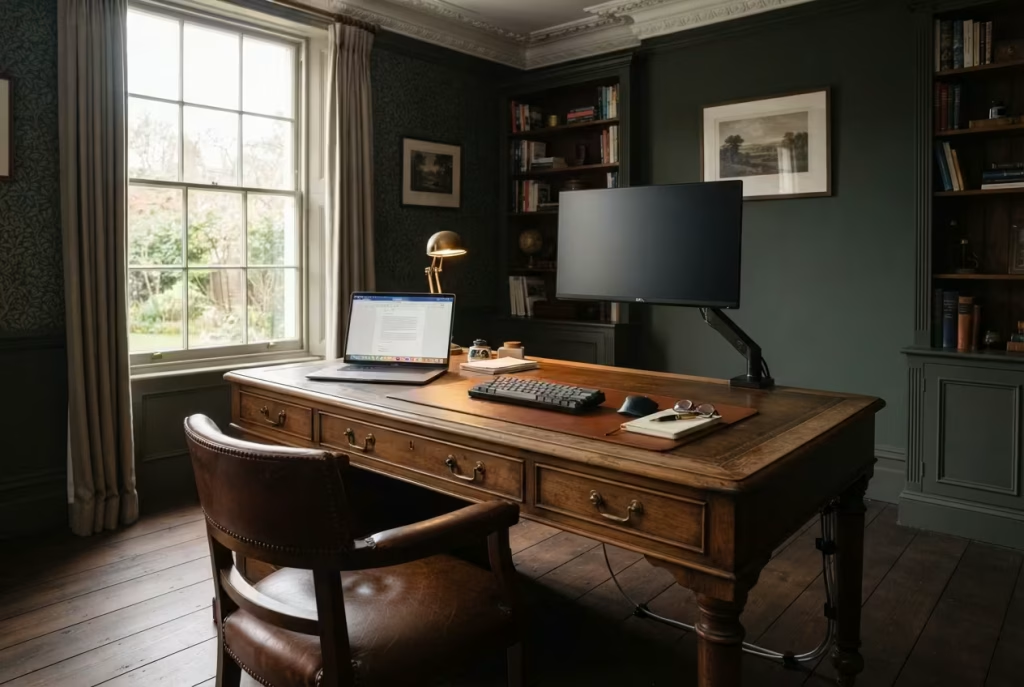
30. Hide the cables, not the technology. Route cords down the back legs of the desk with cable clips, use a large leather desk pad to anchor the keyboard and mouse in one visually contained area, and fit a monitor arm that clamps to the rear edge so the historic writing surface stays genuinely clear. The goal here isn’t to pretend the laptop doesn’t exist, which is both impossible and a little precious. It’s simply to make sure it doesn’t sit there fighting the desk for attention every time you glance up from a call.
Antique or Reproduction A Straight Comparison
| Antique | Reproduction | |
| Typical cost (desk) | £425 to £5,000+ | £160 to £480 |
| Character | Genuine wear, real provenance, one-of-a-kind history | Consistent, predictable finish |
| Ergonomics | Often needs adaptation (chair, footrest) | Frequently built closer to modern comfort standards |
| Availability | Slower to source, needs patience at auction | Widely available, quick to order |
| Best for | Those wanting genuine patina and a real story behind the piece | Those wanting the look without the hunt, or without antique-furniture upkeep |
Neither option is the objectively “correct” one, whatever some purists might insist. A well-made reproduction desk paired with one genuine antique lamp beside it will often read more convincingly, and cost considerably less, than a room built entirely from originals bought in a hurry. The eye is looking for character, not a certificate of authenticity.
Keeping It All in Good Condition
Antique wood and leather need proper, ongoing care rather than a single enthusiastic polish the week you bring them home. Use the correct products to maintain the patina of the wood and keep leather genuinely supple, and consult a restoration specialist for anything of real value before you attempt to clean or repair it yourself. It’s a false economy to save a small fee on expert advice and then damage something irreplaceable through good intentions and the wrong polish. Keep valuable pieces out of direct sunlight and away from extremes of temperature or humidity, since both will damage timber and leather far more quickly than ordinary daily use ever will. And when something genuinely needs attention, think carefully about whether you actually want restoration, which returns a piece to its original condition, or renovation, which updates it for modern use. They’re fundamentally different jobs with fundamentally different outcomes, and it’s worth being entirely clear on which one you actually want before a well-meaning tradesperson strips away something you’d rather have kept exactly as it was.
The Last Word
A Victorian home office at its best isn’t a recreation of a room that existed in 1875, and it was never meant to be. It’s a working space that borrows the era’s confidence, its warmth, and its evident regard for craftsmanship, then lets a bit of your own life sit comfortably alongside it, cables and all. Get the anchor piece right, respect whatever’s genuinely behind the walls, and resist the urge to fill every available surface, and you’ll end up with a room that photographs beautifully and, more importantly by far, one you’ll actually look forward to sitting down in at eight o’clock on an ordinary Tuesday morning.
Frequently Asked Questions
Is Victorian style too dark for a home office?
Not if you’re deliberate about it. The traditional Victorian convention paired dark tones below the dado rail with paler shades above, and modern examples such as the West Dulwich renovation show that jewel-bright colour combined with better light sources, rather than white walls alone, is what actually lifts a dark period room. Abandoning the palette entirely tends to lose the character you wanted in the first place.
How do I stop my Victorian office looking like a museum?
Mix eras deliberately rather than furnishing purely from one period. A contemporary chair against an antique desk, or a modern lamp beside carved woodwork, creates the tension that makes a room feel curated by an actual person rather than roped off for visitors to peer at.
Is an antique desk or a reproduction the better buy?
It depends what you’re optimising for. Antiques offer genuine provenance and character starting around £425, while reproductions at £160 to £480 offer predictable comfort and easy availability without the hunt. Many of the best real-world results mix the two rather than committing entirely to either camp.
Is it safe to use antique or vintage-style lighting?
Only once it’s been properly checked. Vintage lamps often need rewiring before they’re genuinely safe for daily use, typically $300 to $3,000 depending on scope, and if your house itself has old knob-and-tube wiring behind the walls, that’s a separate and considerably more significant issue worth having assessed by a qualified electrician before you add heavy furnishings near any fixture.
How do I make an antique desk comfortable for a full working day?
Pair it with a modern, properly adjustable ergonomic chair rather than a period-accurate one. Standard desk height sits at 71 to 76cm, and if your antique desk runs taller, as many original slope-top and ladies’ writing desks do, a height-adjustable chair and a footrest solve the mismatch entirely without you needing to alter or damage the desk itself.
What’s the best Victorian sub-style for a small room?
Arts and Crafts, generally, and by some margin. Its simpler, cleaner forms carry the period feel without the visual density of High Victorian or Gothic Revival, both of which genuinely need more square footage to breathe properly and avoid feeling crowded.
How much does real Morris & Co wallpaper cost compared to a print reproduction?
Genuine Morris & Co wallpaper runs roughly £86 to £150 per roll today. It’s a fair reflection of a design continuously produced since the 1870s, when Morris himself charged up to 80 pence a roll for his priciest patterns of the era, a genuine luxury item at the time.
Can I mix modern technology into a Victorian-style office without ruining the look?
Yes, and honestly you should. Route cables down the desk legs, use a leather desk pad to anchor your setup visually, and fit a monitor arm rather than letting a laptop and its cables sprawl across the historic writing surface. Concealment, not denial, is the trick that actually works.
What colours help with focus versus creativity in this kind of room?
Darker blues are consistently linked to sustained concentration, while lighter blues and warmer tones such as yellow and orange lean toward creativity and idea generation. Deep burgundy suits a room where you’ll meet clients, since it reads as formal, established and quietly confident.
How do I get the look on a genuinely small budget?
Focus your spending on one anchor piece, the desk, and use paint, a single roll of feature wallpaper, and secondhand or reproduction accessories for everything else. A convincing room rarely needs everything in it to be genuinely antique in order to read as authentic and considered.
How do I keep an antique desk or chair in good condition long term?
Avoid direct sunlight and extremes of temperature or humidity, use the correct specialist products for wood and leather care rather than generic household cleaners, and have anything of real value assessed by a restoration specialist before attempting repairs yourself.